The Microsoft AI platform reflects a company changing from a vendor of Windows and Office into one that connects corporate work data, cloud infrastructure, and AI agents inside one identity system. Azure supplies compute and storage; Microsoft 365 and Dynamics hold work context; GitHub controls much of the development flow; and Copilot puts a common interface in front of those assets. Maia accelerators and Cobalt CPUs now extend the company downward into silicon.
This Microsoft company review focuses on the economics of vertical integration rather than listing Copilot features. It asks how data-center investment returns through Azure consumption and application subscriptions, why the OpenAI relationship and internal models and chips are needed at the same time, and how supply constraints and depreciation create risk behind rapid growth. Financial figures follow the official third quarter of fiscal 2026, ended March 31, 2026.
In this review, Azure AI means the full layer connecting compute, data, deployment, and enterprise controls, not merely a model API.

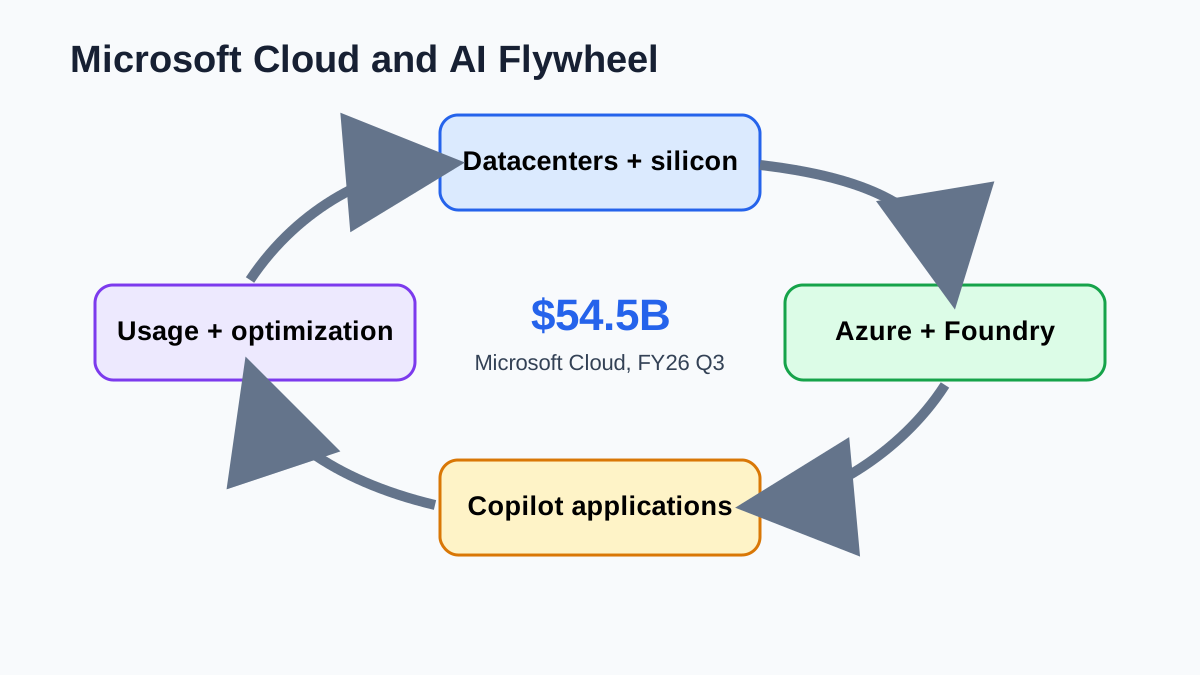
Four layers form the Microsoft AI platform loop
The first layer is data centers and silicon. Microsoft deploys NVIDIA and AMD accelerators while designing Azure Boost networking and storage silicon, Cobalt CPUs, and the Maia 200 inference accelerator. The objective is not dependence on one supplier but a portfolio that can lower cost and power for a given workload. Maia 200 emphasizes the economics of repeatedly generating tokens rather than every stage of model training.
The second layer is Azure and the model platform, where customers manage data, security, model selection, evaluation, and deployment. The third layer comprises Microsoft 365, Dynamics, GitHub, and Security applications. They already contain corporate users, permissions, documents, and workflows, giving AI a place to produce action. The fourth layer is operational feedback: more requests provide signals for GPU scheduling, caching, and model routing, and efficiency gains create more available service capacity.
| Platform layer | Representative assets | Revenue model | Strategic role |
|---|---|---|---|
| Infrastructure | Data centers, NVIDIA/AMD, Maia, Cobalt | Azure consumption | Capacity and unit-cost control |
| Data and models | Azure, Fabric, Foundry | Usage and cloud contracts | Model choice plus enterprise data |
| Applications | M365 Copilot, GitHub, Dynamics, Security | Seats and consumption | AI monetization in existing work |
| Control | Entra, Purview, policy and observability | Platform and security revenue | Consistent identity and compliance |
One product can reduce the selling cost of another. Microsoft can offer GitHub Copilot to an Azure customer, run a Microsoft 365 customer's agents on Azure, and extend Entra permissions and Purview policy to both. Bundling is not automatically customer value, however. Complex licensing or an unclear boundary between existing features and Copilot charges can cause customers to remove unused seats and buy lower-cost specialist tools for selected jobs.
Satya Nadella's two priorities and an $82.9 billion quarter
CEO Satya Nadella described two priorities on the Q3 FY2026 call: build cloud and AI infrastructure for agentic computing, and build high-value agentic systems in productivity, coding, and security. Infrastructure alone faces commodity pricing; applications alone remain exposed to outside compute costs. Owning both layers lets Microsoft connect supply and demand internally.
Microsoft's Q3 FY2026 release reported revenue of $82.9 billion, up 18% year over year. Operating income rose 20% to $38.4 billion, and GAAP net income increased 23% to $31.778 billion. Microsoft Cloud revenue was $54.5 billion, up 29%, while Azure and other cloud services grew 40%. The disclosed annual revenue run rate of the AI business exceeded $37 billion, growing 123%.
| Q3 FY2026 metric | Result | Interpretation |
|---|---|---|
| Total revenue | $82.9 billion | 18% year-over-year growth |
| Operating income | $38.4 billion | 20% year-over-year growth |
| Microsoft Cloud | $54.5 billion | 29% year-over-year growth |
| Azure growth | 40% | Demand across AI and non-AI workloads |
| Quarterly capital expenditure | $31.9 billion | CPUs, GPUs, and long-lived facilities |
| AI business ARR | More than $37 billion | 123% year-over-year growth |
The cost structure matters as much as growth. Quarterly capital expenditure was $31.9 billion, and roughly two-thirds went to shorter-lived assets, mainly GPUs and CPUs. The balance funded sites and facilities intended to monetize for at least 15 years. Corporate gross margin was 68%, but AI infrastructure investment and rising AI usage reduced the percentage year over year. Rapid accelerator replacement directly affects depreciation and profitability even with strong operating cash flow.
Maia 200, Cobalt, and Copilot create technical differentiation
The central claim in the official Maia 200 announcement is token economics rather than a single benchmark. Microsoft knows the request patterns of its own services and can coordinate silicon with data-center power, networks, and software. Maia 200 was live in Iowa and Arizona in Q3, and management said it delivered more than 30% better tokens per dollar than the latest silicon then in its fleet. Cobalt CPUs were deployed in nearly half of Microsoft's data-center regions and ran customer workloads including Databricks, Siemens, and Snowflake.
Microsoft is not abandoning outside accelerators. It uses NVIDIA Blackwell GPU systems, AMD products, and internal silicon according to workload. Internal chips are a way to improve negotiating leverage and selected workload efficiency, not necessarily a single replacement bet. Hiding hardware choice behind Azure APIs lets customers evaluate throughput, latency, and price rather than a processor brand.
Distribution is the application advantage. Paid Microsoft 365 Copilot seats exceeded 20 million, while GitHub places AI inside coding and review. An enterprise agent that reads email, creates documents, and changes systems needs identity, least privilege, audit logs, and data boundaries in addition to model quality. Microsoft connects Entra, Purview, and its security portfolio as that control layer.
Seat count alone does not prove productivity. Enterprises need active-use rates, completed tasks, human review time, errors, and security incidents. As with GitHub Copilot coding agents, greater execution authority makes verifiable changes and approval boundaries more important than faster generation.
Microsoft's AI advantage is not one model. It is the ability to place enterprise data and permissions, Azure compute, and development and work applications inside a shared operating boundary. Only sustained usage converts that integration and data-center spending into a platform moat.
Capital expenditure, capacity, concentration, and conclusion
Investment pace is the first risk. Microsoft says demand exceeds supply and is adding capacity aggressively. Delays in power, transformers, construction, GPUs, or memory postpone revenue even when contracts exist. The opposite mismatch is equally important: if capacity arrives faster than AI usage, depreciation and energy costs pressure margins. Q3 free cash flow of $15.8 billion, reflecting higher capital expenditure, illustrates the balance.
The OpenAI relationship is the second risk. It stimulates Azure demand and product development while adding complexity to investment results, capacity commitments, and model dependence. Offering multiple models through Foundry and developing internal models and silicon increases optionality. Regulation and bundling are the third risk. Joining cloud, productivity, security, and AI can simplify operations for customers but may look like leverage from one market to another to competition authorities. Security is the fourth. Agents with more corporate data and execution rights increase the potential impact of prompt injection, excessive permissions, and leakage.
Microsoft is building a vertical platform from compute to work execution, not merely selling AI models. Revenue of $82.9 billion and 40% Azure growth show demand; $31.9 billion of capital expenditure shows the cost of turning demand into supply. The indicators to follow are Copilot active usage, Azure capacity constraints, realized Maia and Cobalt unit-cost gains, cloud gross margin, free cash flow relative to capital spending, and security outcomes—not AI ARR alone. When infrastructure and applications raise each other's utilization, they form a powerful loop. When unused seats and idle compute accumulate, the same vertical integration becomes fixed-cost risk.


