Showing posts with label Company Review. Show all posts

Saturday, July 25, 2026

Snowflake Company Review — AI Data Cloud and Cortex Agent Strategy

Snowflake is worth reviewing because the data platform race is becoming an AI agent race. This Snowflake company review 2026 focuses on Snowflake AI Data Cloud and Snowflake Cortex Code because both products point toward governed AI execution on enterprise data. Enterprises have already scattered data across warehouses, lakes, SaaS systems, files, and applications. The question is no longer simply whether AI can generate an answer. It is whether AI can analyze, change code, and execute work safely on top of governed data. Snowflake is trying to answer that through AI Data Cloud and the Cortex product family.

In its Q1 fiscal 2027 earnings release, Snowflake reported product revenue of $1.3343 billion, up 34% year over year. CEO Sridhar Ramaswamy said Cortex Code and Snowflake Intelligence extend the company from a trusted foundation for enterprise data into a control plane for the Agentic Enterprise. If Palantir Ontology starts from operational context, Snowflake starts from the data cloud and governance layer.

How Snowflake Makes Money

Snowflake’s core revenue is consumption-based product revenue. Customers run storage, compute, queries, data engineering, analytics, machine learning, applications, and data sharing on Snowflake, then pay based on usage. Unlike classic seat-based SaaS, customer consumption connects directly to revenue.

That model has a clear advantage: as customer workloads grow, revenue can grow naturally. The drawback is that growth can slow when customers optimize spend. This is one reason Snowflake emphasizes AI. If AI analysis, agents, code generation, and app development happen inside Snowflake, they can increase consumption of the core data platform.

Business line Representative features Customer value Revenue signal
Data platform Warehouse, lakehouse, Iceberg, Snowpark Unified analytics and data engineering Compute and storage usage
Governance Horizon Catalog, RBAC, policies, lineage Permission, security, and audit control Enterprise adoption
AI Cortex AI, Cortex Code, Snowflake Intelligence Data-grounded AI analysis and development AI feature consumption
Ecosystem Marketplace, Native Apps, data sharing Data flows between partners and customers Network effects

A self-created photorealistic editorial scene of Snowflake AI Data Cloud and Cortex agents inside an enterprise data operations room

<Snowflake AI Data Cloud operations scene 1.1>

Core Technology and Product Structure

Snowflake’s original strength was a cloud data warehouse architecture that separated storage and compute. Customers could run multiple workloads without managing infrastructure directly. With Snowpark, Streamlit, Marketplace, Native Apps, and Iceberg support, the company expanded from a SQL warehouse into a broader data application platform.

The AI layer centers on Cortex. Snowflake’s 2026 product message includes Cortex AI, Cortex Code, and Snowflake CoWork. The March 2026 general availability note for Cortex Code says it can generate, modify, optimize, and explain SQL and Python code inside Snowsight; run ML pipeline solutions; help with dbt work; search documentation; and answer questions about cost and access. The important point is that it works inside Snowflake’s existing role-based access control and policy model.

Snowflake Intelligence and CoWork address business users. Snowflake’s homepage describes CoWork as a personal work agent that moves from context to clarity to action inside Snowflake’s perimeter. Where enterprise RAG often focuses on document retrieval and answers, Snowflake’s direction is to connect structured data, permissions, and workload execution in one environment.

The most important technical word is governance. When an AI agent accesses enterprise data, it must understand data ownership, PII, masking policies, lineage, and role access. That is why the Cortex Code documentation mentions cost, access, table ownership, and sensitive data questions. Generating SQL is not the hard part. Proposing explainable changes using only permitted data is the harder enterprise problem.

People Behind the Technology

Sridhar Ramaswamy, CEO, symbolizes Snowflake’s AI transition. He co-founded Neeva and previously spent years at Google in search and advertising-related organizations. That background in search, recommendations, and large-scale data products fits Snowflake’s attempt to turn a data platform into an AI user experience.

Co-founder Benoit Dageville represents Snowflake’s original technical DNA. The company’s early differentiation came from database expertise: a cloud-native data warehouse, separation of storage and compute, and elastic scale. That foundation still matters in the AI era. Better models do not help much if enterprise data remains fragmented and poorly governed.

CFO Brian Robins explains the growth and margin profile of the consumption model. In Q1 fiscal 2027, he said Snowflake had 779 customers with more than $1 million in trailing 12-month product revenue, including 46 that crossed the threshold during the quarter. That metric shows large customer consumption is still expanding beyond the AI product narrative.

Financial Analysis in Numbers

Snowflake’s Q1 fiscal 2027 combined strong growth with continued GAAP losses. Based on SEC XBRL data, total revenue was $1.390951 billion and GAAP gross profit was $926.451 million. Company-reported product revenue was $1.3343 billion, up 34% year over year.

Metric Latest period Value Interpretation
Total revenue Q1 FY2027 $1.391B About 33% year-over-year growth
Product revenue Q1 FY2027 $1.334B Core consumption revenue, up 34%
RPO Q1 FY2027 $9.21B Contracted future revenue base
Net revenue retention Q1 FY2027 126% Existing customers continue expanding
GAAP operating loss Q1 FY2027 $326M loss Stock compensation and expenses remain heavy
Free cash flow Q1 FY2027 $232.8M Consumption model still generates cash

A self-created photorealistic editorial scene of analysts reviewing Snowflake Q1 fiscal 2027 financials

<Snowflake Q1 fiscal 2027 financial review scene 4.1>

For the full fiscal 2026 year, revenue was $4.683946 billion. R&D expense in Q1 fiscal 2027 was $534.937 million, about 38% of quarterly revenue. That shows Snowflake is still investing aggressively in AI and platform expansion. At the same time, GAAP net loss was $295.571 million. Investors should therefore look beyond non-GAAP profit and free cash flow to consider how stock-based compensation and acquisition-related expenses affect dilution and long-term margins.

What Looks Promising and What Could Go Wrong

The most promising point is that Snowflake is trying to run AI where the data already lives. If an AI agent is going to build a data pipeline, fix SQL, produce a report, or deploy an app, it needs data context and permission context. Snowflake already concentrates that context. If Cortex Code and CoWork become daily tools, AI usage could pull more consumption into the core platform.

The risks are clear. First, competition with Databricks, Microsoft Fabric, Google BigQuery, Amazon Redshift, Oracle, and Palantir is intense. Second, the consumption pricing model is exposed to customer cost optimization. Third, the size of direct AI revenue contribution is still partly dependent on company narrative and usage indicators. Fourth, data security incidents and permission mistakes become more serious when AI agents can move faster across data estates.

Snowflake is changing from a data warehouse company into an AI data operations platform. That transition is difficult, but if it works, Snowflake can address one of enterprise AI’s hardest bottlenecks: trusted data and governed access. The key things to watch are whether Cortex Code, Snowflake Intelligence, and CoWork reduce real developer and analyst time, and whether that usage translates into product revenue growth. I hope Snowflake keeps expanding enterprise data work in a safer and more productive direction.

ServiceNow Company Review — AI Control Tower and Workflow Automation

ServiceNow is worth examining now because enterprise AI is moving from “tools that answer” to an operating layer that actually closes work. This ServiceNow company review 2026 focuses on ServiceNow AI Control Tower and ServiceNow AI Agents because they show how AI can operate on top of real workflow records. The company started in IT service management, but it now connects HR, customer service, security, development, data, and industry workflows on one platform. In its Q2 2026 earnings release, ServiceNow put AI Control Tower at the center of the story and said agentic deployments of ServiceNow AI increased ninefold in nine months. ServiceNow Q2 2026 results also show why the AI story is tied to durable enterprise contracts, not just product demos.

That shift connects directly to the practical questions raised by enterprise AI agent workflows. Who approved an action? Which data did an agent access? Who recovers the workflow when automation fails? Where does the business record live? ServiceNow’s advantage is that it has spent years sitting inside the record of work: requests, approvals, incidents, changes, and audit trails.

How ServiceNow Makes Money

ServiceNow’s core business model is subscription enterprise software. Customers buy products such as IT Service Management, IT Operations Management, Customer Service Management, HR Service Delivery, Security Operations, and Strategic Portfolio Management. As the number of modules and departments grows, annual contract value expands. The Now Platform is less a bundle of apps than a workflow operating system where requests, approvals, actions, and audit logs move through shared objects.

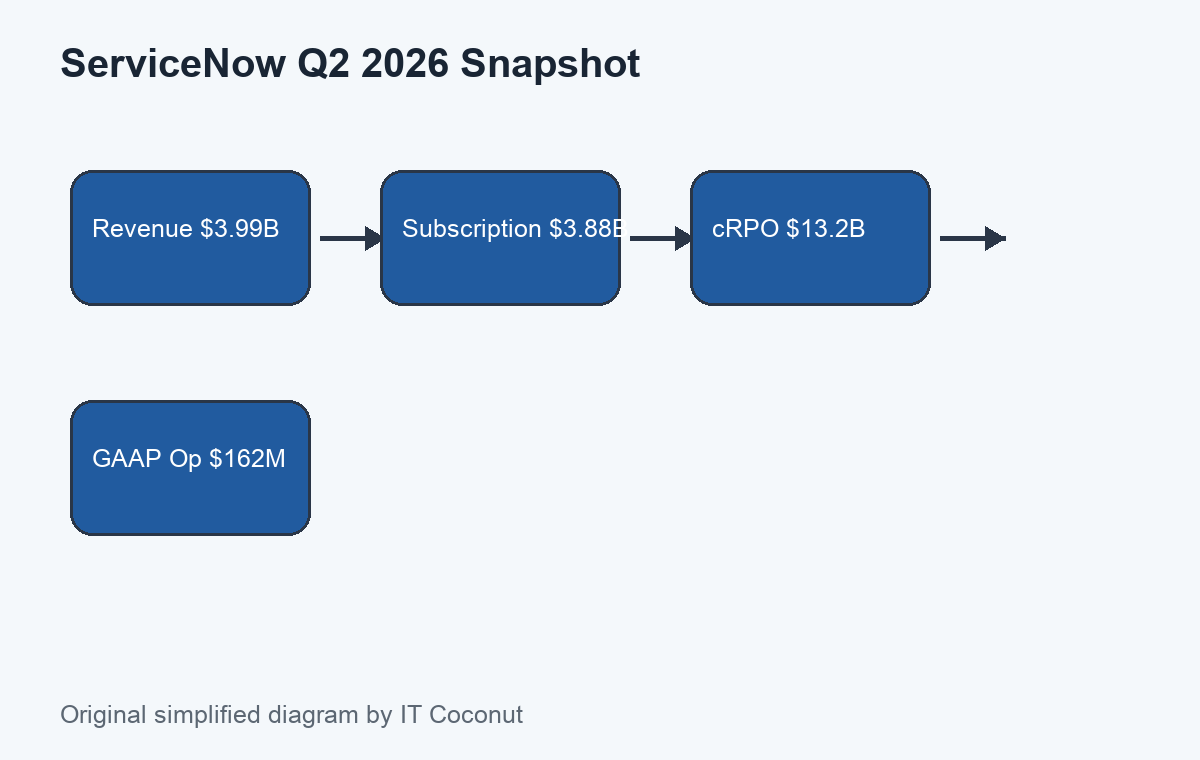
For Q2 2026, subscription revenue was $3.877 billion, up 24.5% year over year. Total revenue was $3.987 billion, and current remaining performance obligations, or cRPO, reached $13.2 billion. The company ended the quarter with 658 customers above $5 million in annual contract value. Those numbers show why ServiceNow is increasingly sold as an enterprise platform rather than a departmental tool.

Business line Representative products Why customers buy Revenue signal
IT and operations ITSM, ITOM, CMDB Manage incidents, changes, assets, and service requests Subscription expansion, large ACV
Employee and customer experience HRSD, CSM, EmployeeWorks Automate repetitive requests and self-service Departmental expansion
Security and risk SecOps, GRC, Armis and Veza integrations Connect vulnerabilities, assets, and identity flows Security budget absorption
AI platform AI Agents, AI Control Tower, Otto Deploy, govern, and measure agents New AI ACV

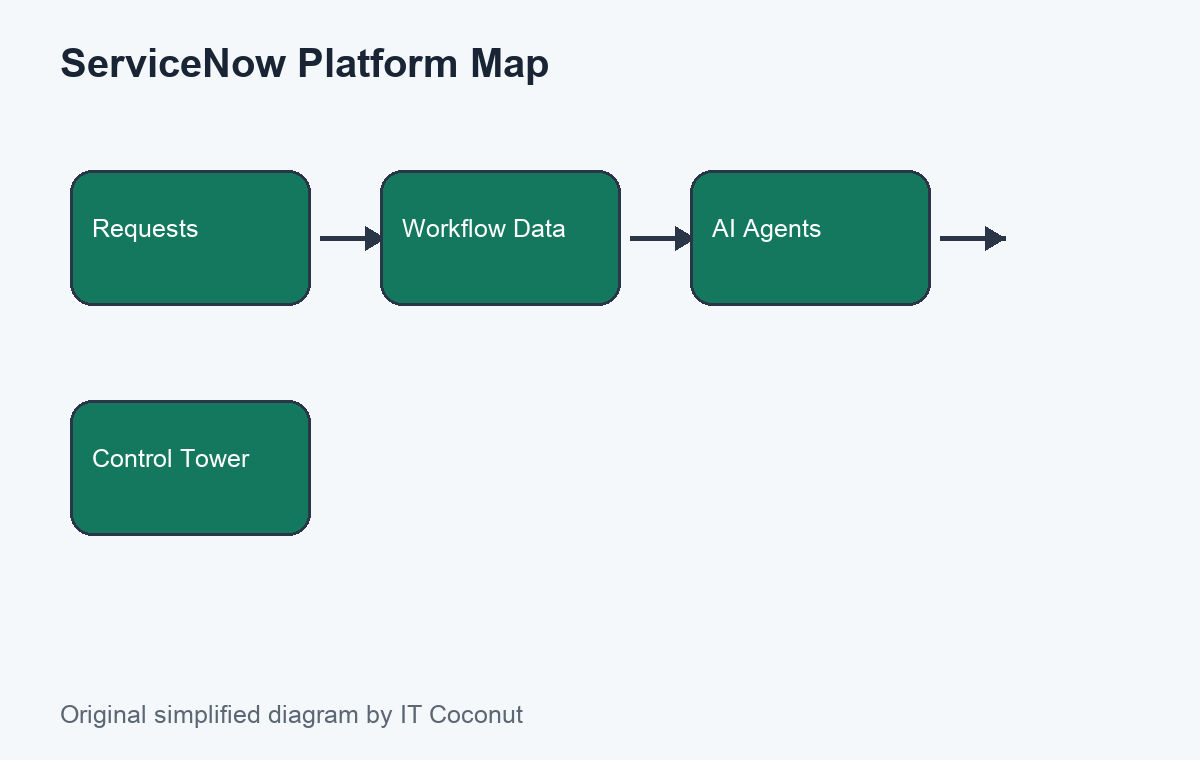
A self-created diagram showing ServiceNow requests, workflow data, AI agents, and Control Tower

<ServiceNow workflow automation structure 1.1>

Core Technology and Product Structure

The core technical asset is workflow data. Customer requests, approvals, changes, incidents, security events, and asset records are managed as objects and states inside the same platform. Before AI, that data powered business automation. With AI, it becomes the operating context that agents need in order to act responsibly.

AI Agents are automated workers assigned to specific roles. ServiceNow’s AI Agents product page describes them not as simple chatbots but as AI specialists with business context and permissions. In an IT service desk, an agent can classify tickets, search knowledge, and run resolution steps. In customer service, it can handle repetitive cases and summarize work for a human agent.

AI Control Tower is the higher-level governance layer. Enterprises using multiple models, clouds, interfaces, and data sources need to manage what agents do and how outcomes are measured. ServiceNow positions Control Tower as a way to connect strategy, governance, management, and performance for AI deployments. The logic resembles AI security monitoring in software delivery: once automation expands, records, permissions, and auditability become product features rather than compliance afterthoughts.

RaptorDB and Workflow Data Fabric also matter. ServiceNow describes RaptorDB as a data layer for real-time workflow performance and analytics, while Workflow Data Fabric links external data sources with ServiceNow’s internal work data. For agents to act in real business processes, they need both fresh data and permitted execution rights. The data layer is therefore as important as model capability.

People Behind the Technology

Bill McDermott, chairman and CEO, is an enterprise go-to-market leader who previously ran SAP. His role has been to push ServiceNow from an ITSM specialist into a broad enterprise platform. In the Q2 2026 announcement, he paired AI Control Tower with the company’s “Rule of 60” narrative. That ability to translate technical direction into language that CFOs and enterprise buyers understand is a major part of ServiceNow’s operating model.

Pat Casey, CTO, is the more technical pillar. ServiceNow’s leadership materials and interviews describe him as an early leader behind the Glide platform and core database technologies. His role helps explain why ServiceNow is not simply adding AI on top of a SaaS portfolio; it is layering AI onto a long-running workflow engine.

Gina Mastantuono, president and CFO, anchors the financial and operating side. In Q2 2026, she pointed to AI net-new ACV growth, Security and Risk momentum, and demand for the CMDB as a governance and data foundation. That framing matters: AI is not just a standalone product line for ServiceNow, but a sales catalyst across security, operations, and data-backed workflows.

Financial Analysis in Numbers

Based on SEC XBRL data and the Q2 2026 Form 10-Q, ServiceNow looks like a large software company that is still growing quickly while already producing GAAP profit. Annual revenue in 2025 was $13.278 billion, and Q2 2026 revenue was $3.987 billion. GAAP operating income for the quarter was $162 million, and GAAP net income was $298 million.

Metric Latest period Value Interpretation
Total revenue Q2 2026 $3.987B 24% year-over-year growth
Subscription revenue Q2 2026 $3.877B Most revenue is recurring subscription
cRPO Q2 2026 $13.2B Strong next-12-month revenue visibility
GAAP operating income Q2 2026 $162M Profitable despite acquisition and compensation costs
R&D expense Q2 2026 $915M About 23% of quarterly revenue
Cash and equivalents June 30, 2026 $2.503B Liquidity remains meaningful after acquisitions

A self-created visual summary of ServiceNow Q2 2026 revenue, subscription revenue, cRPO, and operating income

<ServiceNow Q2 2026 financial snapshot 4.1>

There are caveats. Acquisitions such as Armis and Veza broaden the security story but add integration cost and execution risk. ServiceNow also noted that acquisitions and rising customer AI usage may pressure gross margin. Large federal demand and on-premise subscription timing can also move quarterly revenue between periods.

What Looks Promising and What Could Go Wrong

The most promising point is that ServiceNow may own the “record after AI action.” Many AI products generate answers well, but enterprise work depends on approvals, permissions, history, SLAs, and exceptions. ServiceNow already owns much of that workflow context, which gives it a strong starting point as agents move into real business systems.

The risks are equally concrete. First, the AI Control Tower position overlaps with Microsoft, Salesforce, Atlassian, Palantir, Datadog, and the hyperscalers. Second, agent automation can create operational incidents if permissions or recommendations are wrong. ServiceNow’s AI therefore needs to land as reviewable automation inside business context, not as a promise of full autonomy.

ServiceNow is not a flashy model company. It is a company that has stayed close to how enterprises actually get work done. As AI moves into production workflows, that steadiness may become an advantage. The key things to watch are whether AI Agents reduce repetitive work in measurable ways and whether Control Tower can make governance and ROI visible enough for buyers. I hope ServiceNow keeps turning enterprise AI into safer, less tiring work rather than another layer of dashboards.

404 Dev Room 30 - Taming

Series · 404 Dev Room Webtoon · Ongoing Episode 30 · 404 Dev Room 30 - Taming The trainer in the AI coding room has changed. <...