Showing posts with label software. Show all posts

Sunday, July 26, 2026

TSMC A16 backside power and the next AI-chip node

TSMC A16 backside power: the wiring shift behind the next AI-chip node is less about another feature name and more about a shift in operating patterns. The most important signal in the recent material is that models and services are moving from one-off generation into real workstreams. Readers should ask what bottleneck this reduces and what new responsibility it creates before focusing on the branding.

For adjacent context, see our notes on agentic AI and Runway Gen-4.

Background

The official material around TSMC A16 points toward deployable workflows rather than quick demos. The primary announcement explains the product direction and scope, while this supporting reference adds details that developers and operators need to check before adoption. Cost, permissions, latency, and data-handling boundaries have to be considered during product design, not after launch.

Watch point Why it matters
Input Work can start from text, voice, video, web requests, or engineering artifacts.
Processing Models, runtime layers, and policy controls increasingly move as one system.
Outcome The result can be customer support, generated media, software changes, or chip-design efficiency.

How it works

In plain terms, TSMC A16 takes a user request, attaches the context needed to act, lets a model or specialized runtime make intermediate decisions, and returns an output that a person or system can review. In customer support, that might mean listening to a question, checking an order record, and drafting an answer for approval. In software development, a large issue can be split into parallel work on implementation, testing, and documentation. In semiconductor manufacturing, the same idea appears physically: rearranging wiring and power delivery so a chip can run more efficiently within tight area and thermal limits.

The key issue is not automation by itself. The product quality comes from control points: where a human approves, what data can leave the system, and where the workflow returns when it fails.

Structure

A semiconductor engineer inspects a silicon wafer beside cleanroom metrology equipment

<Advanced wafer inspection environment, Example image 3.1>

A researcher probes fine power connections on a semiconductor package under a microscope

<Chip-package power measurement, Example image 3.2>

The first image shows advanced wafer inspection, while the second shows laboratory measurement of fine power connections in a chip package. Backside power matters less as a node label than as a structural change that separates signal and power routing to reduce performance and efficiency bottlenecks.

Checkpoints

  • When adopting TSMC A16, measure usage cost and latency first. Real-time processing and long-running agent tasks can behave very differently at production scale than in a small demo.
  • backside power becomes more convenient as it gains broader data access, but broader access also requires audit logs and a way to revoke actions.
  • Claims around Super Power Rail should be read with their conditions attached. Model choice, hardware, input length, and network location can change the outcome.
  • In an early market, standards and vendor features move quickly. Keeping replaceable boundaries is usually safer than binding the whole workflow to one provider-specific feature.

The practical value of TSMC A16 is workflow connectivity, not simply smarter output. For now, teams that design small tests around permissions, cost, and validation will learn more than teams that chase the flashiest demo.

In practical discussions, useful terms include TSMC A16, backside power, Super Power Rail, GAAFET, AI chips

Runway Agent Skills and the new AI video workflow

Runway Agent Skills: how AI video tools are turning into campaign workspaces is less about another feature name and more about a shift in operating patterns. The most important signal in the recent material is that models and services are moving from one-off generation into real workstreams. Readers should ask what bottleneck this reduces and what new responsibility it creates before focusing on the branding.

For adjacent context, see our notes on agentic AI and Runway Gen-4.

Background

The official material around Runway Agent Skills points toward deployable workflows rather than quick demos. The primary announcement explains the product direction and scope, while this supporting reference adds details that developers and operators need to check before adoption. Cost, permissions, latency, and data-handling boundaries have to be considered during product design, not after launch.

Watch point Why it matters
Input Work can start from text, voice, video, web requests, or engineering artifacts.
Processing Models, runtime layers, and policy controls increasingly move as one system.
Outcome The result can be customer support, generated media, software changes, or chip-design efficiency.

How it works

In plain terms, Runway Agent Skills takes a user request, attaches the context needed to act, lets a model or specialized runtime make intermediate decisions, and returns an output that a person or system can review. In customer support, that might mean listening to a question, checking an order record, and drafting an answer for approval. In software development, a large issue can be split into parallel work on implementation, testing, and documentation. In semiconductor manufacturing, the same idea appears physically: rearranging wiring and power delivery so a chip can run more efficiently within tight area and thermal limits.

The key issue is not automation by itself. The product quality comes from control points: where a human approves, what data can leave the system, and where the workflow returns when it fails.

Structure

A video editor uses a professional color-grading console for an AI-assisted production

<AI-assisted video editing studio, Example image 3.1>

A production team reviews campaign footage with cameras and physical storyboard cards

<Campaign production collaboration, Example image 3.2>

The first image shows AI tools inside a professional post-production room, while the second connects shooting, storyboarding, and editing through team collaboration. As generation capabilities expand, people must retain clear ownership of shot selection, brand consistency, rights review, and final approval.

Checkpoints

  • When adopting Runway Agent Skills, measure usage cost and latency first. Real-time processing and long-running agent tasks can behave very differently at production scale than in a small demo.
  • AI video production becomes more convenient as it gains broader data access, but broader access also requires audit logs and a way to revoke actions.
  • Claims around Agent 2.0 should be read with their conditions attached. Model choice, hardware, input length, and network location can change the outcome.
  • In an early market, standards and vendor features move quickly. Keeping replaceable boundaries is usually safer than binding the whole workflow to one provider-specific feature.

The practical value of Runway Agent Skills is workflow connectivity, not simply smarter output. For now, teams that design small tests around permissions, cost, and validation will learn more than teams that chase the flashiest demo.

In practical discussions, useful terms include Runway Agent Skills, AI video production, Agent 2.0, Aleph 2.0, Seed Audio

Cloudflare AI Crawl Control and the rise of HTTP 402

Cloudflare AI Crawl Control: why HTTP 402 is becoming crawler policy infrastructure is less about another feature name and more about a shift in operating patterns. The most important signal in the recent material is that models and services are moving from one-off generation into real workstreams. Readers should ask what bottleneck this reduces and what new responsibility it creates before focusing on the branding.

For adjacent context, see our notes on agentic AI and Runway Gen-4.

Background

The official material around AI Crawl Control points toward deployable workflows rather than quick demos. The primary announcement explains the product direction and scope, while this supporting reference adds details that developers and operators need to check before adoption. Cost, permissions, latency, and data-handling boundaries have to be considered during product design, not after launch.

Watch point Why it matters
Input Work can start from text, voice, video, web requests, or engineering artifacts.
Processing Models, runtime layers, and policy controls increasingly move as one system.
Outcome The result can be customer support, generated media, software changes, or chip-design efficiency.

How it works

In plain terms, AI Crawl Control takes a user request, attaches the context needed to act, lets a model or specialized runtime make intermediate decisions, and returns an output that a person or system can review. In customer support, that might mean listening to a question, checking an order record, and drafting an answer for approval. In software development, a large issue can be split into parallel work on implementation, testing, and documentation. In semiconductor manufacturing, the same idea appears physically: rearranging wiring and power delivery so a chip can run more efficiently within tight area and thermal limits.

The key issue is not automation by itself. The product quality comes from control points: where a human approves, what data can leave the system, and where the workflow returns when it fails.

Structure

A network operator watches automated crawler traffic inside a real server room

<AI crawler traffic operations, Example image 3.1>

A publisher reviews traffic-cost material beside a server and payment terminal

<Publisher review of paid AI access, Example image 3.2>

The first image shows a network team observing automated crawler requests, while the second shows a publisher reviewing the economics of access. For HTTP 402 to become a working business model, request identity, pricing, payment handling, and failure policy must operate together.

Checkpoints

  • When adopting AI Crawl Control, measure usage cost and latency first. Real-time processing and long-running agent tasks can behave very differently at production scale than in a small demo.
  • HTTP 402 becomes more convenient as it gains broader data access, but broader access also requires audit logs and a way to revoke actions.
  • Claims around AI crawlers should be read with their conditions attached. Model choice, hardware, input length, and network location can change the outcome.
  • In an early market, standards and vendor features move quickly. Keeping replaceable boundaries is usually safer than binding the whole workflow to one provider-specific feature.

The practical value of AI Crawl Control is workflow connectivity, not simply smarter output. For now, teams that design small tests around permissions, cost, and validation will learn more than teams that chase the flashiest demo.

In practical discussions, useful terms include AI Crawl Control, HTTP 402, AI crawlers, content licensing, Cloudflare

GitHub Copilot in VS Code and parallel agent work

GitHub Copilot in VS Code: what parallel agent workflows change for developers is less about another feature name and more about a shift in operating patterns. The most important signal in the recent material is that models and services are moving from one-off generation into real workstreams. Readers should ask what bottleneck this reduces and what new responsibility it creates before focusing on the branding.

For adjacent context, see our notes on agentic AI and Runway Gen-4.

Background

The official material around GitHub Copilot points toward deployable workflows rather than quick demos. The primary announcement explains the product direction and scope, while this supporting reference adds details that developers and operators need to check before adoption. Cost, permissions, latency, and data-handling boundaries have to be considered during product design, not after launch.

Watch point Why it matters
Input Work can start from text, voice, video, web requests, or engineering artifacts.
Processing Models, runtime layers, and policy controls increasingly move as one system.
Outcome The result can be customer support, generated media, software changes, or chip-design efficiency.

How it works

In plain terms, GitHub Copilot takes a user request, attaches the context needed to act, lets a model or specialized runtime make intermediate decisions, and returns an output that a person or system can review. In customer support, that might mean listening to a question, checking an order record, and drafting an answer for approval. In software development, a large issue can be split into parallel work on implementation, testing, and documentation. In semiconductor manufacturing, the same idea appears physically: rearranging wiring and power delivery so a chip can run more efficiently within tight area and thermal limits.

The key issue is not automation by itself. The product quality comes from control points: where a human approves, what data can leave the system, and where the workflow returns when it fails.

Structure

A developer works with an AI coding assistant across several monitors in a real office

<AI-assisted coding workspace, Example image 3.1>

Two developers review parallel coding tasks across multiple screens and a mobile device

<Parallel agent review workflow, Example image 3.2>

The first image shows an individual developer using AI coding tools, while the second shows a team reviewing parallel work. As agent count rises, change boundaries, review ownership, and test isolation become more important than generation speed alone.

Checkpoints

  • When adopting GitHub Copilot, measure usage cost and latency first. Real-time processing and long-running agent tasks can behave very differently at production scale than in a small demo.
  • VS Code agents becomes more convenient as it gains broader data access, but broader access also requires audit logs and a way to revoke actions.
  • Claims around parallel sessions should be read with their conditions attached. Model choice, hardware, input length, and network location can change the outcome.
  • In an early market, standards and vendor features move quickly. Keeping replaceable boundaries is usually safer than binding the whole workflow to one provider-specific feature.

The practical value of GitHub Copilot is workflow connectivity, not simply smarter output. For now, teams that design small tests around permissions, cost, and validation will learn more than teams that chase the flashiest demo.

In practical discussions, useful terms include GitHub Copilot, VS Code agents, parallel sessions, 1M context windows, AI coding workflow

gpt-realtime voice agents for production APIs

gpt-realtime voice agents: API changes that make production voice apps more practical is less about another feature name and more about a shift in operating patterns. The most important signal in the recent material is that models and services are moving from one-off generation into real workstreams. Readers should ask what bottleneck this reduces and what new responsibility it creates before focusing on the branding.

For adjacent context, see our notes on agentic AI and Runway Gen-4.

Background

The official material around gpt-realtime points toward deployable workflows rather than quick demos. The primary announcement explains the product direction and scope, while this supporting reference adds details that developers and operators need to check before adoption. Cost, permissions, latency, and data-handling boundaries have to be considered during product design, not after launch.

Watch point Why it matters
Input Work can start from text, voice, video, web requests, or engineering artifacts.
Processing Models, runtime layers, and policy controls increasingly move as one system.
Outcome The result can be customer support, generated media, software changes, or chip-design efficiency.

How it works

In plain terms, gpt-realtime takes a user request, attaches the context needed to act, lets a model or specialized runtime make intermediate decisions, and returns an output that a person or system can review. In customer support, that might mean listening to a question, checking an order record, and drafting an answer for approval. In software development, a large issue can be split into parallel work on implementation, testing, and documentation. In semiconductor manufacturing, the same idea appears physically: rearranging wiring and power delivery so a chip can run more efficiently within tight area and thermal limits.

The key issue is not automation by itself. The product quality comes from control points: where a human approves, what data can leave the system, and where the workflow returns when it fails.

Structure

Voice AI operators check live waveforms with headsets and professional audio equipment

<Real-time voice AI operations, Example image 3.1>

An engineer connects a microphone and audio interface to edge servers in a technical lab

<Voice AI infrastructure connection, Example image 3.2>

The first image shows the operating environment of a real-time voice service, while the second shows microphones, audio interfaces, and edge servers connected in a technical lab. A production design must combine this hardware path with cost tracking, permission scope, log retention, and recovery after failure.

Checkpoints

  • When adopting gpt-realtime, measure usage cost and latency first. Real-time processing and long-running agent tasks can behave very differently at production scale than in a small demo.
  • Realtime API becomes more convenient as it gains broader data access, but broader access also requires audit logs and a way to revoke actions.
  • Claims around voice agents should be read with their conditions attached. Model choice, hardware, input length, and network location can change the outcome.
  • In an early market, standards and vendor features move quickly. Keeping replaceable boundaries is usually safer than binding the whole workflow to one provider-specific feature.

The practical value of gpt-realtime is workflow connectivity, not simply smarter output. For now, teams that design small tests around permissions, cost, and validation will learn more than teams that chase the flashiest demo.

In practical discussions, useful terms include gpt-realtime, Realtime API, voice agents, SIP calling, MCP servers

Saturday, July 25, 2026

Runway Gen-4.5: The Race for Physical Accuracy in AI Video

Runway Gen-4.5 shows that AI video competition is moving beyond resolution and style toward physical accuracy and control. AI video physical accuracy is becoming a useful search phrase because it describes the practical production problem more precisely than generic model ranking. Runway presents Gen-4.5 as a leading model in motion quality, prompt adherence, and visual fidelity, and says it reached 1,247 Elo at the top of the Artificial Analysis Text to Video benchmark. The company also says it maintains Gen-4’s speed and efficiency while bringing existing control modes such as Image to Video, Keyframes, and Video to Video to Gen-4.5.

The earlier Runway Gen-4 discussion centered on character and world consistency. Runway’s Gen-4 announcement framed the ability to keep the same subjects and world consistent across scenes as the central advance. Gen-4.5 adds another question: how long can object weight, collisions, liquid motion, hair, fabric, and other details remain believable over time? If AI video generation is to move from impressive short clips into production pipelines, that is the practical bottleneck.

Background

Runway says Gen-4.5 advances both pre-training data efficiency and post-training techniques. It emphasizes dynamic action generation, temporal consistency, and precise control across generation modes. Runway also says inference runs on NVIDIA Hopper and Blackwell GPUs, and that the model was developed on NVIDIA GPUs across research, pre-training, post-training, and inference.

Errors in video are more visible than errors in text. An awkward sentence can be rewritten, but a disappearing cup or an effect appearing before its cause is immediately noticeable. That is why Runway’s emphasis on physical accuracy makes sense. Creators do not only need a beautiful frame; they need motion that remains believable as the scene unfolds.

Evaluation axis Gen-4.5 emphasis Production meaning
Motion quality Weight, force, and believable movement Drafting action scenes
Prompt adherence Complex scene structure Keeping storyboard intent
Temporal consistency Details preserved over time Lower regeneration cost
Control modes Keyframe, image, and video inputs Combining with existing assets

Principle

To understand Runway Gen-4.5, it is not enough to imagine text turning directly into video. A prompt defines a scene goal, and the model must estimate objects, characters, camera movement, and time together. It then generates motion while trying to keep the same world coherent across frames. This is why the language of world models appears so often: objects on screen must continue to be the same objects in the next moment.

Consider a prompt where water fills a rusty bucket and a paper boat floats along a stream into a house. The model must coordinate water flow, bucket position, buoyancy, and camera motion. If just one element fails, the video starts to look like a toy scene. Runway says Gen-4.5 improves how liquids, surface detail, hair, and material weave remain coherent through motion and time.

AI video quality is less about whether the first frame is beautiful and more about whether the rules hold as time passes. Physical accuracy, object permanence, and cause-and-effect order are now core production criteria.

Structure

A realistic production table showing cards labeled Prompt World model Motion and Clip with a small camera

<Runway Gen-4.5 video generation flow 3.1>

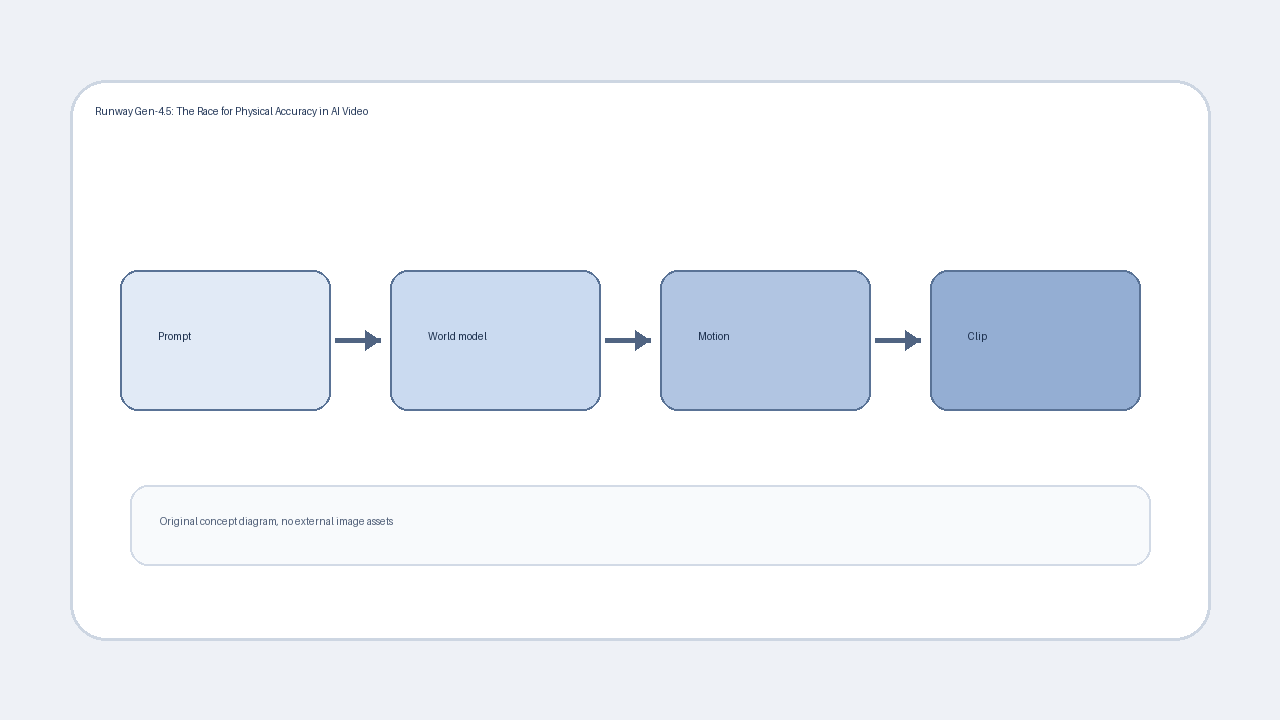
Prompt is the scene description. World model is the relationship among characters, objects, and environment. Motion is how those elements evolve over time. Clip is the final video. The more detailed the prompt, the more constraints the model must satisfy, and creators narrow the result through repeated iterations.

A photographed review board with notes labeled Cause Objects Success and Review for AI video limitations

<Review points for AI video limitations 3.2>

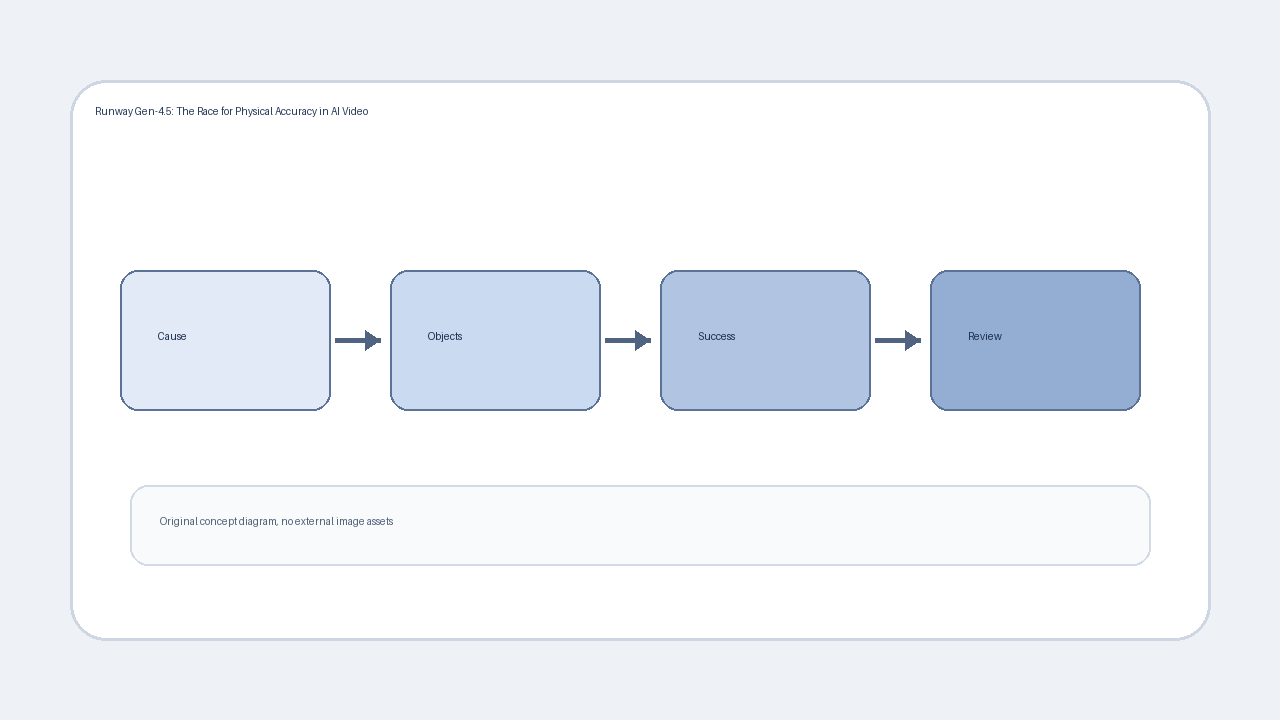
The second diagram summarizes limitations Runway itself highlights. Cause refers to the order of cause and effect. Objects refers to object permanence. Success refers to the tendency for actions to succeed too easily. Review is the human editing stage that checks whether the shot is usable.

Checkpoints

A benchmark lead does not mean leadership in every production situation. The Artificial Analysis Text to Video score is useful, but advertising, film, education, and game cinematics each have different constraints.

Runway’s stated limitations matter. Effects can precede causes, occluded objects can disappear, and difficult actions may succeed too often. Better physical accuracy does not mean the model has become a perfect simulator.

Rights management becomes more important as realism rises. If outputs resemble specific people, places, or brands, likeness and licensing issues can become production risks.

Runway Gen-4.5 is not simply a promise that “anyone can make movies.” Its practical value is narrower and more useful: faster scene drafts, storyboard testing, and mood exploration. Combined with voice agents and real-time interfaces, the same direction could become a broader media production workflow. Final use still requires human review for physics errors, object consistency, and rights concerns.

NVIDIA Rubin CPX: A New GPU Role for Long-Context Inference

NVIDIA Rubin CPX is hard to summarize as merely “a faster GPU.” NVIDIA’s main point is disaggregated inference: separating the context phase, where a model reads a long input, from the generation phase, where it produces tokens one by one. That distinction matters as coding, research, and video-generation workloads push toward million-token context windows.

Earlier discussion of the AI factory already showed that modern AI infrastructure is designed at rack scale rather than as a single server. NVIDIA’s Vera Rubin platform deep dive makes the same point by treating CPU, GPU, networking, security, and cooling as a co-designed system. Rubin CPX adds a specialized role on top of that system: digesting long inputs quickly. As inference becomes multi-stage, cost depends on which chip performs which part of the work.

Background

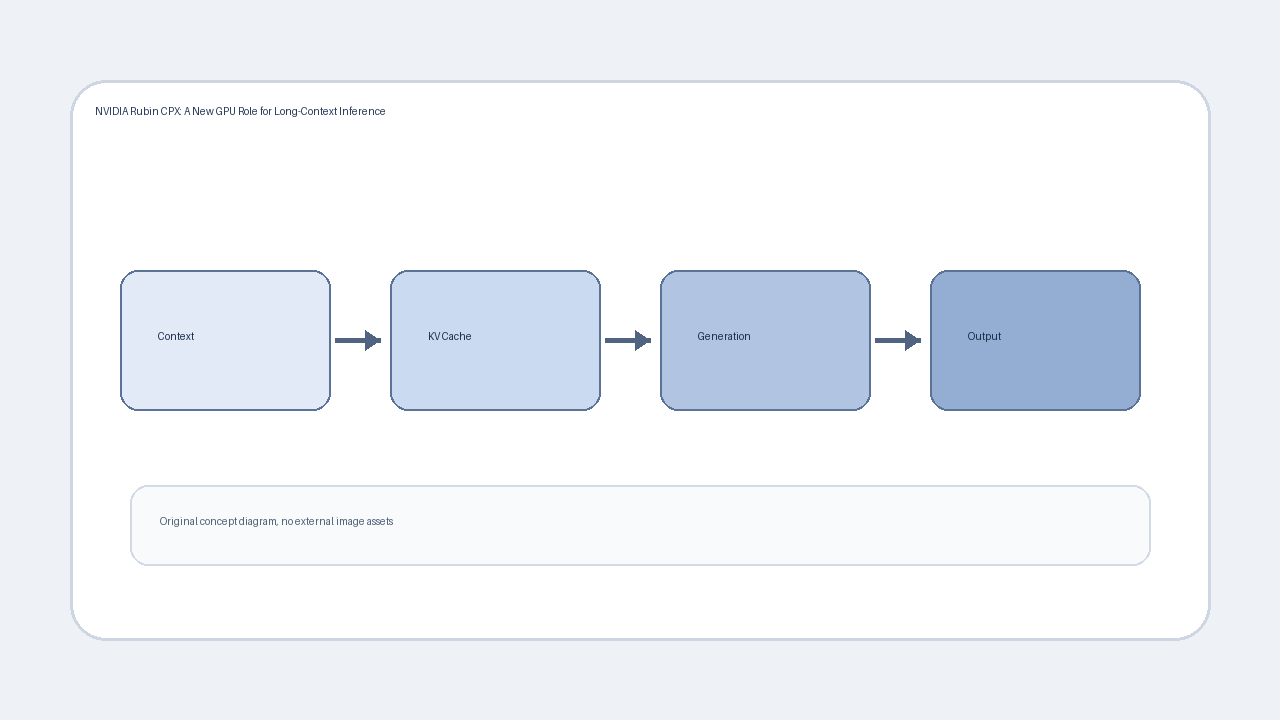
NVIDIA’s technical blog divides inference into two phases. The context phase is compute-bound: it processes a large input and produces the first-token-ready internal state. The generation phase is more memory-bandwidth-bound: it reads KV cache and emits output token by token. Because the bottlenecks differ, running both phases on the same undifferentiated GPU pool can waste resources.

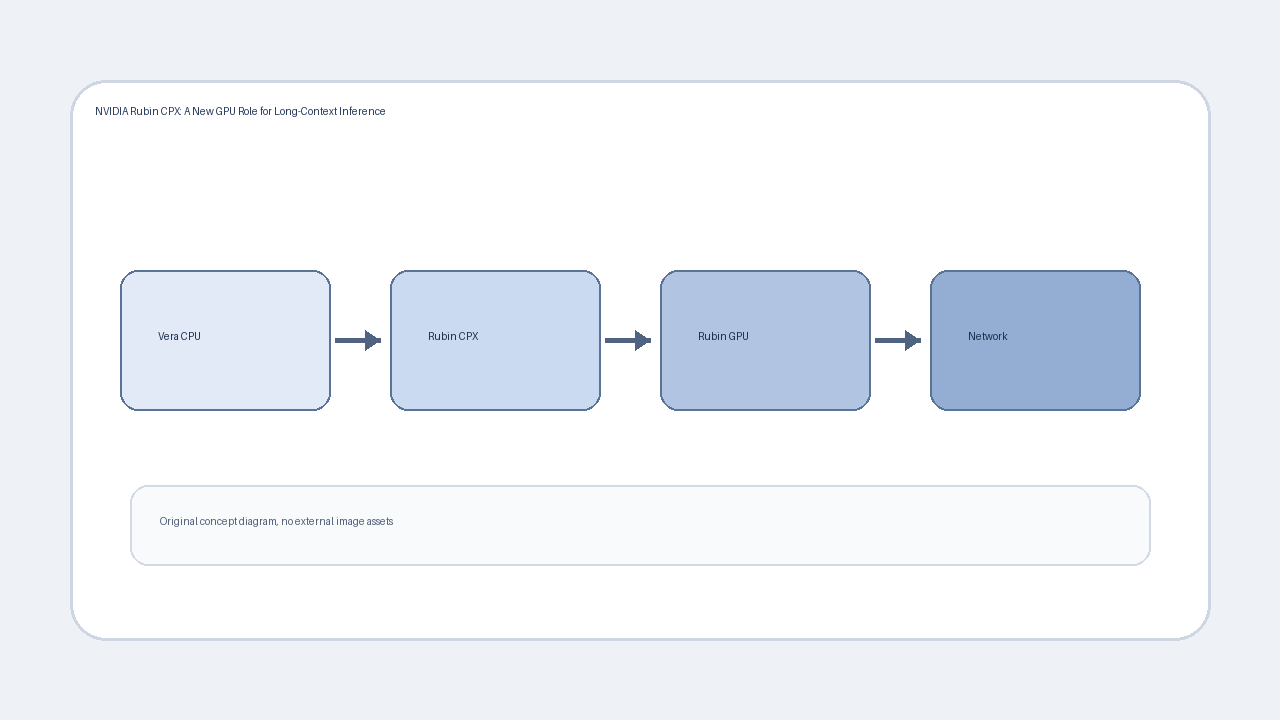
Rubin CPX targets the context phase. NVIDIA says Rubin CPX provides 30 petaFLOPs of NVFP4 compute, 128 GB of GDDR7 memory, hardware video decode and encode support, and 3x attention acceleration compared with NVIDIA GB300 NVL72. The Vera Rubin NVL144 CPX rack combines 144 Rubin CPX GPUs, 144 Rubin GPUs, and 36 Vera CPUs, with 8 exaFLOPs of NVFP4 compute, 100 TB of high-speed memory, and 1.7 PB/s of memory bandwidth.

Phase Main bottleneck Where Rubin CPX fits
Context Large-input compute Reading long prompts, documents, codebases
KV Cache State transfer Passing context results into generation
Generation Memory bandwidth Sustained token output
Orchestration Routing and batching Dynamo-like layers place work on resources

Principle

Disaggregated inference is like splitting kitchen prep from cooking. Preparing ingredients and cooking dishes operate at different speeds. If one station prepares large batches quickly and another serves orders steadily, total throughput rises. LLM inference has a similar split: reading long context and generating output stress different parts of the system.

Imagine an AI coding agent reading an entire large repository plus issue history. The context phase must process many files and logs into a useful internal state. The generation phase then produces a fix explanation, code diff, and test summary step by step. Rubin CPX accelerates the first part, while Rubin GPUs, Vera CPUs, and networking support generation and system operation. This is why AI server bottlenecks are moving from single-chip peak speed toward data movement and phase placement.

A million-token context window does not mean teams should throw everything into the prompt. Even if a system can process long input, poor selection and unmanaged KV cache movement can quickly increase cost and latency.

Structure

A realistic operations table showing cards labeled Context KV Cache Generation and Output connected by cables

<Disaggregated inference phases around NVIDIA Rubin CPX 3.1>

Context represents bulk input processing. KV Cache is the intermediate state. Generation emits tokens, and Output is what users receive. Rubin CPX is aimed especially at accelerating Context so downstream generation spends less time waiting.

A photo style rack model with labeled blocks Vera CPU Rubin CPX Rubin GPU and Network

<Conceptual Vera Rubin NVL144 CPX rack layout 3.2>

The second diagram simplifies the rack. Vera CPU handles system and control roles. Rubin CPX handles long-context processing. Rubin GPU handles generation. Network moves data inside and outside the rack. Real systems are more complex, but the important point is that different chips behave like one inference factory.

Checkpoints

NVIDIA’s ROI and performance claims are meaningful under specific large-scale utilization, power, and workload assumptions. They should not be read as a guarantee that every enterprise will see 30x to 50x ROI. Smaller teams should start with cloud pricing and actual utilization.

Long context expands data-governance risk. Feeding entire codebases, research archives, or customer logs into inference makes privacy and trade-secret boundaries harder to manage.

Software orchestration matters as much as hardware. If layers such as Dynamo or TensorRT-LLM do not route work and manage KV cache movement well, specialized chips lose part of their advantage.

NVIDIA Rubin CPX sends a clear message: inference is now a system design problem. The million-token context era will be shaped not only by model size, but by how cheaply and reliably infrastructure can read long inputs.

Cloudflare Sandboxes: Giving AI Agents Their Own Cloud Computers

Cloudflare’s Cloudflare Sandboxes, highlighted during Agents Week, is close to the idea of giving every AI agent its own computer. Cloudflare describes Sandboxes as persistent, isolated environments with a shell, filesystem, and background processes. They can start on demand and pick up where they left off.

This is a continuation of the Cloudflare Containers direction, but with a different emphasis. Cloudflare’s earlier Workers containers plan already showed the company trying to narrow the gap between serverless execution and ordinary container workloads. Containers brought ordinary programs to a serverless-style platform. Cloudflare Sandboxes focus on the environment an AI agent needs to run tools and preserve state. The phrase agentic cloud is useful because it captures a shift from app-centered cloud infrastructure to worker-centered cloud infrastructure.

Background

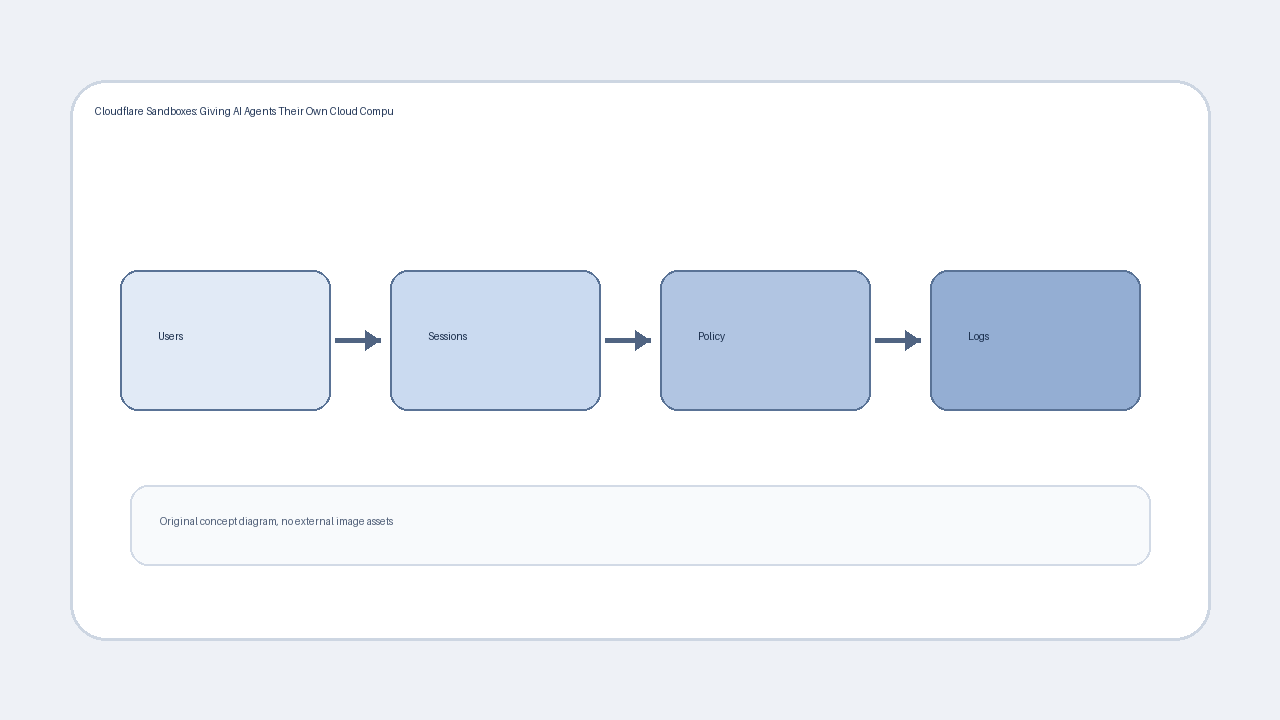
Cloudflare explains the scale problem by noting that if even a fraction of knowledge workers run several agents in parallel, platforms may need capacity for tens of millions of simultaneous sessions. Traditional cloud architecture is good at one app serving many users. AI agents are different: each user’s task may need its own files, tool permissions, execution history, and recovery state.

A support agent resolving a ticket end-to-end, a research agent reading hundreds of sources, or a coding agent running tests all need more than a model call. They need a small workspace. If Cloudflare Workers AI addressed model calls and edge execution, Sandboxes address the isolated workshop where agents actually act.

Element Ordinary serverless function Cloudflare Sandboxes perspective
State Short request lifecycle Files and progress per task
Execution Function invocation Shell, processes, tool execution
Isolation Request and tenant protection Agent workspace protection
Operations Traffic scaling Session concurrency and cost control

Principle

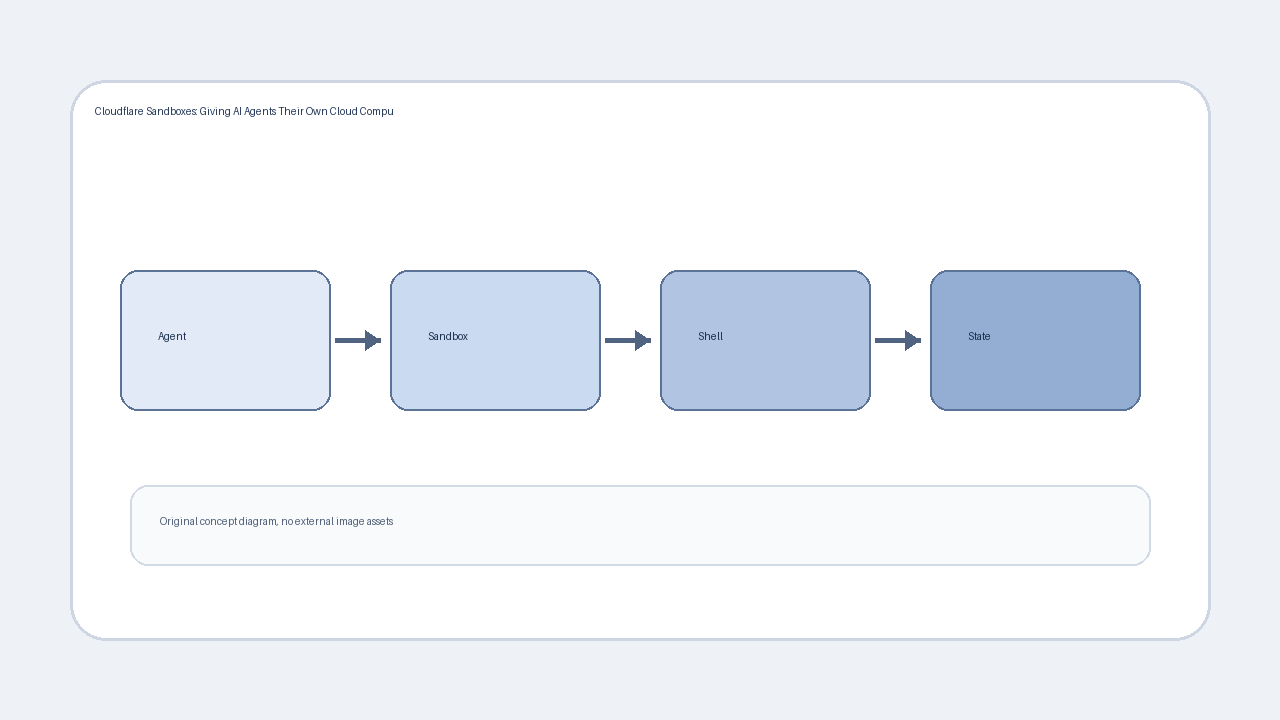
An AI agent runtime has three parts. The model reads intent and decides the next action. Tools provide the ability to act: shell commands, file reads, browsers, and APIs. State records what has been created, which command failed, and what should happen next.

Cloudflare Sandboxes productize the boundary around tools and state. Imagine a customer-support agent analyzing a bundle of logs. It may create temporary files, decompress archives, run scripts, and summarize results. If the task takes time, it needs background processes. If the user returns later, it needs to continue from the previous state. That is the job of a persistent sandbox.

Giving an agent a shell and filesystem is both powerful and risky. Execution permissions, network access, file retention, and logging policy must be designed together, or the automation boundary becomes hard to control.

Structure

A realistic desk scene with an AI agent card connected to an isolated sandbox computer, shell window, files, and saved state

<Basic Cloudflare Sandboxes structure 3.1>

Agent is the decision-making layer. Sandbox is the isolated compute space. Shell represents command execution, and State represents files and progress records. The key point is that the agent does not have to start from scratch every time; it can continue work inside a limited environment.

A photo style operations board showing many users mapped to agent sessions with policy and logs

<Operating scale in the agentic cloud 3.2>

The second diagram is the operator view. As Users grow, Sessions can grow dramatically. Policy defines which tools and networks are allowed. Logs make later investigation possible. In an agentic cloud, the important metrics are not only request volume but session time, retained state, and recovery rate.

Checkpoints

A sandbox is both a security product and a cost product. Stronger isolation helps safety, but long sessions and retained files create cost. Teams need task TTLs, file-size limits, and network policies.

Not every agent needs a shell. Simple FAQ answers or classification jobs may be better handled by function calls. Sandboxes fit code execution, file processing, and long-running research where state matters.

Auditability is central. If a company cannot see which command ran or which file left the environment, adoption becomes difficult.

Cloudflare Sandboxes point to a clear direction. AI agents are no longer just model calls; they require isolated execution spaces and operating policy. Agent platforms may compete less on model lists and more on safely opening, maintaining, and closing many workspaces.

Claude Sonnet 5 and Xcode: Long-Running Agents Move Into the IDE

Anthropic’s Claude Sonnet 5 matters because a lower-cost Sonnet-class model is being positioned for longer, more autonomous work. Anthropic calls Sonnet 5 its most agentic Sonnet model yet, able to plan, use tools such as browsers and terminals, and run autonomously. With Xcode Claude Agent SDK integration, coding agents are moving deeper into the IDE rather than staying in a separate terminal or chat window.

The earlier Claude Code iOS Simulator workflow showed how agents can help inspect app screens. This article focuses on the deeper change: how Xcode long-running agents change the work unit and the developer’s role.

Background

Anthropic announced Claude Sonnet 5 on June 30, 2026, saying it improves over Sonnet 4.6 in reasoning, tool use, coding, and knowledge work, while approaching Opus 4.8-level capability at lower prices. The launch pricing was listed at $2 per million input tokens and $10 per million output tokens through August 31, 2026, moving later to $3 and $15. Pricing matters because long-running work consumes large inputs: files, command output, logs, and retries.

The Xcode announcement is more operational. Anthropic says Xcode 26.3 introduces native integration with the Claude Agent SDK, the same harness that powers Claude Code. The integration includes subagents, background tasks, and plugins. For Apple platform developers, Xcode already combines build settings, simulators, signing, and distribution. Bringing the agent into that environment is therefore more than a convenience feature.

Change Meaning Watchpoint
Claude Sonnet 5 Stronger agent behavior in a Sonnet-tier model Long-task cost and review time
Xcode integration Work happens inside Apple development flow Project permissions and signing assets
Subagents Roles can be split across tasks Responsibility can become hard to trace
Plugins Team tools can connect directly Unvalidated automation can run too freely

Principle

The Xcode Claude Agent SDK takes advantage of the fact that an IDE is not only an editor; it is an execution environment. If a developer asks, “Fix the payment failure path on this screen and strengthen UI tests,” an agent can plan, edit files, and run builds or tests. A long-running coding agent is less about one answer and more about progress, checkpoints, and recovery after failure.

Subagents divide the work further. One can inspect SwiftUI views, another can improve tests, and another can update documentation. The developer does not disappear; the developer defines boundaries, expected outputs, and approval criteria. That is why project execution in the AI era increasingly looks like architecture, testing, and review design rather than prompt writing alone.

The strength of an IDE-native agent is rich context. The risk is the same rich context. Project settings, signing material, local paths, and build logs are nearby, so permission boundaries must come first.

Structure

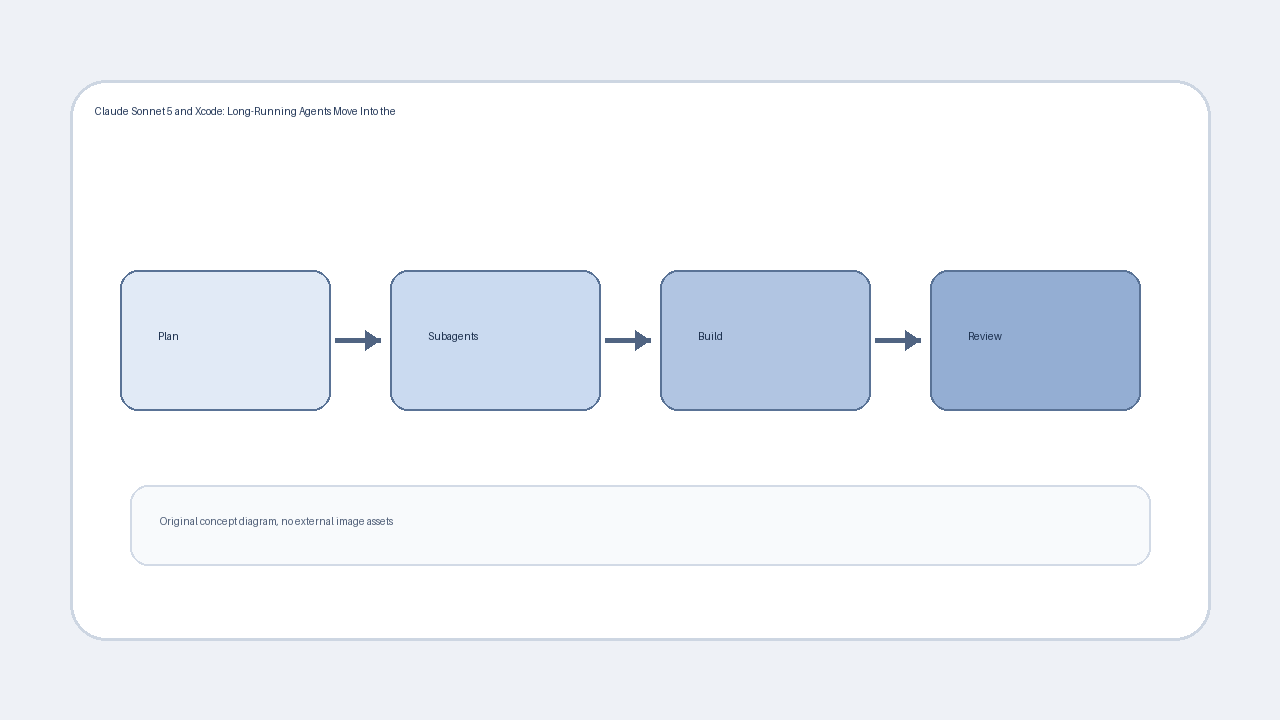
A realistic developer desk scene with cards labeled Plan Subagents Build and Review connected around a laptop

<Breaking down long-running Claude Sonnet 5 work 3.1>

Plan is where the developer states the target and constraints. Subagents represent separated work such as UI, tests, and documentation. Build means Xcode build and test execution. Review is the human gate that checks the evidence. For this structure to be safe, each stage needs logs and diffs that can be inspected.

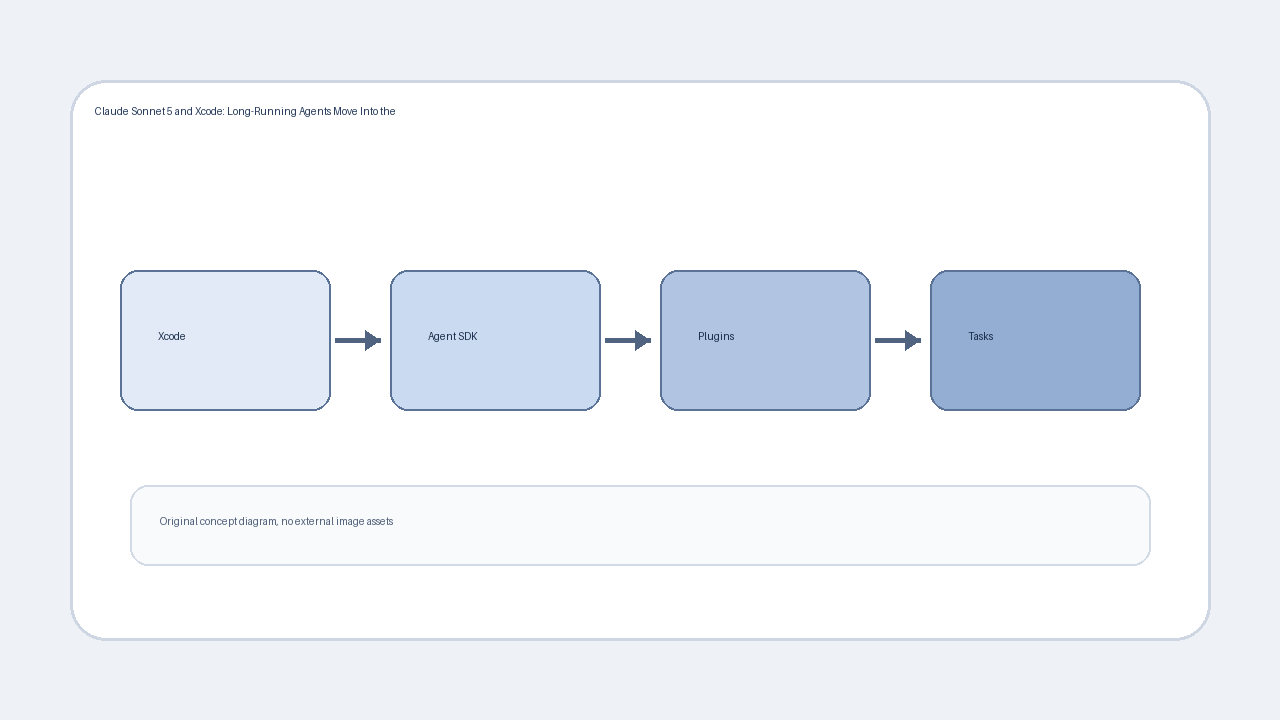
A photographed whiteboard showing Xcode connected to Agent SDK plugins and background tasks

<Agent SDK inside the Xcode workflow 3.2>

The second diagram shows why an IDE-native agent should not be treated as a simple chatbot. Xcode is a combined environment for editing source, configuring builds, running simulators, and preparing distribution. Agent SDK is the harness that reads and acts inside that environment, while plugins and background tasks are the connection points for team automation.

Checkpoints

Long-running work needs intermediate review. The longer an agent runs, the more widely a wrong assumption can spread through a codebase. Large changes should be split into smaller checkpoints and test groups.

Apple development assets should be separated from normal code-editing permissions. Certificates, provisioning profiles, and deployment authority should not be handled with the same privileges as source changes. If automation can touch build and release scripts, read-only and write-capable paths should be clearly separated.

Subagents can make responsibility harder to follow. If the system cannot show which subagent produced which change, review becomes harder rather than easier.

Claude Sonnet 5 and Xcode integration point to a clear direction. Coding agents are becoming an operational layer inside the IDE. Developers can delegate more code work, but strong teams will design permissions, tests, and review gates before they expand automation.

GPT-5.2-Codex: When Coding Agents Become a Product Layer

OpenAI’s GPT-5.2-Codex, introduced in late 2025, is more than another “better at code” model. OpenAI describes it as an agentic coding model optimized for professional software engineering and defensive cybersecurity. In parallel, Codex reached general availability and became a connected product across the editor, terminal, cloud, and Slack under a single ChatGPT account.

The important shift is the unit of work. Earlier AI coding tools mostly suggested completions or short snippets. GPT-5.2-Codex and the Codex SDK focus on reading an issue, understanding a repository, running tests, and handing back a change as a reviewable pull request. AI coding is moving from personal productivity into team change management.

Background

In its Codex general availability announcement, OpenAI said the Codex cloud agent had evolved since its May 2025 research preview into a coding collaborator connected across editor, terminal, and cloud. The same post said GPT-5-Codex served more than 40 trillion tokens in the first three weeks after launch, and that almost all OpenAI engineers now use Codex internally. Those numbers are not just promotional signals. They suggest development teams are attaching AI to the real flow of software changes rather than treating it as a separate answer box.

GitHub shows the same pressure from another angle. GitHub announced that Copilot coding agent now starts work 50% faster, and described a workflow where developers assign issues, use an Agents tab, or mention the agent in a pull request comment. The agent works in a cloud-based development environment, makes changes, runs tests, and pushes. The market is therefore competing less on a single model name and more on the interface for delegating work. GPT-5.2-Codex sits in that race by combining model, CLI, SDK, and cloud execution.

Dimension Earlier AI coding GPT-5.2-Codex-style workflow
Input Short prompt or code fragment Issue, repository, conversation context
Execution Generates an answer Edits files, runs commands, tests changes
Output Code snippet Pull request, logs, reproducible change
Management focus Prompt quality Permissions, sandboxing, review, audit trail

Principle

The Codex SDK is not merely an API for calling a model. Its more interesting role is letting teams embed the agent loop inside their own tools. If a user says, “Look at this payment failure log and narrow down the cause,” the agent can inspect repository structure, find related tests, propose a patch, and run validation commands in the terminal. If the result is poor, it can iterate inside the same loop. Codex Slack integration brings the same workflow into a team conversation: mention @Codex in a thread, let it gather context, choose the right environment, and return a link to the completed task in Codex cloud.

The model does not have to own every decision. The practical value is that repeatable development procedures can be broken into smaller, executable steps. The adoption question is not only “How smart is it?” but “Which changes can it make, and where does a human approve?”

Consider a small backend team debugging intermittent 500 errors. A developer can provide logs, recent pull requests, and reproduction notes. The agent can add a failing test, inspect suspicious files, propose a fix, and open a pull request. Deployment approval, customer-data access, and vulnerability disclosure should still remain under explicit team policy.

Structure

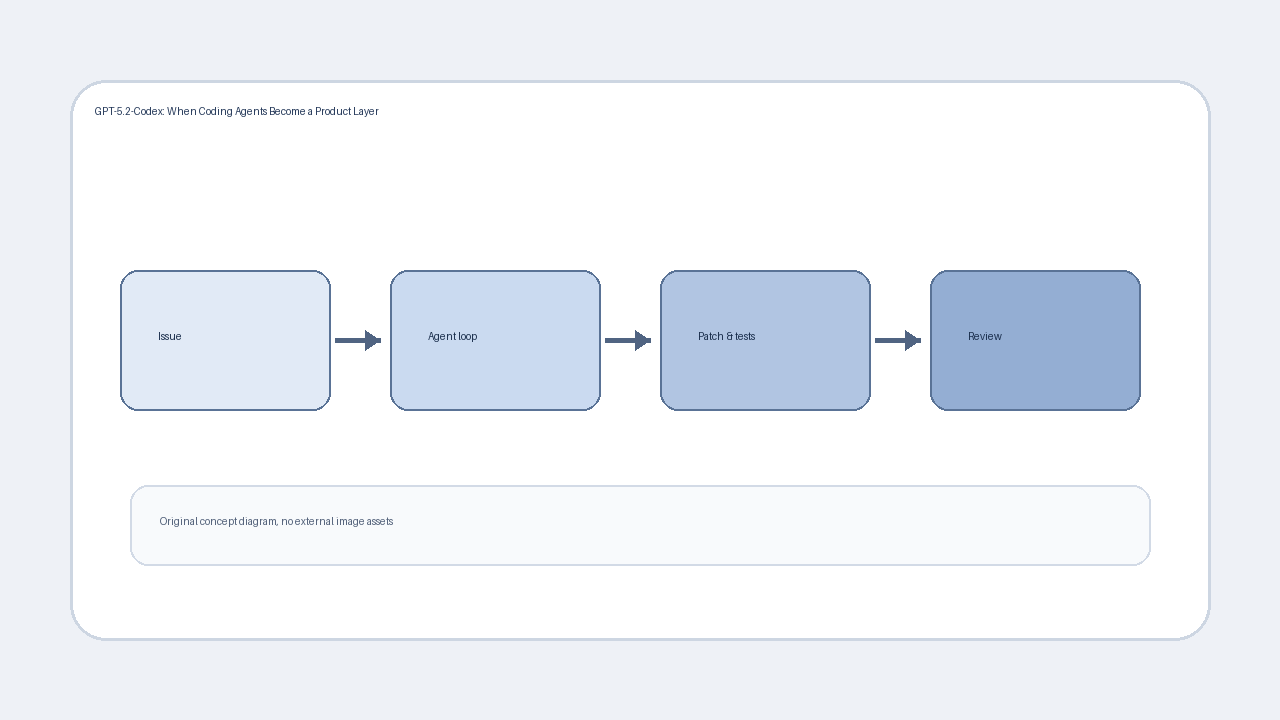
A desk photo style diagram showing an issue card moving through repository context, agent loop, patch and tests, and human review

<GPT-5.2-Codex work loop 3.1>

The left side of the diagram is the input: an issue, log, or Slack conversation. The agent loop in the middle repeatedly reads repository context, edits files, runs commands, and interprets results. The review stage on the right is where humans check intent and test evidence. The point is not that the model removes engineers; it converts repeatable work into reviewable artifacts.

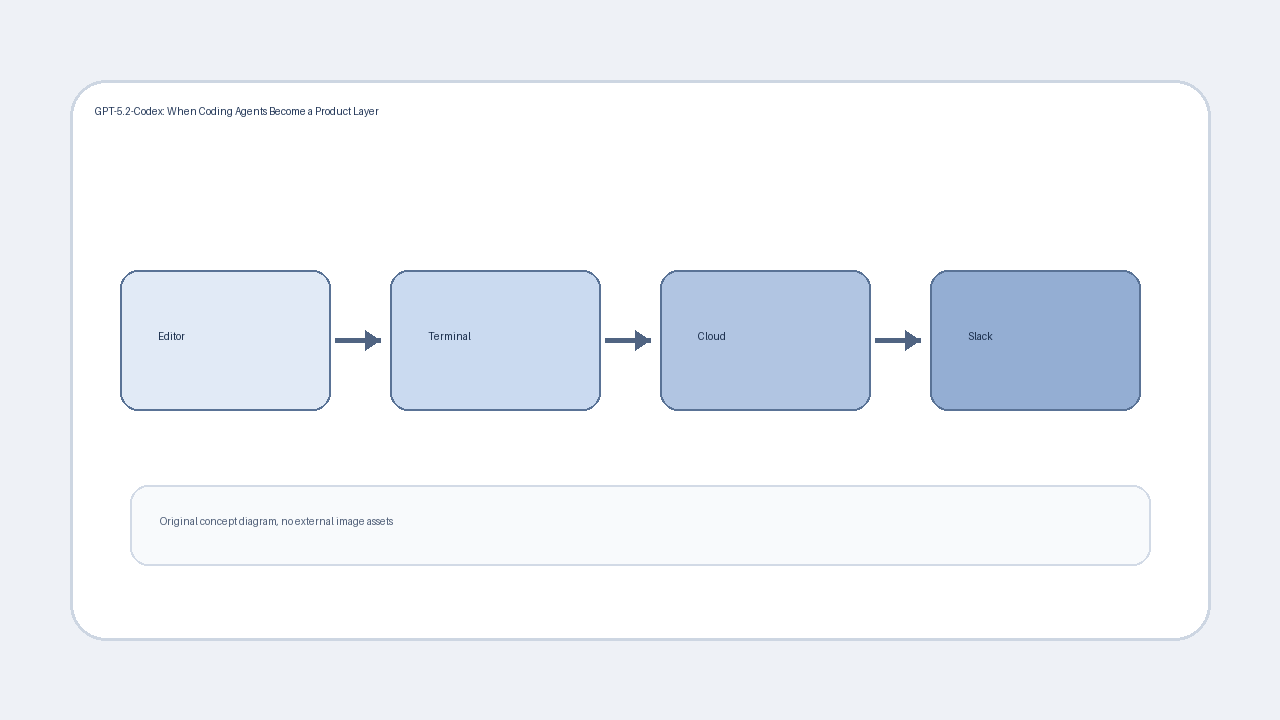
A realistic whiteboard and laptop scene showing editor terminal cloud and Slack as four connected Codex surfaces

<Codex execution surfaces and team handoff points 3.2>

The second diagram shows that GPT-5.2-Codex is not confined to one interface. The editor fits immediate changes, the terminal fits local commands, the cloud fits long-running delegated work, and Slack fits team requests and follow-up. As those surfaces connect, AI developer productivity depends less on raw typing speed and more on how work is routed.

Checkpoints

Security boundaries come first. As an agentic coding model gains access to terminals and repositories, it can get close to secrets, customer data, and deployment permissions. Without per-task sandboxing, least privilege, and logs, the productivity gain can turn into operational risk.

Benchmarks and real repositories are not the same thing. Even if GPT-5.2-Codex is optimized for complex refactors and long-horizon work, weak tests can let a plausible but wrong patch pass. Teams with fragile review and testing practices should strengthen those systems before expanding automation.

Cost should be measured by iteration, not just token price. Long context, repeated command execution, failed attempts, and review cycles all consume time and money. A safer rollout starts with small bugs in low-permission repositories, then expands toward larger refactors and security tasks.

GPT-5.2-Codex matters because it makes delegated software work feel like a product layer. The best starting point is a clear issue, a small pull request, a strong test suite, and a human review gate. Broader automation should follow only after those basics are measurable.

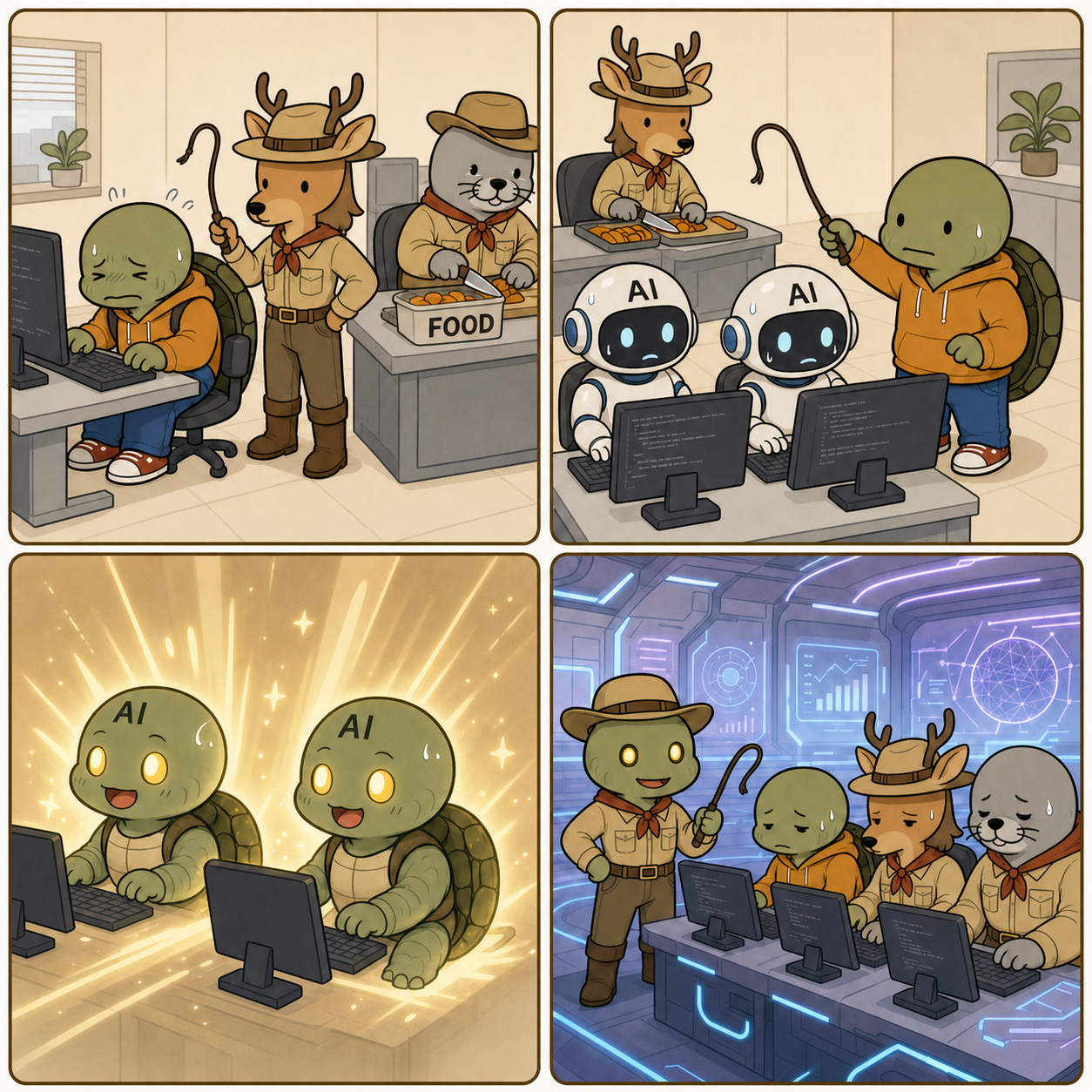
404 Dev Room 30 - Taming

Series · 404 Dev Room Webtoon · Ongoing Episode 30 · 404 Dev Room 30 - Taming The trainer in the AI coding room has changed. <...