Showing posts with label Cloudflare. Show all posts

Thursday, July 23, 2026

Cloudflare Review: Workers, Security, and the Connectivity Cloud

Cloudflare is no longer just a CDN story. The company still sits in front of websites with DNS, caching, DDoS defense, WAF, TLS, bot management, and load balancing. But its current strategy is broader: become a connectivity cloud that links applications, employees, networks, developer workloads, and AI traffic through one global control plane.

That matters because AI agents and API-heavy products change the trust boundary. Traffic moves among clouds, SaaS tools, internal services, and model providers. The company that already sees application traffic, security policy, and developer execution has a credible argument for becoming part of the agentic Internet.
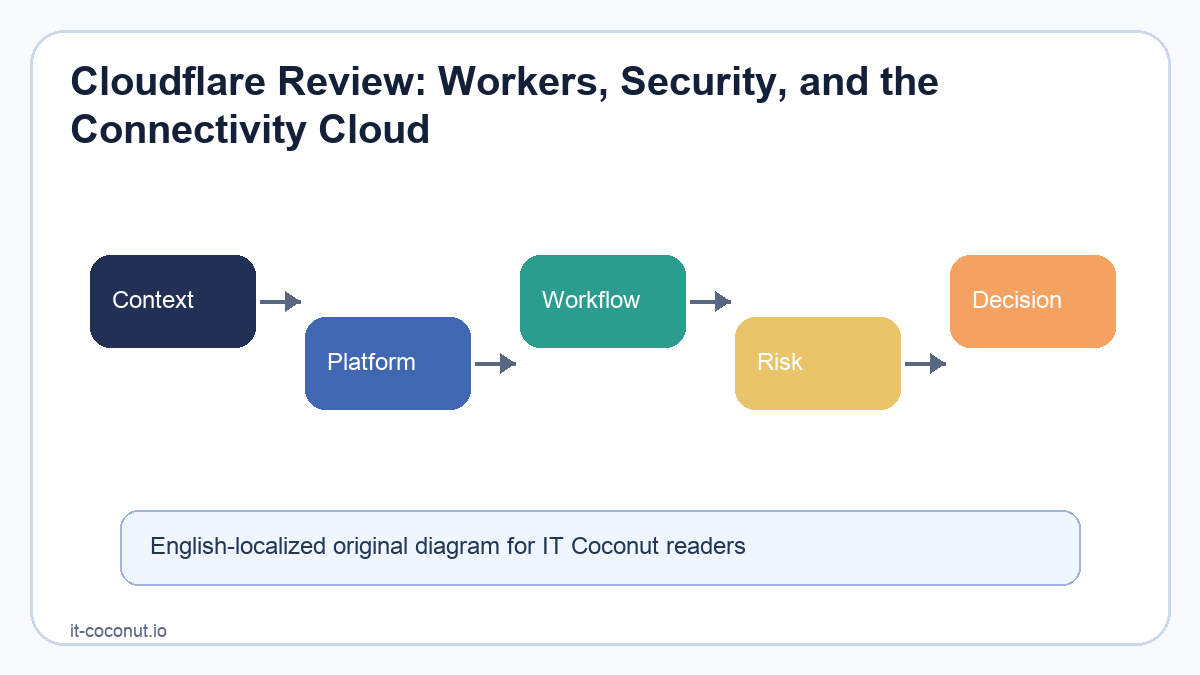
A Cloudflare business and technology map connecting customers, global network, security services, Workers, AI Gateway, and revenue signals

<Cloudflare connectivity-cloud map 1.1>

How Cloudflare makes money

Key details at a glance

Reader question Practical takeaway
What this article explains Cloudflare Review: Workers, Security, and the Connectivity Cloud
Core SEO focus Cloudflare connectivity cloud, Cloudflare Workers AI, AI Gateway
How to read it Separate the durable signal from vendor messaging, short-term hype, and implementation friction.

Cloudflare's revenue model blends subscription software and usage-based services. Security teams may buy DDoS defense, WAF, Zero Trust, and SASE capabilities. Developers may use Workers, R2, D1, KV, Queues, and related services. AI teams can add Gateway and observability for model calls. The company does not break out every product line in detail, so the better read is strategic rather than exact by segment.

The strength is land-and-expand. A customer can enter through security, networking, or developer tooling, then add more products because they run on the same edge network. That is also the risk: the platform must keep proving that one broad control plane is simpler, cheaper, and safer than specialized alternatives.

The AI angle

Workers and AI Gateway give Cloudflare a role in how developers deploy and govern AI workloads close to users. Cloudflare Containers pushes the story further by letting more stateful or specialized workloads run near the edge.

The company also faces operational and ethical questions as it adopts an AI-first operating model internally. Growth, margin pressure, workforce changes, and competitive intensity all deserve scrutiny. The investment takeaway is neutral: Cloudflare is a compelling infrastructure company if the connectivity-cloud thesis works, but the strategy requires disciplined execution across security, developer platforms, and AI networking at once.

What investors should separate

The useful way to read Cloudflare is to separate three layers: traffic growth on the global network, product expansion into Workers and security, and the financial discipline needed to turn developer adoption into durable cash flow. A strong edge platform can still disappoint if usage grows in low-margin patterns or if enterprise sales cycles stretch longer than expected.

Operational caveat

Cloudflare's advantage is strongest when customers want performance, security, and application logic close to users. It is weaker when a workload depends heavily on a single hyperscaler database, specialized GPU infrastructure, or private enterprise systems that cannot easily move to an edge runtime. That is why Workers should be viewed as an expansion layer, not a complete replacement for every cloud architecture.

Practical takeaway

For builders, the signal is that edge platforms are becoming programmable application environments. For investors, the question is whether that programming layer increases customer retention and average spend without forcing Cloudflare into the cost structure of a traditional infrastructure provider.

Related reading

For broader context, read AI coding agents.

A second useful reference is vibe coding.

Readers following the infrastructure side may also want Claude 4 agentic coding.

References

Cloudflare Containers: Why Edge Containers Matter for Developers

Cloudflare Containers matter because they blur a line developers have lived with for years. Workers made lightweight code easy to run close to users, but not every useful service fits neatly into a serverless function. Containers are the familiar answer for heavier runtimes, background services, and custom dependencies. Cloudflare’s public beta brings those two worlds closer together.

In its Containers public beta announcement, Cloudflare describes a model where Workers can create and route to container instances. The developer-facing idea is straightforward: keep the global programmability of Workers, but add a place for workloads that need a container.

A diagram showing a user request entering Cloudflare Workers, reaching a container instance, using state or volumes, and returning a response

<Workers routing requests to containerized workloads 1.1>

Why edge containers are appearing now

The web stack has been moving in two directions at once. On one side, developers want global low-latency platforms that hide infrastructure. On the other side, modern software often needs custom runtimes, native packages, AI services, queues, media processing, or stateful components that do not fit a tiny request handler.

That tension explains the interest in edge containers. A container is not new, and neither is edge computing. The useful change is the combination: route requests globally, keep simple code at the edge, and call into a container only when the workload needs it.

For teams already thinking about agentic AI, this matters because AI-enabled applications often need more than a single stateless endpoint. They may need orchestration, file processing, custom binaries, model-adjacent services, or long-running work. A Workers container runtime gives those applications another deployment shape.

How Workers and containers fit together

Cloudflare’s Containers documentation describes Containers as a way to run containerized applications that can be controlled from Workers. The Worker remains the programmable entry point. The container becomes the heavier execution environment behind it.

A simplified request path looks like this:

Layer Role
User request Arrives at Cloudflare’s network near the user.
Worker Handles routing, logic, authentication, and service coordination.
Container instance Runs code that needs a full container environment.
State or storage Supports workloads that cannot be purely stateless.
Response Returns through the same programmable edge path.

This is programmable compute rather than a replacement for every server. The value is not simply “containers at the edge.” It is the ability to decide, in code, when a request should stay inside a lightweight Worker and when it should reach a containerized service.

The relationship with Workers is important. Workers are still the front door. Containers extend what can happen behind that front door.

What developers can use it for

The most natural use cases are services that need both global routing and a more flexible runtime. Examples include image or document processing, specialized API backends, AI-adjacent utility services, automation workers, developer tooling endpoints, and applications with dependencies that are awkward to package as a small function.

It may also change how teams design prototypes. Instead of choosing between a serverless edge function and a full cloud service from the start, a developer can keep the request path close to users while moving heavier logic into a container when needed.

There is a connection with agentic engineering as well. Developer platforms are increasingly expected to provide controlled execution spaces, clear routing, and observable results. Cloudflare Containers approach the same infrastructure problem from the application-runtime side.

Limits and operational questions

The first question is state. Containers make heavier workloads possible, but stateful systems still require careful design. Developers need to understand how instances are created, how long they live, where data is stored, and what happens during failure.

The second question is cost. A Workers container runtime may simplify architecture, but containerized workloads can be more expensive than lightweight request handlers. Teams should benchmark real traffic rather than assume the edge location automatically makes everything cheaper.

The third question is portability. Containers are a familiar packaging format, but the surrounding routing, lifecycle, and platform APIs are still vendor-specific. If a service depends deeply on Cloudflare’s control model, moving it elsewhere may require more than shipping the same image.

The practical conclusion is that Cloudflare Containers are best understood as a new middle layer: more capable than a small edge function, more globally programmable than a traditional server, and still subject to the same engineering questions about state, cost, reliability, and lock-in. For developers building globally distributed software, edge containers deserve attention because they make the deployment menu more flexible.

Key sources

404 Dev Room 30 - Taming

Series · 404 Dev Room Webtoon · Ongoing Episode 30 · 404 Dev Room 30 - Taming The trainer in the AI coding room has changed. <...