Showing posts with label Korean startup grant. Show all posts

Sunday, August 2, 2026

KICXUP Challenge: Korea PoC grant for AI, data and security startups

The KICXUP Challenge grant is worth a close look if your startup can test technology with Korean industrial-complex companies, rather than only attend a showcase. The 2026 KICXUP Challenge & Local program is run through K-Startup by the Korea Industrial Complex Corporation with Korea Credit Guarantee Fund support. According to the official notice, applications close at 17:00 Korea time on August 12, 2026.
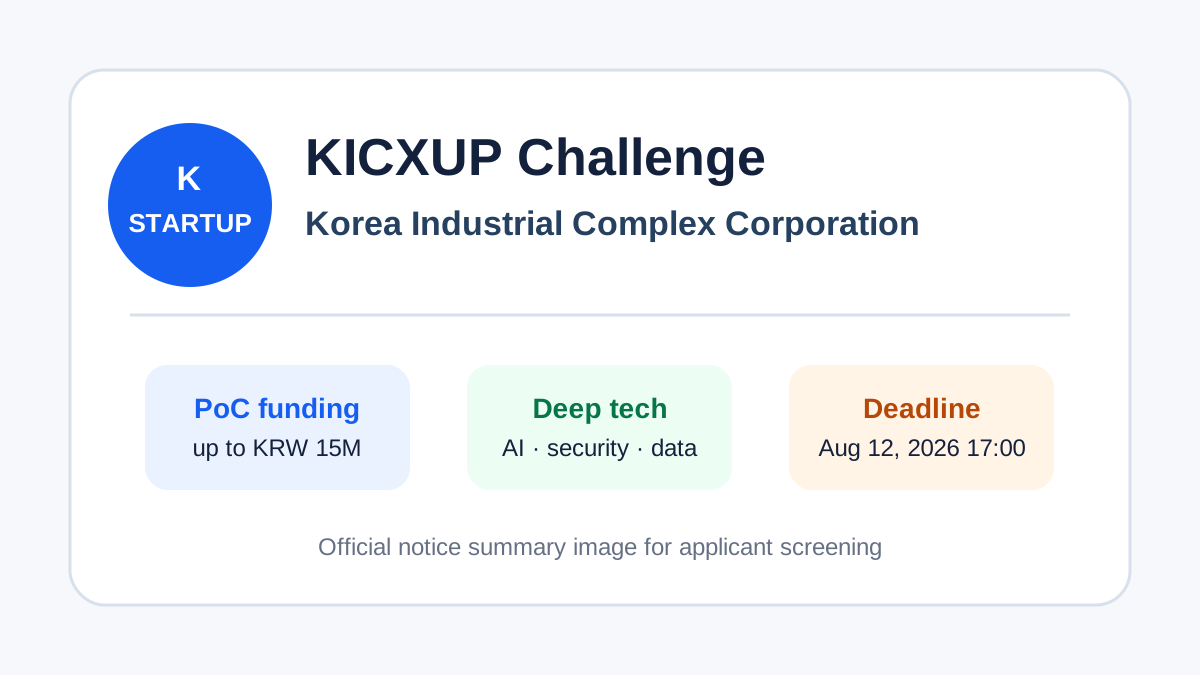
K-Startup and Korea Industrial Complex Corporation KICXUP program identification image

<KICXUP program identification image 1.1>

What the program offers

Item Details
Program 2026 KICXUP Challenge & Local startup recruitment
Lead organization Korea Industrial Complex Corporation, with Korea Credit Guarantee Fund support
Application window July 31, 2026, 09:00 to August 12, 2026, 17:00 KST
Application route Online form linked from the official K-Startup notice
Main support PoC funding up to KRW 15 million per case, corporate matching, investment and TIPS linkage, financial and non-financial support
Contact kicxup@cntt.co.kr, +82-2-3152-8657

For international readers, K-Startup is Korea’s central government startup-support portal. Programs listed there are usually written for companies that can operate in the Korean market or collaborate with Korean institutions. This Korea industrial PoC grant is especially relevant because it connects startups with industrial demand companies and gives selected teams a structured route to prove a B2B use case. The official notice is available on the K-Startup detail page.

Who should consider applying

The notice says the program is open to domestic and overseas startups seeking technology collaboration with industrial-complex demand companies. The standard eligibility window is companies up to seven years old and prospective founders; universities and research institutions are also included. For Korean deep tech PoC fields, startups up to ten years old may be eligible. The listed deep-tech areas include AI and big data, cybersecurity and networks, semiconductors, bio-health, future mobility, energy, robotics, aerospace and quantum technologies.

That makes the Korean startup grant most useful for teams with a concrete industrial workflow to validate:

  • AI or data platforms that reduce cost, downtime or defects in manufacturing, logistics or energy operations
  • predictive maintenance, visual inspection, safety monitoring or process-automation products
  • industrial cybersecurity, OT security or network-monitoring products
  • B2B SaaS companies that already have a pilot-ready product but need a Korean reference customer and a PoC budget

A consumer app or a broad productivity tool may struggle unless the team can explain a specific industrial-complex use case. Before applying, write one plain sentence describing the customer problem, the deployment site, the PoC metric and the expected business outcome.

Selection flow and documents

The KICXUP Challenge track plans a first document screening of 140 companies and a second presentation round selecting around 70 companies. The Local track is smaller: eight consortia in the first round and four in the final round. The presentation format is short, with seven minutes for the pitch and three minutes for Q&A, so the strongest deck will not be the one with the most technology slides. It should show the demand company’s problem, the implementation plan, the data or environment required, measurable success criteria and what happens after the PoC.

Required documents include the application form, personal-information consent, a business plan or company introduction, and, for the Local track, a collaboration commitment or MOU. Applicants should also check ordinary exclusion risks such as tax arrears, financial default, prior sanctions for false documentation and restricted industries.

Why this was selected over the KOCCA candidate

A relevant KOCCA-listed candidate was the 2026 Game Development AI Transformation support program posted by Busan IT Industry Promotion Agency. It supports AI maturity diagnosis, consulting, education, expert matching and AI platform usage for small and indie game developers. That is a strong fit for game studios, and the official KOCCA notice is useful for that niche. For a broader English-speaking audience tracking KICXUP AI startup opportunities, however, KICXUP is more broadly applicable: it covers AI, data, cybersecurity and other deep-tech fields, and it links the Korea PoC grant to corporate collaboration and follow-on financing routes.

Practical takeaways

Treat KICXUP as a customer-validation program, not just a subsidy. The PoC funding matters, but the bigger value is a structured industrial collaboration that can become a reference case in Korea. If your team has an AI, data, security or platform product that can be tested with a Korean industrial partner, check the official K-Startup program notice, confirm the online form and supporting documents, and finish the submission before the August 12 deadline rather than waiting until the final hour.


Monday, July 27, 2026

Gwanak S Valley at KES 2026: checklist for AX and robotics startups

Gwanak S Valley at KES 2026: checklist for AX and robotics startups

The KES 2026 startup booth opportunity through the Gwanak S Valley booth program at Korea Electronics Show 2026 is a local market-access opportunity for startups based in Seoul’s Gwanak district. The official K-Startup program notice names AX, robotics, mobility, digital health, XR, spatial computing, and electronic components as relevant fields.

Applications close on August 7, 2026 at 14:00 Korea time. The application route is the Gwanak startup support notice.

Quick eligibility view

Item What applicants need to check
Applicant base A company located in Gwanak with a product or solution suitable for KES
Business age The K-Startup listing indicates companies up to the under-ten-year range
Event October 13–16, 2026, COEX Halls A and B in Seoul
Support Booth, display fixtures, buyer and investor meetings, and related event participation
Restriction No duplicate support for the same KES participation from another public program

Startup team reviewing trade show application papers and a small booth model

<Trade show preparation 1.1>

The Korean-location rule is important

This Korean startup grant is not open to every overseas or Korea-interested company. It is aimed at companies with a Gwanak presence, such as a headquarters, main business site, lab, or branch. For an AI startup Korea team, that location condition should be checked before spending time on the application package.

What the program actually provides

The support includes a promotional booth worth about KRW 5 million, booth fixtures such as an information desk and graphic wall, buyer and investor meetings, and access to side programs including innovation awards and purchasing or VC consultations. For a startup, the practical value depends on whether the team can demonstrate a stable product and turn booth traffic into follow-up meetings.

Founders preparing an AI product demo schedule in a bright startup office

<Demo schedule planning 2.1>

Before applying

  1. Prepare the application form, privacy consent, business registration copy, and Korean IR deck.
  2. Make sure the IR deck contains slides for each evaluation item, as the notice requires at least one slide per criterion.
  3. Check whether the company is already receiving another public subsidy for the same KES participation.
  4. Define a three-minute demo flow and a post-event sales or investment follow-up target.

This K-Startup program is best for a Gwanak-based AX, robotics, XR, or digital health company that can show a product on the exhibition floor, not just describe a roadmap.

Daegu AX PoC grant: startup checklist before August 7

Daegu Open Innovation AX PoC: what startup teams should check before August 7

Daegu startup PoC teams should read this carefully. This Daegu AX grant is useful for founders comparing Korea PoC funding options and preparing a lead company commitment. Daegu’s open innovation AX program is a focused Korean startup grant and a practical K-Startup program for companies that already have a practical collaboration path with a larger corporate or public-sector partner. The official K-Startup program notice is not a broad idea contest; it is designed for startups ready to run a proof of concept with a lead company.

Applications close on August 7, 2026 at 16:00 Korea time. The application route is the Daegu startup portal.

Eligibility in plain English

Item What applicants need to check
Applicant type A startup with prior collaboration discussions completed with a lead company
Company age Up to seven years old, or up to ten years for new-industry fields
Location Headquartered in Daegu, or able to move headquarters to Daegu within two months after agreement
Selection scale About two companies
Support KRW 15 million PoC funding per company, consulting, networking, and follow-on support

Startup founders reviewing application papers and a trade support checklist at a desk

<Application preparation 1.1>

The partner commitment matters most

For an AI startup Korea team, the strongest fit is a company that can name the operational problem, the partner site, and the measurable result. The program requires a lead-company participation commitment, so the business plan should not read like a generic AI pitch. It should explain how the PoC will work in a real workflow, whether the technology is generative AI, data analytics, cloud automation, or security operations.

What the funding can realistically cover

The program offers KRW 15 million per selected company. That is helpful, but it is not enough for an unfocused enterprise transformation project. Treat the grant as a way to fund a tightly scoped proof: data access, integration work, field testing, and a result metric that can support follow-on sales or investment conversations.

AI startup team discussing a cloud proof of concept in a bright Seoul office

<PoC scope planning 2.1>

Pre-application checklist

  1. Make sure the partner commitment letter matches the company name, contact person, and PoC topic in the business plan.
  2. If the company is not already based in Daegu, calculate the legal and operational impact of relocating headquarters within two months.
  3. Prepare tax certificates, financial statements, and employee-insurance documents early because they can slow down the application.
  4. Keep the PoC narrow enough to finish with KRW 15 million, and treat investment or follow-on projects as separate outcomes.

This K-Startup program is best for a startup that already has a potential customer or industrial partner and needs public support to turn that relationship into a measured pilot.

Sunday, July 26, 2026

CEATEC 2026 Support for Korean Digital and AI Startups

The CEATEC 2026 support notice targets Korean digital ICT AI companies preparing for the Japanese market. It plans to select around eight companies and support their participation in CEATEC 2026 in Chiba, Japan. The application window runs from July 23, 2026 to August 4, 2026 at 18:00 Korea time.

The operator is the Global Digital Innovation Network, so applicants should treat this as GDN CEATEC support rather than a generic travel subsidy. The official K-Startup program notice lists booth, travel, workshop, business matching, and possible interpretation support. Applications are submitted through the GDN event page, and event context is available on the CEATEC official site.

Program snapshot: exhibition support plus Japan-market access

Item Summary
Program CEATEC 2026 exhibition support for participating companies
Application window July 23, 2026 ~ August 4, 2026 18:00 KST
Event dates October 13 ~ 16, 2026
Venue Makuhari Messe, Chiba, Japan
Scale Around 8 digital, ICT, or AI companies
Support Booth rental and setup, round-trip airfare, workshop, 1:1 business matching, interpretation if needed

For global readers, this is a Korea-based support program. It is most relevant to companies incorporated in Korea that already have a commercial product and some Japan-market readiness signal.

Eligibility: Japan-ready digital and AI companies

Applicants need a commercial product or service using digital, ICT, or AI convergence technology and must be able to demonstrate it. They also need at least one Japan market readiness signal, such as prior export or sales to Japanese partners, an MOU or NDA, local intellectual property, a Japanese subsidiary or branch, investment from a Japanese VC or institution, or previous participation in a Japanese exhibition. At least one founder or co-founder must be able to participate onsite during the exhibition.

For an AI startup Korea team, the application should explain why CEATEC is the right market-development channel. A model demo alone is not enough; evaluators need to see buyer context, deployment conditions, security or data-handling readiness, and a credible follow-up plan.

CEATEC 2026 preparation — a photorealistic editorial scene of a Korean digital and AI startup team checking booth materials and demo devices

<CEATEC 2026 exhibition preparation scene 2.1>

Evaluation: show evidence, not only ambition

The selection process uses a first quantitative eligibility screen and a second qualitative document review. Missing a required criterion can end the application at the first stage. The second stage relies on external evaluators and ranks applicants based on submitted materials.

Strong applications should connect the exhibition booth to a concrete pipeline: target Japanese customer segments, partner meetings, demo scenarios, pricing or procurement readiness, and post-event follow-up. The notice names GDN Business Team 1 as the contact point at ict@gdinfoundation.com, with phone contacts 031-8039-6756 and 031-8039-6754.

Japan market readiness workshop — a photorealistic editorial scene of a Korean AI team reviewing Japan-market materials and follow-up plans

<Japan market readiness workshop scene 3.1>

Final checklist before applying

  • Confirm whether both the event-page submission and the additional Google Form are required under the notice.
  • Prepare evidence for at least one Japan-readiness condition: partner agreement, local IP, subsidiary, investment, sales, or past exhibition record.
  • Make sure a founder or co-founder can attend CEATEC from October 13 to 16, 2026.
  • Check that the company has not already received overlapping support for the same exhibition from another public program.
  • Prepare an English or Japanese demo kit and a post-event B2B follow-up calendar.

This Korean startup grant is best for teams that can turn a booth into customer discovery, partner validation, or concrete sales conversations in Japan.

Related reading

Daegu Open Innovation PoC Grant: What AI Startups Need to Know

The Daegu PoC grant under Daegu Open Innovation is a Korea-focused support program for startups that already have a concrete collaboration topic with a lead corporate or public-sector partner. According to the K-Startup notice, applications are open from July 21, 2026 at 09:00 to August 7, 2026 at 16:00 Korea time.

This is not a broad idea competition. The notice asks applicants to bring a pre-discussed PoC project and a partner commitment letter. The K-Startup program notice lists support for about two companies, with KRW 15 million in PoC funding per company. Applications are submitted through the Daegu Startup Hub project page, and the operator is the Daegu Center for Creative Economy and Innovation.

Program snapshot: PoC funding tied to a lead partner

Item Summary
Program 2026 Daegu Startup Open Innovation bottom-up PoC program
Application window July 21, 2026 09:00 ~ August 7, 2026 16:00 KST
Scale Around 2 startups
Support KRW 15 million PoC budget, consulting, networking, follow-on links
Application Online submission via Daegu Startup Hub
Contact AX Innovation Team, 053-759-6397, c-lab@ccei.kr

For international readers, this is a Korean startup grant with local operating conditions. A company must either be based in Daegu or commit to moving its headquarters to Daegu within two months after the agreement.

Eligibility: Daegu location plus a real collaboration project

Applicants must satisfy three core conditions. First, the startup must have completed prior collaboration discussions with a lead company, mid-sized firm, SME, public company, or similar partner. Second, it must generally be within seven years of founding; startups in designated new-industry fields can be within ten years. Third, the company must be headquartered in Daegu or be able to relocate its headquarters there within two months after signing the program agreement.

For an AI startup Korea team, the strongest angle is not “we use AI” but “this partner can validate our model or platform in a real workflow.” Data platforms, SaaS tools, security products, and applied AI systems should describe the partner site, available data or environment, success metric, and expected business outcome.

Daegu Open Innovation PoC meeting — a photorealistic editorial scene of a startup team and lead partner reviewing field-validation plans

<Daegu Open Innovation PoC planning scene 2.1>

Application strategy: the partner letter is the core asset

Required documents include the application form and business plan, personal information consent form, lead partner commitment letter, business registration certificate, national and local tax clearance certificates, 2025 financial statement certificate, and employee insurance list. Corporate applicants may need a recent corporate registry extract, and companies relocating to Daegu need a headquarters relocation commitment.

The process moves through eligibility screening, document review, presentation review, and an agreement expected around August. This bottom-up PoC program rewards applicants that can show project validity, technical capability, feasibility, and willingness to collaborate. A thin partner letter is risky; the application should show what the partner will provide, what will be tested, who owns each step, and what evidence will be produced by the end of the PoC.

Daegu PoC execution readiness — a photorealistic editorial scene of a founder and operations manager discussing a prototype test plan

<PoC field-validation readiness scene 3.1>

Final checklist before applying

  • Confirm that the partner can sign the commitment letter and support the proposed test environment.
  • Check whether the headquarters requirement is already satisfied or whether relocation to Daegu is realistic.
  • Tie the KRW 15 million budget to a specific PoC plan, not to general product development.
  • Review tax, closure, debt-default, and participation-restriction conditions before submission.
  • Prepare for a fast start, because the agreement is expected in August and the program is built around execution.

This K-Startup program is best suited to teams that have moved beyond sales exploration and can turn a partner conversation into a measurable field test.

Related reading

404 Dev Room 30 - Taming

Series · 404 Dev Room Webtoon · Ongoing Episode 30 · 404 Dev Room 30 - Taming The trainer in the AI coding room has changed. <...