Showing posts with label AI startup Korea. Show all posts

Sunday, August 2, 2026

KICXUP Challenge: Korea PoC grant for AI, data and security startups

The KICXUP Challenge grant is worth a close look if your startup can test technology with Korean industrial-complex companies, rather than only attend a showcase. The 2026 KICXUP Challenge & Local program is run through K-Startup by the Korea Industrial Complex Corporation with Korea Credit Guarantee Fund support. According to the official notice, applications close at 17:00 Korea time on August 12, 2026.
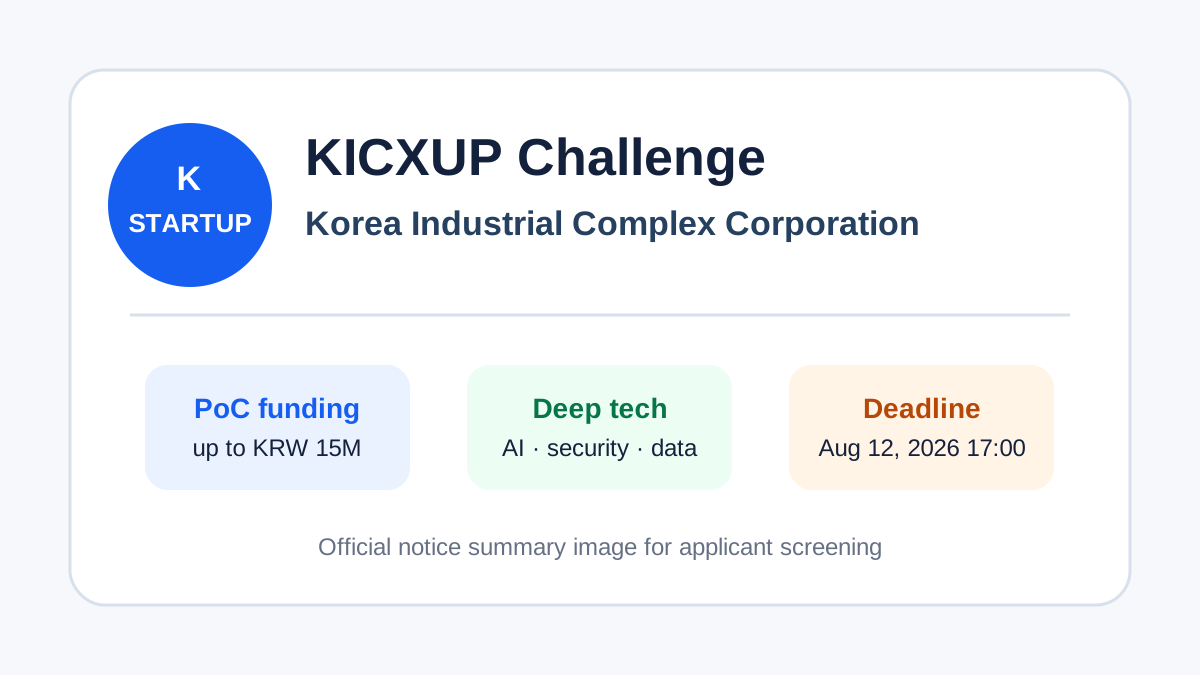
K-Startup and Korea Industrial Complex Corporation KICXUP program identification image

<KICXUP program identification image 1.1>

What the program offers

Item Details
Program 2026 KICXUP Challenge & Local startup recruitment
Lead organization Korea Industrial Complex Corporation, with Korea Credit Guarantee Fund support
Application window July 31, 2026, 09:00 to August 12, 2026, 17:00 KST
Application route Online form linked from the official K-Startup notice
Main support PoC funding up to KRW 15 million per case, corporate matching, investment and TIPS linkage, financial and non-financial support
Contact kicxup@cntt.co.kr, +82-2-3152-8657

For international readers, K-Startup is Korea’s central government startup-support portal. Programs listed there are usually written for companies that can operate in the Korean market or collaborate with Korean institutions. This Korea industrial PoC grant is especially relevant because it connects startups with industrial demand companies and gives selected teams a structured route to prove a B2B use case. The official notice is available on the K-Startup detail page.

Who should consider applying

The notice says the program is open to domestic and overseas startups seeking technology collaboration with industrial-complex demand companies. The standard eligibility window is companies up to seven years old and prospective founders; universities and research institutions are also included. For Korean deep tech PoC fields, startups up to ten years old may be eligible. The listed deep-tech areas include AI and big data, cybersecurity and networks, semiconductors, bio-health, future mobility, energy, robotics, aerospace and quantum technologies.

That makes the Korean startup grant most useful for teams with a concrete industrial workflow to validate:

  • AI or data platforms that reduce cost, downtime or defects in manufacturing, logistics or energy operations
  • predictive maintenance, visual inspection, safety monitoring or process-automation products
  • industrial cybersecurity, OT security or network-monitoring products
  • B2B SaaS companies that already have a pilot-ready product but need a Korean reference customer and a PoC budget

A consumer app or a broad productivity tool may struggle unless the team can explain a specific industrial-complex use case. Before applying, write one plain sentence describing the customer problem, the deployment site, the PoC metric and the expected business outcome.

Selection flow and documents

The KICXUP Challenge track plans a first document screening of 140 companies and a second presentation round selecting around 70 companies. The Local track is smaller: eight consortia in the first round and four in the final round. The presentation format is short, with seven minutes for the pitch and three minutes for Q&A, so the strongest deck will not be the one with the most technology slides. It should show the demand company’s problem, the implementation plan, the data or environment required, measurable success criteria and what happens after the PoC.

Required documents include the application form, personal-information consent, a business plan or company introduction, and, for the Local track, a collaboration commitment or MOU. Applicants should also check ordinary exclusion risks such as tax arrears, financial default, prior sanctions for false documentation and restricted industries.

Why this was selected over the KOCCA candidate

A relevant KOCCA-listed candidate was the 2026 Game Development AI Transformation support program posted by Busan IT Industry Promotion Agency. It supports AI maturity diagnosis, consulting, education, expert matching and AI platform usage for small and indie game developers. That is a strong fit for game studios, and the official KOCCA notice is useful for that niche. For a broader English-speaking audience tracking KICXUP AI startup opportunities, however, KICXUP is more broadly applicable: it covers AI, data, cybersecurity and other deep-tech fields, and it links the Korea PoC grant to corporate collaboration and follow-on financing routes.

Practical takeaways

Treat KICXUP as a customer-validation program, not just a subsidy. The PoC funding matters, but the bigger value is a structured industrial collaboration that can become a reference case in Korea. If your team has an AI, data, security or platform product that can be tested with a Korean industrial partner, check the official K-Startup program notice, confirm the online form and supporting documents, and finish the submission before the August 12 deadline rather than waiting until the final hour.

Friday, July 24, 2026

Seoul AI Hub Residency 2026: What Startup Teams Should Check

The Seoul AI Hub residency notice on K-Startup is aimed at AI startups and founders preparing AI businesses in Korea. The official K-Startup page lists the application window as July 22, 2026 at 09:00 through August 11, 2026 at 23:59 KST, with online submission through Startup Plus.

For readers outside Korea, this is best understood as a Korea-based public startup workspace and scale-up program, not a remote grant. The attached Seoul AI Hub guide says up to 21 companies will be selected. Residents receive office infrastructure for an initial one-year term, with annual extension review up to four years, and access to Seoul AI Hub programs such as AX projects, open innovation, global expansion, demand-side and investor matching, and GPU cloud programs. The official Korean source is the K-Startup notice and the attached recruitment guide; applications are submitted through Startup Plus.

Program snapshot: workspace plus AI ecosystem access

This is not simply a cheap office listing. The value is the combination of workspace, meeting rooms, shared infrastructure, and eligibility to participate in Seoul AI Hub programs. A Korea-based AI company that needs customer introductions, investor access, high-performance computing programs, global-market preparation, or structured startup support may find it more relevant than a pure rent comparison.

Item Official notice summary
Program 2026 second Seoul AI Hub new resident company recruitment
Application period July 22, 2026 09:00 ~ August 11, 2026 23:59 KST
Selection scale Up to 21 companies
Target AI startups and prospective founders with AI technology or service plans
Residency term Basic one year, extendable up to four years through review
Application route Online submission through Startup Plus
Contact 02-2135-6814, gone@seoulaihub.kr

For English-language search, the K-Startup AI hub program is best framed as a Seoul startup workspace for Korea-based AI teams rather than a global remote accelerator.

Applicants must be able to register their address at Seoul AI Hub within 30 days after selection. Prospective founders also need to establish the business and register the address within that window.

Eligibility: AI focus, company age, and address transfer

The recruitment guide gives three main eligibility gates. The applicant must have, or be preparing, AI technology or an AI service. The company should have been established in October 2018 or later, or the applicant should be a prospective founder. The selected team must also be able to transfer its registered address to Seoul AI Hub within 30 days after selection.

A team considering a Korea AI startup office should also check the exclusion list before applying. The guide names tax delinquency, debt-default restrictions, suspended or closed businesses, past removal from Seoul startup facilities, prior Seoul AI Hub withdrawal or graduation history, and some overlapping Seoul public workspace support as risk factors. Some exceptions exist, such as ending or giving up another workspace benefit before the new residency contract, so applicants need to read the official guide carefully.

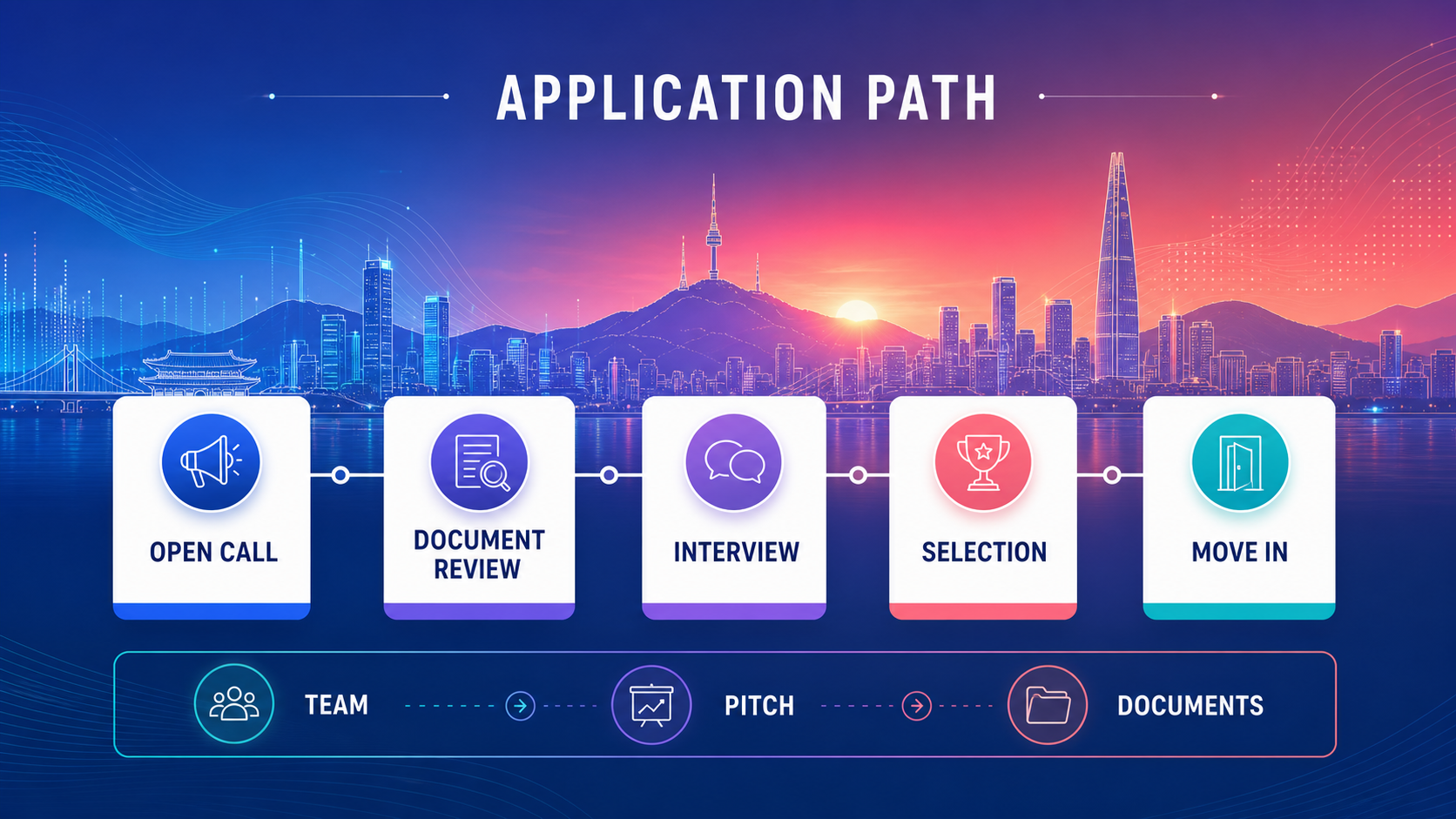
Seoul AI Hub residency timeline — online application, document review, interview, and move-in milestones

<Seoul AI Hub residency timeline 2.1>

Costs and selection: office type, team size, and AI fit

The guide lists 21 available offices across types A through D. The K-Startup page summarizes independent office cost as KRW 6,020 per square meter, VAT excluded. The attached guide breaks that into monthly rent of KRW 4,080 per square meter plus monthly management cost of KRW 1,940 per square meter. Applicants should calculate the preferred office type, resident headcount, six-month prepayment or mid-payment conditions, and VAT before treating the space as inexpensive.

Selection runs through document review and an interview-style presentation. The guide assigns weight to support impact, execution capability, technology, and business potential. A strong application should not stop at model performance. It should connect AI specialization, market size, customer validation, financial stability, and a concrete plan for using Seoul AI Hub's programs.

Seoul startup workspace decision map — eligibility, scale, benefits, and costs for AI teams

<Seoul startup workspace decision map 3.1>

Pre-submission checklist

  • Register and apply through Startup Plus, using the Apply support-program application flow described in the guide.
  • Prepare the resident application and business plan, privacy consent, eligibility confirmation form, and company introduction deck first.
  • Add required documents such as business registration, corporate registry, recent financial statements, social-insurance certificate, and national and local tax certificates where applicable.
  • Confirm whether the company can transfer its registered address and whether the planned resident headcount matches the requested office type.
  • Prepare a short pitch: the guide indicates a five-minute presentation and five-minute Q&A for the interview round.

The best-fit applicant is a Korea-based AI team that can explain why being inside Seoul AI Hub changes its growth trajectory. The application should tie the technology, market, team, and use of hub programs into one practical plan.

Related reading

Thursday, July 23, 2026

Daegu DEEP-BOUND: Korea's Global Deep-Tech Startup Program

Daegu DEEP-BOUND is a Korean deep tech program for companies based in Daegu that want help preparing for overseas markets. The 2026 notice is especially relevant to AI, semiconductor, robotics, mobility, bio-healthcare, and other advanced technology teams that already have a serious product but need sharper global positioning.

This is not a general grant for any international founder. It is a Korea-focused K-Startup program, and the eligibility language points to Daegu-based deep-tech companies or Daegu-based companies commercializing public technology from a research and development special zone. For a qualified AI startup Korea opportunity, the program offers market strategy, English IR support, investor meetings, and overseas proof-of-concept connections rather than a simple cash award.

Fast facts for applicants

Item Details
Program 2026 Daegu Global Deep-Tech Support Program, DEEP-BOUND
Application window July 16, 2026 18:00 to August 10, 2026 15:00 KST
Application method Email submission to yna@ynarcher.com
Who can apply Daegu-based deep-tech companies in five future industries, or Daegu-based companies commercializing public technology from a special R&D zone
Priority Daegu Innopolis research companies and advanced technology companies may receive priority
Selection schedule Document review on Aug. 12, presentation review on Aug. 18, kickoff on Aug. 25, subject to change
Contact 070-4256-4070 / yna@ynarcher.com

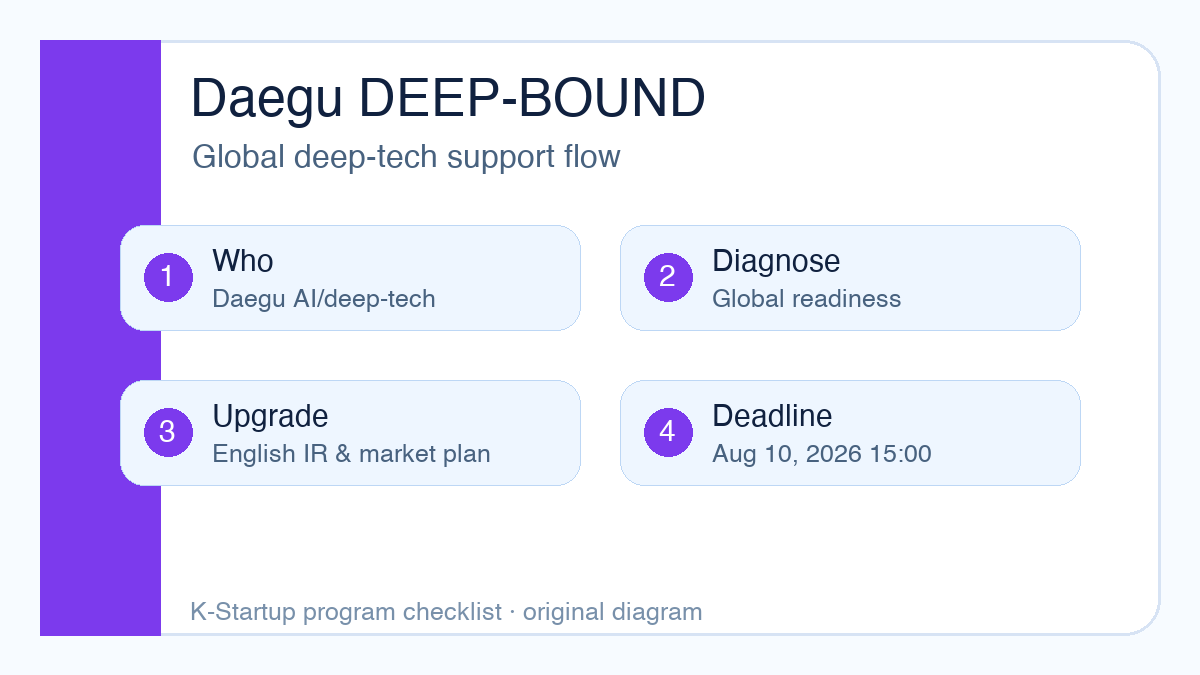
Original diagram summarizing the Daegu DEEP-BOUND program by applicant type, readiness diagnosis, IR upgrade, and deadline

<Daegu DEEP-BOUND support flow 1.1>

The key filter is location and technology fit. If the company is not tied to Daegu or to the public-technology commercialization track described in the notice, this is probably not the right program. If the fit is clear, the deadline gives teams enough time to prepare a focused global expansion narrative.

Who should apply

The strongest applicants are not just “interested in going global.” They can name a target market, describe why the product is difficult to localize alone, and explain what kind of partner, buyer, investor, or pilot site would prove traction. That is especially important for healthcare AI, robotics software, semiconductor tooling, industrial data platforms, and other categories where a foreign buyer needs technical evidence before a sales conversation.

The support package includes global readiness diagnosis, company-specific consulting, national market analysis, global strategy planning, English IR translation and redesign, global IR and investor matching, online demo day participation, overseas PoC demand matching, local institution and buyer meetings, and follow-on support. In plain English, global PoC support is the centerpiece: the program is useful if a startup can define what it wants a foreign customer or partner to test.

This context also matters for English-speaking readers who follow the Korean IT market. Korea's regional startup programs are often tied to local industry clusters, not only national policy themes. Daegu's emphasis on bio-healthcare, robotics, mobility, semiconductors, and AI reflects that cluster-based approach.

Application checklist

  1. Confirm that the company is based in Daegu or fits the public-technology commercialization route stated in the notice.
  2. Map the product to one of the listed future industries, such as AI, semiconductors, robotics and mobility, or bio-healthcare.
  3. Prepare the official application form and keep the file name aligned with the notice.
  4. Attach the business registration certificate, corporate registry documents where applicable, company introduction material if needed, and privacy consent documents.
  5. State the target country, buyer type, pilot hypothesis, required data or equipment, and expected timeline.
  6. After sending the email, keep a record of the submitted files and confirm receipt if possible.

The selection schedule is compact: document review on August 12, presentation review on August 18, and DEEP-BOUND kickoff on August 25. The notice says the presentation review and kickoff are planned offline, so a founder or senior operator should be ready to participate in person.

What to watch before submission

The exclusion list covers gambling-related sectors, tax delinquency, financial account restrictions, false documents, infringement of another party's technology or intellectual property, and companies restricted from government support programs. A public-technology commercialization applicant should also clarify ownership, licensing, and usage rights before presenting the business plan.

For AI startups, avoid describing the product only as a model or demo. A better application explains the overseas workflow: who uses the system, what data is needed, what risk is reduced, what metric will prove success, and which partner can validate it. The same discipline applies to agentic AI products, industrial platforms, and software-heavy hardware companies.

The deadline is August 10, 2026 at 15:00 KST. Email submission sounds simple, but attachment mistakes are common. Check the form, consent document, company evidence, and presentation availability before sending.

References

404 Dev Room 30 - Taming

Series · 404 Dev Room Webtoon · Ongoing Episode 30 · 404 Dev Room 30 - Taming The trainer in the AI coding room has changed. <...