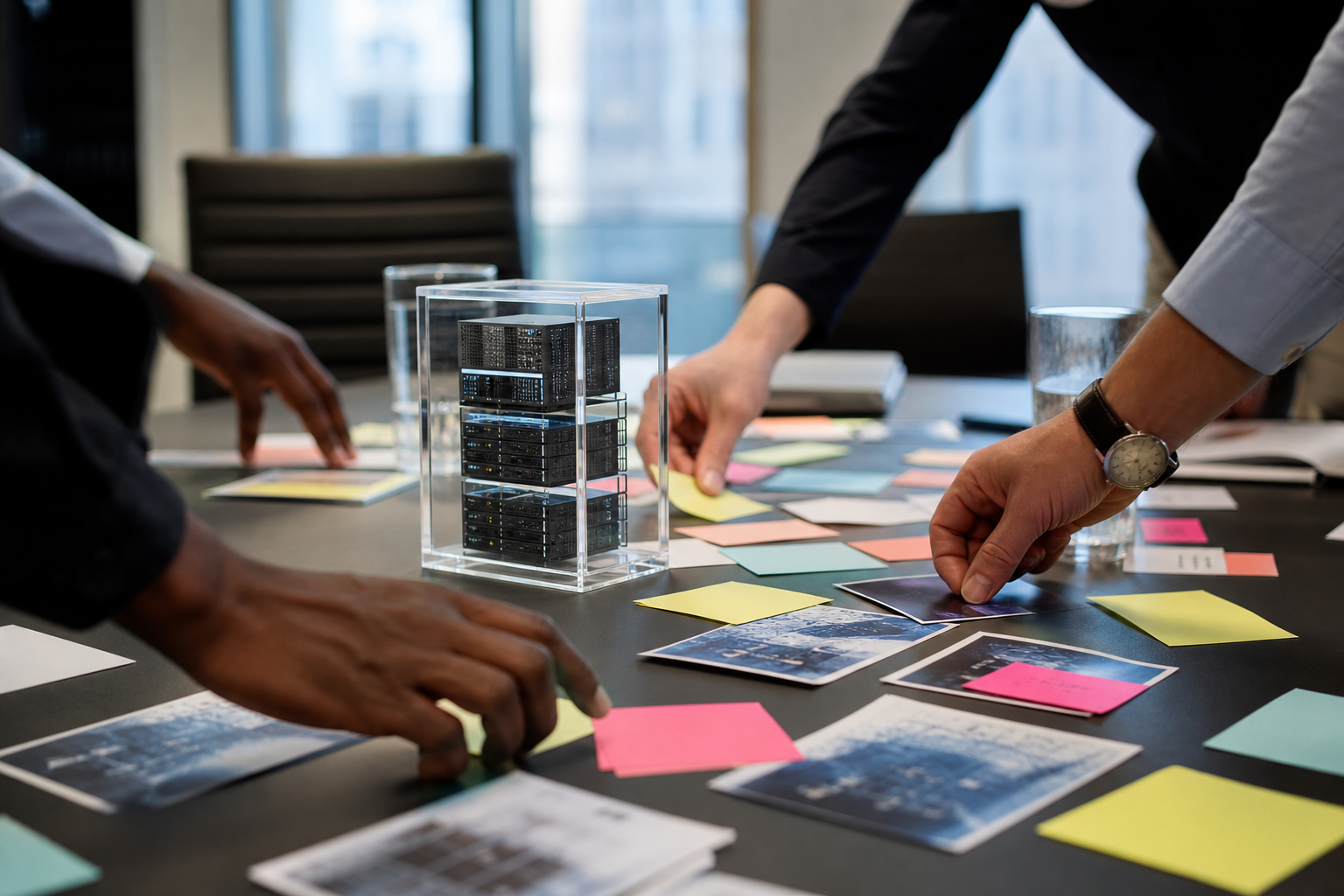
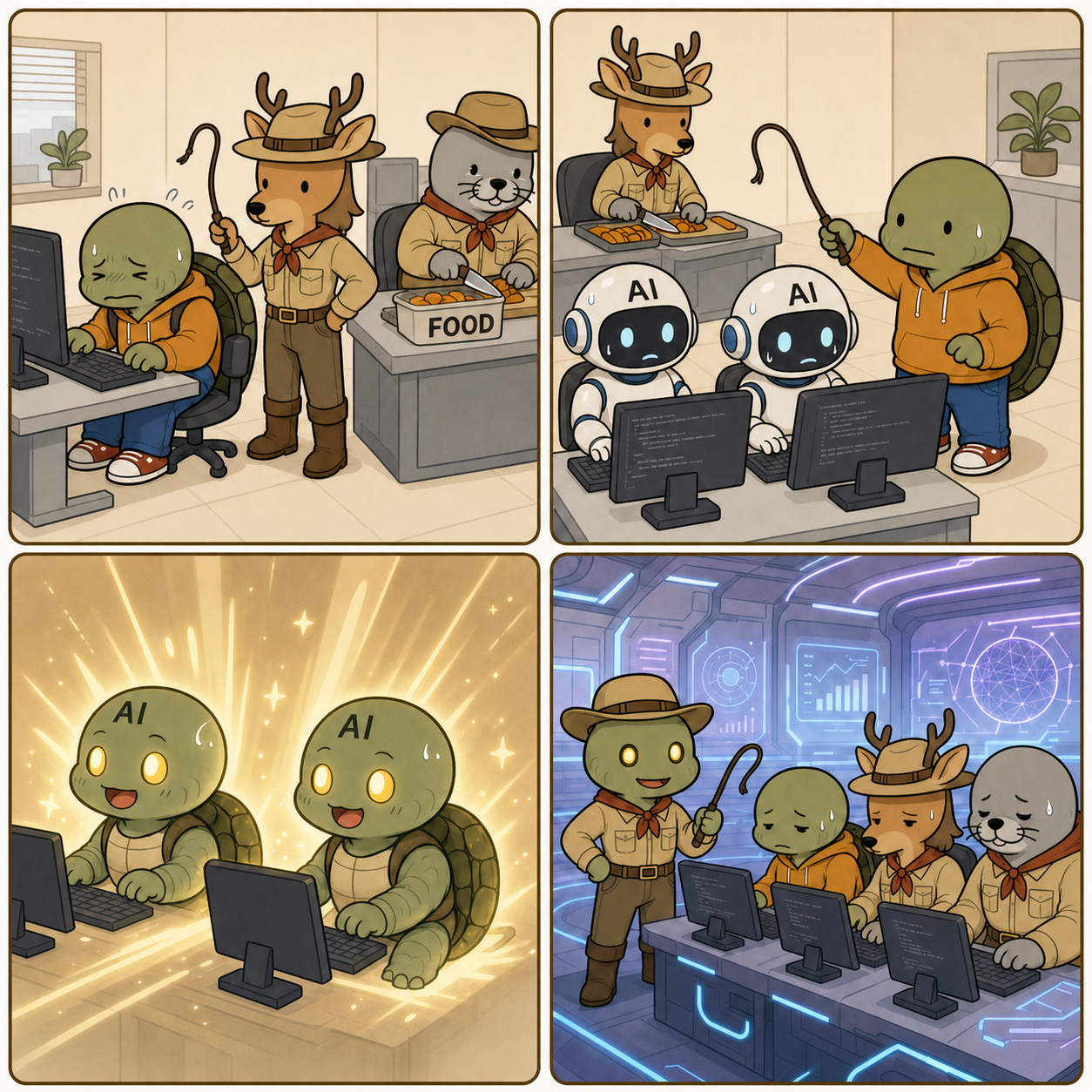
The most important change in Claude automation is not another model score. It is the point where automation begins. In the past, teams first designed which screen a person should open and which button a robot should press, then connected an RPA or API workflow. Now a task can begin with an outcome: “Read these documents, apply the decision criteria, create a report, and share it with the team.”
Anthropic describes Claude Code as an agentic tool that reads codebases, edits files, runs commands, and connects to development tools. Claude Cowork extends the same architecture beyond the terminal into knowledge work, producing formatted documents, organized files, research summaries, spreadsheets, and presentations. This article examines where Claude overlaps with existing automation products and how the work itself may change.
The transition also extends the development shift described in Claude 4 agentic coding and long-running AI workflows into knowledge work.
The role of records, permissions, and audit trails inside enterprise systems becomes clearer when compared with ServiceNow's AI Control Tower and workflow automation.
The same question appears in Microsoft's vertical integration from Azure to Copilot, where identity and work data become part of the platform strategy.
In this article, “threat” does not mean that existing products will disappear immediately. It means that Claude expands the area where unstructured input can be read, a plan can be formed, and several tools can be called, putting pressure on the way automation products are built, priced, and differentiated. The 90% and 95% figures are the author's conditional estimates, not public benchmarks.
Automation is moving from flows to agents
From Claude Code to Claude Cowork
Claude Code is not just a chat window that prints an answer. It is a loop that tries to finish a task: read the code, edit several files, run commands, inspect failures, and choose the next action in the same session. The official Claude Code documentation describes connections to external tools and data through MCP, as well as recurring tasks.
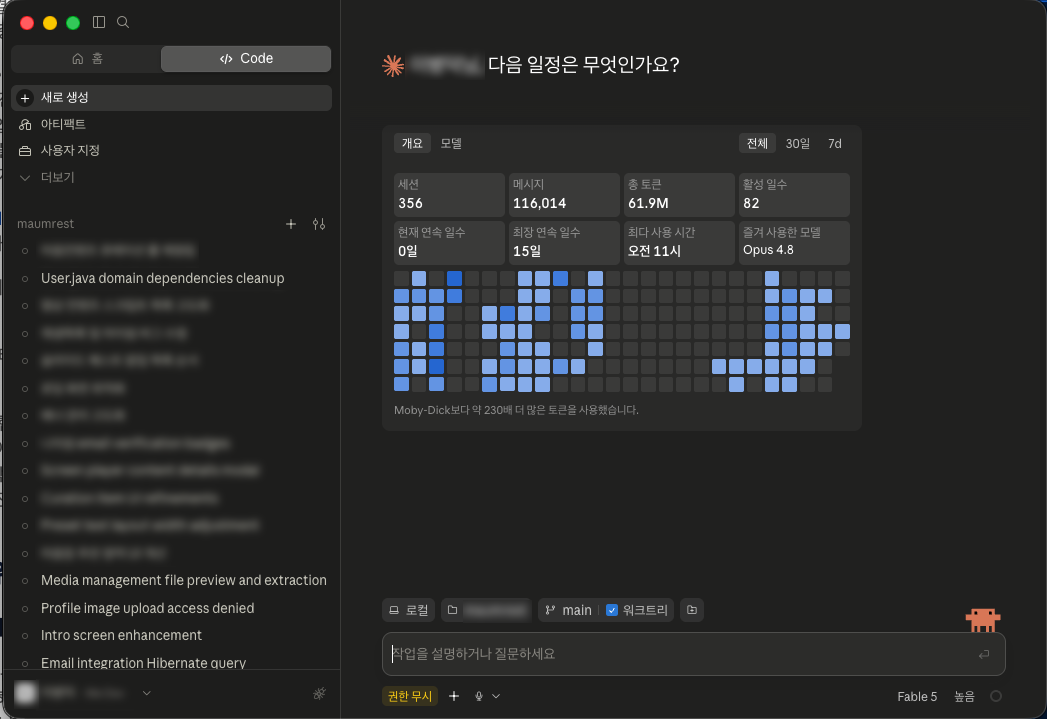
Claude Cowork exposes this structure to non-developers. Instead of learning terminal commands, a user describes the desired outcome. Claude can read files and connectors, carry out multiple steps, and leave behind documents, spreadsheets, or presentations. The Claude Cowork guide describes Cowork as bringing Claude Code's agentic architecture to knowledge work beyond coding, with scheduled tasks and project-level files, instructions, and memory.
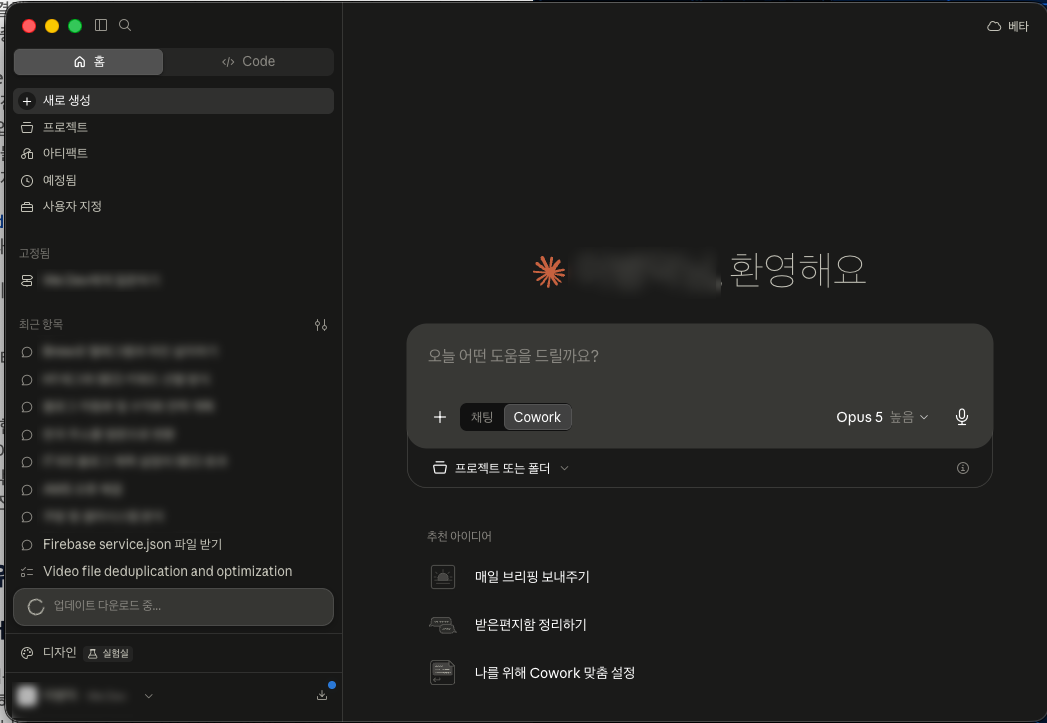
The important shift is that developers are no longer the only people who can create the first version of an automation. Developers still need to design permissions, data structures, exception handling, and deployment. But a subject-matter expert can describe what should be processed, when it should happen, and what approval is required.
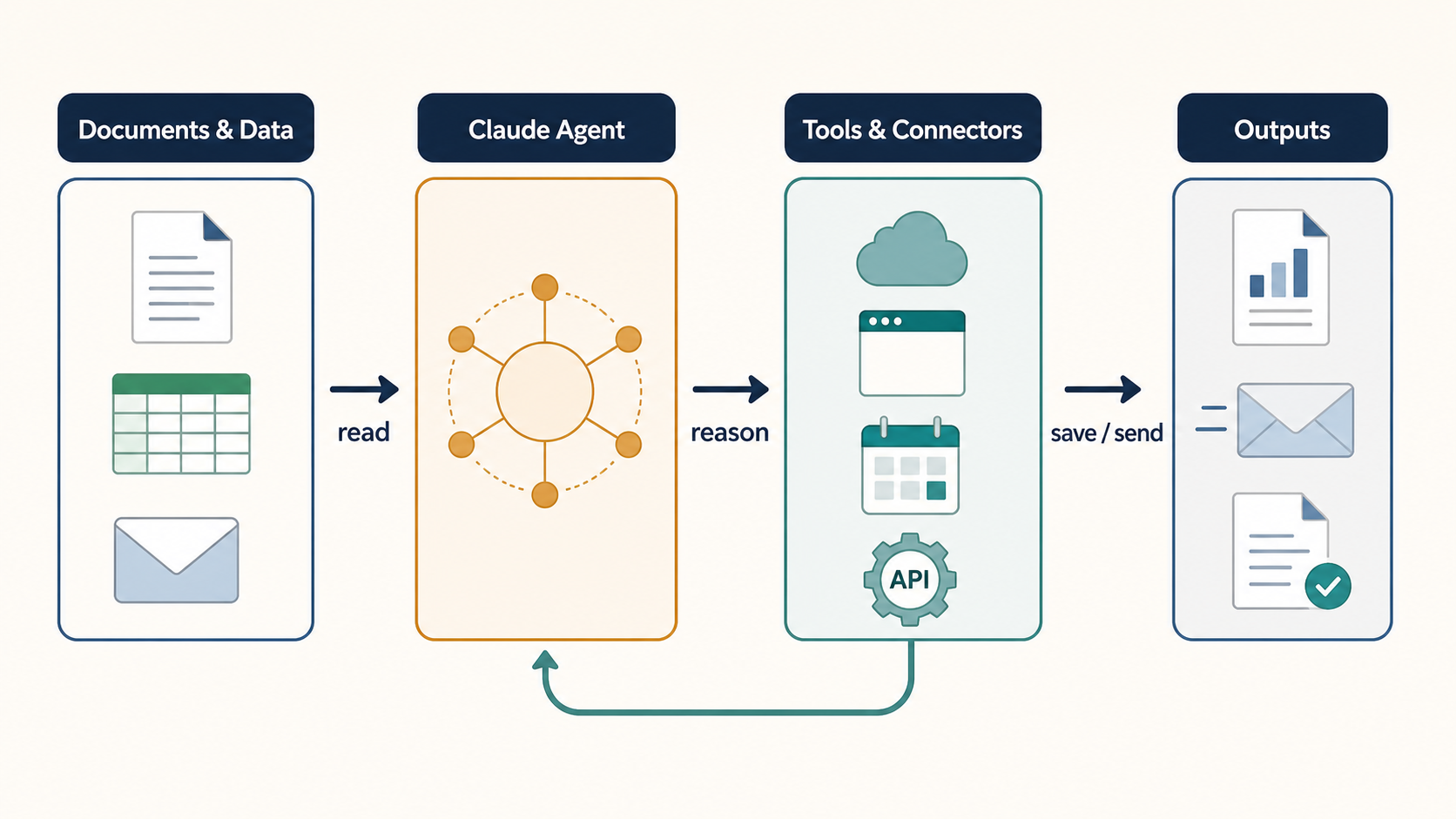
Two directions of tool-calling loops
Automation does not have to flow in only one direction. A document can trigger a tool call, or a tool can provide the first input for a new document.
- A document-first loop: Read PDFs, Word files, spreadsheets, or email; summarize, classify, and organize the content; save a new document in Google Drive, prepare an email draft, or record the result in a business system.
- A tool-first loop: Pull data from a CRM, calendar, Drive, Slack, or an internal API; compare and summarize the results; then create a report, meeting brief, follow-up list, or downstream update.
Anthropic's Google Workspace connector guide describes searching Gmail, Calendar, and Drive, creating documents, and saving generated files to Drive. When no connector exists, computer use in Cowork can navigate a browser or screen directly. It is still a research preview, however, and is slower and more error-prone than a direct connector.
The narrow edge of traditional RPA was the question of exactly where on a computer to read data, which tool to use, and what format to send or save. Screen coordinates, cell locations, filenames, credentials, and exception screens had to be defined in advance. An LLM agent turns part of that problem into contextual reading and planning, but RPA and APIs remain better fits for repetitive work and strict audit requirements.
The automation products Claude puts under pressure
Claude does not replace every existing product. But once a user can describe a goal in natural language, have an agent read an unstructured document, and let it choose the next tool, the overlap with the following product groups grows quickly.
| Area | Overlapping products | Where Claude overlaps | Where existing products remain strong |
|---|---|---|---|
| UI and RPA automation | UiPath Platform, Power Automate Desktop, Automation Anywhere, Blue Prism | Seeing a screen, opening files, and handling long-tail multi-step work | Deterministic execution, unattended operation, permissions, audit, retries, and large robot fleets |
| App connections and iPaaS | Zapier Agents, Make AI Agents, n8n, Workato | Connecting apps and APIs from natural-language goals and choosing tools conditionally | App catalogs, visual flows, run history, retries, and operator monitoring |
| Document processing and IDP | Microsoft AI Builder, UiPath Document Understanding, ABBYY products | Reading, classifying, and extracting from PDFs, Word files, and email | Fixed schemas, field-level confidence, validation queues, bulk processing, and regulated templates |
| CRM and back office | Salesforce Agentforce Operations, ServiceNow AI Agents | Coordinating email, documents, ERP records, and people across a process | Native CRM and ITSM context, permissions, process templates, approval chains, and accountability |
| Enterprise work platforms | Microsoft 365 Copilot and Workflows, Google Workspace and Gemini, Notion products | Summarizing files, producing briefings, searching team knowledge, and creating follow-up work | Tenant security, identity, sharing permissions, and native storage integration |
The first part to feel pressure is simple automation-building services. A small team once had to choose triggers and actions one by one to connect an incoming email, file classification, summarization, notification, and storage. Claude can create the first design from the goal and the data location, which lowers the value of purely mechanical wiring.
Existing automation platforms are not treating Claude only as an enemy. UiPath is moving toward a control plane that coordinates agents, robots, tools, and people. Microsoft describes a complementary pattern in which an agent handles judgment while a workflow provides structure and an audit trail. The next differentiator is therefore less “a robot that clicks buttons” and more a safe operating system for deploying, observing, and governing many agents.
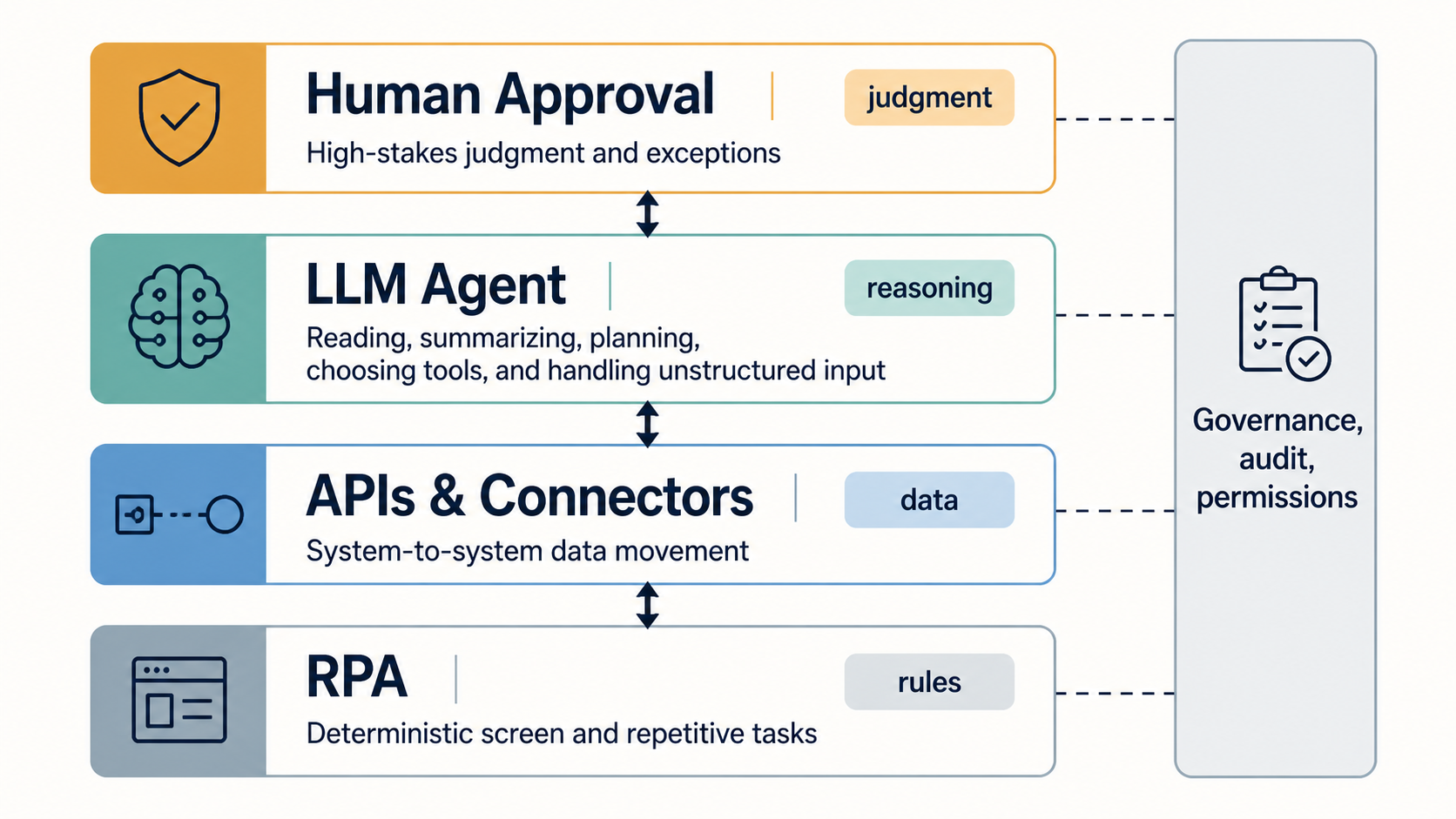
Claude is better understood as a catalyst that widens the top of the automation market than as one RPA automation product competing with every incumbent. RPA can handle defined screen work, APIs can provide stable system-to-system paths, and an LLM agent can interpret unstructured input and plan the next action. The practical architecture combines all three.
The conditions for automating 90% of knowledge work
Cloud storage and file formats become the foundation
The success of agentic work depends at least as much on tools as on the model.
- Google Drive, SharePoint, Dropbox, and similar cloud storage become shared locations for files and permissions.
- Synced folders and desktop connectors reduce manual uploads when an LLM needs access to local files.
- Word, Excel, PowerPoint, PDF, TXT, and Markdown tools and parsers provide the entry point for opening and understanding files. For region-specific formats such as HWP, teams must verify whether the connector or parser actually supports the format.
- APIs, MCP, and shell scripts provide the exit path for sending results to another system or producing a new file.
Claude is not limited to reading files. Its file creation and editing capabilities include creating spreadsheets, presentations, documents, and PDFs. When the model that reads and summarizes a file is connected to the tools that produce and deliver the result, the subject-matter expert can focus on the purpose and approval rules instead of each product's menu.
Marketing plans and structured analysis move first
Consider a marketing plan: gather market material, list competitors, classify customer groups, write campaign hypotheses, draft a schedule and budget, then produce a report and presentation. The human still needs to define what should be investigated and which constraints apply. An agent can handle much of the reading and assembly.
I estimate that the document-writing and deliverable-production portion of a well-defined marketing plan can be about 90% automated. This does not mean that an entire campaign is 90% autonomously executed. People still need to verify current market numbers, competitor facts, budget assumptions, and legally sensitive language.
Analysis, summarization, planning, and production in a fixed format can reach a higher level of automation. If the input documents are sufficient, the output format is stable, and a human approval step exists before writing to an external system, I expect more than 95% of that production work to be automatable. This is a conditional estimate that varies with the organization, documents, and permissions.
Scheduled tasks in Claude Cowork turn recurring work into a product feature: summarize email, Slack, and calendar items each morning, or collect Drive material and create a weekly report. The unit of automation changes from “press this button” to “deliver this outcome every week.”
The next competition is security, governance, and judgment
What changes in government, legal, tax, and real-estate work
Public institutions, law firms, tax and accounting practices, and real-estate consultancies can benefit greatly from LLMs because they handle large volumes of text and high-value information. Their work often involves searching historical records, comparing context, drafting policies or opinions, and reporting in a prescribed format. Microsoft's AI Builder document-processing architecture also assumes a flow that receives documents, extracts information, routes review, and communicates the result while people handle exceptions.
These organizations cannot simply send every document to an external LLM. Personal information, confidential records, legal privilege, and sensitive government data may be involved, and an audit must show who accessed which document and which decision was made. Anthropic's Cowork safety guide distinguishes the risk of read tools from write tools and warns that scheduled tasks, browsers, and connectors can pass data across services, so permissions and human review must match the stakes.
In organizations that solve the security, regulatory, and audit problems, I expect much of the routine work currently performed by staff to become automated. “Ninety-five percent of staff become unnecessary” is not the point. The point is that people can be released from the repetitive work of copying, searching, organizing, and formatting, then spend more time on judgment and design.
The roles of idea-setter and document producer separate
In the past, policy and business-plan owners often spent nights searching old records, organizing ideas into documents, preparing drafts, and writing reports. In the future, finding and comparing historical context and generating multiple directions, prototypes, and report drafts will increasingly be automated.
People will spend more time choosing a better direction, applying real-world constraints, and testing whether the result will work in practice. The valuable skill shifts from making one polished document under pressure to judging many candidates and quickly validating a prototype.
Existing RPA and APIs do not disappear in this model. They become more important because an agent's decision still needs to be reflected safely in a business system through APIs, business rules, approval chains, and audit logs. The market is moving toward combining agent reasoning with the control of existing systems, not toward “one LLM does everything.”
The fact that an agent can read a document and call tools does not mean it should run unsupervised. Malicious instructions inside a document, excessive permissions, stale data, API errors, or hallucinations can lead to an unintended message, deletion, or policy decision. Separate read and write permissions, and keep human approval before external transmission and final reporting in sensitive workflows.
Summary
Claude changes the industrial landscape through more than better answers:
- Claude Code turns developers' file, command, and tool work into an agentic loop.
- Claude Cowork extends that architecture to non-developers working with documents, files, and cloud tools.
- RPA, APIs, document processing, and collaboration products are likely to move toward governed orchestration rather than simply disappear.
- Structured work can reach a high automation rate, but direction, accountability, security, and final approval are not automatically solved.
Companies that move early are redesigning workflows around AI instead of merely adding another tool. What does your company still copy, search, organize, and reformat by hand? If you can define the purpose, data access, and approval boundary, the first useful automation may be closer than it appears.