Showing posts with label MoAI ADK. Show all posts

Monday, July 27, 2026

MoAI ADK and Harness Engineering 2 - A Human-Code-Zero Team

Series · MoAI ADK and Harness Engineering

Article series · Completed

Episode 2 · MoAI ADK and Harness Engineering 2 - A Human-Code-Zero Team

MoAI ADK and Harness Engineering 2 - A Human-Code-Zero Team

Using Claude Code business seats and a MoAI harness, my team reached 100% participation in AI-assisted development and zero manually typed production code. “Human code zero” does not mean zero human work or unreviewed automatic deployment. People define problems, approve designs and judge test evidence and operational risk. Agents produce and revise the code.

The harness in a real project

Modern web, current Spring Boot and Flutter cannot be governed by merely telling a model to understand the repository.

Harness asset Web Spring Boot Flutter
Domain contract User flow and visible state Aggregates, transactions and policies Screen state and offline policy
Interfaces API client and types OpenAPI, errors and events DTOs, serialization and deep links
Quality gates Lint, unit, E2E and build Format, unit, integration and build Analyze, test and build
Deployment contract Environment and static assets Container and DB migrations Signing and store flavors

Project analysis and domain-design documents form the spine. Coding guides, dependency rules, API contracts, CI/CD commands and branch, commit and PR policies attach to them. The model reads that context, creates a SPEC, implements in small increments and runs the validation recipe for each stack.

A team reviewing AI coding output and test evidence

<One hundred percent AI development means people move from code entry to ownership of evidence and risk—not zero human judgment.>

Claude Code seats are tools; team agreements are the operating system

Business seats give every team member access to a common coding agent. Seats alone merely multiply personal prompting styles. Repository-wide SPECs, commands, gates and review language produced repeatability.

Our workflow is:

  1. A person decides the outcome, constraints, acceptance criteria and risk.
  2. The agent reads code maps and domain documents, then proposes implementation and test plans.
  3. A person approves boundaries and data changes.
  4. The agent implements and iterates local verification.
  5. CI repeats the recipe in a clean environment.
  6. A person reviews requirement traceability, test evidence, security and operations—not only the diff.
  7. Deployment observations and incident lessons feed back into the harness.

This matches the role transition in our harness engineering analysis: problem decomposition, contracts, verification and feedback become the bottleneck, not typing speed. A vibe coding workflow that judges only the visible result loses those contracts and traceability.

Work humans must still absorb

AI authorship does not transfer accountability:

  • Analysis: customer problems, legal and security constraints, product priorities.
  • Design: domain boundaries, data ownership, failure isolation and maintenance cost.
  • Review: omissions, overimplementation, privilege escalation, privacy and licenses.
  • Testing: critical journeys, exploratory tests, devices, networks and recovery.
  • Operations: deployment approval, observability, rollback, incident command and communication.

If one AI writes a test and then passes its own test, the independence of the evidence is weak. People must determine whether the test proves the requirement, contains false positives and covers failure paths and nonfunctional conditions. Harness engineering closes the distance between “it compiles” and “the product operates safely.”
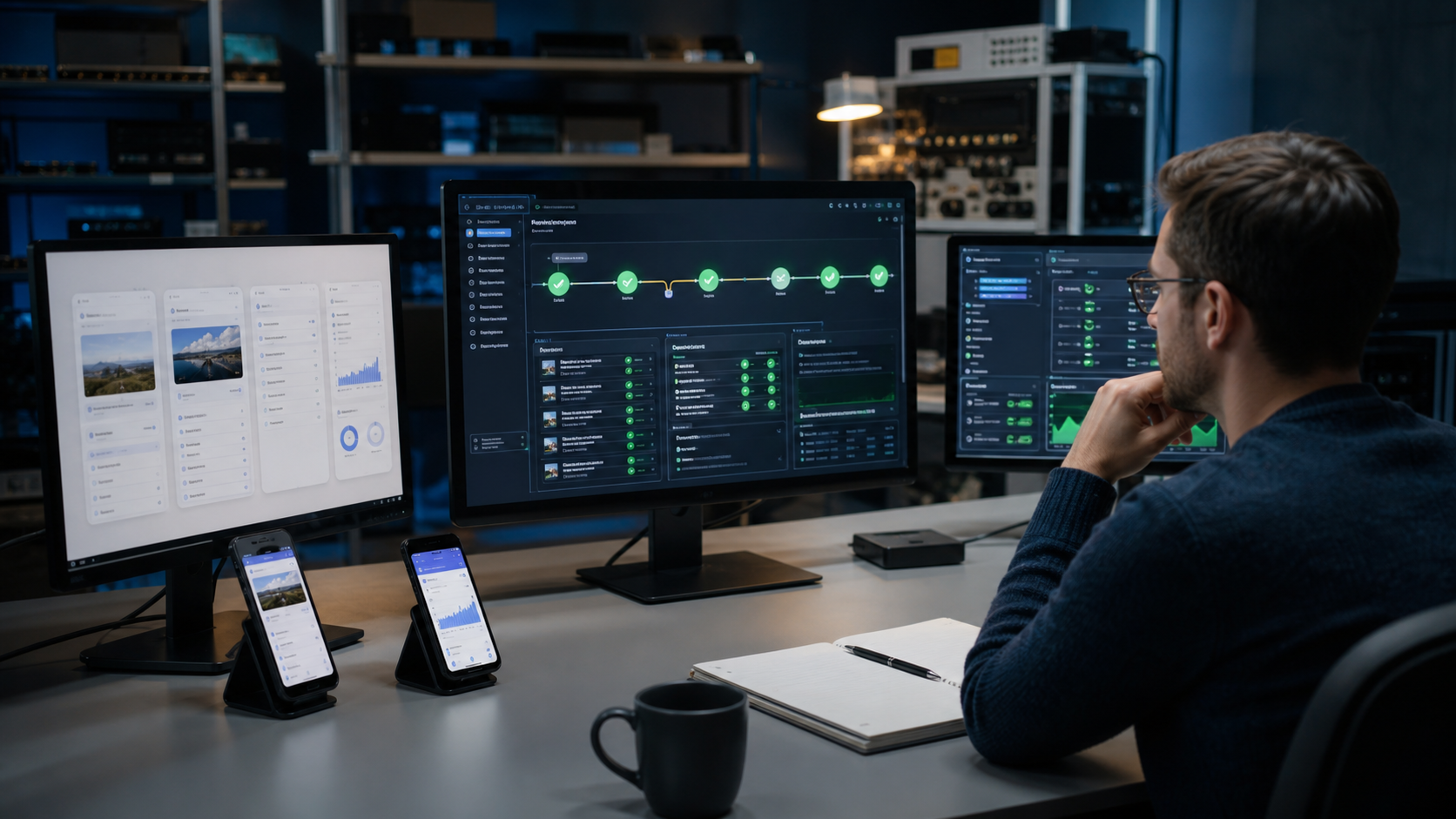
An engineer inspecting CI/CD evidence for web, backend and mobile

<Different web, backend and mobile checks must become one deployment contract.>

Fable 5 and the value of a harness for long work

Anthropic announced Claude Fable 5 on June 9, 2026 and restored global availability on July 1 after a temporary export-control suspension. The company positions it for ambitious, long-running coding and knowledge work, with planning, delegation and self-checking inside harnesses such as Claude Code.

Those are vendor claims, not a final independent benchmark verdict. In my operation, however, recent models do follow long instructions, role boundaries, test loops and prohibitions more reliably. Stronger models do not make harnesses obsolete. Their larger action radius increases the risk of completing the wrong objective very efficiently, so approval gates and observability matter more.

Community response: productivity versus cost and complexity

The official repository and ClaudeAI launch discussion praise SPEC-first work, TDD, specialist agents and repeatable team procedures. The objections deserve equal weight:

  • Specifications and orchestration slow down tiny changes.
  • Multi-agent context and repeated verification increase token cost.
  • Automatically expanding documents can preserve stale rules and create bureaucracy.
  • Framework convenience can turn model independence into runtime coupling.

A team should not impose one heavy process on everything. Use lighter gates for small fixes, standard gates for normal features and stricter approval for identity, payment or data changes. Delete unused context regularly.

Conclusion: the real productivity of human code zero

The achievement is not the number zero itself. Team members spend less time entering syntax and more time specifying requirements, evaluating changes and shortening feedback loops. A failed task should become a better SPEC, guide, test or CI rule—not remain one person's prompting trick—so the next model and teammate learn from it.

MoAI is not magic that builds the product for us. It is an AI development manual kit that makes team practice executable. The meaningful metrics are escaped defects, lead time, rollback rate, review time and requirement traceability, not generated lines of code. When people retain direction and accountability while agents execute, human code zero becomes reproducible engineering rather than reckless vibe coding.

MoAI ADK and Harness Engineering 1 - The AI Development Manual

Series · MoAI ADK and Harness Engineering

Article series · Completed

Episode 1 · MoAI ADK and Harness Engineering 1 - The AI Development Manual

MoAI ADK and Harness Engineering 1 - The AI Development Manual

I use a MoAI harness on projects that combine modern web applications, current Spring Boot services and Flutter apps. I first understood it as a collection of manuals for AI coding. Practice showed that this was only half the picture. Documentation is central, but a useful harness also decomposes work, constrains tools and uses test evidence to choose the next action.

The name needs one correction: in the official MoAI ADK repository, ADK means Agentic Development Kit, not AI Development Kit. It is a SPEC-first kit for organizing coding agents in a real repository, not a kit for training a new model.

One acronym, several different layers

Product or category Primary purpose Relationship to project code
MoAI ADK Development harness for specs, roles, workflows and verification Governs repository-wide development
Google ADK Build, evaluate and deploy user-facing agents Embedded in an application runtime
OpenAI Agents SDK Tool use, handoffs and traces Embedded in Python or TypeScript apps
Microsoft Agent Framework and LangGraph Stateful multi-agent workflows Service execution frameworks
Claude Code, Codex and Gemini CLI Coding agents that inspect and modify repositories Engines that execute harness rules

MoAI and Google ADK therefore should not be compared as direct substitutes. The latter helps build an agent inside a product. MoAI constructs the workshop around agents that build the product. Claude Code is the worker; MoAI is the procedure, blueprint and inspection station.

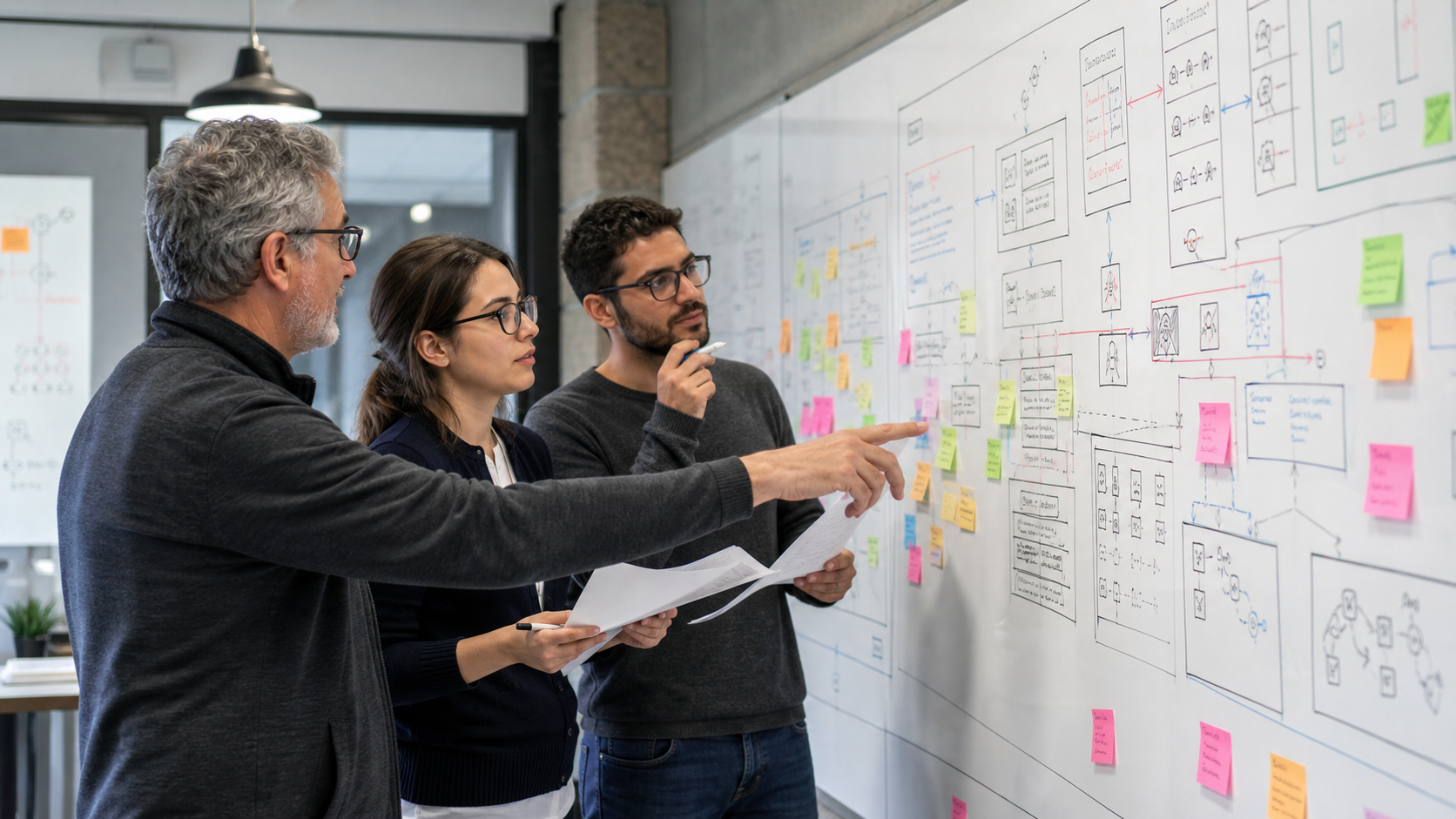
A development team organizing architecture and domain rules

<A harness begins with agreed domain and architecture, not a prompting trick.>

Four layers turn manuals into a harness

The practical structure has four layers:

  1. Knowledge: product goals, structure, stack, domain model, database and code maps.
  2. Contracts: SPECs, acceptance criteria, coding guidance, architecture boundaries and Git rules.
  3. Execution: plan, implementation, repair, review, E2E and synchronization commands invoking specialist agents and tools.
  4. Verification: builds, static analysis, unit, integration and E2E tests plus quality gates.

Documents alone can be acknowledged and then forgotten by a model. Tests alone can encourage an agent to chase green output without understanding the design. Declarative guidance and executable verification must work together.

A development workspace connecting documents, code, tests and Git

<Documents form the control plane; builds, tests and Git make its rules executable.>

Why SPEC-first is stronger than a prompt

A prompt disappears into a conversation. A SPEC stays in the repository. Breaking requirements into scenarios, domain rules, affected components, tests and acceptance evidence lets another session or model begin from the same contract.

Instead of “implement order cancellation,” a harness can define:

  • state transitions and refund responsibility before and after settlement;
  • dependency direction across Spring Boot application, domain and infrastructure layers;
  • an API schema and errors shared by web and Flutter clients;
  • migration, retry and idempotency requirements;
  • completion criteria for unit, integration, contract and UI tests.

This does not eliminate agent freedom. It separates the area available for exploration from boundaries that must not break, addressing the structural weakness discussed in our vibe-coding analysis.

How MoAI relates to harness engineering

Harness engineering treats agent performance as more than a model score. Context delivery, tools, persistence, observability, verification and recovery form a runtime system. Research such as AI Harness Engineering and observability-driven harness evolution now treats that system as an engineering object.

MoAI applies the idea to a development repository: context maps locate evidence, session state survives longer work, and checklists plus self-verification expose failure. Language-aware tools and scaffolding-first workflows support the loop. Agent and skill counts change across releases; the stable point is the closed cycle of specification, implementation, verification and documentation synchronization.

How model-independent is it?

MoAI's strongest idea is investing in project memory rather than one model. Domain documents, SPECs, architecture decisions, tests and Git history survive a move between coding agents. This repository, for example, keeps Claude Code assets as the source of truth while a Codex adapter reads the same instructions.

“Completely independent” would still be an exaggeration. Command syntax, hooks, context capacity, team-agent features and permissions differ by runtime.

Precise assessment: knowledge, contracts and verification are model-independent; commands, hooks and tool invocation need adapters.

That division preserves team assets when model fashions change. It also explains why a repository contract should precede adoption of Claude Code or a GitHub Copilot agent workflow.

Part 2 examines how our team reached 100% AI-assisted development and zero manually typed production code, along with the analysis, review and testing that humans must still own.

404 Dev Room 30 - Taming

Series · 404 Dev Room Webtoon · Ongoing Episode 30 · 404 Dev Room 30 - Taming The trainer in the AI coding room has changed. <...