Viewing Qualcomm only as a smartphone modem company hides both its strengths and its risks. Qualcomm combines QTL, which licenses cellular standard-essential patents, with QCT, which supplies modems, application processors, radio-frequency components, and chips for automotive and IoT systems. It is now extending the CPU, GPU, NPU, and connectivity technology in Snapdragon into PCs, vehicles, XR, and industrial edge devices for an era in which AI runs across devices.
This Qualcomm company review asks whether on-device AI can produce real diversification. Local models can reduce latency, exposure of private data, and connectivity costs, but they face memory, power, and thermal limits. Technology alone does not remove Apple and Samsung concentration, customer modem programs, Chinese demand, or licensing regulation. Figures use the FY2025 10-K and disclosed FY2026 quarterly materials. This is not investment advice.

QCT and QTL form one research engine
QCT semiconductors and QTL licensing support the same research base through different economics.
QCT sells Snapdragon, modem-RF systems, the automotive Digital Chassis, and IoT chipsets. QTL licenses inventions essential to CDMA, OFDMA, 3G, 4G, and 5G standards. Chip revenue responds to share and product cycles; licensing earns from broad adoption of cellular standards. Cash from both businesses funds another cycle of wireless and low-power computing research.
| Business | Core product or right | Revenue driver | Primary risk |
|---|---|---|---|
| QCT handsets | Snapdragon, modem, and RF | Premium mix and units | Customer silicon and phone demand |
| QCT automotive | Cockpit, connectivity, ADAS | Design wins followed by production | Long cycles and safety liability |
| QCT IoT and PC | Industrial, networking, XR, PC | Edge AI and new form factors | x86, Arm, and ecosystem competition |
| QTL | Standard-essential patent licenses | Sales of cellular devices | Regulation, litigation, renewals |
The combination is unusual. Patents arising from Qualcomm's standards work create license revenue, while its chips implement those inventions and demonstrate performance. Dependence on highly profitable QTL also creates sensitivity when regulators or customers challenge terms. A patent being essential to a standard and every commercial term being justified are separate propositions.
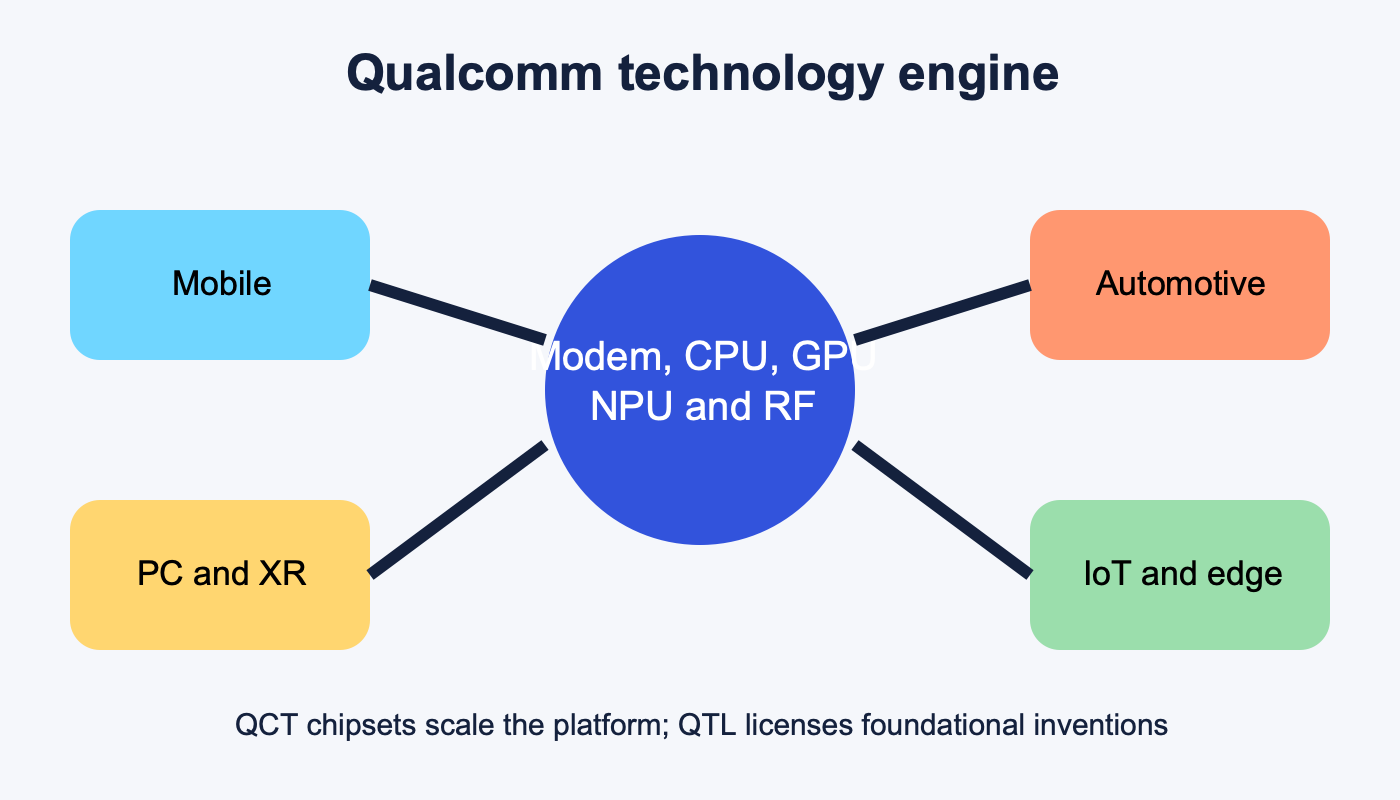
QCT generated most FY2025 revenue and handsets remain its largest component. Fast growth in automotive or IoT therefore does not prove that phone dependence has disappeared. Diversification becomes real when announced design wins enter production and grow large enough to absorb handset volatility.
The technical logic of Snapdragon on-device AI
Qualcomm's official Snapdragon overview documents the platform scope discussed here.
Snapdragon coordinates CPU, GPU, Hexagon NPU, image processor, modem, Wi-Fi, Bluetooth, and security within one power budget. On-device AI can process speech, camera data, and personal context without sending every request to the cloud. Responses can be faster, raw sensitive data can remain local, and some functions can work with weak connectivity.
Yet a high NPU TOPS figure is not a user benefit by itself. Models must be quantized for limited memory; work must be scheduled across CPU, GPU, and NPU; battery life and surface temperature must remain acceptable. Developers encounter different runtimes on Android, Windows, and automotive operating systems. Qualcomm's defense is less a single accelerator than system optimization from modem through NPU plus SDKs that OEMs and developers can actually use.
Snapdragon X puts Windows on Arm performance and battery life at the center of the PC proposition. Application compatibility and enterprise management matter more than benchmark peaks alone. Snapdragon Digital Chassis combines connectivity, cockpit, and driver assistance, but automotive design wins can take years to enter production. Industrial IoT and robotics analyze camera and sensor data on site, favoring platforms that combine connectivity with efficient AI.
This positioning contrasts with NVIDIA BlueField-4, which controls data movement around CPUs and GPUs in data centers. NVIDIA expands high-power AI-factory infrastructure; Qualcomm targets the power- and thermal-constrained edge close to users. They compete in parts of the stack but are complementary when models trained in the cloud run inference on devices.
Cristiano Amon's diversification and the numbers
The official leadership profile provides the management background used in this analysis.
Cristiano Amon led Qualcomm's semiconductor and 5G work before becoming CEO in 2021. His central task is to reuse smartphone connectivity and compute technology across automotive, PCs, industrial IoT, and edge AI. Reuse can improve R&D leverage, but sales channels, certification, software, and support cycles differ in every market. Organizational execution cannot be assumed from technical similarity.
Qualcomm's FY2025 Form 10-K reports total revenue of $44.284 billion. QCT revenue was $38.717 billion and QTL revenue was $5.582 billion. QTL is smaller by revenue but its strong profit contribution is important to research capacity and overall economics. Cash-flow analysis must test whether Qualcomm can sustain major R&D while returning capital.
| FY2025 metric | Result | What it says |
|---|---|---|
| Total revenue | $44.284 billion | Combined mobile recovery and diversification |
| QCT revenue | $38.717 billion | Chips and platforms dominate sales |
| QTL revenue | $5.582 billion | Patent licensing has disproportionate profit value |
| Key operating evidence | Auto, IoT, and PC revenue | Proof of reduced handset dependence |
An automotive pipeline offers long-term visibility, but a backlog is not present revenue. Programs can be canceled and production volumes can fall, while automotive quality and safety standards exceed consumer-device requirements. PCs likewise need more than advanced silicon: Windows applications, drivers, and enterprise deployment experience matter. Related connectivity semiconductor companies show how much system value now depends on moving data reliably, not merely executing arithmetic.
Apple, licensing, AI hype, and the conclusion
Apple's expansion of internal modems is the most direct risk. A major customer moving in-house can reduce shipments and bargaining power. Samsung and Chinese handset vendors can also select internal or competing components. Customer and regional concentration make geopolitics, export controls, and demand weakness capable of arriving together.
QTL is the second risk. Fair, reasonable, and non-discriminatory terms for standard-essential patents, device-level royalty bases, and competition law have produced years of disputes. Past legal outcomes do not guarantee every future jurisdiction or renewal. Breadth is the third risk: mobile, PC, automotive, XR, and industrial IoT are attractive, but developer support and sales investment can become fragmented.
AI hype is the fourth. On-device AI must reduce cloud cost or improve privacy and latency enough to motivate upgrades. Infrequently used demos or difficult model updates will not turn NPU specifications into durable pricing. Rivals bring different strengths: Apple's vertical integration, MediaTek's cost structure, NVIDIA's AI ecosystem, and Intel and AMD's PC base.
Qualcomm's core is not one modem component. It is the ability to optimize connectivity, compute, sensing, and efficient AI as a platform. Diversification should be judged by whether non-handset revenue and software adoption reduce QCT volatility, not by the number of markets announced.
Qualcomm is using cellular patents and smartphone cash generation to move toward an edge AI platform. Automotive and PCs are large opportunities accompanied by long production cycles and ecosystem switching costs. The decisive indicators are handset revenue, Apple's modem transition, automotive production revenue, repeat Snapdragon X adoption, QTL renewals, and cash flow relative to R&D. Improvement across those measures would transform the narrative from a phone company's diversification into the expansion of an edge-computing platform.