Showing posts with label profile. Show all posts

Sunday, July 26, 2026

Mira Murati’s Thinking Machines Lab and the Custom AI Bet

Mira Murati is worth watching now not simply because she was OpenAI’s former chief technology officer, but because her next company is trying to answer a harder question: who gets to shape advanced AI after the model is trained? Murati was close to the launch and scaling of ChatGPT, DALL·E, and GPT-4. At Thinking Machines Lab, the emphasis is different: make AI systems more understandable, customizable, and useful for people with specific goals.

That distinction matters as the market moves beyond headline model releases. The first wave of generative AI products taught companies what a powerful general interface can do. The next wave is about whether teams can adapt models to their own data, evaluation standards, workflows, and risk constraints without handing all control to a small number of frontier labs.

Thinking Machines Lab’s official homepage frames the problem directly. It says the scientific community’s understanding of frontier AI systems lags behind their capabilities, that training knowledge is concentrated inside top labs, and that current systems remain difficult to customize for specific needs and values. Murati’s new company is interesting because it turns openness, customization, human-AI collaboration, and infrastructure quality into the center of the product thesis.
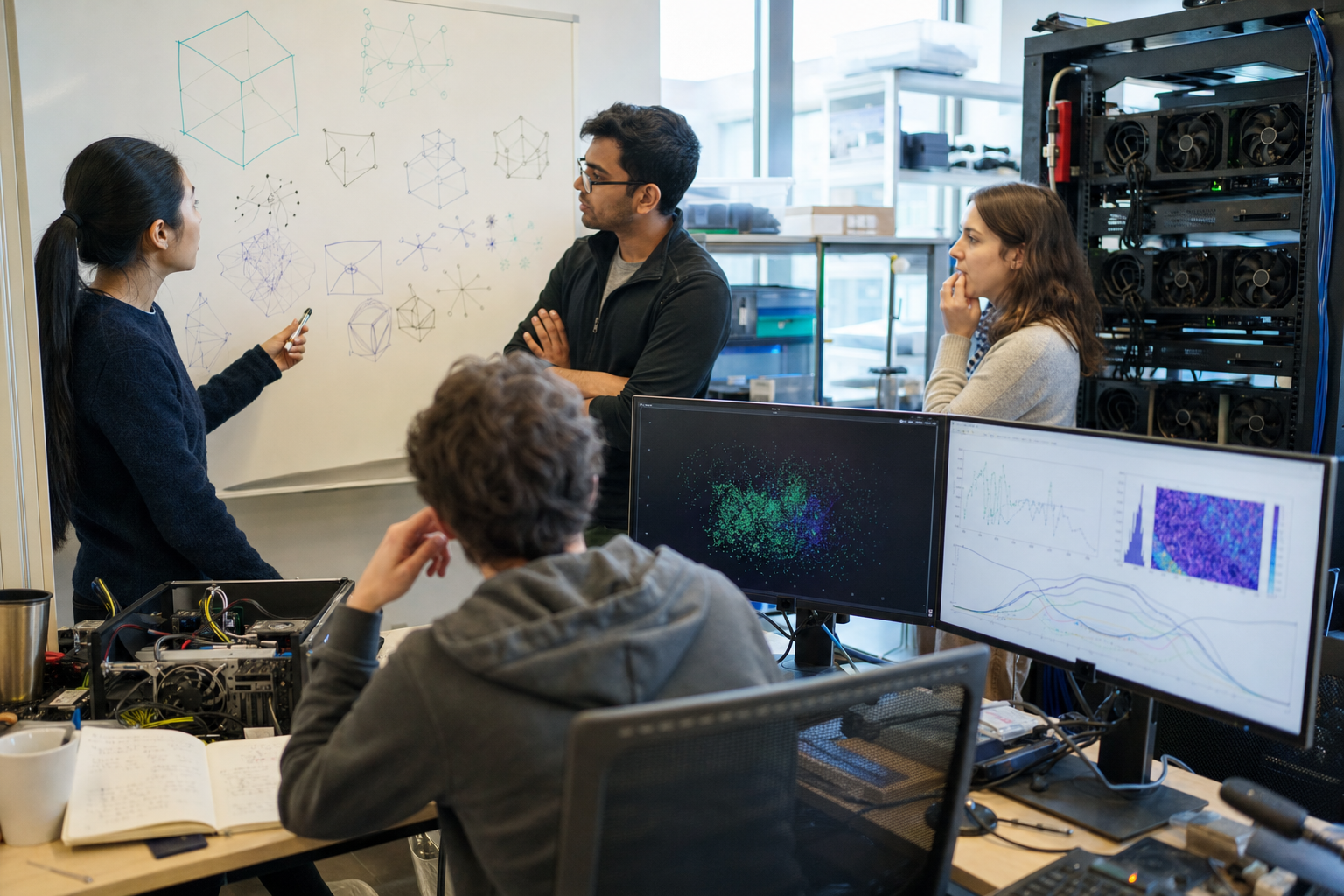
Researchers discuss customizable AI beside GPU equipment and model-evaluation screens

<Custom AI research collaboration, Example image 1.1>

Why Mira Murati’s background matters

Murati’s reputation is built around translating research into products that millions of people can actually use. Fast Company’s 2023 profile described her as OpenAI’s CTO and a leader behind ChatGPT, DALL·E, and GPT-4. Unlearn’s biography also summarizes her earlier work across Tesla’s Model X program, Leap Motion, and OpenAI, while noting her role across research, product, and safety teams.

That mix is relevant because AI products do not succeed on model quality alone. Deployment interfaces, feedback loops, safety reviews, developer experience, cost controls, and user trust all have to work together. Murati has already operated near that intersection. Thinking Machines Lab appears to be moving the same product discipline toward researchers and developers who want to fine-tune, test, and deploy AI for narrower professional contexts.

Lens OpenAI-era relevance Thinking Machines Lab relevance
Productization Turning frontier models into mainstream products Giving researchers and builders more control over model adaptation
Research culture Public model releases, papers, and safety debates Frequent technical writing, code, and shared recipes as part of the pitch
Safety Deployment policies and evaluation pressure Iterative safety through testing, red-teaming, and external research support
Differentiation General-purpose AI interfaces Custom AI models shaped around user data, values, and workflows

The gap Thinking Machines Lab is targeting

Thinking Machines Lab says “science is better when shared,” but its strategy is not just a philosophical statement. The company stresses human-AI collaboration rather than fully autonomous systems alone, adaptable and personalized AI, multimodal capabilities, strong infrastructure, and frontier model intelligence in domains such as science and programming. In practice, that points to a major market question: who controls the training and evaluation loop around LLM tools once they enter real work?

A July 2025 CNBC report said Thinking Machines Lab raised $2 billion, with a16z leading the round and Nvidia, AMD, Accel, ServiceNow, Cisco, and Jane Street among the investors. The size of the round drew attention, but the investor mix is just as telling. Semiconductors, enterprise software, infrastructure, and quantitative engineering all matter if the company is trying to build a serious customization and training platform rather than another consumer chatbot.

The strategic shift is from “everyone uses the same large model through the same interface” to “teams adapt models around their own data, evaluation criteria, and workflow constraints.”
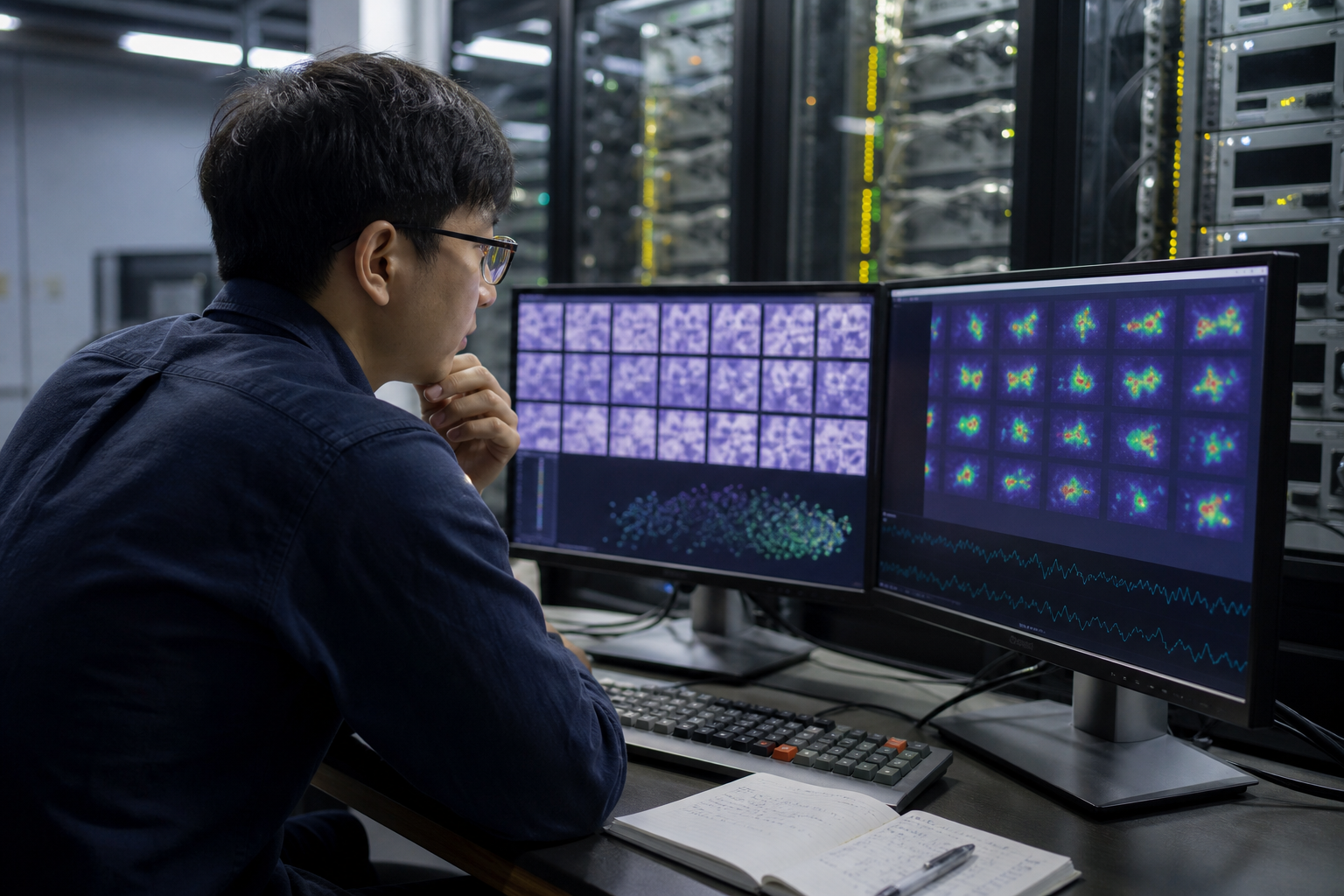
A researcher compares model-evaluation results in front of GPU servers

<Custom model evaluation environment, Example image 2.1>

What Tinker AI reveals about the strategy

Tinker is the clearest product signal so far. Thinking Machines Lab describes it as a training API for researchers: users control model training and fine-tuning, while the company handles infrastructure. The page reduces the interface to four core functions: forward_backward, optim_step, sample, and save_state. That is a developer-facing way to say the product is not just a prompt box. It is meant to expose enough of the learning loop for real experimentation.

Tinker AI also points to a pragmatic view of customization. The product uses LoRA, a fine-tuning method that trains a smaller adapter rather than updating every base-model weight. That can make experimentation cheaper and more flexible, especially for teams that care about their own data, reward signals, and evaluation environments. The official FAQ says user data is used solely to fine-tune user models and is not used to train Thinking Machines Lab’s own models, a crucial promise for enterprise and research adoption.

Question Why it matters What readers should check
Control Researchers can interact with training and sampling directly Can the team attach its own evals and review process?
Infrastructure Distributed training and scheduling are abstracted away Are cost, reliability, and reproducibility visible enough?
Data policy User data is not used for the company’s own model training, according to the FAQ Do contracts, logging, and retention rules match the claim?
Model choice Multiple open-source models are supported Does the workflow reduce dependence on one vendor?

This is a practical issue for companies outside Silicon Valley as well. Adding a chatbot is very different from adapting a model to business data and measuring whether it performs reliably. The latter requires clean datasets, security boundaries, domain experts, and failure analysis. Murati’s company is notable because it is trying to productize that less glamorous but more durable layer of AI work.

The upside and the unresolved risks

Thinking Machines Lab’s direction is compelling, but custom AI also raises familiar problems in sharper form. The more control users have over training and fine-tuning, the more important governance becomes. Data rights, privacy, security, bias, reproducibility, and audit trails are not side issues. They determine whether a custom model can be trusted in customer support, scientific research, software engineering, finance, healthcare, or legal workflows.

Performance standards are another challenge. A model tuned for one organization should not be judged only by public benchmark scores. It needs task-specific evaluations and a clear view of failure costs. A support assistant, a code reviewer, a research summarizer, and a clinical documentation helper all fail in different ways. Tools like Tinker AI should therefore be evaluated not only by supported model lists, but by how well they help teams design tests, inspect outputs, recover from mistakes, and document decisions.

Murati’s career shows how quickly AI research can become a mainstream product. Thinking Machines Lab is aiming at the next layer: giving researchers and builders more room to adapt models without taking on all the infrastructure burden themselves. The important question is no longer just how large the next model is. It is whether organizations can shape AI around their own work, keep evidence of what changed, and improve it safely over time.

Saturday, July 25, 2026

Fei-Fei Li and Spatial Intelligence: The AI Frontier After ImageNet

Fei-Fei Li matters again not because ImageNet is old history, but because her current work is pushing a sharper question into the AI mainstream: after models learn to write, search, code, and generate images, how do they learn the structure of the world? In 2026, Li is no longer only the Stanford professor associated with the dataset that helped ignite modern computer vision. She is also co-founder and CEO of World Labs, a company organized around spatial intelligence.

The Stanford School of Engineering profile describes Li as the Sequoia Professor in Stanford’s Computer Science Department, a founding co-director of Stanford HAI, and co-founder and CEO of World Labs. The same profile credits her as the inventor of ImageNet and the ImageNet Challenge, a large-scale dataset and benchmark widely regarded as one of the forces behind the modern deep learning revolution. That history makes her current argument more interesting: the person who helped machines learn to see images is now arguing that AI must learn to reason through three-dimensional worlds.

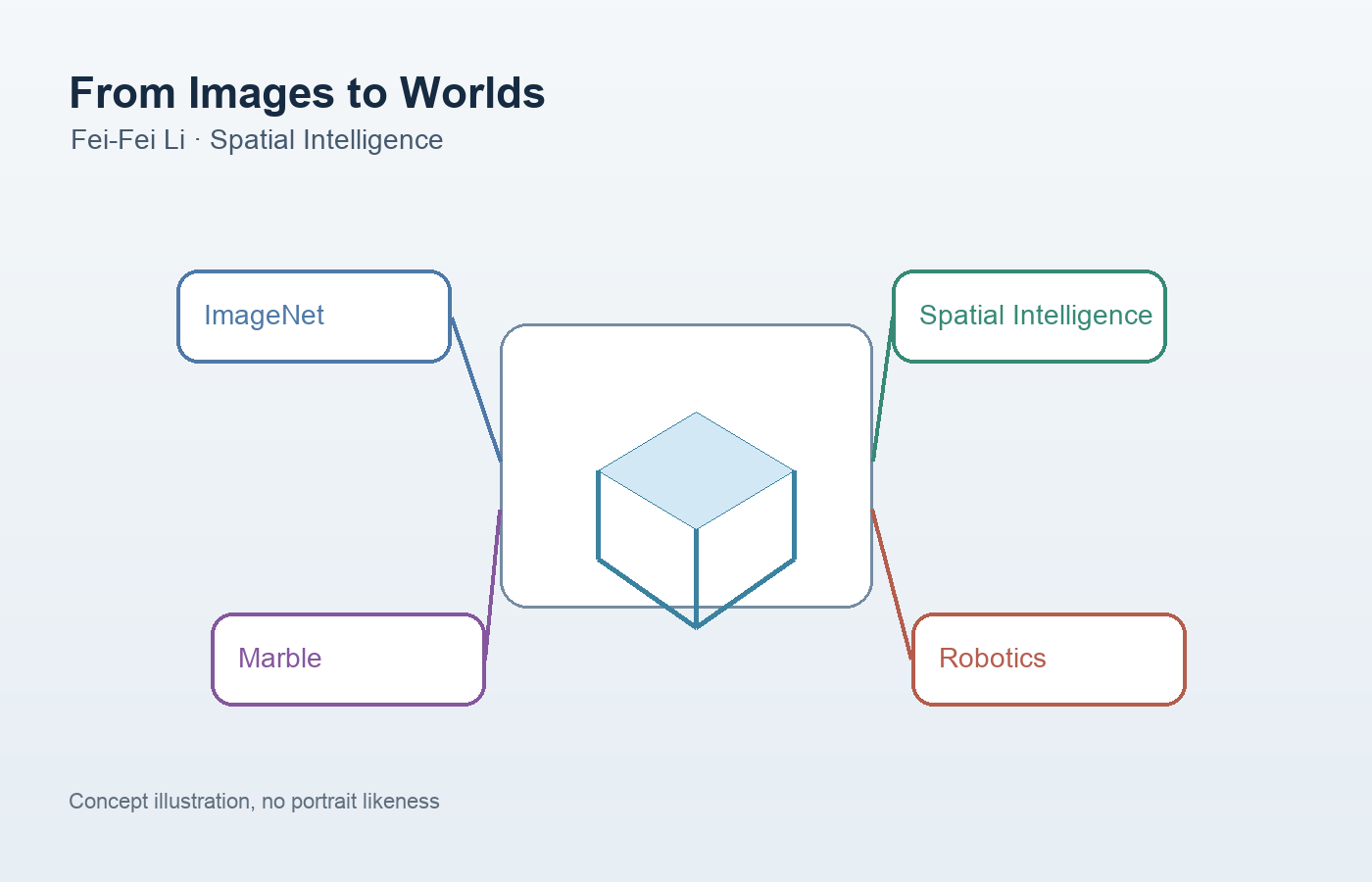
A clean editorial concept image showing a researcher desk with cards labeled ImageNet, Spatial Intelligence, Marble, and Robotics around a small 3D room model

<Fei-Fei Li’s research arc from ImageNet to spatial intelligence 1.1>

Who Fei-Fei Li is

Li’s signature contribution is ImageNet. It showed how large-scale labeled visual data, benchmark discipline, neural networks, and GPU compute could combine to move computer vision forward. Many later advances in image recognition, medical imaging, autonomous perception, and generative visual systems sit downstream from that shift. For readers who mostly know AI through chatbots, ImageNet is a reminder that the current wave of foundation models did not begin with text alone.

Her work also extends beyond technical benchmarks. The Stanford HAI profile notes that Li directed the Stanford AI Lab from 2013 to 2018, served as Google Cloud’s Chief Scientist of AI/ML during her Stanford sabbatical from 2017 to 2018, and co-founded AI4ALL to broaden inclusion and education in AI. That combination matters. Li tends to frame technical progress together with human-centered design, public interest, and access to AI education.

Period Main role Why it matters for AI
Late 2000s–2010s ImageNet and computer vision research Large datasets and benchmarks accelerated deep learning progress
2013–2018 Stanford AI Lab leadership Vision, robotics, and interdisciplinary AI work moved closer together
2019 onward Stanford HAI and policy-facing work Human-centered AI, governance, and access became part of the agenda
2024 onward World Labs co-founder and CEO The focus shifts toward 3D worlds, simulation, and spatial reasoning

What she is saying now

Li’s current message is not that language models are unimportant. It is that language is incomplete. In her November 2025 essay “From Words to Worlds”, she argues that LLMs have transformed work with abstract knowledge but still lack the grounded ability to understand and interact with physical and virtual spaces. Her compact formulation is worth quoting: “Spatial intelligence is AI’s next frontier.” That is the reason 3D world models matter: they aim to represent space, objects, and action consequences rather than only describing them in fluent prose.

World Labs translates that thesis into product and research language. The company’s about page says it is building frontier world models that can perceive, generate, reason, and interact with the 3D world. Its first product, Marble, creates spatially cohesive, high-fidelity, persistent 3D worlds from inputs such as text, a single image, video, or spatial prompts, then lets users edit and export those worlds.

World Labs’ January 2026 World API announcement is important because it makes world generation programmable. The API can generate navigable 3D environments from text, images, panoramas, multi-view inputs, and video, with outputs that can be rendered on the web, exported to downstream tools, or integrated into simulations and interactive systems. In other words, World Labs Marble is not positioned as a one-off visual demo. It is being framed as an application layer developers can call.

Spatial intelligence is broader than attractive 3D graphics. Li’s argument is that AI systems need to handle position, scale, motion, occlusion, physical interaction, and the consequences of action if they are going to help creators, designers, robots, and simulation-driven workflows.

Why this matters beyond language models

For technology teams, the most practical reason to watch Li is that the generative AI market is moving beyond text and flat media. Video models are already competing on physical accuracy and world consistency; AI video physical accuracy is becoming a production-quality issue rather than a novelty. Spatial intelligence extends that same concern into 3D environments, robotics, simulation, education, and design.

This is also adjacent to the debate around AI world models. Yann LeCun emphasizes systems that can learn representations of the world and plan through them; Li and World Labs are pushing a product-oriented version of the same broad frontier, where generated environments can be explored, edited, exported, and eventually used by agents and robots. The shared question is whether AI can move from describing the world to modeling the structure that makes action possible.

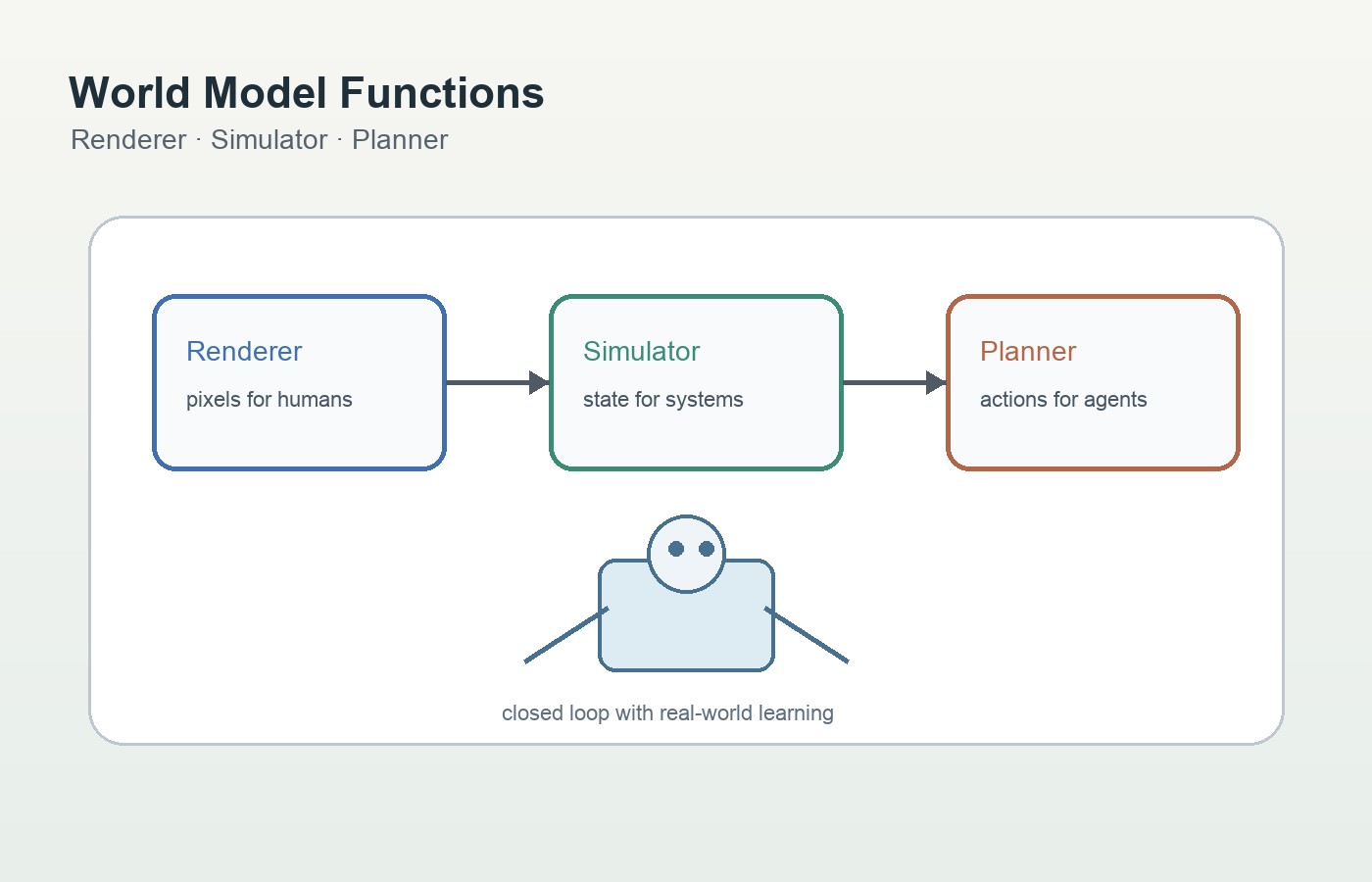
World Labs’ June 2026 essay “A Functional Taxonomy of World Models” makes the distinction useful. It divides world models into renderers, simulators, and planners. Renderers output what a viewer sees. Simulators output structured state that can be computed on, inspected, and used by software systems. Planners output actions given observations and goals. The distinction keeps teams from confusing a visually impressive 3D scene with a physically reliable environment for robotics or engineering.

A realistic editorial photo of a tabletop 3D lab mockup with cards labeled Renderer, Simulator, Planner, and Robot beside a laptop

<World model functions: renderer, simulator, planner 3.1>

The July 2026 SceniX acquisition underlines the robotics angle. In the official announcement, World Labs says robotics is where spatial intelligence becomes physical: a robot must perceive its surroundings, understand how objects move and interact, anticipate the consequences of its actions, and act reliably. That is a very different standard from making a beautiful render. It is a claim about closed-loop behavior in messy environments.

My view

Li’s advantage is that she does not treat AI as a parade of slogans. ImageNet was powerful because it connected a big idea with data, benchmarks, community practice, and measurable progress. Spatial intelligence will need the same kind of discipline. The interesting questions are not only “Can this model make a room?” but “What inputs does it accept, what geometry does it preserve, what physics can be trusted, what simulator can use the output, and how do we measure failure?”

The limitations are just as important. Marble and the World API should not be mistaken for complete physics engines or general-purpose robot brains. World Labs’ own taxonomy essay discusses the scarcity of explicit 3D and physical data, the sim-to-real gap, and the risk of generated geometry that looks plausible while being structurally or physically wrong. In safety-critical fields such as robotics, healthcare, architecture, and manufacturing, visual plausibility is not enough. Reliability, scale, and testable accuracy matter more.

Even with those caveats, Li is worth following closely. Text-centered AI changed how people work with knowledge. Spatial intelligence could change how machines help people build, test, and act inside worlds. For English-speaking readers, the point is not simply that a new 3D generation tool exists. The bigger signal is that simulation, robotics, digital twins, education, and spatial design are beginning to converge around the next interface for AI.

404 Dev Room 30 - Taming

Series · 404 Dev Room Webtoon · Ongoing Episode 30 · 404 Dev Room 30 - Taming The trainer in the AI coding room has changed. <...