Showing posts with label vibe coding. Show all posts

Tuesday, August 4, 2026

Motif 3 Beta Review — A 314B Korean AI from a 30-Person Startup

Motif 3 Beta is a sovereign AI experiment in how far a small Korean startup can go by optimizing architecture and infrastructure rather than simply counting GPUs. Our review of GPU bottlenecks in AI servers provides useful context for why sparse computation matters. It is also an unfinished beta: commercial licensing and training-data disclosure remain limited, so the technical headline should be read together with those constraints.

Official blue three-dimensional Motif Technologies logo symbol

<Official Motif Technologies logo, credit Motif Technologies 1.1>

What kind of company is Motif Technologies?

Motif Technologies was established in February 2025 after growing out of the AI business of Moreh, an AI-infrastructure company. Moreh focuses on GPU-cluster optimization, distributed inference, and model efficiency, while Motif focuses on model design and generative-AI products. Motif describes itself as more than a chatbot company: it combines foundation models, infrastructure knowledge, and enterprise AI-transformation work.

The CEO is Junghwan Lim. According to the company’s official profile, Lim holds a bachelor’s degree from KAIST and a Ph.D. from the University of Oxford. He previously worked as a data scientist at PUBG and Samsung Research, then served as Director of AI at Moreh. That combination of mathematical research, industrial data work, gaming, and GPU infrastructure helps explain Motif’s emphasis on efficient independent model design.

Public company databases put Motif at roughly 30 employees as of June 2026 and classify it as an unlisted startup. It is not a large company by conventional enterprise standards, but it is unusually small for a team releasing a 314B-parameter model. Earlier 2025 reporting described a team of fewer than 25 people, so the headcount should be treated as a dated estimate rather than a permanent fact. THE VC’s company profile lists Motif as a 2025 startup, names Lim as its representative, and marks it private.

Official portrait of Motif Technologies CEO Junghwan Lim

<Junghwan Lim, CEO of Motif Technologies, credit Motif Technologies 2.1>

The key idea is a large MoE model with a much smaller active computation

The Motif-3-Beta model card lists about 314 billion total parameters, roughly 13 billion active parameters per token, and a 256K-token context window. It is a Mixture-of-Experts model rather than a dense model that computes every parameter for every token. The router selects eight experts from 384 routed experts, along with one shared expert.

Item Public specification Why it matters
Total parameters About 314B Overall model capacity and storage scale
Active parameters About 13B per token Approximate computation selected for each token
Expert routing 384 routed experts, top-8, plus one shared expert Sparse computation that changes with the input
Context 256K tokens A design target for long documents and repositories
Layers and hidden size 53 layers, 4096 hidden size Core architecture details in the model card
Tensor type bfloat16 Numerical format for training and inference

Motif says the model starts from an in-house design rather than repackaging the parameters of an existing open model. The card identifies Grouped Differential Latent Attention, Grouped PolyNorm per expert, a modified mHC component, and a Multi-Token Prediction head. The MTP head can support self-speculative decoding by predicting future tokens ahead of the normal sequence.

That does not mean that 314B automatically equals GPT-4-level quality. MoE separates total capacity from per-token computation, but routing, memory movement, and parallel communication can still dominate real operating cost. Thirteen billion active parameters is an interesting efficiency figure, not a guarantee of low total serving cost.

Official Motif-3-Beta model-card image showing Motif Technologies and the Hugging Face repository

<Official Motif-3-Beta model-card image, credit Hugging Face Motif Technologies repository 3.1>

Strong early evaluation, but a narrow verification window

The Motif-3-Beta model card reports an Artificial Analysis Intelligence Index score of 44. The third-party index combines several dimensions such as knowledge, reasoning, mathematics, and coding, and its ranking changes as more models and evaluations arrive. The careful claim is therefore that the beta checkpoint recorded AAII 44, not that it holds a permanent global rank.

There is another important limitation: the model card does not provide a complete Motif-3 benchmark suite for KMMLU, HumanEval, MBPP, or SWE-bench. The earlier Motif 2.6B card reported HumanEval 68.3 and MBPP 60.3, but those numbers cannot be transferred to Motif 3. A larger model does not automatically become a better coding agent.

Motif 3 is a general-purpose multilingual text model, and the public beta does not support image input. Developers can serve it locally with vLLM or SGLang through OpenAI-compatible endpoints, but the model card lists B200 and H200 as the tested GPU environments. That is a serious barrier for an individual developer. A 256K context window may help with repository-scale context, but actual coding quality depends on tool calls, file selection, test execution, and error-repair loops.

Is it free, paid, or available through an API?

The Motif-3-Beta weights can be downloaded from Hugging Face without an access request. However, the current license allows use, modification, and redistribution for personal, educational, and non-commercial research purposes only. Commercial use requires prior written permission from Motif Technologies. “Open weights” therefore does not mean unrestricted commercial open source.

Motif’s official Open API page currently describes the Motif 12.7B Reasoning API and an OpenAI Chat Completions-style call flow. It does not present a public commercial price table or model-specific hosted API terms for Motif-3-Beta. The practical distinction is:

Access path Current public status
Motif-3-Beta weights Downloadable under a non-commercial research license
Hosted Motif-3-Beta API No public commercial price or availability confirmed
Motif 12.7B Reasoning API Official page explains key issuance and API-style calls
Local API Possible through vLLM or SGLang with an OpenAI-compatible server

For an enterprise deployment, downloading a checkpoint is only the beginning. Licensing, GPU bills, incident response, privacy controls, and vendor support matter more than the first successful inference. A beta checkpoint should be evaluated in an isolated environment before it touches customer data.

What training data was used?

This is where the public record needs a clear boundary. The official Motif-3-Beta card discloses architecture, parameters, context length, and usage, but it does not provide a detailed list of source datasets, copyright arrangements, language-token distribution, or filtering process. It is therefore not responsible to claim that a specific set of websites, books, or code repositories trained the model.

The earlier Motif 2.6B card states that it used 384 AMD MI250 GPUs for 42 days and trained on 2.4 trillion tokens. That is information about the earlier model, not Motif 3. Government-program reporting and secondary coverage discuss Korean data and large-scale resources for Motif 3, but a definitive answer about the final corpus should wait for a technical report and a clearer data-governance disclosure.

This distinction matters for Korean AI. A large Korean corpus is not enough by itself. Long-term trust depends on how news, web, public documents, code, and dialogue data were licensed; how duplication, contamination, and personal information were removed; and whether evaluation sets were kept out of training.

How did Motif obtain GPUs and capital?

Motif’s earlier advantage was experience with AMD GPUs. The official Motif 2.6B card records 384 AMD Instinct MI250 GPUs and 42 days of training, while company interviews emphasized the ability to make a small model infer on a single AMD GPU and to lower infrastructure cost. This fits Moreh’s background in software that makes heterogeneous GPU infrastructure usable rather than tying an entire model effort to one vendor.

Motif 3 is a different scale. Motif was selected as an elite team in the government’s Independent AI Foundation Model project, known in Korean coverage as Dokpamo. Reporting says that a roughly 30-person team used more than 700 government-provided GPUs and completed a preview checkpoint in about five months. Within the consortium, Motif leads model design while Moreh handles GPU-cluster optimization, distributed inference, and compression.

This should not be simplified to “the government gave the company cash to buy GPUs.” Public material clearly describes GPU resources and a government development and evaluation structure, but it does not clearly disclose direct cash support or GPU ownership terms. On the investment side, 2026 reporting mentioned 5 billion won from Forest Ventures and 10 billion won from other institutions, while another report described a total 24 billion won financing and an approximately 130 billion won valuation. Because the public detail is incomplete, the careful wording is “reports described a 24 billion won financing,” not a fully verified cap table. DealSite’s report provides the available detail.
Official Motif model-family image representing the relationship between AI models and infrastructure

<Official Motif AI model-family image, credit Motif Technologies 4.1>

The next target is an industrial AI ecosystem

Motif’s stated goals have three layers. First, it wants to extend language models into image and video generation. Second, it wants to move from multimodal models toward physical AI and robotics. Third, it wants to open models and software commercially where possible and build public and industrial AI-transformation examples. This is also an infrastructure problem, similar to the economics of AI GPU cloud services.

That is ambitious for a 30-person company, but it also explains why Motif combines model research with Moreh’s infrastructure work and enterprise AX projects. Model sales alone may not cover frontier-scale GPU costs. A sustainable route is to build enterprise-specific models, infrastructure, and transformation revenue, then reinvest that revenue into foundation-model development. The partnership with Samil PwC is one example of this B2B route.

What Motif needs to prove for the vibe-coding era

I hope Korean AI models grow beyond Korean conversation and summarization into genuinely useful vibe-coding systems. Vibe coding is not just generating one code block. It means repeatedly completing a software task:

  • reading a repository and selecting only the necessary files;
  • breaking a request into small changes and explaining a plan;
  • safely calling terminals, tests, browsers, and Git tools;
  • reading an error log and repairing the actual cause;
  • explaining security risks and waiting for human approval before high-impact actions.

Motif 3’s 256K context and sparse MoE design are promising foundations for this direction. But the public beta does not yet provide enough Motif-3-specific coding and tool-use evaluation, and its non-commercial research license prevents a straightforward commercial coding service. A future release should publish SWE-bench-style results, tests on Korean repositories, failure-repair rates, tool-call success, long-task latency, and cost—not only one headline score.

The goal of Korean AI should not be to win one ranking against a foreign model. It should be to let Korean developers control their code and data while achieving world-class productivity. Motif 3 Beta is an interesting intermediate result that shows this possibility, while leaving data transparency, commercial licensing, and real-world evaluation as its next assignments.

Conclusion

Motif Technologies is an unlisted startup of roughly 30 people, but it combines Lim’s research and industry background, Moreh’s GPU software foundation, government compute from Dokpamo, and private investment to produce Motif-3-Beta. Its approximately 314B total parameters, 13B active parameters, 256K context, and custom MoE architecture are technically notable.

The AAII 44 score is a starting point, not proof of commercial success. Training-data provenance, Motif-3 coding performance, commercial API pricing, final licensing, and stable operating cost still need to become clearer. If Motif keeps publishing those details and connects the model to vibe coding and industrial agents, Korean AI can move from “a model that understands Korean” toward “a model that completes Korean work.”

Friday, July 24, 2026

The end of frameworks part 2: after coding, what remains?

AI frameworks, the end of coding, binary assets, Software 2.0, and the AI coding recipe all point to a post-human-framework transition.

If part 1 was about the history of human-centered frameworks, part 2 is about how AI may redefine what a framework is.

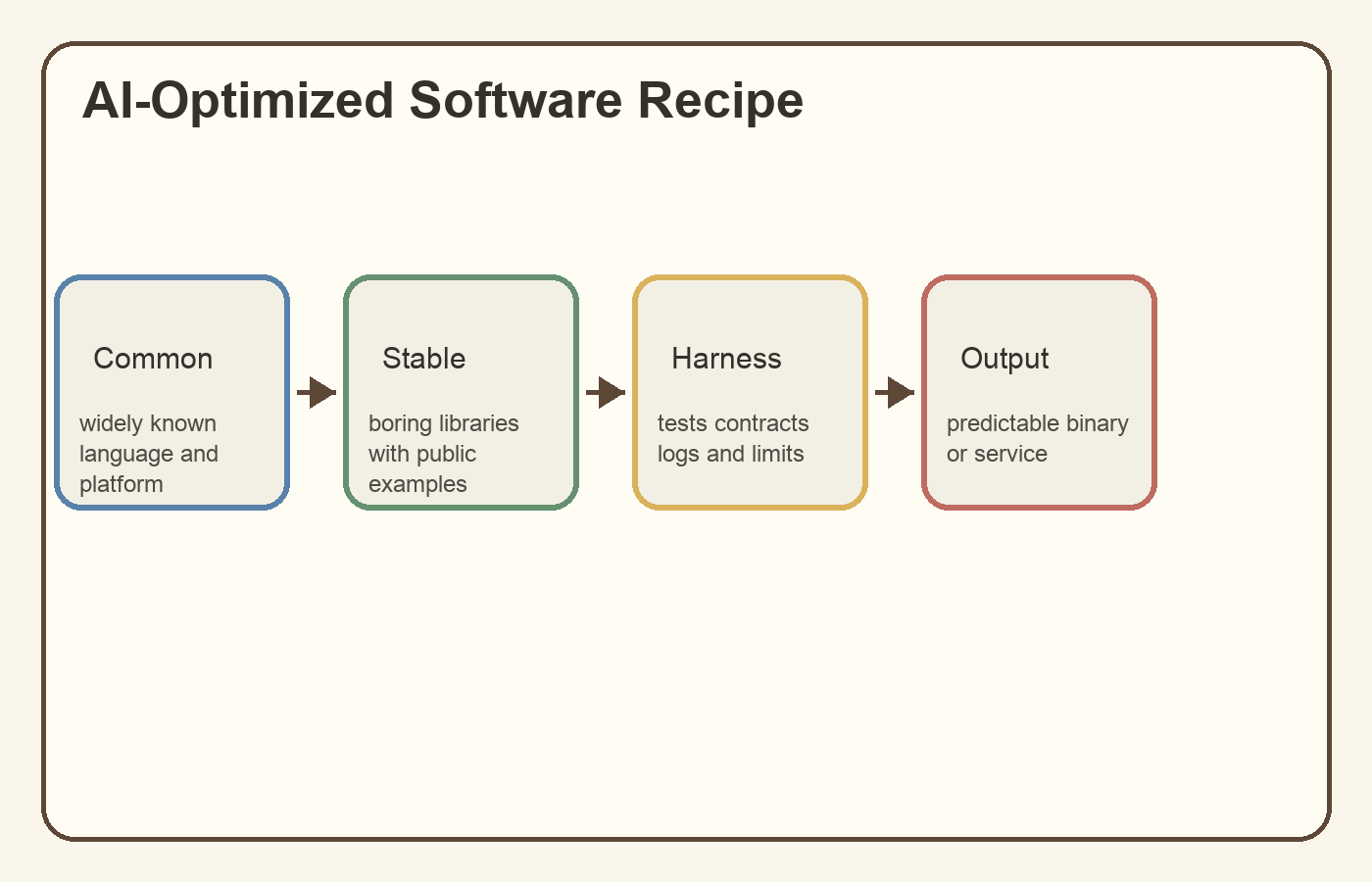
A self-made diagram showing an AI coding recipe built from common languages, stable libraries, harnesses, and predictable outputs

<AI coding recipe structure 1.1>

1. An unfamiliar framework raises the learning curve for AI

For a human developer, a framework is something to learn. It may be difficult at first, but with manuals, examples, and team habits, it becomes comfortable. For AI, a framework is different. A model does not understand a framework in the same way a person does. It reconstructs patterns from repeated code, documentation, open source projects, issues, and answers.

That difference matters. Technologies used around the world have higher probability mass. Python, JavaScript, SQL, REST, HTML, Docker, PostgreSQL, and React have abundant public examples. A private company framework, internal DSL, or undocumented component system is a much stranger language for the model.

Strong harnesses, tests, type systems, code review, and permission limits can block many mistakes. But that protection has a cost. The prompt must keep explaining internal rules. Context must carry exceptions. Every unfamiliar abstraction consumes tokens and creates another verification loop. A framework that improved human productivity can become a learning curve for AI.

Technology choice Effect on human developers Effect on AI
Widely known standard stack Easier hiring and collaboration More training examples, easier prediction
Internal framework Fits internal work More errors if context is missing
Excessive abstraction Reduces repeated human work Makes execution paths harder to infer
Strong test harness Prevents human mistakes Guards AI output
Private DSL Expresses business concepts Raises token cost when examples are scarce

Good design in the AI coding era may therefore look less like a beautiful new framework and more like a recipe the model can predict reliably. Boring, widely known combinations may outperform elegant abstractions. That is also an important lens for practical vibe coding and the broader Software 3.0 transition.

2. The most common technology combinations become AI recipes

GitHub Octoverse 2024 shows Python rising to the top of GitHub usage while Jupyter Notebooks and generative AI projects expanded. That is more than a popularity ranking. Public code is a map for AI. The more code, documentation, examples, and failure discussions exist, the easier the path is for a model.

Stack Overflow Developer Survey 2024 points in the same direction. Developers depend heavily on API and SDK documentation, and tools such as Docker, npm, and PostgreSQL remain widely used. If AI is going to code efficiently, it will likely prefer combinations that the world has already made common, documented, and testable.

The most mature languages and platforms humanity created may be reorganized into AI manuals. A web service recipe might look like TypeScript, React, Node, PostgreSQL, Docker, Playwright, OAuth, and REST or GraphQL. A data product recipe might look like Python, FastAPI, PostgreSQL, Pandas, PyTorch, Docker, OpenAPI, and CI tests. The core value is not novelty. It is probability.

An AI coding recipe is not about chasing the newest tool. It is about choosing combinations that models have seen often, that have many public examples, and that can be tested at clear boundaries.

In that light, the claim that new frameworks for humans may stop appearing becomes plausible. For human developers, a new framework can be a new productivity tool. For AI, a new framework is an under-learned probability space.

3. AI may learn executable assets, not its own human-style framework

If AI optimizes for efficiency, does it need to create its own React or Django? Humans need abstraction. We name things, create layers, write manuals, and memorize examples. AI can work differently. What it needs is not a structure that is pleasant for humans to read. It needs a representation that reliably produces desired behavior.

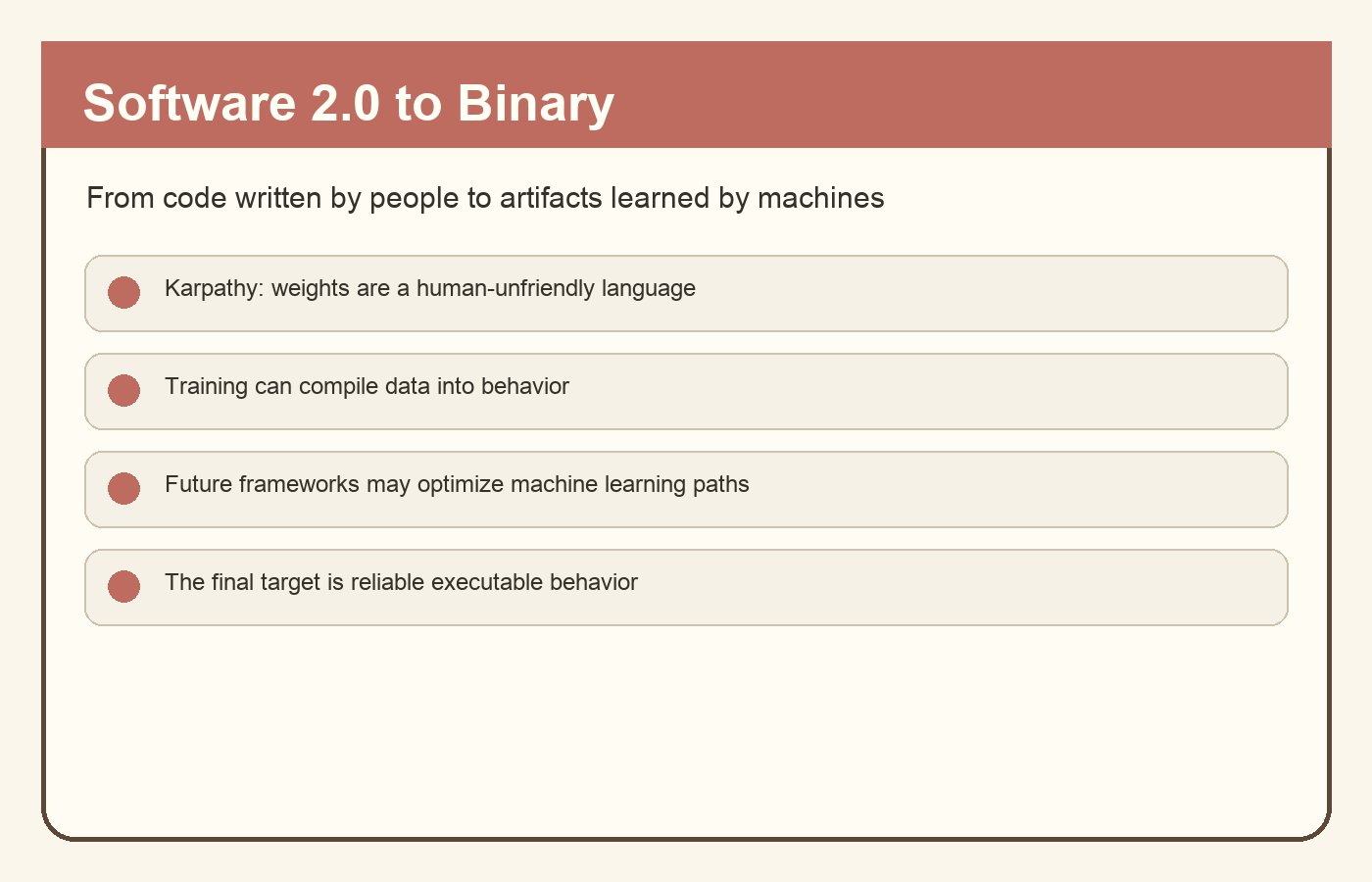
Andrej Karpathy’s Software 2.0 makes this point sharply. Karpathy describes classical software as Software 1.0, written directly by people in languages such as Python or C++. Software 2.0 is written in a much less human-friendly language, such as neural network weights. Dataset and architecture define a search space, and training acts like a compiler that produces the final network. This is the stage before what many now call Software 3.0.

A self-made card explaining the transition from human-written code to data, training, and executable software assets

<Software 2.0 and executable assets 1.2>

Push that frame further and future AI does not need a human-readable framework of its own. It may work directly with functioning binary assets, model weights, executable function bundles, validated service blocks, and evaluation harnesses. For humans, source code is an explanation. For AI, the working behavior itself can become the training target.

This does not mean coding disappears tomorrow. Today’s AI still writes code, compiles it, tests it, and runs it. But that pipeline may exist because of humans and the current computing stack. Learning coding, writing code, compiling, installing, and running may be a long chain built around human comprehension.

4. Code itself may be a human interface

Code feels natural to us because we grew up inside programming culture. But code is not a law of nature. It is a notation humans created to control machines. C, Java, Python, JavaScript, and SQL all exist so people can read, write, discuss, and modify instructions. The computer ultimately wants executable state change, not a pretty source file.

In his Y Combinator talk, Karpathy describes Software 3.0, natural language programming, and the LLM operating system. Natural language remains a human-friendly interface. But under that interface, execution may involve model calls, tools, memory, permissions, datasets, evaluators, and runtime environments, not only text code.

At some future point, coding itself may fade from the center. More precisely, the act of humans directly writing source code may move to the edge. If AI can create and verify reliable executable assets directly, source code becomes a less necessary intermediate form.

Current pipeline Why humans needed it Possible AI-era replacement
Translate requirements into code Humans needed to instruct machines Natural language, examples, simulations, policies
Coding Humans specified execution rules Models create executable assets directly
Compilation Human code became machine format Training or synthesis produces executable behavior
Install and runtime Humans prepared environments Standard in-memory execution environments
Debugging Humans found logical errors Evaluators and repair loops handle more of it

The end of coding is not a romantic prediction. It is a cold technical possibility. If source code is a human-friendly intermediate representation, domains with fewer humans may keep less of that representation.

5. AI frameworks bloom only when bugs approach zero

This does not mean every program disappears soon. We are still at the very beginning of AI frameworks. Current AI development tools remain human-centered. A person writes prompts, reads code, checks tests, approves deployment, and accepts responsibility. Today’s AI frameworks are collaboration harnesses, not full replacements.

A true AI-native framework needs one more condition: the bug rate of AI-generated programming assets must approach zero. If the artifacts used for learning contain many bugs, then the AI’s executable assets can inherit that pollution. A small logical error can be compressed, regenerated, and redeployed quietly.

Brooks’ essential complexity returns here. Less code does not remove the difficulty of payments, healthcare, law, security, accounting, permissions, responsibility, or exceptions. Future AI frameworks may deal with those complexities through evaluations, simulations, safety constraints, policies, datasets, and executable assets instead of human-readable code.

A post-code world cannot arrive safely while generated assets remain noisy. If AI learns from buggy artifacts, it may produce faster, but it may also spread errors faster.

6. What disappears may not be programming, but the program itself

Marc Andreessen’s old phrase “software is eating the world” described how software absorbed industry after industry. The next question is whether AI eats the form of software itself.

Coding, bugs, and analog logical mistakes may be the germs of a digital world built by humans. Humans translate intentions into code, compile code, install it, run it, and then fix the bugs that appear. That detour was powerful for decades, but it is not necessarily eternal.

One distant day, programming may not be the thing that disappears. The program itself may disappear. Users may not install apps. Organizations may not choose frameworks. Developers may not design folder structures. Instead, the needed executable asset may appear in memory, be verified, be used, and vanish.

That future framework will not be a manual humans read. It will define what assets a model may generate, what constraints must hold, what evaluations must pass, and what execution boundaries cannot be crossed. The end of human-centered frameworks is therefore the beginning of AI frameworks.

The conclusion is not that developers vanish tomorrow. It is that the central question changes. Instead of asking whether a framework makes coding easier for humans, we will ask whether it lets AI create executable assets with a lower error rate.

Era Core question Representative tools Durable value
Human development How can people build faster? Frameworks, manuals, components Productivity, collaboration, reuse
AI-assisted development How can people use AI safely? Prompts, tests, harnesses, agents Verification, control, responsibility
AI executable asset era How can AI create working assets directly? Models, evaluations, policies, in-memory assets Error rate, reliability, immediacy

The end of frameworks is not the end of tools. It is the end of an era in which tools primarily helped humans write code more easily. What comes next may not be an easier framework, but software assets people no longer need to read.

Solo founder boom part 1: vibe coding and the quality wall

Solo founder boom: can vibe coding really create economies of scale?

Open YouTube, X, TikTok, or any founder community for long enough and the same story keeps showing up: this is the age of the solo founder. One person can record content, launch a landing page, attach a payment link, and start selling. Add vibe coding to the story, and the pitch becomes even stronger. The phrase vibe coding solo founder now captures the promise that you do not need to write every line of code. You describe what you want, an AI tool builds a working product, and a one person business suddenly looks possible.

I do not think that direction is wrong. In fact, it is probably one of the most important shifts in small business right now. But one question is often missing. Building something alone and turning it into a business with economies of scale are completely different problems. The method that sells 100 units, the method that sells 10,000, and the method that reaches 1 million users are not just larger versions of the same thing. At each stage, the rules change.

The U.S. Census Bureau reported that the United States had 29.8 million nonemployer businesses in 2022, meaning businesses with no paid employees, with $1.7 trillion in receipts. A later Census story said nonemployer establishments kept growing through 2023 and that their average annual growth from 2012 to 2023 outpaced employer businesses. So yes, the era of one person businesses is real. But that does not mean large solo businesses are easy. The data actually suggests the opposite: more people are operating alone, while the number of solo operators that break into large scale remains limited.

The argument of this essay is simple. Solo founding is more possible than before, but big outcomes still depend on IT products, quality and marketing, and the ability to build economies of scale. Vibe coding lowers the cost of getting the first product into the world. It does not remove every bottleneck in the business.

Solo founding became easier, but scale did not

The solo founder boom is persuasive because the tooling really has changed. In the past, one person needed a developer, designer, marketer, support person, payment system, hosting stack, and operations workflow just to get started. Today, many of those layers are available as software. No code builders, payment infrastructure, cloud platforms, generative AI, and automation tools have moved into the hands of individuals.

But a business does not end at “can I build it?” It has to sell. It has to deliver the same thing repeatedly. It has to hold quality when more customers arrive. That is where solo founding gets much harder.

Scale stage What can work Capability required Main bottleneck
100 sales Personal network, communities, hand selling Trust, explanation, fast response The founder’s own time
10,000 sales Content, ads, partnerships, search traffic Distribution, funnels, customer data Marketing efficiency and operations
1 million users Product led growth, network effects, platform loops Product strategy, automation, infrastructure Quality, security, scalability, brand

The point of this table is blunt. The larger the scale, the less a business can rely on the founder’s stamina. Selling 100 pens through friends and personal trust is possible. Selling 10,000 requires distribution, content, advertising, inventory or fulfillment, and customer support. Reaching 1 million users requires a product that carries its own expansion loop. People need to arrive, stay, refer, return, and trust the product without the founder manually pushing every interaction.

That is why modern solo founding almost inevitably needs IT products. By IT products, I do not only mean a venture backed SaaS platform. I also mean booking flows, payment pages, course platforms, automated estimates, customer dashboards, CRM systems, recommendation engines, onboarding emails, community tools, analytics, and anything else that turns repeated work into a system. When Stripe talks about financial infrastructure from the first transaction to the billionth, it is describing this same reality. Modern businesses need payments, subscriptions, billing, data, and automation inside the product if they want to grow beyond the founder’s hands.

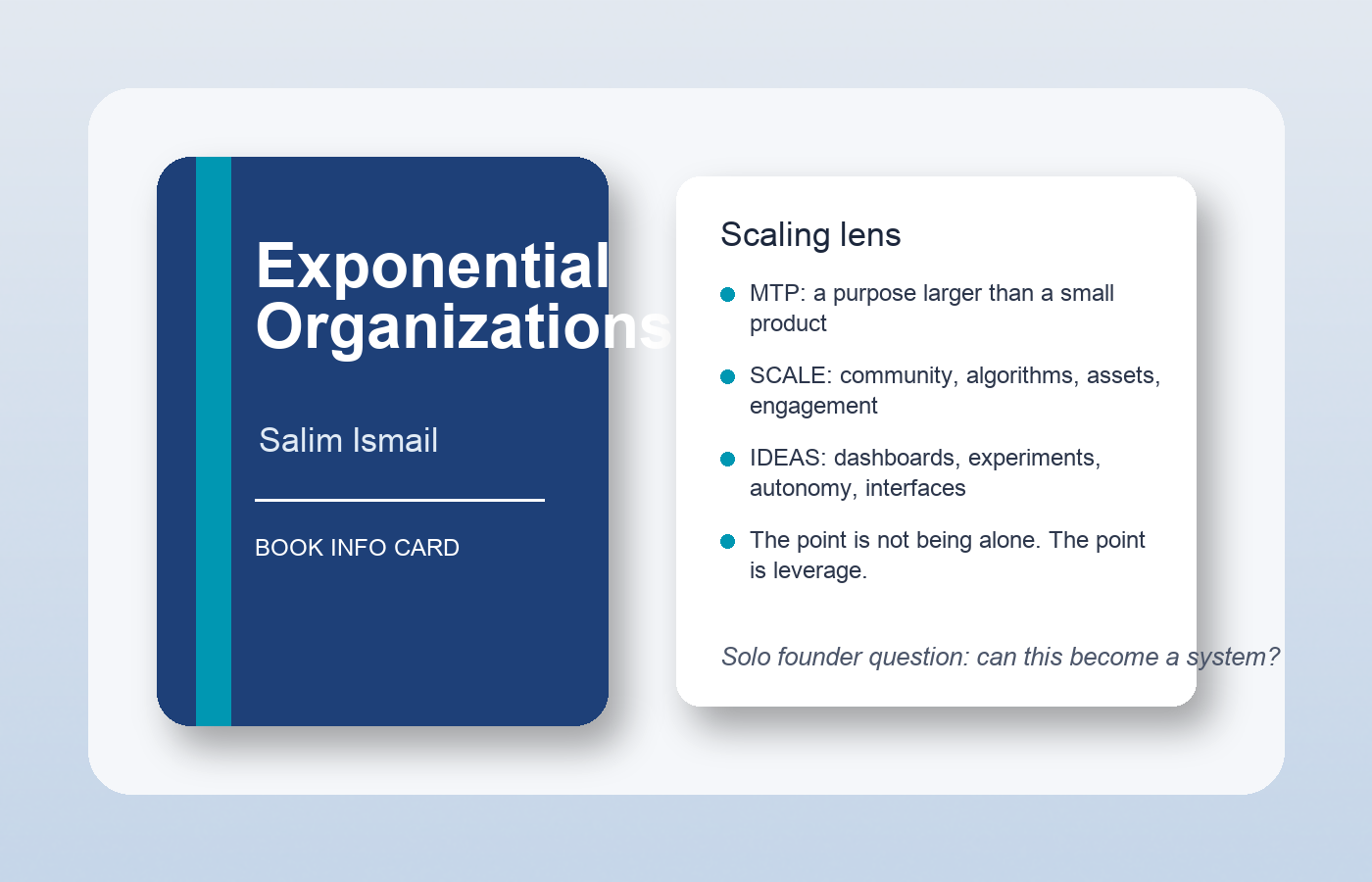
A desk scene showing an Exponential Organizations book information card with scaling notes

<Exponential Organizations book information card 1.1>

Salim Ismail’s Exponential Organizations, published in Korean as 《지수형 인간》, is useful here because it gives language to this exact gap. The book argues that fast growing organizations do not scale only by adding more people. They use information technology, algorithms, communities, external assets, and engagement mechanisms to increase output. Readingraphics’ summary describes the ExO framework through ideas such as MTP, SCALE, and IDEAS. The vocabulary belongs to business books, but the lesson is sharp for solo founders.

If you are working alone, you need leverage even more than a team does. You cannot add staff every time demand rises, so the system has to absorb more of the work. Without that leverage, solo founding is not freedom. It becomes a high pressure self employment job where the founder is the product manager, developer, marketer, salesperson, support desk, and operations team at the same time.

Vibe coding is a strong starting point, but quality is a separate problem

Vibe coding became tied to solo founding for an obvious reason: it lowers the product creation barrier. Business Insider reported on Andrej Karpathy’s February 2025 description of a new style of coding where you “fully give in to the vibes.” In practice, the founder describes a feature in natural language, an AI tool generates code, and the founder keeps testing and steering the result.

This works especially well from zero to one. Landing pages, internal tools, MVPs, simple web apps, and prototypes can be produced much faster than before. Forbes described solo founders using tools such as Replit, Cursor, Lovable, and Claude Code to build digital products and test revenue; that is the same productivity pressure behind AI coding on Mac. Given that shift, it is not surprising that “solo founding equals vibe coding” has become a strong marketing line.

The problem starts after the first version. Human level software quality does not appear just because a lot of code was generated. Good software comes from understanding the customer’s real problem, deciding what not to build, handling edge cases, recovering from failures, checking security, and feeding customer complaints back into product decisions. That work is related to coding, but it is not just coding.

Quality area What vibe coding helps with What the human still owns
First screen and MVP Layout, basic logic, sample data Problem definition and willingness to pay
Feature additions Common implementation patterns Prioritization and scope control
Testing Test scaffolds and repeated checks Deciding which failures matter
Security and scalability Checklists and partial fixes Architecture, permissions, operational responsibility
Customer care Chatbots and email automation Complaint interpretation, refund policy, trust repair

Startups.com’s overview of vibe coding draws a similar boundary. Vibe coding works well for prototyping, greenfield projects, common web app patterns, and automation scripts. It struggles with complex existing codebases, performance critical systems, security sensitive work, complex debugging, and production scale. In other words, vibe coding is a way to get a product into the world faster. It is not an automatic quality guarantee.

This is where the first wall appears: quality and marketing. Quality is not a one time checklist. It is a probabilistic measure built over time. A product working today does not prove that it is good. It has to work for different customers, in different environments, with different mistakes, over many support cycles. It has to become more reliable as complaints repeat. It has to keep basic promises even when the founder is asleep. That takes planning, customer experience, painful iteration, and operations sense.

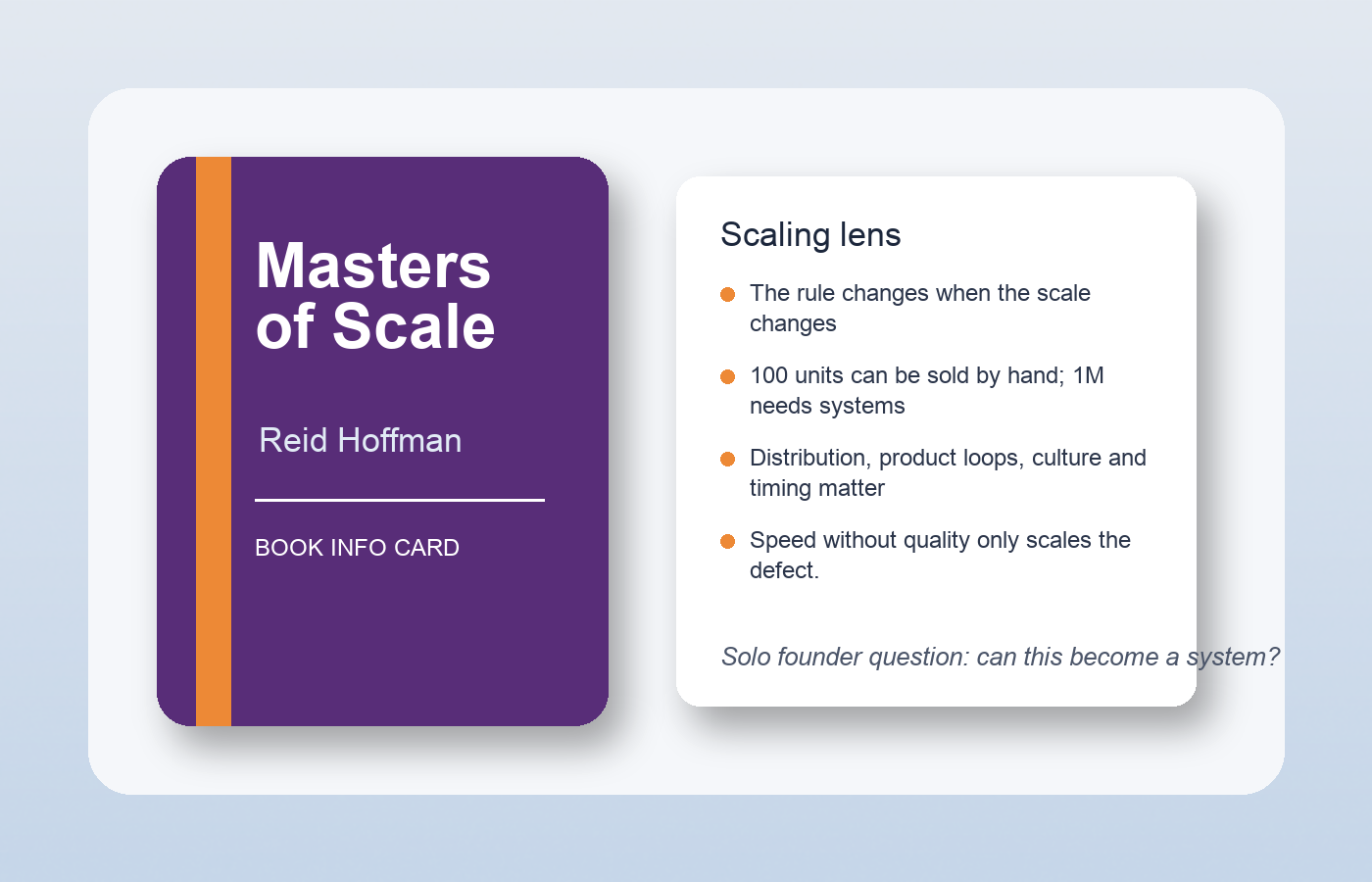
A desk scene showing a Masters of Scale book information card with staged growth notes

<Masters of Scale book information card 2.1>

Reid Hoffman’s Masters of Scale is relevant for exactly this reason. The Masters of Scale profile describes Hoffman as LinkedIn’s cofounder, a Greylock investor, and the host of a show focused on how companies grow. The useful idea is not simply “grow fast.” It is that a company needs different rules at different stages of scale. Manual work that makes sense early becomes a bottleneck later. But automating too early can freeze the product before the founder understands the customer.

So a solo founder using vibe coding has to care about sequence. First, touch the customer’s problem by hand. Then productize the repeated parts. After that, automate the operations that would break as customers increase. Skip that order and a fast built product becomes a fast breaking product.

Thursday, July 23, 2026

Vibe Coding Limits: What It Takes to Ship a Real Product

The core limit of vibe coding is easy to state: code is not the whole product. Natural-language coding tools can turn an idea into screens, routes, database calls, and deployment scripts faster than many people expected. But a working demo is not the same as a product that strangers can trust, use, and pay for.

That distinction matters most for non-developers. The faster a prototype appears, the harder it can be to notice the invisible work that remains: requirements, architecture, testing, deployment, monitoring, customer support, and market entry. Vibe coding is useful. It is just not a substitute for product thinking or disciplined software delivery.

Speed can take you to the wrong destination

Most professional software work follows some version of plan → design → build → test → release → deploy → operate. The names differ by organization, but the pattern is stable: teams decide what problem to solve, design a structure, implement it, move it into a real environment, and keep it alive.

NIST's DevSecOps reference model describes that lifecycle as a connected system rather than a coding-only activity. NIST's Secure Software Development Framework also emphasizes tracking security requirements, design decisions, and vulnerabilities after release.

Phase Question that must be answered What vibe coding often hides
Requirements Whose problem are we solving, and why? Building features users do not actually need
Design How should data, permissions, screens, and failures be separated? Letting local code suggestions become the whole architecture
Development How do requirements become maintainable behavior? Connecting generated code without understanding it
Deployment How will the product move safely into production? Missing secrets handling, backups, rollback, domains, and access control
Operations Who owns incidents, cost, feedback, and changes? Treating launch as the finish line

When analysis is skipped, "what the tool can build" becomes the requirement. When design is skipped, every generated shortcut becomes technical debt. When operations are skipped, nobody knows what to do when the product breaks.

A detailed feature request is not the same as product discovery. It can express a problem you already understand; it cannot automatically uncover customers, constraints, policies, and edge cases you never investigated.

Where vibe coding really helps

Vibe coding shines when the risk is low and feedback is fast. It can produce interface sketches, CRUD screens, API glue, data transformation scripts, and deployment drafts. It also lets non-developers test an idea visually instead of waiting for a full engineering cycle.

That makes AI coding a strong partner for prototypes, internal tools, and early product exploration. It fits especially well when a human can review the structure and when mistakes can be reversed quickly. The broader trend toward AI coding agents will make this style of work even more common.

But speed is not automatic productivity. METR's 2025 study of experienced open-source developers found that, in the studied setting, developers using AI tools took 19% longer on average than those who did not. That result should not be generalized to every tool or workflow. It is a useful warning against assuming that generated code is always faster once review, debugging, and integration are included.

Good candidates for vibe coding include:

  • prototypes that test whether an idea is understandable
  • small internal automations with limited users
  • repetitive code generation that a human can inspect
  • early deployments where rollback is simple and failure cost is low

Poor candidates include payments, personal data, complex permissions, medical or financial decisions, and high-concurrency systems. In those areas, verifiability matters more than generation speed.

A conceptual image showing polished code blocks separated from unfinished testing, operations, and marketing pieces

<The last-mile gap between vibe coding and product readiness 2.1>

The last few percent come from human testing

The "last few percent" is not a measured industry statistic. It describes the gap between a demo that works for its creator and a product that unfamiliar users can complete confidently. In that zone, producing more code often helps less than watching real people struggle with the product.

Automated tests are excellent for known rules: failed login, bad input, duplicated requests, API responses, authorization mistakes, and data consistency. They are weaker at noticing that a button label feels risky, an error message sounds accusatory, a checkout step creates doubt, or a workflow simply feels annoying.

Nielsen Norman Group's Usability Testing 101 explains the value of observing representative users as they perform real tasks. This kind of testing is not about statistical certainty. It is about discovering why someone hesitated, misunderstood, or gave up.

A practical split helps:

Logic testing

  • Can a new user complete the core task without explanation?
  • Do invalid inputs, double-clicks, and network failures preserve data correctly?
  • Can unauthorized users access someone else's information?
  • Can a failed deployment or incident be rolled back?

Experience testing

  • Does the first screen make the product's purpose obvious?
  • Do labels and error messages reduce anxiety instead of blaming the user?
  • Does the product give enough feedback before important actions?
  • Would a user trust the flow enough to return?

Non-developers often have an advantage here. They may not read the code, but they can notice customer language, operational context, awkward flow, and emotional friction.

Marketing is part of product readiness

A technically impressive product still fails if nobody finds it. Search results, app stores, communities, newsletters, partnerships, and sales channels are not afterthoughts. They are part of the product's path to a real user.

The U.S. Small Business Administration's market research guide frames market research as a way to find customers and reduce risk. For vibe-coded products, that work should begin before the feature list is complete.

A simple market-readiness checklist is enough to start:

  1. Define one customer group. Avoid "everyone." Pick the group with the most painful problem.
  2. Interview before pitching. Ask at least five people how they solve the problem now.
  3. Choose one acquisition path. Start with search, one community, a newsletter, a partner, or a sales motion.
  4. Track behavior, not vanity metrics. Focus on signup, first successful task, return use, or payment intent.
  5. Repeat the message. Describe the outcome users get, not only the features the tool has.

The conclusion is not that vibe coding should stop. It is that the tool's speed belongs mainly in development and early deployment. Requirements, design, testing, operations, and marketing still need human ownership. That is how a fast demo becomes a product that survives contact with real users.

404 Dev Room 30 - Taming

Series · 404 Dev Room Webtoon · Ongoing Episode 30 · 404 Dev Room 30 - Taming The trainer in the AI coding room has changed. <...