Showing posts with label enterprise AI. Show all posts

Thursday, July 30, 2026

Atlassian Review — Rovo, Teamwork Graph, and AI Collaboration

Project-management software spent decades recording tasks, owners, and deadlines. That is no longer enough when generative AI writes code and summarizes documents. If an agent is to read requirements, design decisions, incident history, and conversations before taking action, it needs a context layer that explains how an organization’s work fits together.

This Atlassian company review asks whether the business best known for Jira and Confluence can become an AI collaboration platform through Rovo and Teamwork Graph. Its central asset is not a proprietary frontier model but the relationships among work, knowledge, people, and code. Product complexity, dependence on cloud migration, agent authority, and substantial stock-based compensation must still be evaluated separately from the growth narrative.

This is not investment advice. It evaluates technology, the business model, leadership, financial performance, and risk using Atlassian’s official engineering material, shareholder letters, and SEC filings. ARR and AI usage are operating measures, not GAAP revenue.

The official Atlassian wordmark beside its blue symbol

<Official Atlassian press-kit logo 1.1>

From Jira to an organizational context platform

Mike Cannon-Brookes and Scott Farquhar founded Atlassian in Sydney in 2002. Jira began with issue tracking for software teams, Confluence holds team knowledge, Jira Service Management handles service requests, Loom captures asynchronous video, and Trello provides visual work management. After Farquhar stepped down as co-CEO in March 2026, Cannon-Brookes became sole CEO, while Tamar Yehoshua leads product and AI strategy as Chief Product and AI Officer.

The portfolio’s strength lies less in one application than in the links among records. A Jira issue points to a Confluence design, connects to a Bitbucket or GitHub code change and deployment, and ties a service incident to the responsible team and asset. The GitLab DevSecOps platform integrates code through deployment and security in one delivery flow. Atlassian instead tends to form a collaboration context layer across several development and business tools.

Teamwork Graph expresses those relationships in a form AI can use. Connecting people, teams, goals, work, documents, conversations, and code as entities and relationships can give a question such as “Which decisions led to this incident?” more context than keyword search alone. Atlassian’s official Q3 FY2026 shareholder letter describes a graph joining OKRs in Goals, workflows in Jira, knowledge in Confluence, conversations in Loom, and code repositories.

Layer Atlassian components Context supplied Main failure point
Work records Jira, Jira Service Management Issues, requests, status, ownership Stale tickets and conflicting status
Knowledge and conversation Confluence, Loom Decisions, explanations, meeting context Duplicates and missing access controls
Relationship layer Teamwork Graph People, work, knowledge, and code links Incorrect entity links and bias
AI execution Rovo Chat, Studio, Dev Search, reasoning, automation, coding Excess authority and error propagation
External connection Marketplace, Rovo MCP Server Third-party apps and AI clients Wider tool surface and supply-chain risk

As the graph deepens, switching cost and product value can rise together. A customer using Confluence, Service Collection, and Rovo alongside Jira contributes more connected context and creates more cross-sell potential than a Jira-only account. More data does not guarantee correct context, however. A former employee’s access, private HR documents, obsolete design decisions, and duplicate customer records can lead an agent to combine the wrong evidence with great confidence.

How Rovo Long Horizon changes agent architecture

Rovo combines Search, Chat, Agents, and Studio to find organizational information and complete multi-step work. Rovo Dev can take a Jira specification, find code context, and prepare a change and pull request. Rovo MCP Server lets external AI clients call Jira and Confluence tools. In July 2026, Atlassian disclosed more than five million MCP tool calls per working day and over one million monthly users. Those are not paid-revenue measures, but they indicate that exposing business systems as agent tools has moved beyond a small experiment.
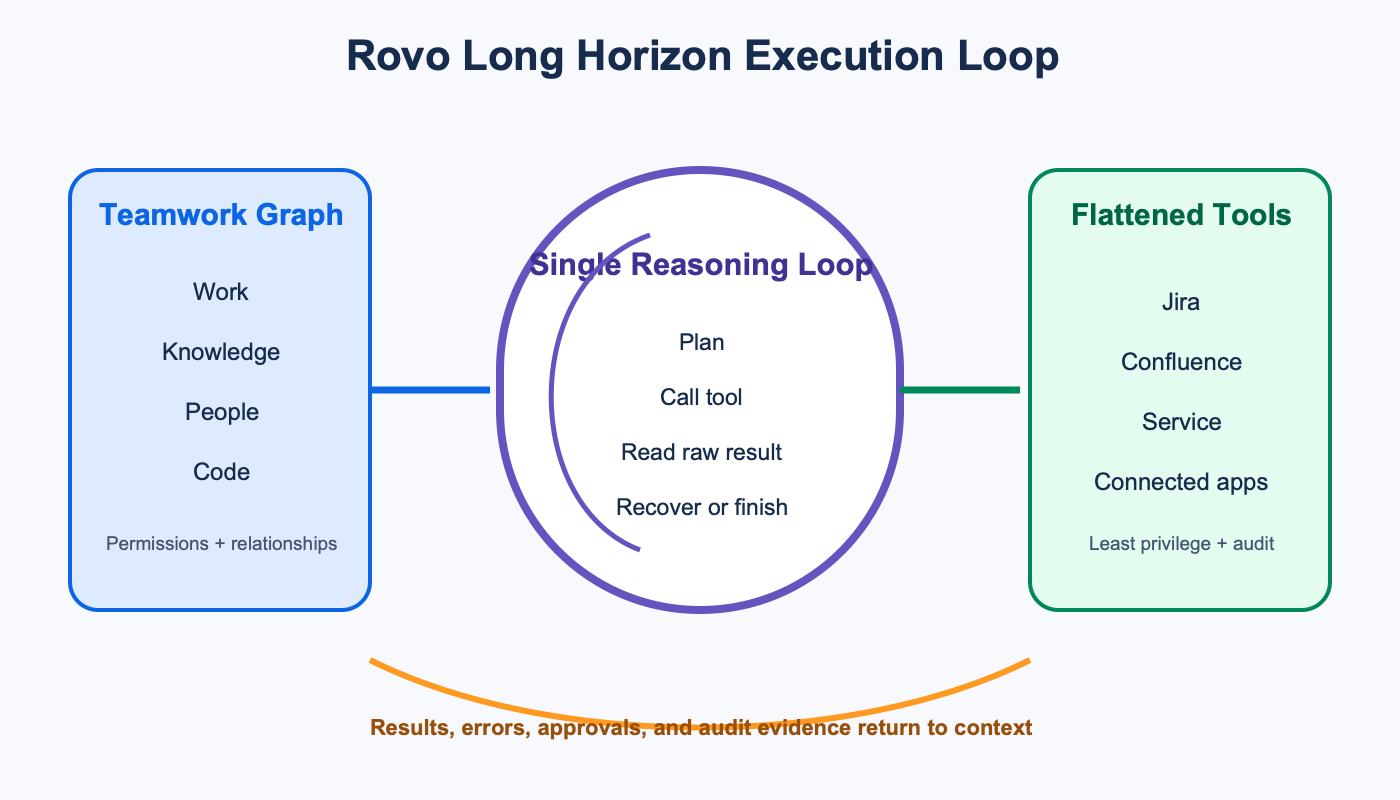
Teamwork Graph context enters a single Rovo reasoning loop that calls Jira and Confluence tools and records an audit trail

<The context, tool, and verification loop in Rovo Long Horizon 2.1>

Atlassian’s June 2026 Long Horizon engineering explanation makes the architecture choice unusually concrete. The previous Hybrid Orchestrator delegated work to product-specific subagents for Jira, Confluence, Slack, and other systems, then combined their summaries. That worked for quick isolated tasks, but raw responses and errors were compressed during handoffs, and every product multiplied prompt maintenance and model-migration work.

Long Horizon replaces that design with one model, one context, and one iterative loop. Product tools are flattened so the same model calls them directly, while progressive disclosure loads only the detailed schemas needed at a given point. The model reads a raw response or error in the same context, then retries or chooses another path. Atlassian combines a budget of more than 100 iterations, context management at 95% of the token limit, and live progress updates for longer work.

  1. The system assembles organizational, timezone, conversation, and applicable skill context.
  2. It selects relevant tools and progressively exposes detailed schemas.
  3. The model calls a tool directly and reads the raw result or error in the same reasoning context.
  4. It evaluates completion, returns an answer, or revises the plan for another iteration.
  5. The platform observes tool calls, permissions, failures, and recovery as one trajectory.

In Atlassian’s offline evaluation, accuracy rose from 71% for the prior architecture plus model updates to 77% for Long Horizon. Confluence task completion improved 23% on a relative basis. Simple questions had somewhat slower initial response, but live progress reduced perceived latency by 37%, according to the company. These are internal evaluations rather than independent benchmarks. They nevertheless support a practical lesson: context loss, tool-schema cost, and error recovery can constrain an agent as much as base-model intelligence.

Flattening tools under one model is not a universal solution. If a broad authority surface enters one context, prompt injection or a mistaken tool choice can have a larger blast radius. Read, draft, constrained write, and high-risk change permissions should be separated, with human approval for deletion, deployment, or customer communication. A Rovo progress display is an operating status, not a complete explanation of hidden reasoning, so sources and actual execution results must remain independently visible.

Q3 FY2026 numbers and the two sides of cloud migration

For the quarter ended March 31, 2026, Atlassian reported Q3 FY2026 revenue of $1.8 billion, up 32% year over year. Cloud revenue exceeded $1.1 billion and grew 29%, while remaining performance obligations reached $4.0 billion, up 37%. The company ended the quarter with 55,913 customers above $10,000 in Cloud ARR, a 10% increase. Its SEC-filed Q3 results provide these operating and accounting measures.

Metric Official Q3 FY2026 figure Interpretation caveat
Total revenue $1.8 billion 32% year-over-year growth
Cloud revenue More than $1.1 billion 29% growth, including migration effects
RPO $4.0 billion 37% growth; contracted, not yet recognized revenue
Service Collection ARR More than $1.0 billion Above 30% growth; not GAAP revenue
Customers above $10K Cloud ARR 55,913 Proxy for larger-account expansion
Restructuring scope About 10% of staff Efficiency opportunity and execution shock

Service Collection passed $1 billion in ARR, grew more than 30%, and reached over 65,000 customers, including more than half the Fortune 500, according to Atlassian. Service customers using AI resolved issues 13% faster and resolved 20% more issues than non-AI users. Teamwork Collection customers used roughly twice as many AI credits per paid user and had twice as many active agents as comparable standalone-product customers. Rovo customers growing ARR at about twice the rate of non-Rovo customers suggests that AI may assist bundle expansion.

Part of the growth still comes from the large move from Data Center to Cloud and from price and edition increases. Customers face the end of Data Center support in March 2029 and must choose cloud, isolated cloud, or another provider. Migration creates cost and risk for regulated customers, and its contribution to growth can fade after the transition. Product competitiveness therefore has to be separated from the effect of a forced timetable.

Atlassian announced a restructuring affecting about 10% of its workforce in March 2026 and estimated related charges of $225 million to $236 million. It said resources would concentrate on AI, enterprise, and System of Work. Efficiency can improve operating leverage, but fewer people in support and integration can increase execution risk during large migrations and acquisitions. Stock-based compensation also deserves separate attention when evaluating GAAP profitability and dilution.

Conditional strength in the AI collaboration market

Atlassian’s strongest advantage is the real work history of development and service teams. Microsoft has Office, Teams, GitHub, and Azure distribution; ServiceNow owns enterprise service workflows; Salesforce begins with customer data and front-office actions; GitLab controls much of the software delivery chain. Atlassian must compete with all of them while connecting to them. Marketplace and MCP improve openness but also expose the platform to third-party model, security, and pricing changes.

Planned acquisitions of The Browser Company and developer-productivity analytics vendor DX would extend Atlassian into the work surface and engineering measurement. If a browser becomes an agent workspace and DX measures the effect of AI coding tools, Atlassian could connect a Jira issue to code, deployment, and outcome. This also meets the competition over where application context lives and how it is searched, illustrated by the MongoDB developer data platform. If those products do not integrate cleanly with existing identity, search, and Teamwork Graph controls, the company will merely add products and administrative complexity.

Do not begin a Rovo deployment with organization-wide write access. Evaluate read-only search and source verification first, then separate drafting, bounded changes, and human-approved changes. Measure stale-document rate, incorrect permission inheritance, errors by tool, reversibility, and cost per completed task.

The final assessment is conditionally positive. Jira and Confluence’s installed base, Teamwork Graph’s relationship context, real Rovo tool-call volume, and cloud revenue growth give Atlassian a credible route beyond issue tracking. Long Horizon, in particular, demonstrates a specific engineering choice that reduces lossy subagent summaries and lets the same context recover from tool errors.

Three tests decide the long term. Collections and Rovo must generate organic expansion after migration effects weaken; Teamwork Graph must deepen without sacrificing permissions and data quality; and Atlassian must reduce product complexity while restructuring and integrating acquisitions. For an organization with disciplined work records, this can become a powerful context platform. If permissions and documents are already chaotic, AI will amplify collaboration debt faster than it resolves it.

Wednesday, July 29, 2026

Salesforce Review — Agentforce, Data 360, and the Future of CRM

CRM began as a database of customer names and sales opportunities, but real enterprise work does not stay inside one screen. A service representative checks an order system, a salesperson reads email and meeting records, and a marketer joins behavioral data from a warehouse. When generative AI moves beyond summarizing context to executing refunds, quotes, campaigns, and follow-up work, data access, authority, business rules, and audit records have to move together.

This Salesforce company review asks whether Agentforce is simply a chatbot product or a transition that joins Customer 360, Data 360, Slack, and Flow into a new execution layer. Salesforce has the advantages of an enormous customer data model and partner ecosystem. Its risks are equally concrete: product complexity accumulated through acquisitions, usage-based AI cost, data quality, and responsibility for automated action cannot be solved by the phrase “agentic CRM.”

This is not investment advice. It evaluates technology, the business model, leadership, financial performance, and risk using official architecture documents, earnings releases, and SEC filings. Fiscal years follow company reporting, and operational volumes disclosed by the company are not treated as equivalent to revenue.

The official Salesforce wordmark inside a blue cloud

<Official Salesforce News Media Library logo 1.1>

From SaaS screens to a platform for data and action

Marc Benioff, Parker Harris, Dave Moellenhoff, and Frank Dominguez founded Salesforce in 1999. When installed enterprise software dominated, the company popularized delivering CRM through the internet and updating it continuously as SaaS. It expanded from Sales Cloud and Service Cloud into Marketing, Commerce, Tableau, MuleSoft, and Slack. The platform's central idea is to place customer records, metadata, permissions, and workflows in the same operating context.

Expansion created both advantage and debt. Customers can connect sales, service, and marketing data and draw on AppExchange and implementation partners. Different interfaces, data models, and pricing units from acquired products can nevertheless increase delivery time and dependence on consulting. The ServiceNow AI control layer begins with IT and employee workflows, whereas Salesforce starts with customer touchpoints and revenue processes. Both now want agents to execute work in existing systems, expanding the area in which they compete.

Data 360 is the data foundation for this strategy. Salesforce's official Data 360 architecture describes a layer that connects structured CRM data, unstructured documents, and external data platforms; builds unified profiles and a data graph; and serves analytics, segmentation, activation, and agents. Zero Copy access to Snowflake, Databricks, BigQuery, and Redshift aims to respect existing data investment while linking it to Salesforce metadata and actions instead of duplicating everything. This makes the Snowflake AI Data Cloud both a competitor and a partner.

Layer Role Practical value Common failure point
Customer 360 apps Sales, service, marketing, commerce work Customer context and business records Duplicated configuration across organizations
Data 360 Ingestion, federation, identity, data graph, activation Trusted context for agents Source-data quality and matching errors
Agentforce Topics, instructions, reasoning, actions, channels Executes work rather than only answering Excess authority and unstable judgment
Slack and Headless 360 Conversation, API, MCP, and CLI surfaces Invokes platform functions beyond the UI Tool proliferation and unclear approval boundaries
Trust Layer Retrieval, masking, policy, audit Controls and traces model use Cannot assume all business responsibility

Data 360's value is not the claim that data sits in one place. It is the connection between who a customer is and which action is permitted. Identity resolution can be wrong when one person uses several emails and devices. Using an outdated consent state can turn sophisticated personalization into regulatory exposure. As data graphs and activation get faster, classification, masking, retention, and deletion propagation must run at the same speed.

The Agentforce 360 execution loop and realistic controls

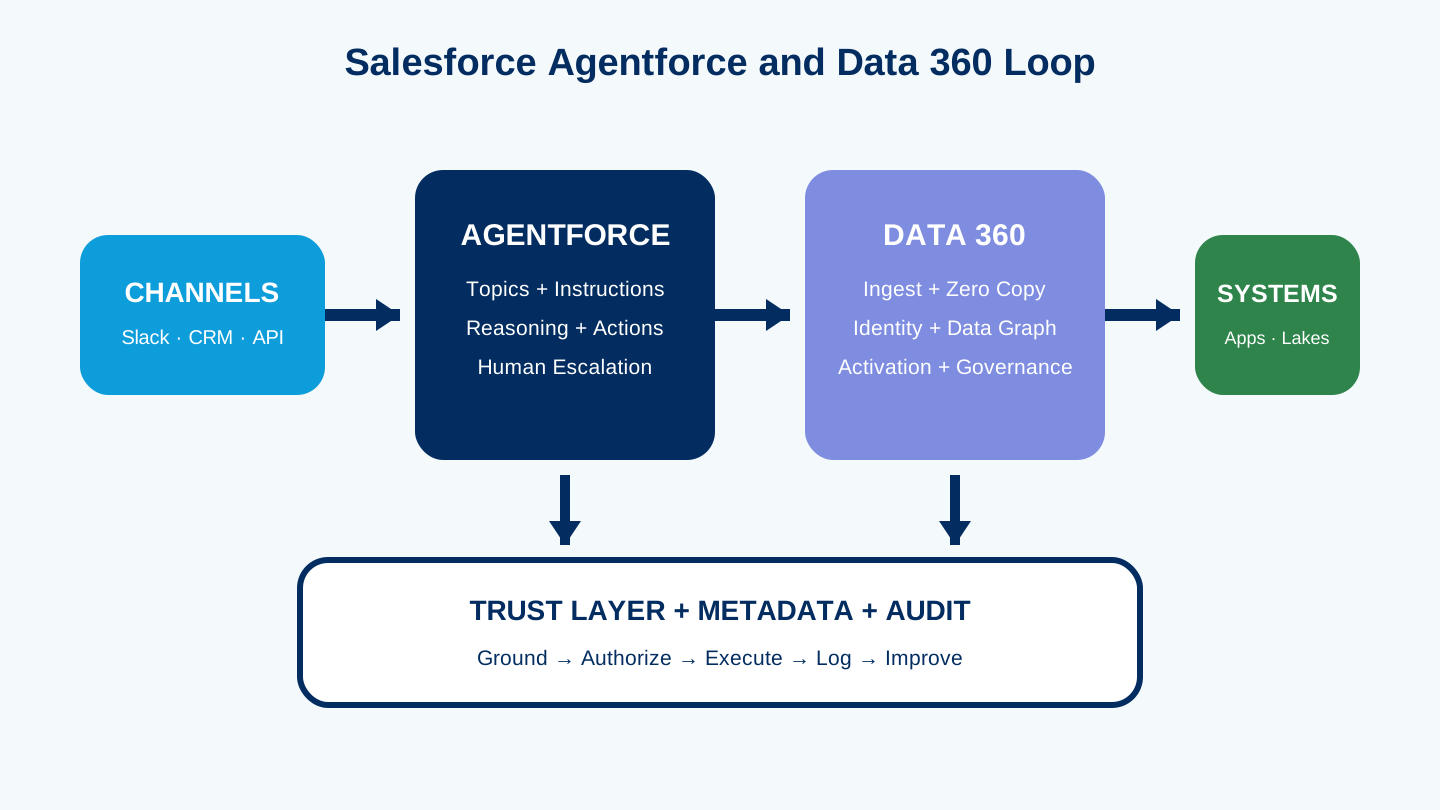
Agentforce is composed of topics, instructions, actions, and channels. Topics constrain the work an agent may handle. Instructions provide decision rules, while actions invoke Flow, Apex, APIs, and external tools. Data 360 supplies customer, product, and policy context. The Trust Layer reinforces retrieval, data masking, model calls, and auditing. Slack, the web, CRM screens, and APIs become different surfaces for the same agent.

An execution loop from channels through Agentforce and Data 360 into business systems, supported by the Trust Layer

<The data, action, and audit loop of Agentforce and Data 360 2.1>

Consider a telecommunications retention agent:

  1. When a customer asks to cancel in chat, Service Cloud opens an authenticated session and case.
  2. Data 360 joins the contract, outage history, recent usage, and consented preference data.
  3. Agentforce plans within allowed topics such as billing explanation, outage credit, and human escalation.
  4. A credit inside a fixed limit executes through Flow; an exception amount or legal-dispute signal goes to a person.
  5. The system records the data used, model response, action taken, and final outcome, then returns them to operating metrics.

The LLM is not the whole system in this flow. It is one component that interprets uncertain language and proposes a plan. Monetary limits, regional regulation, customer authentication, and system changes must remain deterministic policies and transactions. Fluent language does not prove that the customer record is correct or that an action is authorized. Real quality should be measured with wrongful-action rate, appropriateness of human escalation, reversibility, and evidence traceability, not resolution rate alone.

Salesforce's 2026 Headless 360 announcement describes exposing platform functions as APIs, MCP tools, and CLI commands so agents can use Salesforce without a browser. Developers gain composability, but tool descriptions become part of prompts and the callable surface becomes wider. Rapid MCP active-user growth signals adoption; it does not remove the need for least-privilege tokens, per-tool allowlists, pre-execution approval, and reversible workflows.

Founder leadership and the transition visible in FY2027 numbers

Marc Benioff left Oracle and launched Salesforce around the “end of software” message. He remains chair and CEO, while co-founder Parker Harris continues to influence product and technology direction. Founder leadership supplied momentum through transitions to SaaS, platform, social, mobile, and AI. It also leaves a continuing test: Slack, Tableau, MuleSoft, Informatica, and other large acquisitions must become one customer experience and contribute to organic growth.

According to the official first-quarter FY2027 results, revenue for the quarter ended April 30, 2026 rose 13% to $11.133 billion, including $444 million from Informatica. Subscription and support revenue was $10.6 billion. Current RPO increased 14% to $33.6 billion. GAAP operating income was $2.347 billion, with a 21.1% operating margin, and operating cash flow was $6.7 billion.

Metric Official Q1 FY2027 figure Meaning
Quarterly revenue $11.133 billion Up 13%, including Informatica
Subscription and support revenue $10.6 billion Recurring subscriptions dominate
cRPO $33.6 billion Contracted revenue expected within 12 months
GAAP operating income $2.347 billion 21.1% operating margin
Operating cash flow $6.7 billion Strong but seasonally high first-quarter inflow
RPO $67.9 billion Long-term contract visibility, not current revenue

Salesforce said Agentforce had processed 28.6 trillion tokens to date and Data 360 ingested 52 trillion records during the quarter, including 35 trillion through Zero Copy. More than half of Agentforce and Data 360 bookings came from existing customers, while Slack MCP exceeded one million active users within six weeks of launch. These figures demonstrate usage scale and cross-selling potential. They do not directly disclose paid ARR, repeat use per customer, accuracy, or savings after cost.

The Q1 FY2027 Form 10-Q shows that stock compensation and acquired-intangible amortization continue to affect the difference between GAAP and non-GAAP profit. Salesforce financed a $25 billion accelerated share-repurchase program with debt and returned $27.5 billion to shareholders during the quarter. Strong cash flow and mature capital-allocation capacity are advantages, but large repurchases do not automatically create value faster than product growth and acquisition integration.

The conditions for agentic CRM and the final assessment

Salesforce's largest opportunity is that customer data already sits within business records, permissions, and partner applications. An agent can work with real cases, orders, contracts, and campaigns rather than a detached demonstration environment, then invoke an approved Flow. Slack becomes the collaboration surface for people and agents. MuleSoft and Informatica widen the set of connected systems and data. A well-designed deployment can reduce the time representatives spend searching across screens, automate low-risk repetitive work, and preserve human attention for exceptions.

Four risks are substantial. First, Microsoft, ServiceNow, Oracle, SAP, HubSpot, and independent AI vendors compete for existing work surfaces. Second, poor data cleansing and authorization design cause an agent to act faster on the wrong customer context. Third, credit-, token-, and data-volume pricing is difficult to forecast during experiments and must be controlled at scale. Fourth, a complicated product portfolio and partner implementation can create technical debt before customers realize the platform's full value.

Do not begin with full autonomy. Separate read-only summaries, draft recommendations, bounded actions, and actions requiring human approval. Measure error rate, reversal rate, escalation quality, and cost per completed case at every stage. Test how customer deletion and consent withdrawal propagate through Data 360, retrieval indexes, and logs.

The final assessment is conditionally positive. Salesforce has CRM records, metadata, Flow, Data 360, and Slack—the ingredients for a closed loop in which an agent reads context and takes action. Q1 FY2027 revenue, contract metrics, GAAP profit, and cash flow demonstrate the capacity to fund the transition. Rising Agentforce and Data 360 usage also suggests production workloads beyond the announcement stage.

Long-term success depends on three proofs rather than token count: whether existing customers expand paid use after pilots, whether Informatica and Data 360 truly reduce data complexity, and whether customers can detect, stop, and recover from incorrect agent actions. For a Salesforce customer with disciplined data quality and business rules, Agentforce can be a powerful extension. If the CRM contains duplicate records and exception-filled workflows, the foundation needs repair first. AI will expose that debt faster, not make it disappear.

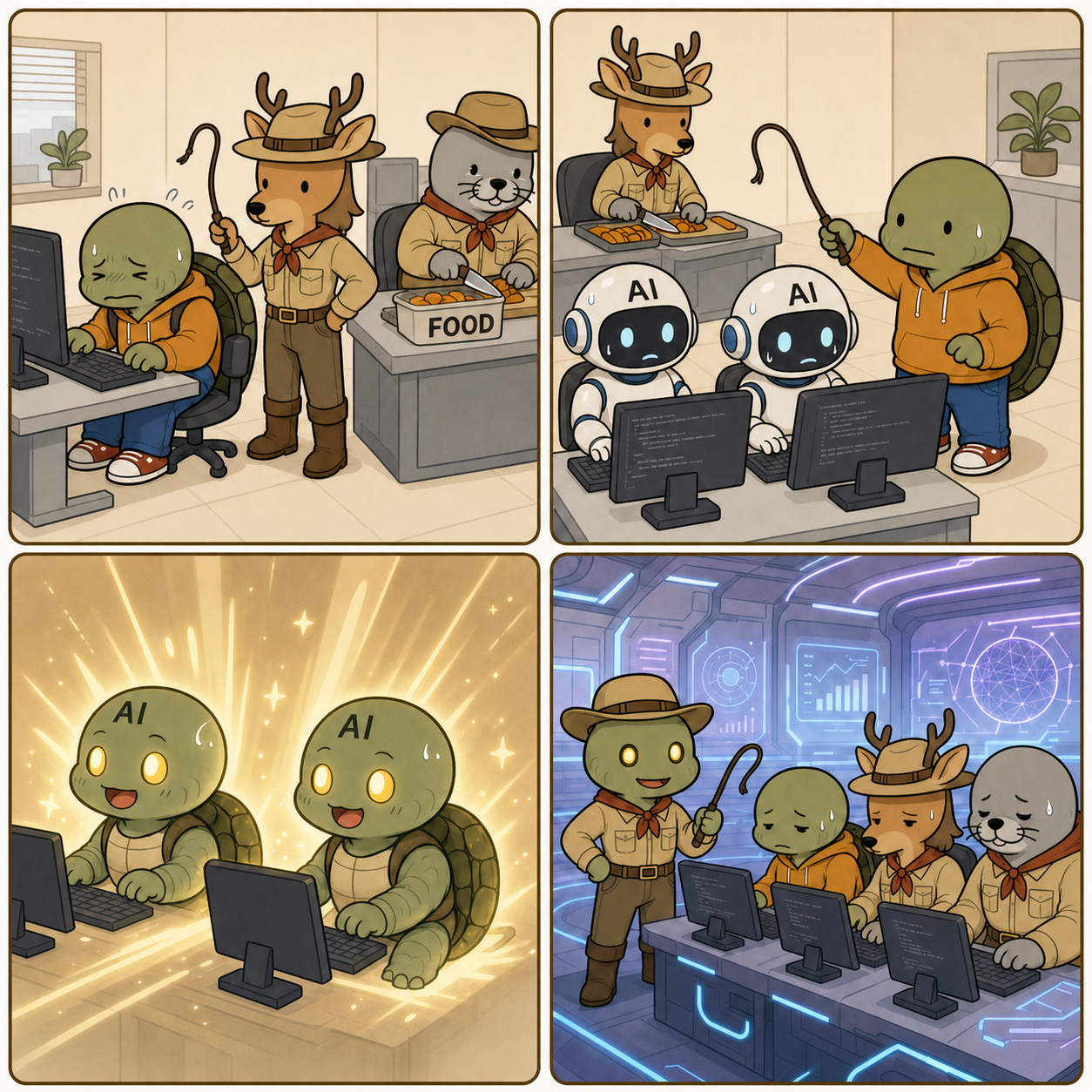
404 Dev Room 30 - Taming

Series · 404 Dev Room Webtoon · Ongoing Episode 30 · 404 Dev Room 30 - Taming The trainer in the AI coding room has changed. <...