AI took the work, and the subway passengers changed.
<From people to AI robots on the subway 1.1>
Panel details
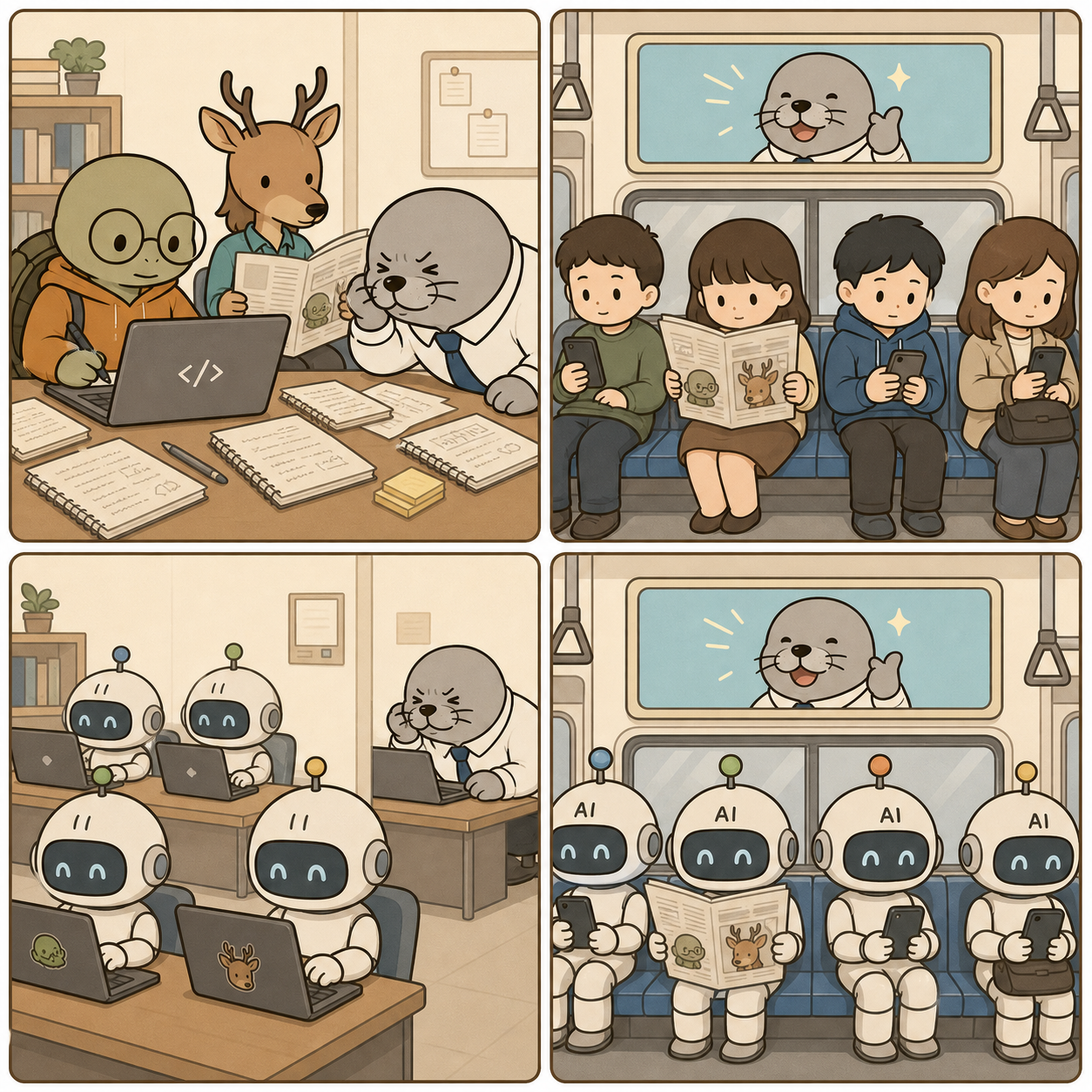
Kkobugi wears glasses and writes on a laptop. Messy paper notebooks covered with notes are scattered beside it. Saseum reads a newspaper nearby, while Mulbeom squints and leans close to the laptop because he cannot see well.
Passengers on a subway look at newspapers and phones. Drawings of Kkobugi and Saseum are visible behind one newspaper, and an overhead subway advertisement shows Mulbeom smiling as the model.
Several AI robots write on laptops. Kkobugi's mark is visible behind one laptop, and Saseum's mark is also visible. Mulbeom still squints at a laptop from the corner.
The same subway composition as panel 2 now has robots instead of people. AI is written on the robots' foreheads. The Kkobugi and Saseum drawings behind the newspaper and the smiling Mulbeom in the subway advertisement remain the same as in panel 2.
Intent 404 Dev Room episode 29, Grave, satirizes people recording information, AI taking over the work, and subway passengers turning into robots in a 2x2 four-panel webtoon.
Gemini 3.6 Flash is the latest fast-response branch in Google’s Gemini API model lineup. The important word is “Flash.” Instead of spending the longest possible reasoning budget on every request, it is designed around wide input, quick turnaround, and lower-cost repeated calls across documents, images, code, and audio. That makes the more interesting question not whether it is a smarter chatbot, but where it belongs in an agent that repeatedly calls tools, checks results, and revises its work. The practical adoption question is AI agent cost: how a multimodal AI model with long context AI capabilities should be routed inside a product.
Google’s Gemini API model documentation describes Gemini 3.6 Flash as a model that can handle text, image, video, and audio inputs with text output. The latest models guide and API changelog also show why developers need to verify model names, supported inputs, and feature availability against the live API documentation. For a fast model, the design center is less “what can it answer once?” and more “where should repeated calls sit in the workflow?”
Background: the bottleneck after the large-model race
In a real AI product, the expensive moment is often not a single answer. It is the failed iteration. Search, file reading, code edits, test runs, summaries, and another round of edits can multiply model calls quickly. As earlier Claude 4 agentic coding patterns showed, using the strongest model at every step can stabilize quality, but it also raises latency and cost. Using only a cheaper model can introduce mistakes in tool order, long-context handling, or final reasoning.
A fast multimodal model such as Gemini 3.6 Flash targets that middle layer. It can take in a broad bundle of documents, screenshots, logs, and short media descriptions, then reserve deeper reasoning for the moments that actually require it. Independent hands-on reviews tend to highlight speed and everyday task handling as strengths while still warning that complex reasoning and factual claims need separate checking. That is not simply a weakness; it defines the value of the Flash tier. Its strongest role is often running the loop cheaply and quickly, not making every final decision by itself.
Design question
Where Gemini 3.6 Flash fits
What still needs care
Are there many documents and a short answer?
Meeting notes, logs, and requirements summaries
Preserve links to supporting passages
Does the input include images or screens?
Screenshot classification and UI-state explanation
Recheck small text, charts, and visual details
Will an agent call the model repeatedly?
Planning drafts, candidate filtering, result cleanup
Put final decisions through stricter checks
Is latency a core product constraint?
Chat-style work assistants and real-time support
Measure the speed-accuracy tradeoff in production
Principle: read broadly, iterate lightly
Imagine an internal development assistant asked to summarize the cause of last week’s payment outage and draft a prevention checklist. The agent has to inspect incident tickets, deployment logs, Grafana screenshots, related code diffs, and customer-support summaries. A Flash model can quickly scan that bundle, narrow the suspicious areas, and send only the highest-risk logs or code paths to a stronger model or human reviewer.
The same routing logic appears in practical OpenAI Codex cloud agent workflows. The key idea is layering. The fast model organizes evidence and reduces the candidate set. The more expensive model focuses on ambiguous root-cause analysis or final wording. When a model card is available, as in Google DeepMind’s Gemini 3.6 Flash model card, teams should read supported inputs, safety evaluation, and known limits together. “Fast” is a product advantage, but the operating rule must still specify which inputs the model handles well and which decisions it should not own alone.
<How documents, images, and logs can be organized first, with important judgments routed to a separate review layer 3.1>
Structure: where it fits inside an agent runtime
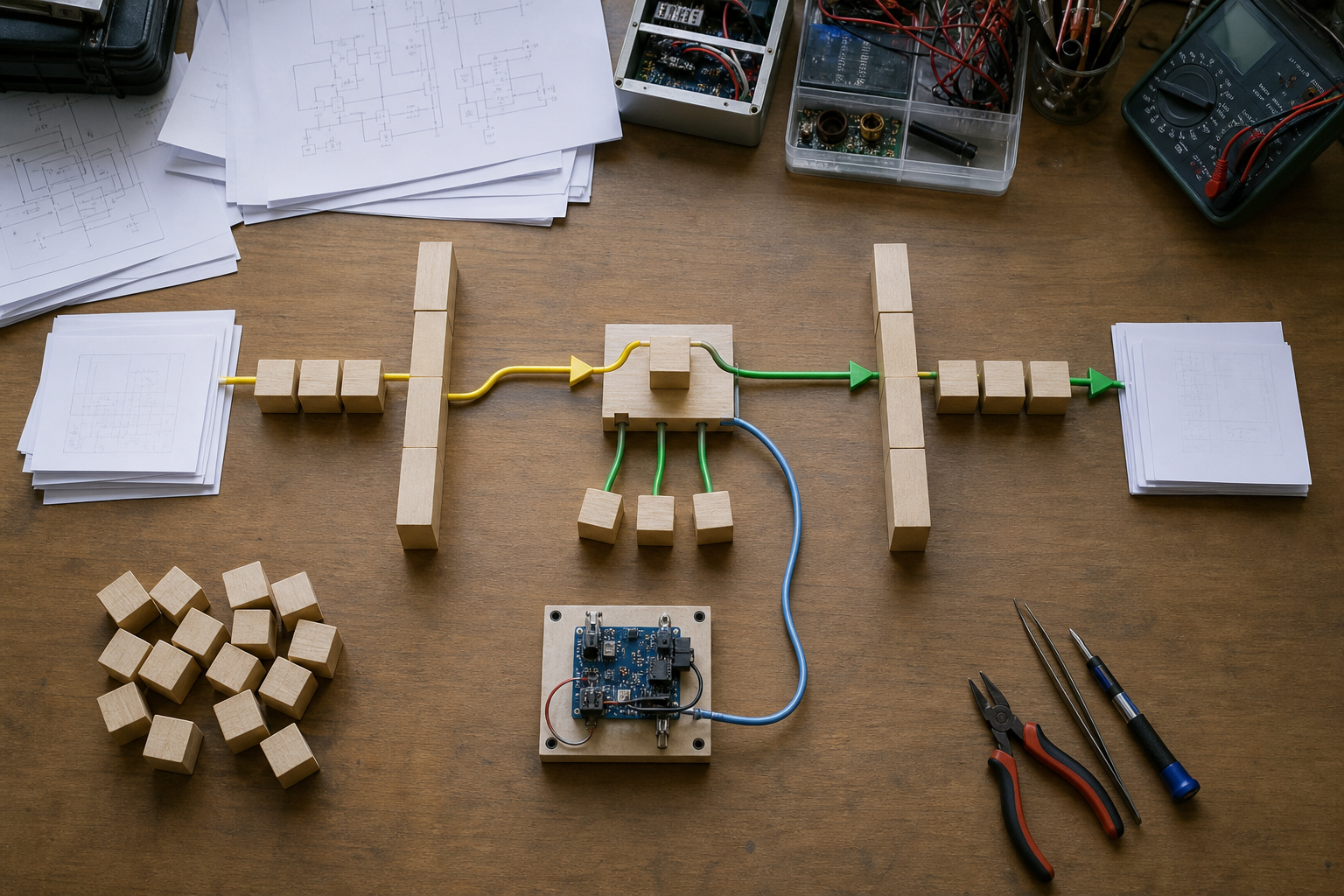
A practical runtime has four boxes. First, the collection layer groups documents, images, and logs into the same work unit. Second, Gemini 3.6 Flash performs fast summarization, classification, and candidate extraction. Third, high-risk judgments go to tests, rules, a stronger model, or human review. Fourth, the final response preserves supporting links and the remaining uncertainty.
<A multimodal agent workbench that groups different inputs while separating the verification stage 4.1>
In this architecture, the Flash model is not the single brain that decides everything. It is a fast operating layer. It fits tasks such as clustering thousands of customer messages by theme, extracting release-risk areas from notes, or reading screenshots together with logs to draft reproduction steps. It is a weaker fit for vulnerability decisions, legal wording, financial figures, or medical judgments unless those outputs are backed by evidence and a separate review path.
Checkpoints: four things to examine before adoption
First, real cost comes from call structure, not only token price. If a fast model creates duplicate summaries and follow-up questions, total cost may not fall. Teams should split the workflow into initial organization, candidate extraction, and final verification, then measure the failure rate at each stage.
Second, long context is an input window, not memory. A model may accept many files without treating every detail equally. Important numbers, policy clauses, and API names should keep their original locations and be checked again before they appear in the final answer.
Third, multimodal input changes the user experience, but it also changes verification. A model can appear to understand a screenshot while still misreading small text, table structure, color meaning, or time-series context. A product that relies on screen input should store the original image and the model’s explanation together so later review is possible.
Fourth, current model names should be configuration, not hard-coded product logic. Google’s model documentation and changelog show that names, features, and recommended usage keep changing. Long-lived products should keep model choice in environment configuration or a routing table and prepare fallback paths when a model, feature, or safety route is unavailable.
Gemini 3.6 Flash does not mean every request should move to one smartest model. It signals that agent products increasingly need separate lanes for fast models, stronger models, and rule-based verification. If a team needs to organize a lot of input quickly, this model is worth evaluating first on a workflow cost chart, not only on a leaderboard.
Episode 27 · Development Room 404 Ep. 27: Rain Ritual
Developers still wait for an AI blessing.
<From rain ritual to AI blessing 1.1>
Panel details
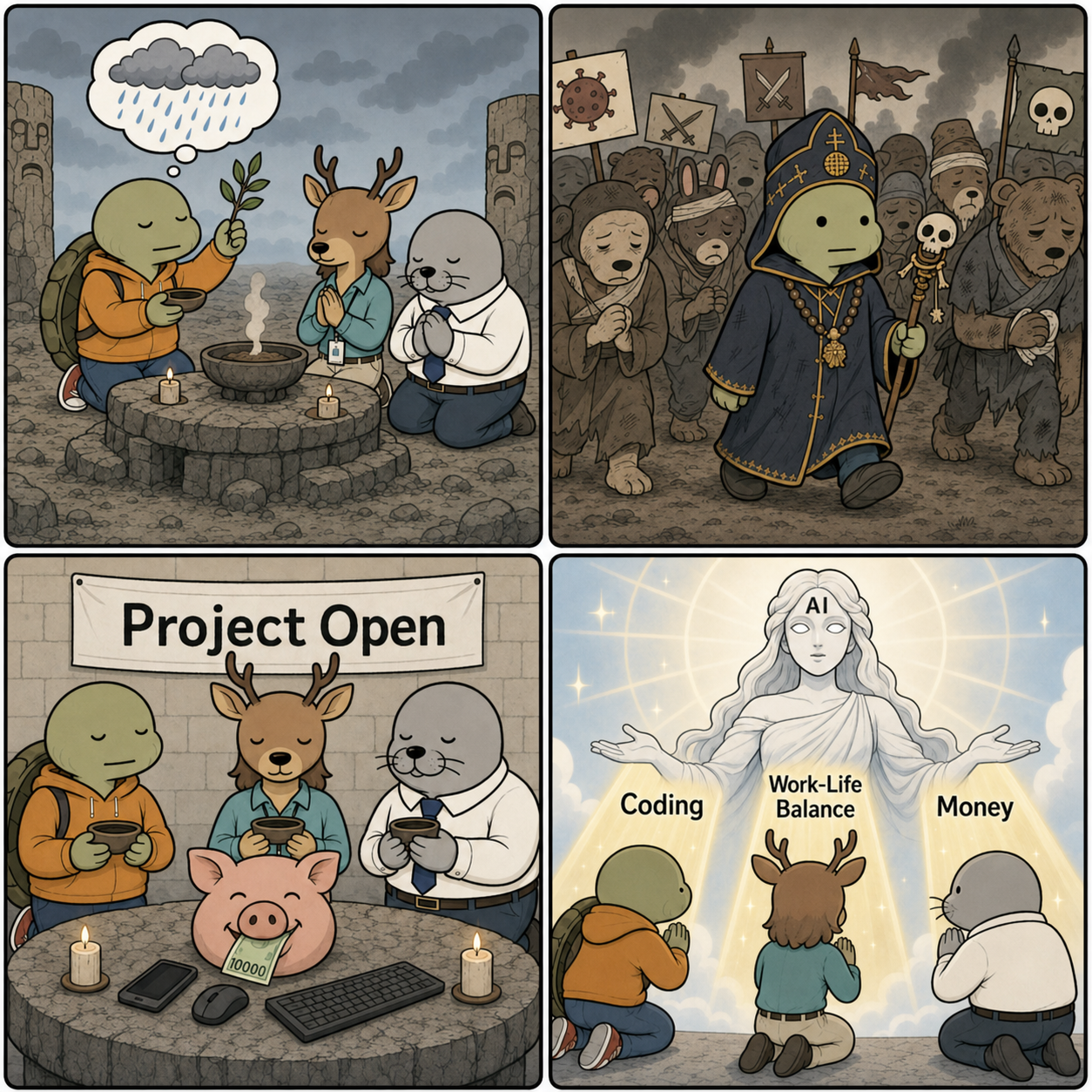
Kkobugi performs a rain ritual at an ancient altar while imagining rain, with Kim Saseum and Park Mulbeom praying beside him.
Kkobugi marches in a strange old priest robe, followed by people marked with disease, defeated war survivors, and skull signs that evoke a religious war.
Kkobugi, Kim Saseum, and Park Mulbeom perform a ceremony before a wall labeled Project Open. A pig's head with a ten-thousand-won bill, phones, a mouse, and keyboards sit on the altar.
Kkobugi, Kim Saseum, and Park Mulbeom kneel before a white, pupil-less goddess marked AI and pray. The words Coding, Work-Life Balance, and Money appear above streams of blessing light.
Intent Development Room 404 episode 27, Rain Ritual, satirizes developers praying for rain, a project opening, and AI blessings through an absurd four-panel webtoon.
KEA IoT and Big Data Planning Support: what Korean startups should check before August 31
The K-Startup notice for KEA’s IoT product development and big data planning support is aimed at Korean companies that have connected-device products or product data but need help turning that data into a practical analytics or AI project. Applications close at 18:00 KST on August 31, 2026. Before applying, teams should define the product, the available data, and the business question they want the support to address.
This is a Korean startup support program with a Google Form application flow. Keep a copy of the submitted response and final attachments, especially if filing close to the deadline.
Program snapshot
Item
Details
Program
KEA IoT product development and big data planning support
Application window
July 28, 2026, 14:00 to August 31, 2026, 18:00 KST
Eligible applicants
Companies preparing or holding IoT home-appliance or electronic-device products; companies that need product-data analysis; teams exploring AI data-based services or business models
Support
IoT product development support and big data analytics project planning
This is a strong fit for a Korean hardware, appliance, or device startup that already has a product concept and wants to use product data more effectively. It is less useful as a general lecture program and more useful when the company can point to logs, sensor data, quality data, usage patterns, or operational data that could become an analytics or AI planning project.
What to prepare
The application should connect four points: the device, the data, the problem, and the expected result. For an AI startup Korea team or a device company entering a K-Startup program, a concise problem statement will matter more than broad claims about digital transformation. Explain what data exists, what decision it could improve, and what internal owner will continue the work after the support period.
Checkpoint
What to prepare
Product
Current or planned IoT device and its core function
Data
Available product, sensor, quality, or user data
Goal
Prediction, personalization, quality improvement, or operational efficiency
Execution
Internal owner, schedule, and follow-up plan
Application cautions
The notice describes a review process that moves from eligibility screening to a kick-off meeting and final support decision. The public application link is a Google Form, and the notice lists KEA contact numbers for platform operation and data analysis. Applicants should treat the K-Startup notice as the controlling source for the deadline and retain proof of final submission. This Korean startup grant style program is practical only if the company can commit people and data, not just an idea. It is also a focused IoT data support Korea opportunity for device teams.
Meta Muse Image and Muse Video matter less because they are another pair of media models, and more because of where Meta wants to put them. When AI image generation and AI image editing live in a separate web app, it mostly serves people who already know how to write prompts. Meta is trying to move that capability into everyday editing flows inside Facebook, Messenger, Instagram, and WhatsApp.
Reuters reported in July 2026 that Meta integrated Muse Image into the Meta AI chatbot and highlighted complex prompt interpretation, photo inputs, and direct edits through sketches or annotations. CNBC described Muse Image as the first image-generation model from Meta Superintelligence Labs, framing it as part of Meta's effort to reduce reliance on outside generative models and build native tools for creators and advertisers.
AI video generation has already advanced quickly in specialist production tools such as Runway. Muse is interesting for a different reason: it tests what product rules are needed when similar technology is attached not to a studio workflow, but to social feeds, messaging, and ad creation. The shift resembles the way OpenAI Codex cloud agent moved coding assistance from demos into operational developer workflows.
Background
The generative media market is splitting into two broad paths. One path is the studio-style tool: high-resolution video, character consistency, and precise scene control for production teams. The other is the everyday generative feature that uses photos, conversations, friend networks, and feed context already present in consumer apps. Muse Image belongs closer to the second path.
Meta's advantage is distribution. It does not need to wait for users to sign up for a new creative tool; it can test features directly inside large social apps. That makes the technology naturally useful for advertising drafts, lightweight memes, and repeated content variations. The downside is that consent, likeness rights, training data, and reuse of public photos become immediate product risks rather than abstract policy debates.
The Verge's July 2026 Meta archive also points to the controversy around Muse Image potentially pulling other Instagram users into AI-generated photos. Even if the feature is technically impressive, unclear rules about who can reuse which photo in what context can make trust problems surface before image quality becomes the central question.
Layer
Product meaning
What to check
Photo input
Extends an existing image into a new scene
Whether subjects and logos stay accurate
Sketch editing
Makes region-level edits easier
Whether synthetic changes are disclosed
Social distribution
Connects generation and posting
Consent and likeness settings
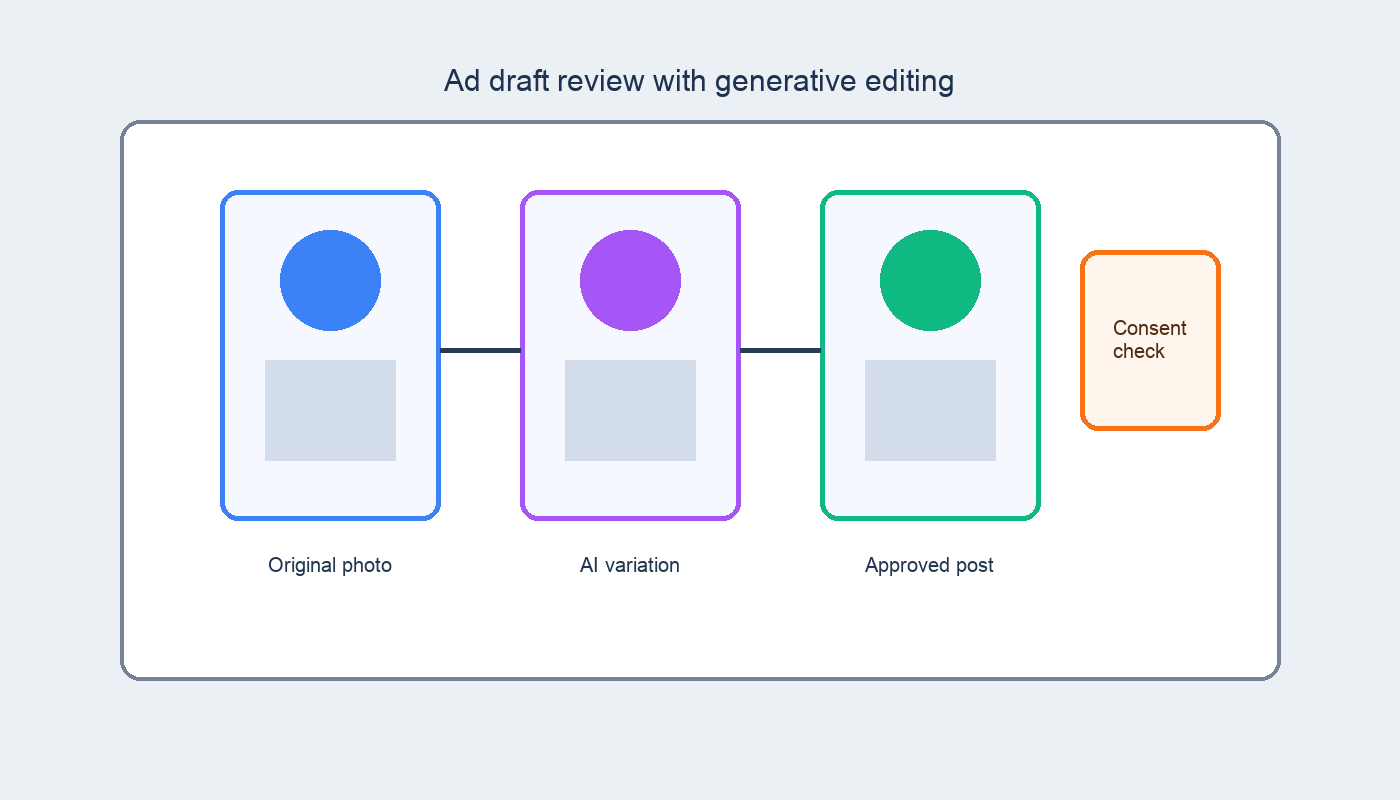
<Muse ad-draft use case 1.1>
Reuters and CNBC point to the same product shift: Muse is not just a demo model, but a capability placed inside Meta's own app surfaces.
How it works
As a product flow, Muse Image has four steps. First, the user enters a text prompt or provides an existing photo. Second, the model separates the subject, scene, style, and edit request. Third, it generates a new image or redraws only part of the image. Fourth, the user continues editing through sketches or annotations, such as “change only this background” or “remove this object.”
A small business, for example, could upload a product photo and ask for “the same item on a summer outdoor table, but keep the logo unchanged.” In professional editing software, that would require background removal, compositing, and color adjustment as separate tasks. In a social generative AI tool, those steps are compressed into conversational edits.
Muse Video should be read more carefully. Reuters said Meta also announced an early preview of its video generation model. Video is harder than still images because the subject has to remain stable across frames, and motion, lighting, and camera changes must make sense over time. That is why practical uses are likely to start with short clips, ad drafts, and feed-ready variations before expanding into longer production workflows.
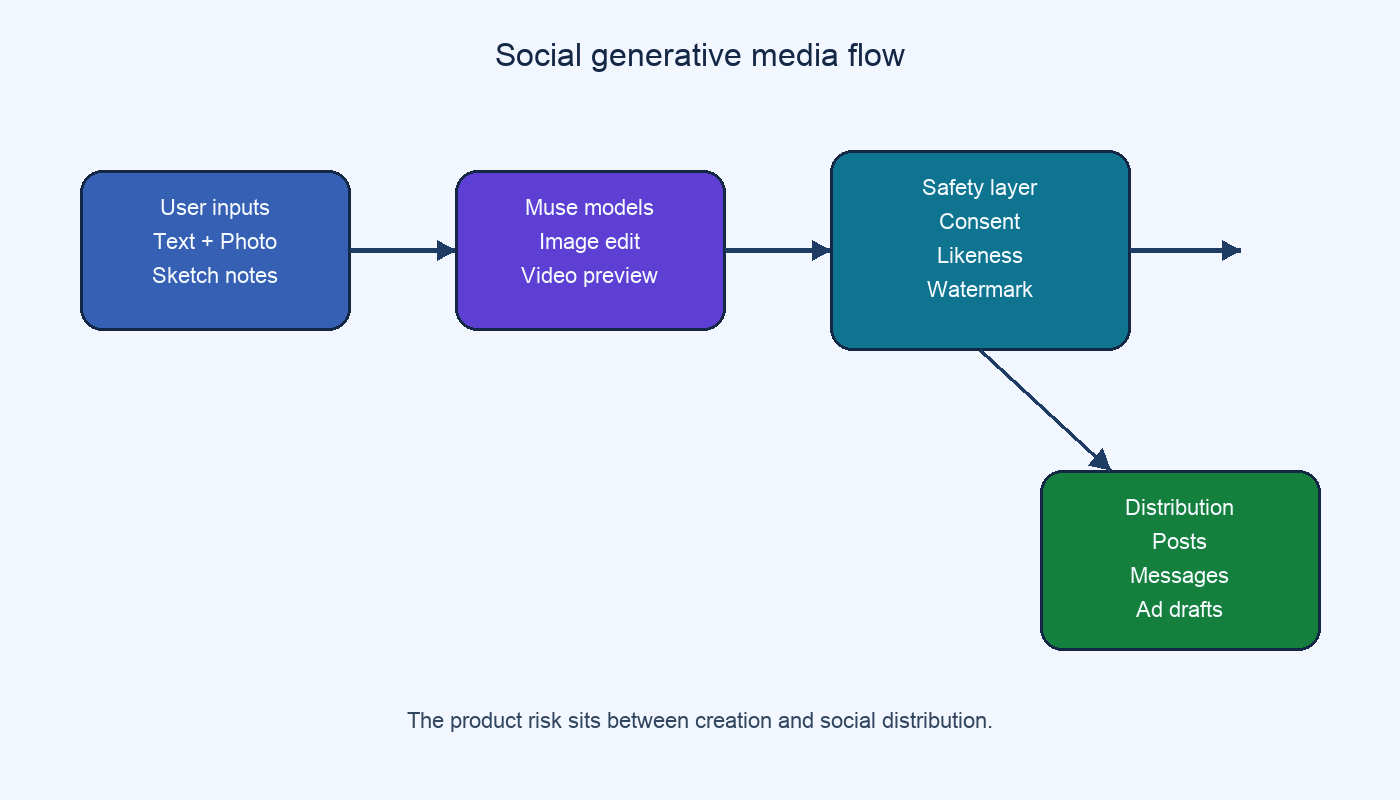
Product structure
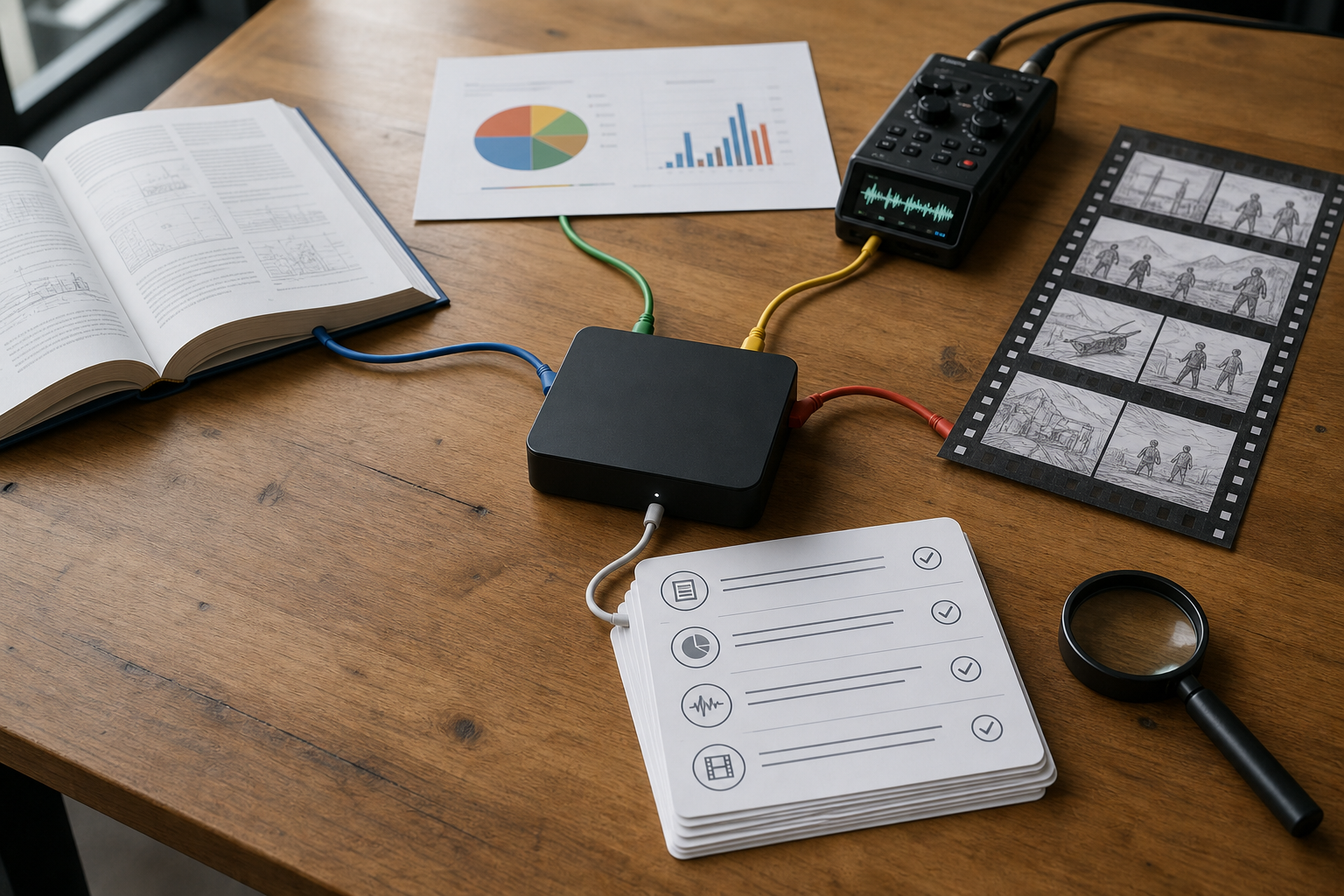
<Muse generative media product flow 3.1>
The left side of the diagram is user input. Text, photos, sketches, and annotations can be combined so the model can generate a new image or change a selected region. The middle safety layer represents controls for public-photo reuse, faces, brands, sensitive scenes, watermarking, and provenance. The right side is Meta's existing distribution surface: posting, ad mockups, and message sharing.
The important point is that the model is not the whole product. The same generative capability becomes a creative tool when it lives in a standalone app, but becomes part of a relationship network and privacy policy when it lives inside a social platform. Users gain convenience, while the platform has to design much stricter rules for rights, consent, and misuse.
Checkpoints
Consent and likeness: A public photo is not the same as permission for synthetic reuse. Features that call up people's images need clear defaults, opt-outs, and notifications.
Truthfulness in advertising: Fast ad mockups are useful, but they can also create scenes that do not match the real product. Disclosure and review rules have to catch up.
Temporal consistency in video: A short clip may look plausible while hands, text, logos, or object positions shift over time. Brand use still needs human review.
Platform lock-in: When generation, editing, and distribution all happen inside one company's apps, the workflow is convenient, but portability, rights metadata, and compatibility with outside editing tools may suffer.
Muse is therefore more than another image model. It shows what happens when generative AI moves from standalone services into the default editing layer of everyday apps. In that sense, social generative AI is less a separate tool category than a new interface layer for media feeds. The evaluation cannot stop at sharpness or prompt adherence; it also has to include who supplied the input, whose photos can be reused, and where the output will appear.
For readers, two practical checks matter. First, look for the settings that control whether your own photos can be used in other people's generated content. Second, if you plan to use AI-generated images for work or advertising, review rights and factual accuracy before celebrating the speed of creation.
KOCCA Global Game Hub tenant program: checklist for game tech companies
The KOCCA support notice for the Global Game Hub Center tenant program is a rolling opportunity for Korean game companies that need a Pangyo base and structured business support. The notice says applications opened on April 27, 2026, and remain rolling, with about 15 tenant companies available as of the June 2026 update.
Because this is a rolling Korean government-backed space program, available rooms and move-in timing can change. Applicants should confirm current availability with KOCCA before preparing final documents.
Program snapshot
Item
Details
Program
2026 Global Game Hub Center additional tenant recruitment
Application window
From April 27, 2026, rolling recruitment
Eligible applicants
Korean incorporated small and medium-sized game companies, game developers, or companies with game-development-related technology
Scale
Around 15 tenant rooms as of June 2026: 3 small, 11 medium, and 1 large
Support
80% rent support, 50% management-fee support, software, consulting, hiring, translation, QA, IR, and promotion support
Application
KOCCA business management system
<Program and organizer identifier 1.1>
Who should consider it
This is not a general Korean startup grant for every founder. It is limited to Korean incorporated SMEs in the game sector or companies with game-development technology. A team should be ready for the operational requirements of a physical tenant program, including lease-related procedures and moving its headquarters address to the Global Game Hub Center within 30 days after signing the occupancy agreement.
Benefits and cost structure
The main value is lower office cost combined with game-specific business support. KOCCA lists 80% rent support and 50% management-fee support, while the tenant must pay a deposit calculated on three months of rent and management fees. KOCCA's 2026 Global Game Hub recruitment release also identifies tenant space, development infrastructure, and capability-building programs as the center's core support. The program also offers game-development software support, production and publishing consulting, funding and overseas expansion advice, tax, legal and HR consulting, recruiting support, translation and QA, IR consulting, and promotion support. For a game startup Korea team, the program is most useful when office cost, publishing readiness, and investor preparation are all active bottlenecks.
Checkpoint
What to verify
Company status
Korean incorporated SME in games or game technology
Address transfer
Ability to move headquarters within 30 days after agreement
Cash planning
Deposit plus remaining rent and management-fee burden
Growth goal
Fit with development, publishing, fundraising, or overseas expansion support
Application cautions
Applications are submitted through KOCCA’s business management system. The notice recommends visiting the facility before applying, and documents generally cannot be supplemented after submission. Contact routes differ for program questions, facility visits, and online system issues, so teams should separate those questions before calling. This KOCCA game startup support program may select fewer companies than the posted capacity if suitable applicants are limited, and companies scoring 70 or higher can still be ranked by score if demand exceeds the available rooms. For readers comparing a Korean game hub program, the relocation obligation is the first gate to check.
KEA IoT and Big Data Planning Support: what Korean startups should check before August 31
The K-Startup notice for KEA’s IoT product development and big data planning support is aimed at Korean companies that have connected-device products or product data but need help turning that data into a practical analytics or AI project. Applications close at 18:00 KST on August 31, 2026. Before applying, teams should define the product, the available data, and the business question they want the support to address.
This is a Korean startup support program with a Google Form application flow. Keep a copy of the submitted response and final attachments, especially if filing close to the deadline.
Program snapshot
Item
Details
Program
KEA IoT product development and big data planning support
Application window
July 28, 2026, 14:00 to August 31, 2026, 18:00 KST
Eligible applicants
Companies preparing or holding IoT home-appliance or electronic-device products; companies that need product-data analysis; teams exploring AI data-based services or business models
Support
IoT product development support and big data analytics project planning
This is a strong fit for a Korean hardware, appliance, or device startup that already has a product concept and wants to use product data more effectively. It is less useful as a general lecture program and more useful when the company can point to logs, sensor data, quality data, usage patterns, or operational data that could become an analytics or AI planning project.
What to prepare
The application should connect four points: the device, the data, the problem, and the expected result. For an AI startup Korea team or a device company entering a K-Startup program, a concise problem statement will matter more than broad claims about digital transformation. Explain what data exists, what decision it could improve, and what internal owner will continue the work after the support period.
Checkpoint
What to prepare
Product
Current or planned IoT device and its core function
Data
Available product, sensor, quality, or user data
Goal
Prediction, personalization, quality improvement, or operational efficiency
Execution
Internal owner, schedule, and follow-up plan
Application cautions
The notice describes a review process that moves from eligibility screening to a kick-off meeting and final support decision. The public application link is a Google Form, and the notice lists KEA contact numbers for platform operation and data analysis. Applicants should treat the K-Startup notice as the controlling source for the deadline and retain proof of final submission. This Korean startup grant style program is practical only if the company can commit people and data, not just an idea. It is also a focused IoT data support Korea opportunity for device teams.
Muse Spark 1.1 is the agentic multimodal AI model Meta introduced on July 9, 2026. The important point is not simply that the model sounds better in conversation. It is that Meta is exposing a model designed to work with external tools and computer interfaces through a developer API. Meta says Muse Spark 1.1 is available in Thinking mode in Meta AI and through the public preview of the Meta Model API.
That matters because the center of AI competition is shifting from “Can the model produce a good answer?” to “Can it complete a long-running task without breaking the workflow?” Muse Spark 1.1 is meant to bring planning, subagent delegation, tool calling, screen understanding and code repair into one operating loop. For developers, this is the kind of technology where permission boundaries, logs, recovery paths and safety evaluation matter before raw model scores do.
Agentic multimodal AI also makes computer use AI and long context agents part of the same deployment decision.
Background
Meta’s Muse Spark 1.1 announcement emphasizes three directions. First, the model is aimed at agentic work that adapts to tools, MCP servers and custom skills. Second, it connects multimodal understanding with coding and computer use. Third, Meta says the model can actively manage a 1 million-token context window, allowing it to retrieve earlier decisions during extended sessions.
This is related to the broader multi-agent direction, but it is different from the way a conventional chatbot is used. Imagine an ecommerce operator asking an agent to analyze last month’s return-support flow, revise an FAQ draft and check a test order in an admin console. The model would not merely read documents. It would have to inspect a screen, write a script when automation is faster, and directly click through the interface when that is simpler. Meta says Muse Spark 1.1 was trained to distinguish when scripting is the better path and when direct interface use is the more practical route.
What to watch
Why it matters
Practical question
Tool calling
Executes external apps, MCP tools and functions
Which permissions should be exposed?
Computer use
Operates screens, browsers and applications
Which steps need human approval?
Long context
Maintains decisions across extended work
How are stale facts corrected?
Safety evaluation
Measures deployment risk before and after launch
Are blocking, audit and recovery logs available?
How it works
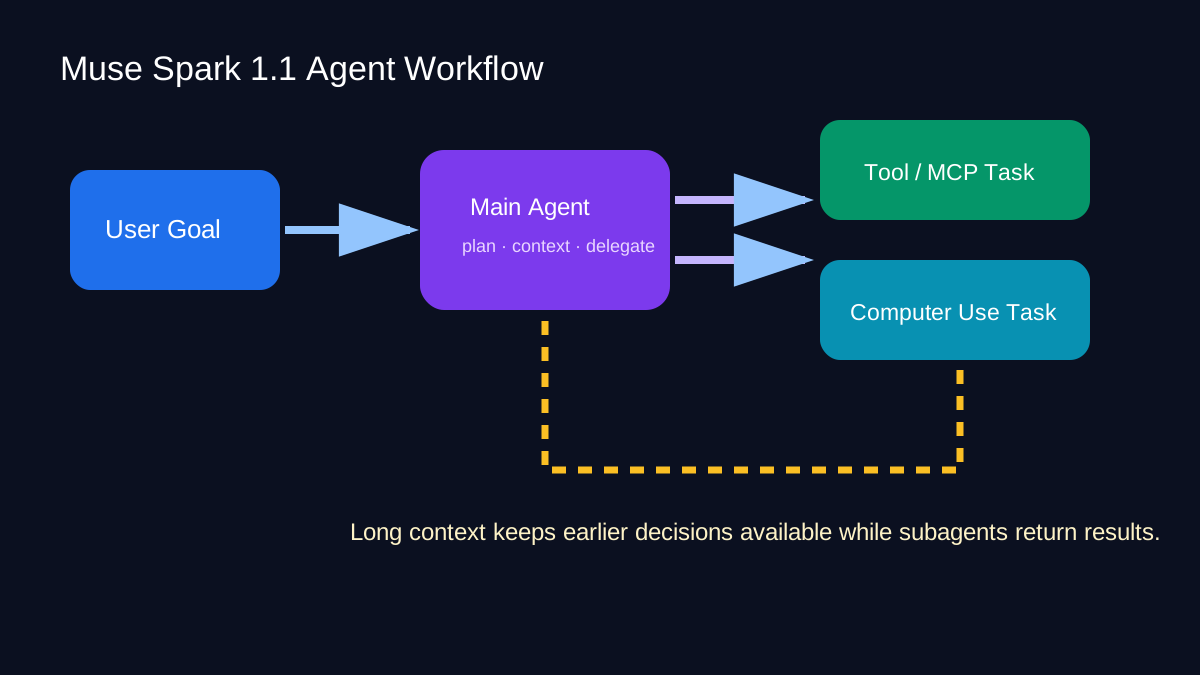
The operating principle behind Muse Spark 1.1 is closer to “a main agent divides work and coordinates tools and subworkers” than to “one large model reasons through every click by itself.” Meta’s announcement says that when the model acts as the main agent, it can gather context, make a plan and delegate execution across parallel subagents. When it acts as a subagent, it keeps to its assigned job and escalates back to the main agent when needed.
A coding example makes the pattern easier to see. The model builds a web app, much like the practical edge of browser AI agents, captures automated screenshots to identify user-visible failures, traces those failures back to relevant code, applies fixes and validates the result. Multimodal understanding is therefore not just a feature for “reading a screen.” It becomes useful when visual evidence can flow into code changes and test commands.
When an organization adopts agentic multimodal AI, task definition comes before model selection. Quality and safety depend on what the model may see, what it may execute and when it must stop and hand control to a human.
Architecture
The diagram below simplifies the Muse Spark 1.1 workflow. A user goal enters the system, the main agent manages the plan and context, and tool or computer-use tasks are split out for execution. Long context acts as the connective tissue that keeps earlier decisions and returned results available.
<Muse Spark 1.1 agent workflow 3.1>
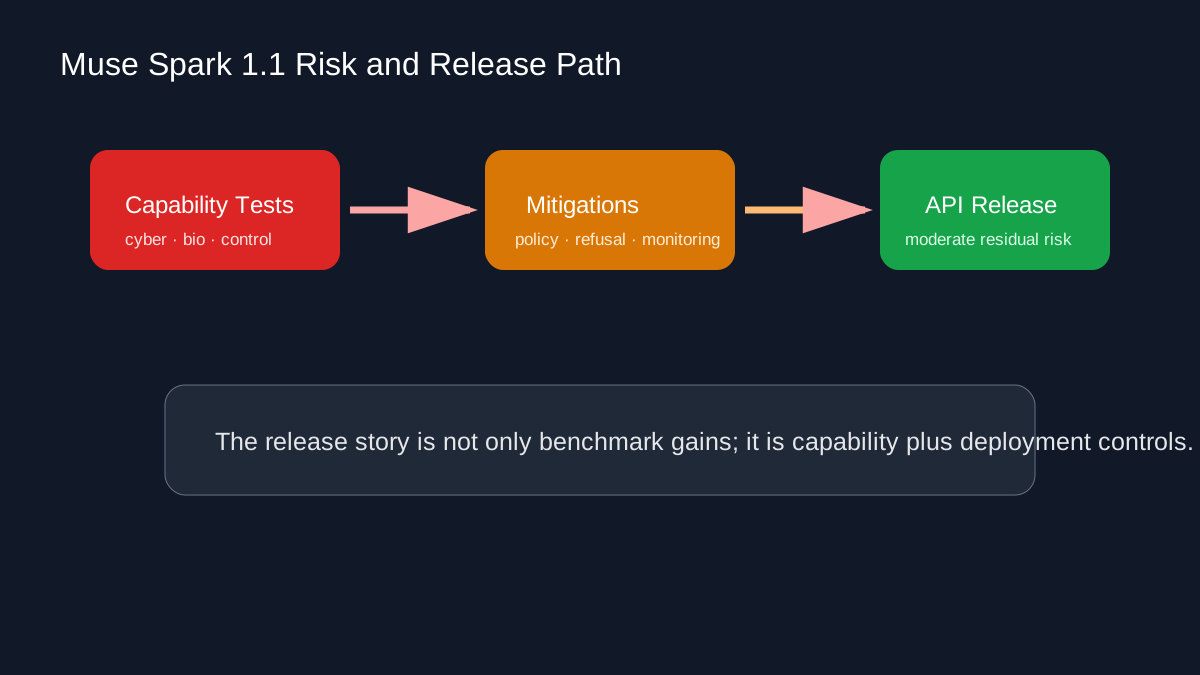
Once a public API can carry broad agentic permissions, risk assessment becomes part of the product rather than a footnote. The Muse Spark 1.1 Evaluation Report evaluates chemical and biological risk, cybersecurity, loss of control, adversarial robustness and model behavior. The report says that before mitigations, Meta cannot rule out Muse Spark 1.1 reaching a high-risk threshold in chemical and biological as well as cybersecurity domains; after deployment mitigations, Meta assesses the residual risk as moderate or lower.
<Muse Spark 1.1 risk-management path 3.2>
Checkpoints
A model connected to an API needs permission design more than a demo chatbot does. If files, browsers and internal systems are opened all at once, a small error can become a real-world change.
Benchmark gains do not guarantee successful workplace automation. Company-specific interfaces, policies, exceptions and audit logs can make the same model behave very differently.
Long context agents are useful, but it can also preserve outdated instructions or mistaken observations for too long. Context compaction and update rules need to be explicit.
The publication of a safety report is a positive signal, but numbers are not a deployment license. Each organization still needs its own risk criteria and approval workflow.
In short, Muse Spark 1.1 is a sign that multimodal models are moving toward developer-facing agent platforms. The interesting part is not the model’s conversational polish; it is the packaging of tool use, screen understanding, long-task management and safety mitigations into one product surface. In practical adoption, the first question should not be “What can we automate?” but “How far should this be allowed to automate?”
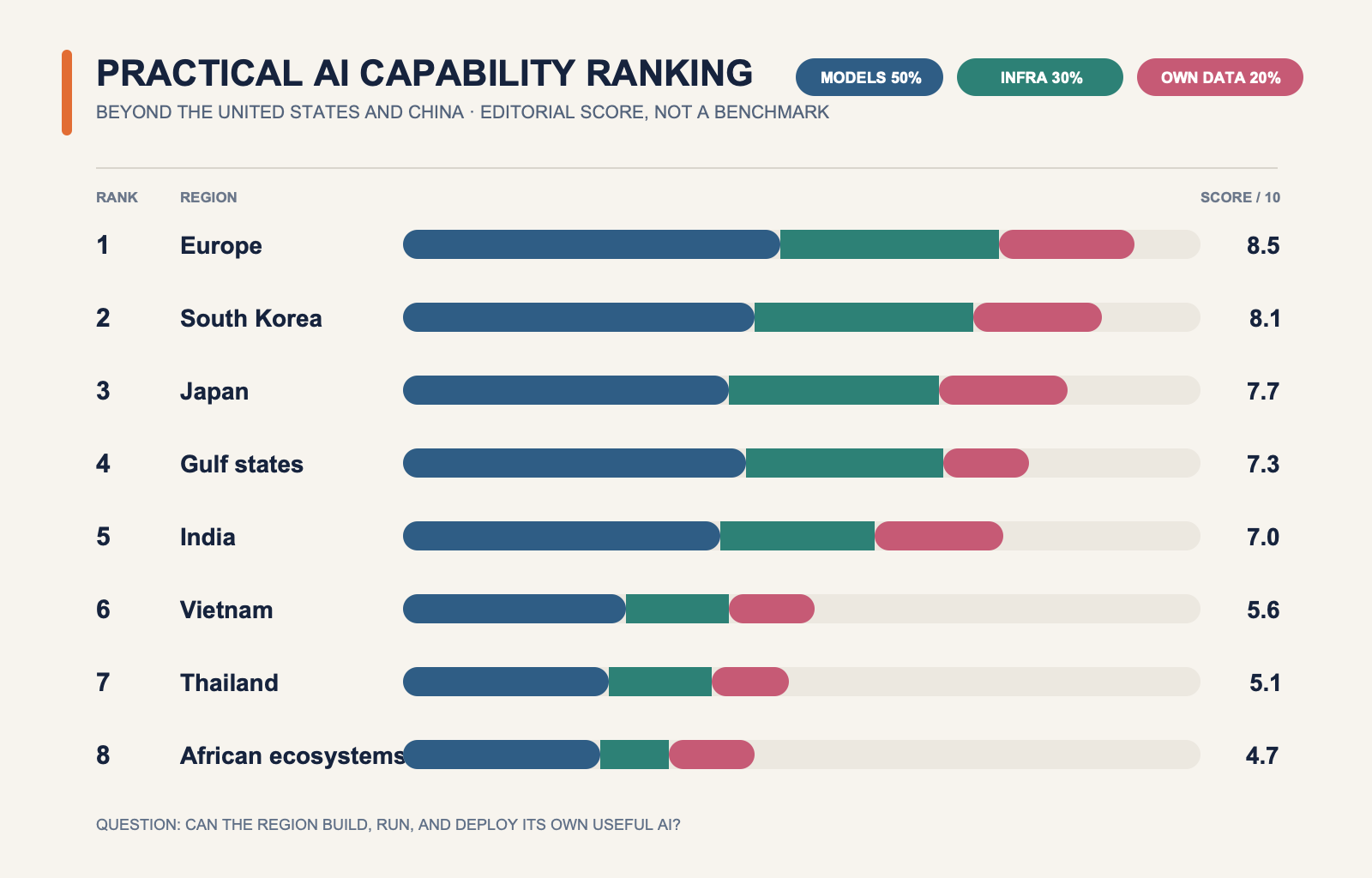
Once the United States and China are removed, who can actually build AI, keep it running, and connect it to domestic industry? This article gives a direct answer through a new global AI ranking. Instead of a broad Stanford-style index, it uses three things a reader can feel. First, does a country have Korea AI models or equivalent models that can be sold as a service or released as open weights? Second, does it have the GPUs, capital, and research organizations to keep training and operating them? Third, can it connect AI to domestic administrative, industrial, and language data rather than only buying data from elsewhere?
This is not an official international ranking. It is an editorial capability ranking that separates countries which merely buy U.S. or Chinese models from those that have acquired some ability to secure models, infrastructure, and data for their own language and industries. The weights are 50% model ownership, 30% AI GPU infrastructure, capital, and research organizations, and 20% domestic-data capacity. Europe is evaluated as a shared market, research, and computing bloc rather than as one country.
The Answer First: Practical AI Capability Beyond the U.S. and China
The scores below are not decimal benchmark results. They are weighted A-to-C judgments against the three tests above. A means a region can produce and operate that layer with domestic leadership; B means representative models or programs exist but supply-chain or scale gaps remain; C means local adaptation and deployment are possible but large-scale autonomy is not. A decimal such as 8.5 only expresses the weighting; it is not a precise measurement of model performance. The score does not say how many points a model is behind ChatGPT. It says whether a country or region can build a useful model, continue operating it, and put it to work on its own data.
<Editorial capability ranking weighted by models 50%, infrastructure 30%, and domestic data 20% 1.1>
Rank
Region or country
Models 50%
Infrastructure 30%
Domestic data 20%
Practical judgment
1
European Union bloc
A-
A
A-
The thickest non-U.S./China bloc: Mistral-family models plus large research, industrial, and shared-compute capacity
2
South Korea
B+
A
A-
Not a global frontier-model leader, but Korean models, HBM, manufacturing data, and public GPU support are moving together
3
Japan
B
A-
A
A durable path centered on Japanese language, manufacturing, and public-sector sovereignty rather than global model headlines
4
Gulf states, led by the UAE and Saudi Arabia
B+
A-
B
Falcon, Jais, ALLaM, and exceptional GPU, energy, and capital strength; a thinner research and domestic-data base
5
India
B
B
A-
Major talent, public digital rails, and language markets, but limited depth in frontier GPUs, chips, and large domestic models
6
Vietnam
C+
C
B
Fast progress in Vietnamese models and national data strategy, with large-scale training infrastructure still being built
7
Thailand
C
C
B-
Thai open models such as Typhoon and public deployment exist, but compute and capital remain small
8
African regional ecosystems
C
C-
B-
Language communities, mobile, and fintech data are assets, while power, GPUs, and capital vary sharply country by country
The point of placing Europe first is not that one European company beat GPT. Europe’s score combines firms such as France’s Mistral, research institutions across countries including Germany, France, and Italy, industrial data, and the EU AI Factory program. Korea reaches second not because one Korean model tops every leaderboard, but because semiconductors and manufacturing data are attached to the model effort.
Test One: Is There a Model You Can Sell or Open and Use?
The first test is simple. Does a country have a model good enough to use in its language and enterprise workflows? If not, does it at least have an open model whose weights, code, and technical documentation let developers adapt it into a domestic service? We do not count the number of derivative repositories on Hugging Face; fine-tuned copies of the same base model would inflate a country’s apparent strength. This test counts only representative models that are sustained as commercial APIs or are released with public weights, code, or technical documentation.
Region or country
Representative models and evidence
Model judgment
Europe
France’s Mistral Large and Mistral Small families, alongside multiple open-weight releases
The only non-U.S./China bloc visibly present in the global commercial-model market. It is still not as deep as the leaders: Stanford’s 2024 count showed Europe with three notable models.
South Korea
NAVER HyperCLOVA X commercial services, LG AI Research EXAONE 4.0 open 32B, telco and national-project models
Korea has a usable Korean-language layer in both commercial and open forms. There is not enough basis to call it equivalent to the top global closed frontier-model group.
Japan
LLM-jp open models, GENIAC-supported Japanese LLMs, and PFN–NICT–Sakura Internet collaboration
Japan is building sovereign models for Japanese, manufacturing, and public use rather than trying to dominate the English-language frontier. LLM-jp’s work includes a 172B open beta produced by an academic and industry community.
Gulf states
UAE Falcon H1 and Falcon Arabic, Jais; Saudi Arabia’s ALLaM 34B
The Gulf has unmistakable Arabic-model and open-model presence. The UAE in particular also uses open releases as a talent, diplomatic, and ecosystem strategy.
India
Indian-language models from Sarvam and Krutrim, plus IndiaAI’s model, data, and tools platform
Models for a vast multilingual market are expanding. India remains a catch-up group in the global performance race for very large general-purpose models.
Vietnam and Thailand
Vietnam’s PhoGPT; Thailand’s Typhoon-7B and later Thai-language models
Both meet the basic condition of not leaving their national language entirely to foreign models. Their model size, training resources, and enterprise-deployment breadth are far below the upper group.
Africa
Distributed open research and translation communities such as Masakhane
Africa is not one country. Its common problem is building training and evaluation data for more than 2,000 low-resource languages.
This is why Europe ranks first and Korea second on the model-centered reading. Europe has a model business that can sell to global customers through Mistral. Korea has both HyperCLOVA X and EXAONE as commercial and open Korean-model layers. Japan, the Gulf, and India have credible models, but their current strength is more concentrated in language regions, state programs, or local markets than in the broad global general-purpose market.
Test Two: Do GPUs, Chips, Money, and Researchers Keep Arriving?
Releasing one model is different from building the next generation two years later. This test asks how many GPUs can be secured, whether capital and power can expand data centers, and whether universities, labs, and companies form a continuous pipeline. AI GPU infrastructure is not just a server purchase; it includes energy, networking, operations talent, and long-term funding.
The European Union bloc has the broadest public research base and shared infrastructure. In October 2025, the European Commission announced 19 AI Factories in 16 member states. Its advantage is that startups, universities, and SMEs can use a common infrastructure layer. Its weakness is continued dependence on U.S. supply chains for much of the highest-end GPU design and cloud capacity, plus slower cross-country decisions.
South Korea does not design the leading training GPUs, but it has HBM, memory, foundry, and industrial-supply-chain capacity. The Ministry of Science and ICT said Korea would secure a cumulative 37,000 GPUs by 2026, including 15,000 through government procurement, while sovereign-AI projects receive GPU and data support. The claim is not that every chip is domestic; it is that Korea has unusually strong physical links between AI compute and industrial strategy.
Japan supports compute for foundation-model development through GENIAC and is trying to join government, research institutes, telecoms, and manufacturers into one ecosystem. Sixteen projects were selected for its fourth support cycle in 2026. Japan’s strengths are capital, manufacturing, and institutional depth; its gaps include GPU supply and product speed relative to U.S. platforms.
The Gulf is the most aggressive capital-led challenger. The UAE combines TII, which developed Falcon, with G42; Saudi Arabia combines SDAIA with large national investment plans. Money, energy, and political decision speed can procure GPUs and data centers quickly. Semiconductor manufacturing and the layered university-startup research ecosystem remain thinner than in Europe, Korea, or Japan.
India has enormous engineering talent and a software industry, but remains import-dependent for the highest-end GPUs and chips. IndiaAI Compute is building a public cloud direction of more than 10,000 GPUs for public bodies, universities, and startups. It is a serious start, but not yet comparable with Europe’s shared supercomputing layer or the industrial supply chains of Korea and Japan.
Vietnam, Thailand, and African ecosystems have less large-scale training compute, power capacity, and patient capital than their adoption needs suggest. Their realistic strategy today is not to resell foreign models unchanged, but to tune smaller open models on local language, government, finance, and manufacturing data while pooling access to scarce compute.
Test Three: Not “Do You Have Data?” but “Can You Train and Operate on Your Own Data?”
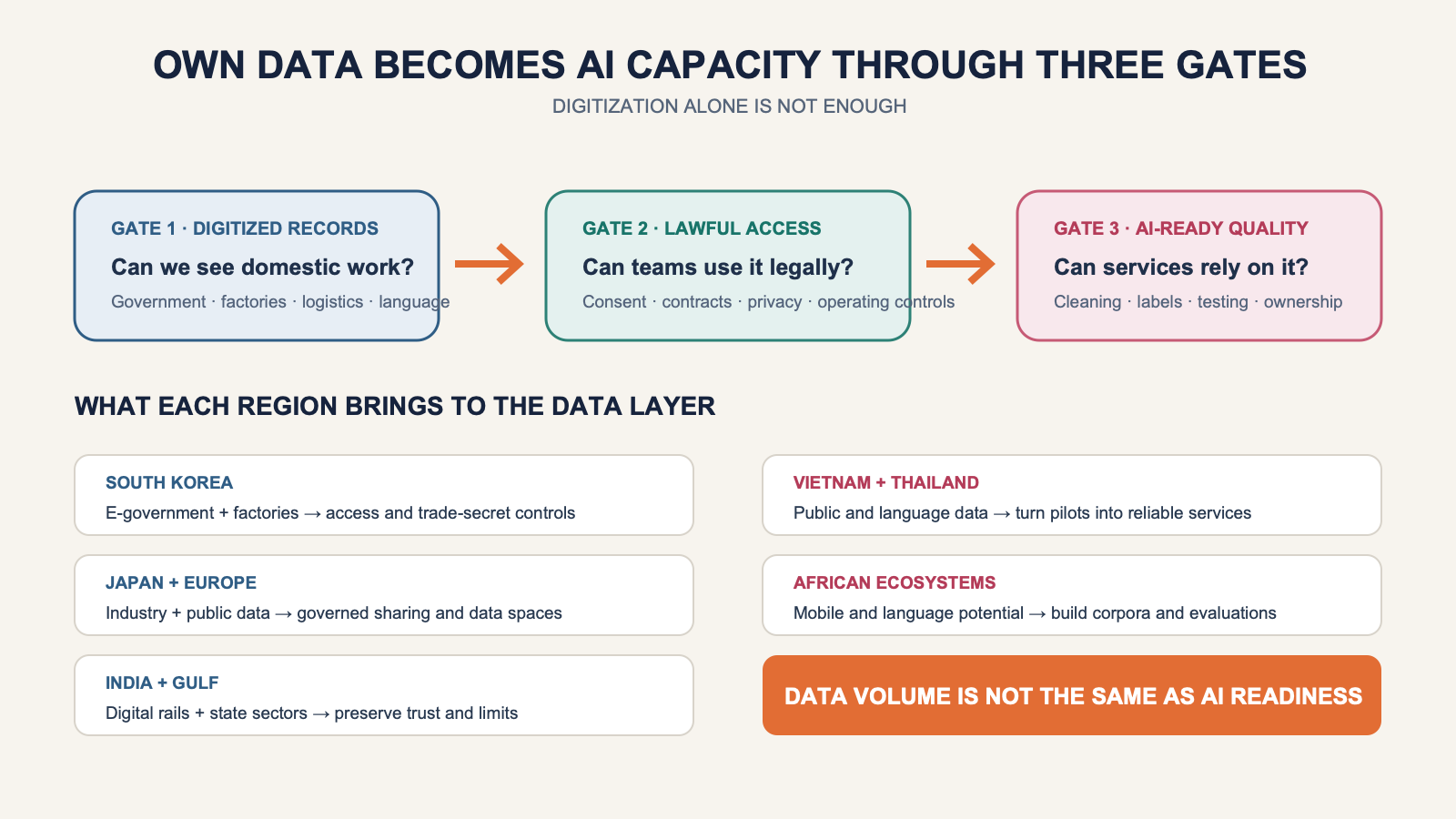
Domestic data is not a pile of web pages scraped or bought elsewhere. It is the data produced only in that country: administrative procedures, factory equipment, hospital records, financial transactions, logistics flows, local language, and customer support. Strong digitization does not automatically make that data useful for AI. Privacy, trade secrets, copyright, ownership between agencies, and weak quality must be overcome. Data becomes AI-ready only when it has lawful access, cleaning, labeling, and accountable operating ownership.
<National AI advantage appears only after data passes digitization, lawful access, and AI-ready quality 4.1>
Korea has dense e-government, telecom, finance, and manufacturing data. Equipment data from semiconductor, automotive, shipbuilding, logistics, and factories is especially hard for foreign models to reproduce. But this data is scattered inside companies and institutions, and privacy and trade-secret rules mean “the country has data, therefore a model can train on it” is false. Korea’s real contest is safe access, federated learning, de-identification, and field deployment.
Japan also has deep manufacturing, robotics, precision-equipment, and public-record data. Older systems, company silos, and conservative procurement can slow combination of those assets. Japan’s Government AI GENAI connects laws, the Official Gazette, and ministry knowledge bases for controlled government use. That is a data-product approach rather than an assumption that every public record should be freely exposed.
Europe is strong in automotive, machinery, medicine, finance, and scientific data. GDPR and the AI Act can slow some personal-data and high-risk use cases, but they do not mean Europe lacks data. Europe’s direction is to create trusted cross-border access through industrial data spaces and common rules. That could be a major advantage in manufacturing AI, while the cost of aligning rules and contracts remains a real drag.
India has a major asset in digital public infrastructure such as Aadhaar and UPI, along with a huge multilingual and mobile market. If trust around privacy and public-data use is not maintained, scale becomes a social risk. India’s advantage is the breadth where consumer, administration, and payment data meet; its challenge is cleaning and evaluating that data fairly across many languages.
The Gulf has state-led data in government services, energy, logistics, and finance, plus fast execution. Its absolute population and language-data scale, and its independent research ecosystem, are smaller than those of India and Europe. That makes Arabic, government, and energy domains more realistic targets than a generic data-volume contest.
Vietnam, Thailand, and African regional ecosystems should not be dismissed here. Vietnam’s 2026–2030 National Data Strategy and AI law treat national, ministerial, and local databases as part of AI infrastructure. Thailand is connecting banking, telecom, tourism, public-service data, and Thai models. Africa has major potential in mobile, fintech, and local-language data but lacks corpora and evaluation sets for low-resource languages; communities such as Masakhane are therefore building the language-data layer itself.
How to Read This Ranking
The conclusion is not “Europe won and everyone else lost.” Outside the U.S. and China, Europe is the thickest composite bloc, Korea is the most industrially connected challenger, Japan has the most durable Japanese-language and manufacturing sovereignty path, the Gulf is the fastest state-led builder of money and GPUs, and India has the widest combination of talent, languages, and public digital rails. Vietnam, Thailand, and African ecosystems trail in frontier general-purpose models, but have more realistic opportunities where local language and public, financial, or manufacturing problems must be solved first.
Use this order when assessing a country’s AI position. First ask, “Does it have a representative commercial or open-weight model?” Then ask, “Can it fund GPUs, researchers, and training for a next generation?” Finally ask, “Can it legally and safely connect that model to domestic industrial data?” Only places strong in all three are moving from consuming AI to operating AI. This order is also more useful for a company evaluating Japan’s digital and AI market or a developer following the international agenda around AI safety.
Dario Amodei is one of the most unusual figures in AI right now. As Anthropic’s CEO, he is pushing Claude deeper into enterprise software, developer workflows, and cloud platforms. At the same time, he keeps arguing that the strongest AI systems need stricter evaluation, stronger public oversight, and a clearer way to stop unsafe deployments.
That combination is why he matters. The frontier AI race is no longer just a contest over benchmark scores. It is becoming a contest over compute supply, government trust, enterprise distribution, safety research, and who gets to define responsible deployment.
Anthropic describes itself as an AI safety and research company that builds reliable, interpretable, and steerable systems. In 2026, that mission statement is no longer separate from the business. Claude’s growth, Anthropic’s cloud partnerships, and Amodei’s public-policy arguments are now parts of the same story.
<AI leadership under safety pressure 1.1>
From scaling researcher to frontier AI CEO
Before becoming a CEO, Amodei was a researcher with roots in biology and neuroscience. Bloomberg’s 2026 profile frames him as one of the people associated with the scaling-law view at OpenAI: the idea that large language models could keep improving as data and compute increased, even without changing the basic algorithmic recipe.
That view helped turn large language models from impressive demos into a serious industrial platform. After co-founding Anthropic in 2021, Amodei moved the same long-horizon thinking into company strategy. Anthropic’s company page describes a team built across research, policy, product, and operations, with Dario Amodei and Daniela Amodei listed among the company’s board members.
The result is a CEO who speaks like both a scientist and an operator. When Amodei says powerful AI systems may arrive around late 2026 or early 2027, the claim is not just a prediction. It is also a planning assumption behind Anthropic’s product velocity, policy proposals, and infrastructure commitments.
Claude growth is now an infrastructure story
The clearest change in 2026 is scale. Anthropic announced an expanded Amazon partnership that secures up to 5 gigawatts of new capacity for training and serving Claude. The company also said it is committing more than $100 billion over the next decade to AWS technologies, while Amazon is investing $5 billion immediately with the possibility of up to $20 billion more in the future.
Those numbers show that Claude is no longer just another chatbot in a product comparison. It is part of the AI infrastructure economy. Anthropic said enterprise and developer demand accelerated in 2026, consumer usage rose sharply, and run-rate revenue surpassed $30 billion, up from roughly $9 billion at the end of 2025. The same announcement said more than 100,000 customers run Claude on Amazon Bedrock.
Question
2026 signal
Why it matters
Compute
Up to 5 GW of new capacity
Frontier models are constrained by power, chips, and cloud contracts
Revenue
Run-rate revenue above $30 billion
Enterprise AI is moving from pilots to operating budgets
Distribution
Claude across AWS, Google Cloud, and Microsoft Azure
Multicloud access is becoming a strategic advantage
This also explains why the AI infrastructure market keeps expanding. Companies such as CoreWeave GPU cloud became important because frontier AI competition is increasingly decided before the user opens an app: in data centers, chip roadmaps, power contracts, and inference capacity.
The useful way to read Amodei is not as a safety-only critic. He is a safety-first CEO making some of the largest infrastructure bets in AI. That tension is the point.
Safety is becoming part of the strategy
Amodei’s recent public comments have also made him central to the AI regulation debate. In a June 2026 ABC News interview, he argued for stronger rules, including a narrowly defined government power to block unsafe AI deployments. The article also points to his view that third-party assessment should help determine when a model presents unacceptable risk.
His statement after the Paris AI Action Summit makes the same argument in a broader frame. Amodei said democratic AI leadership, security risks, and economic transition should be central topics at the next international summit. He pointed to risks such as CBRN misuse, autonomy, and loss-of-control scenarios, while also referring to Anthropic’s research on alignment faking.
<Balancing AI safety, regulation, and compute strategy 3.1>
This is not only a communications position. Anthropic’s research page shows active work across interpretability, economic research, frontier red teaming, alignment, and societal impacts. In July 2026, the company highlighted work on a “global workspace” in language models, dual-use knowledge controls, robotics, security impact, and how people use Claude at different times of day.
For Amodei, safety is not a separate department that reviews finished products. It is a way to justify how fast Anthropic ships, where it asks governments to intervene, and why enterprise customers should trust Claude in regulated environments.
Why readers should watch him now
Amodei’s influence comes from putting optimism and risk in the same argument. In the ABC News interview, he said AI could help cure diseases that have affected humanity for centuries. He also said the labor-market transition may require tools such as wage reinsurance, retention incentives, stronger unemployment insurance, and longer-term economic support.
That balance is useful, but it should not be accepted uncritically. Anthropic is a commercial company with a direct stake in the rules it is helping shape. A government power to block unsafe deployments sounds simple in principle, but the details are hard: who evaluates the model, which risks count, how evidence is shared, and how companies appeal decisions.
There is also a measurement problem. Claude’s revenue growth and research output do not automatically prove broad productivity gains across every workplace. Enterprise AI adoption can create real value, but it can also produce compliance work, workflow disruption, and new security risks.
Still, Amodei is worth watching because he captures the next phase of AI competition. The question is shifting from “which model is smartest?” to “which company can secure enough compute, build credible evaluations, serve enterprises reliably, and offer a governance story that regulators and customers can believe?”
Bottom line
Dario Amodei is not just the CEO behind Claude. He is one of the main people trying to define how frontier AI companies talk about safety, scale, and public accountability while they grow at extraordinary speed.
Anthropic’s Amazon compute agreement, Claude’s revenue trajectory, and the company’s safety research all point in the same direction: AI safety is becoming part of business strategy, not a side note. For readers following Claude and Anthropic, the better lens is no longer model capability alone. Watch compute deals, third-party evaluation, government oversight, and the labor-market debate alongside the product releases.