Showing posts with label K-Startup. Show all posts

Sunday, August 2, 2026

KICXUP Challenge: Korea PoC grant for AI, data and security startups

The KICXUP Challenge grant is worth a close look if your startup can test technology with Korean industrial-complex companies, rather than only attend a showcase. The 2026 KICXUP Challenge & Local program is run through K-Startup by the Korea Industrial Complex Corporation with Korea Credit Guarantee Fund support. According to the official notice, applications close at 17:00 Korea time on August 12, 2026.
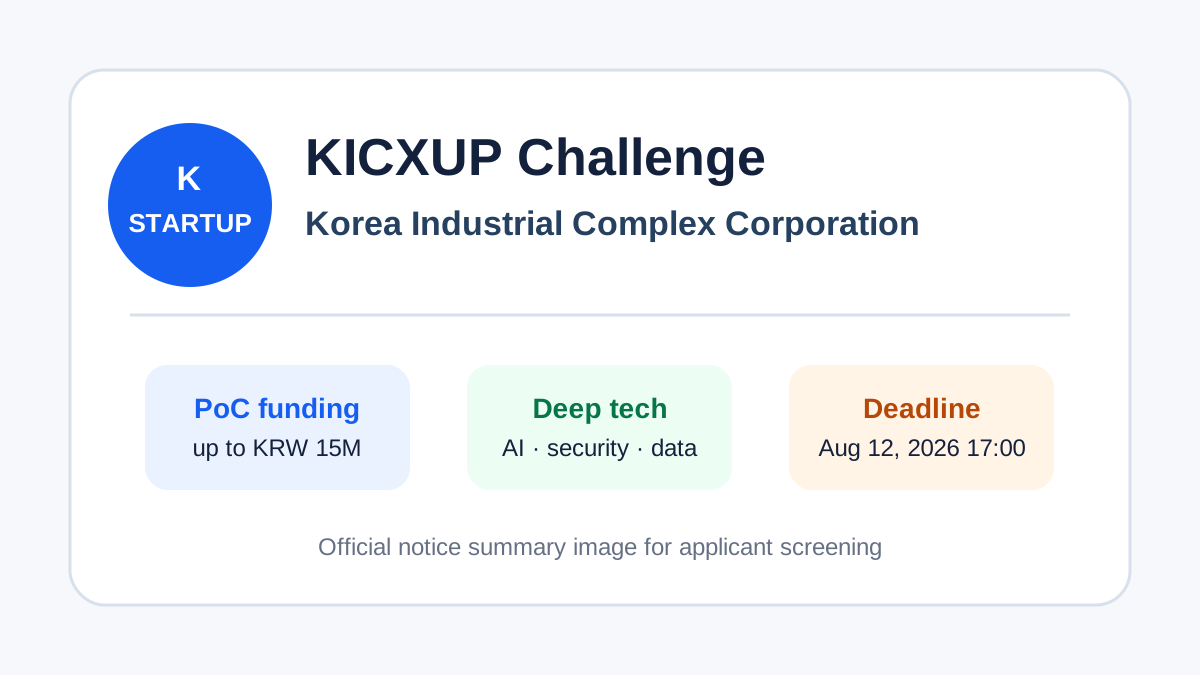
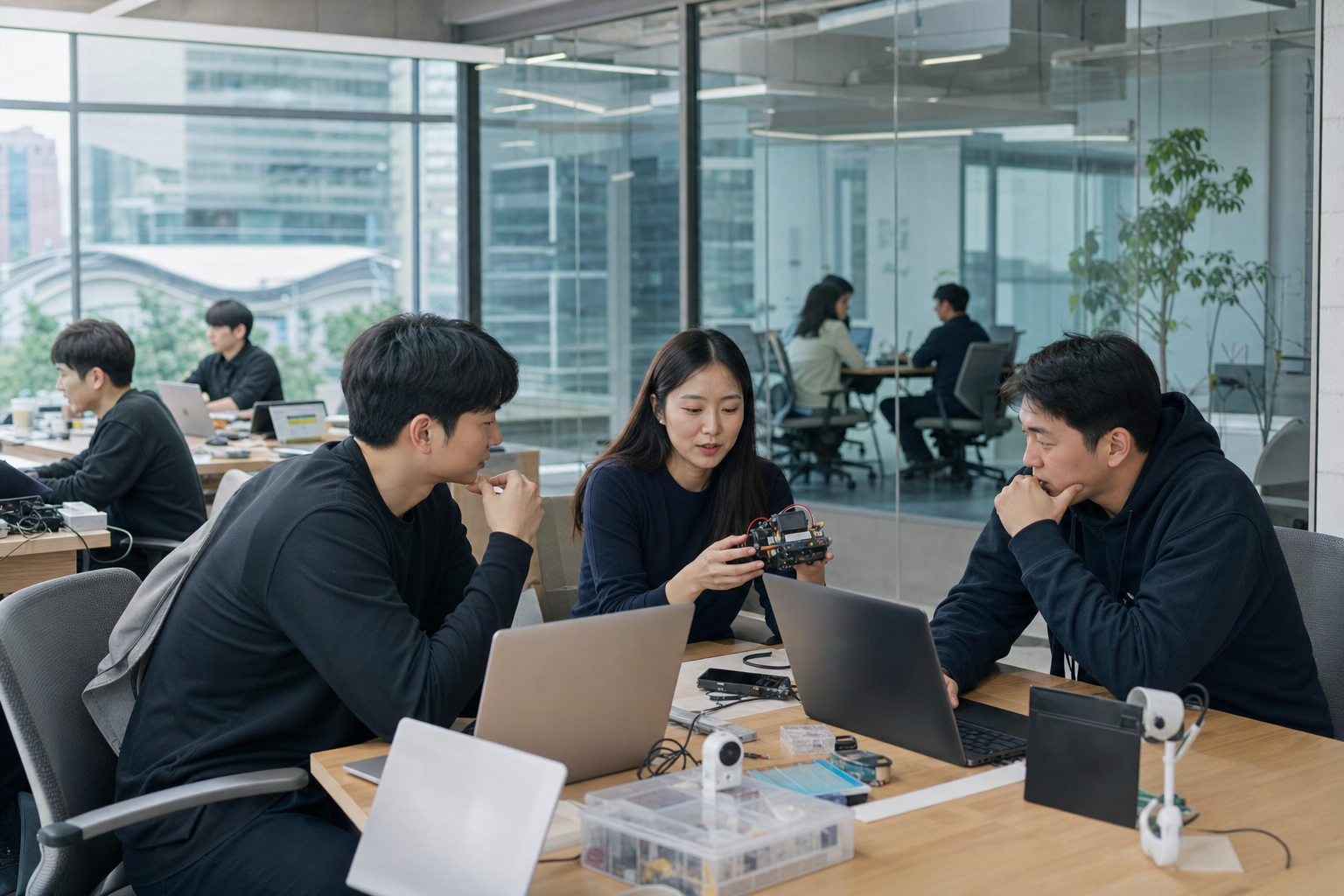
K-Startup and Korea Industrial Complex Corporation KICXUP program identification image

<KICXUP program identification image 1.1>

What the program offers

Item Details
Program 2026 KICXUP Challenge & Local startup recruitment
Lead organization Korea Industrial Complex Corporation, with Korea Credit Guarantee Fund support
Application window July 31, 2026, 09:00 to August 12, 2026, 17:00 KST
Application route Online form linked from the official K-Startup notice
Main support PoC funding up to KRW 15 million per case, corporate matching, investment and TIPS linkage, financial and non-financial support
Contact kicxup@cntt.co.kr, +82-2-3152-8657

For international readers, K-Startup is Korea’s central government startup-support portal. Programs listed there are usually written for companies that can operate in the Korean market or collaborate with Korean institutions. This Korea industrial PoC grant is especially relevant because it connects startups with industrial demand companies and gives selected teams a structured route to prove a B2B use case. The official notice is available on the K-Startup detail page.

Who should consider applying

The notice says the program is open to domestic and overseas startups seeking technology collaboration with industrial-complex demand companies. The standard eligibility window is companies up to seven years old and prospective founders; universities and research institutions are also included. For Korean deep tech PoC fields, startups up to ten years old may be eligible. The listed deep-tech areas include AI and big data, cybersecurity and networks, semiconductors, bio-health, future mobility, energy, robotics, aerospace and quantum technologies.

That makes the Korean startup grant most useful for teams with a concrete industrial workflow to validate:

  • AI or data platforms that reduce cost, downtime or defects in manufacturing, logistics or energy operations
  • predictive maintenance, visual inspection, safety monitoring or process-automation products
  • industrial cybersecurity, OT security or network-monitoring products
  • B2B SaaS companies that already have a pilot-ready product but need a Korean reference customer and a PoC budget

A consumer app or a broad productivity tool may struggle unless the team can explain a specific industrial-complex use case. Before applying, write one plain sentence describing the customer problem, the deployment site, the PoC metric and the expected business outcome.

Selection flow and documents

The KICXUP Challenge track plans a first document screening of 140 companies and a second presentation round selecting around 70 companies. The Local track is smaller: eight consortia in the first round and four in the final round. The presentation format is short, with seven minutes for the pitch and three minutes for Q&A, so the strongest deck will not be the one with the most technology slides. It should show the demand company’s problem, the implementation plan, the data or environment required, measurable success criteria and what happens after the PoC.

Required documents include the application form, personal-information consent, a business plan or company introduction, and, for the Local track, a collaboration commitment or MOU. Applicants should also check ordinary exclusion risks such as tax arrears, financial default, prior sanctions for false documentation and restricted industries.

Why this was selected over the KOCCA candidate

A relevant KOCCA-listed candidate was the 2026 Game Development AI Transformation support program posted by Busan IT Industry Promotion Agency. It supports AI maturity diagnosis, consulting, education, expert matching and AI platform usage for small and indie game developers. That is a strong fit for game studios, and the official KOCCA notice is useful for that niche. For a broader English-speaking audience tracking KICXUP AI startup opportunities, however, KICXUP is more broadly applicable: it covers AI, data, cybersecurity and other deep-tech fields, and it links the Korea PoC grant to corporate collaboration and follow-on financing routes.

Practical takeaways

Treat KICXUP as a customer-validation program, not just a subsidy. The PoC funding matters, but the bigger value is a structured industrial collaboration that can become a reference case in Korea. If your team has an AI, data, security or platform product that can be tested with a Korean industrial partner, check the official K-Startup program notice, confirm the online form and supporting documents, and finish the submission before the August 12 deadline rather than waiting until the final hour.


Monday, July 27, 2026

Gwanak S Valley at KES 2026: checklist for AX and robotics startups

Gwanak S Valley at KES 2026: checklist for AX and robotics startups

The KES 2026 startup booth opportunity through the Gwanak S Valley booth program at Korea Electronics Show 2026 is a local market-access opportunity for startups based in Seoul’s Gwanak district. The official K-Startup program notice names AX, robotics, mobility, digital health, XR, spatial computing, and electronic components as relevant fields.

Applications close on August 7, 2026 at 14:00 Korea time. The application route is the Gwanak startup support notice.

Quick eligibility view

Item What applicants need to check
Applicant base A company located in Gwanak with a product or solution suitable for KES
Business age The K-Startup listing indicates companies up to the under-ten-year range
Event October 13–16, 2026, COEX Halls A and B in Seoul
Support Booth, display fixtures, buyer and investor meetings, and related event participation
Restriction No duplicate support for the same KES participation from another public program

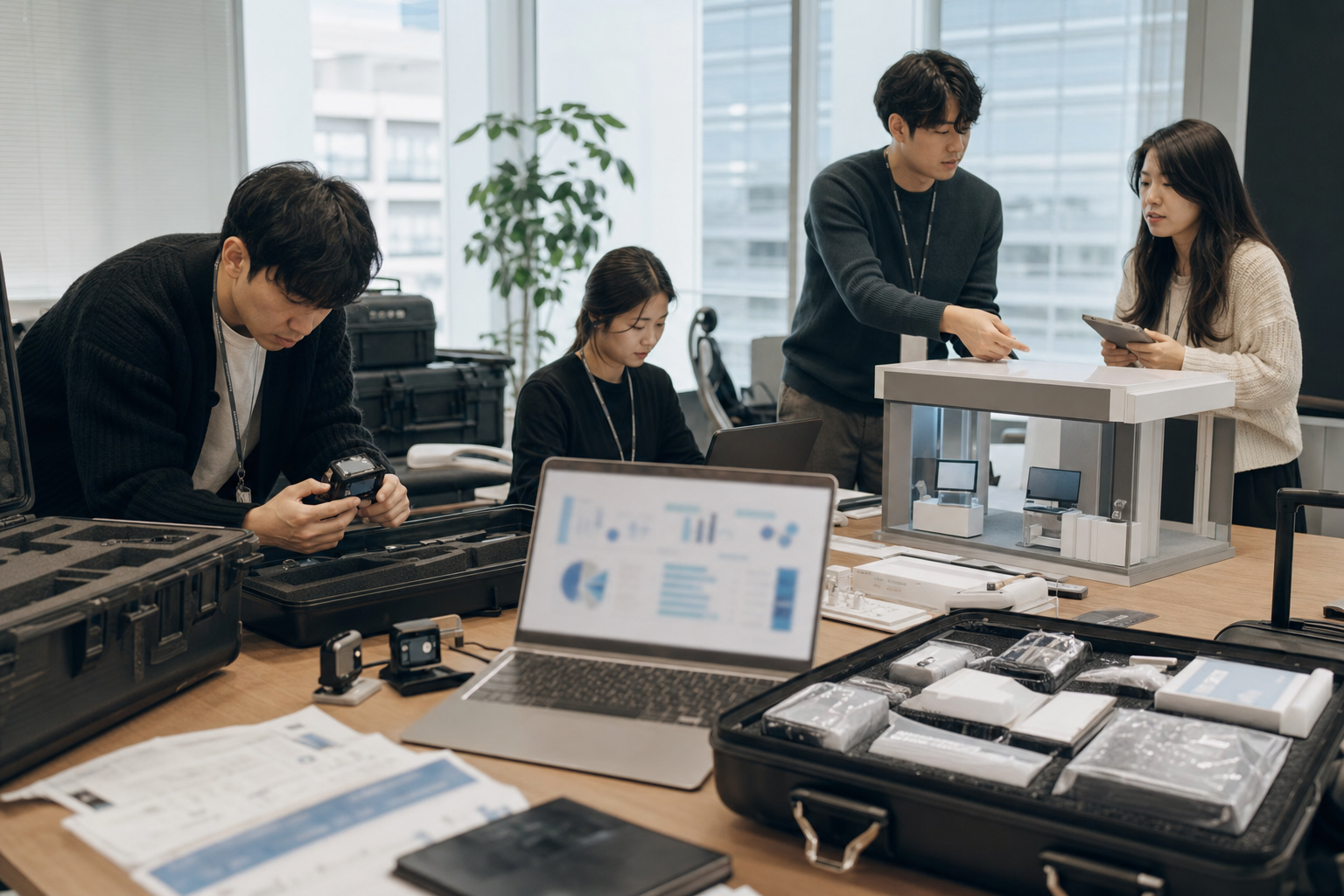
Startup team reviewing trade show application papers and a small booth model

<Trade show preparation 1.1>

The Korean-location rule is important

This Korean startup grant is not open to every overseas or Korea-interested company. It is aimed at companies with a Gwanak presence, such as a headquarters, main business site, lab, or branch. For an AI startup Korea team, that location condition should be checked before spending time on the application package.

What the program actually provides

The support includes a promotional booth worth about KRW 5 million, booth fixtures such as an information desk and graphic wall, buyer and investor meetings, and access to side programs including innovation awards and purchasing or VC consultations. For a startup, the practical value depends on whether the team can demonstrate a stable product and turn booth traffic into follow-up meetings.

Founders preparing an AI product demo schedule in a bright startup office

<Demo schedule planning 2.1>

Before applying

  1. Prepare the application form, privacy consent, business registration copy, and Korean IR deck.
  2. Make sure the IR deck contains slides for each evaluation item, as the notice requires at least one slide per criterion.
  3. Check whether the company is already receiving another public subsidy for the same KES participation.
  4. Define a three-minute demo flow and a post-event sales or investment follow-up target.

This K-Startup program is best for a Gwanak-based AX, robotics, XR, or digital health company that can show a product on the exhibition floor, not just describe a roadmap.

Daegu AX PoC grant: startup checklist before August 7

Daegu Open Innovation AX PoC: what startup teams should check before August 7

Daegu startup PoC teams should read this carefully. This Daegu AX grant is useful for founders comparing Korea PoC funding options and preparing a lead company commitment. Daegu’s open innovation AX program is a focused Korean startup grant and a practical K-Startup program for companies that already have a practical collaboration path with a larger corporate or public-sector partner. The official K-Startup program notice is not a broad idea contest; it is designed for startups ready to run a proof of concept with a lead company.

Applications close on August 7, 2026 at 16:00 Korea time. The application route is the Daegu startup portal.

Eligibility in plain English

Item What applicants need to check
Applicant type A startup with prior collaboration discussions completed with a lead company
Company age Up to seven years old, or up to ten years for new-industry fields
Location Headquartered in Daegu, or able to move headquarters to Daegu within two months after agreement
Selection scale About two companies
Support KRW 15 million PoC funding per company, consulting, networking, and follow-on support

Startup founders reviewing application papers and a trade support checklist at a desk

<Application preparation 1.1>

The partner commitment matters most

For an AI startup Korea team, the strongest fit is a company that can name the operational problem, the partner site, and the measurable result. The program requires a lead-company participation commitment, so the business plan should not read like a generic AI pitch. It should explain how the PoC will work in a real workflow, whether the technology is generative AI, data analytics, cloud automation, or security operations.

What the funding can realistically cover

The program offers KRW 15 million per selected company. That is helpful, but it is not enough for an unfocused enterprise transformation project. Treat the grant as a way to fund a tightly scoped proof: data access, integration work, field testing, and a result metric that can support follow-on sales or investment conversations.

AI startup team discussing a cloud proof of concept in a bright Seoul office

<PoC scope planning 2.1>

Pre-application checklist

  1. Make sure the partner commitment letter matches the company name, contact person, and PoC topic in the business plan.
  2. If the company is not already based in Daegu, calculate the legal and operational impact of relocating headquarters within two months.
  3. Prepare tax certificates, financial statements, and employee-insurance documents early because they can slow down the application.
  4. Keep the PoC narrow enough to finish with KRW 15 million, and treat investment or follow-on projects as separate outcomes.

This K-Startup program is best for a startup that already has a potential customer or industrial partner and needs public support to turn that relationship into a measured pilot.

Sunday, July 26, 2026

Seoul AI Hub Residency 2026: A Practical Checklist for AI Startups

Seoul AI Hub Residency 2026: A Practical Checklist for AI Startups

A new K-Startup notice is open for applications. For international readers, the key point is that this is a Korean government startup support notice; applicants generally need a Korea-relevant entity, founder status, or operating base that satisfies the official eligibility language.

The deadline is August 11, 2026, 23:59 KST. Treat the time as Korea Standard Time and leave room for portal, attachment, or email delays.

Quick decision table

Question What to check
Program fit pre-founders and startups with AI technology, AI services, or a concrete plan to build them in Korea
Application route online submission through K-Startup
Main source K-Startup official notice
Search intent Seoul AI Hub second intake and K-Startup Seoul AI Hub readers tracking Korea opportunities

An AI startup team reviews a prototype in a modern Seoul coworking hub

<AI startup residency workspace, Example image 1.1>

Who should look closely

This opportunity is most useful for teams that can explain why Korea is the right operating context, not just why the technology is interesting. A strong application should connect the product, the customer or test environment, the budget request, and the expected outcome. That matters whether the team frames itself around Seoul AI Hub startups or a broader Korea AI workspace program plan.

How to prepare

  1. Read the K-Startup detail page and the attached notice before writing the application narrative.
  2. Map every requested document to a specific eligibility or evaluation point.
  3. Make the budget or workspace rationale concrete: what will be built, tested, introduced to customers, or validated during the support period.
  4. Keep proof of submission, especially when the route is email rather than a fully tracked portal workflow.

AI startup founders receive mentoring beside a GPU workstation and sensor prototypes

<Seoul AI Hub technical mentoring, Example image 3.1>

Final checks before submission

  • The company or founder profile matches the Korea-specific eligibility wording.
  • The application explains the product, the AI component, the market use case, and the requested support in one coherent story.
  • Required signatures, privacy-consent forms, and attachments are complete.
  • The submission timestamp is safely before the Korean deadline.

Use the official K-Startup page as the final authority. If an attached PDF or form differs from the web summary, follow up with the operating institution before submitting.

K-Startup Manufacturing AI Support Before August 7

K-Startup Manufacturing AI Support Before August 7

A new K-Startup notice is open for applications. For international readers, the key point is that this is a Korean government startup support notice; applicants generally need a Korea-relevant entity, founder status, or operating base that satisfies the official eligibility language.

The deadline is August 7, 2026, 18:00 KST. Treat the time as Korea Standard Time and leave room for portal, attachment, or email delays.

Quick decision table

Question What to check
Program fit hardware manufacturing companies that own or are developing AI technology usable on a factory floor
Application route email submission to creativefactory@iact.or.kr
Main source K-Startup official notice
Search intent manufacturing AI grant Korea and K-Startup factory AI grant readers tracking Korea opportunities

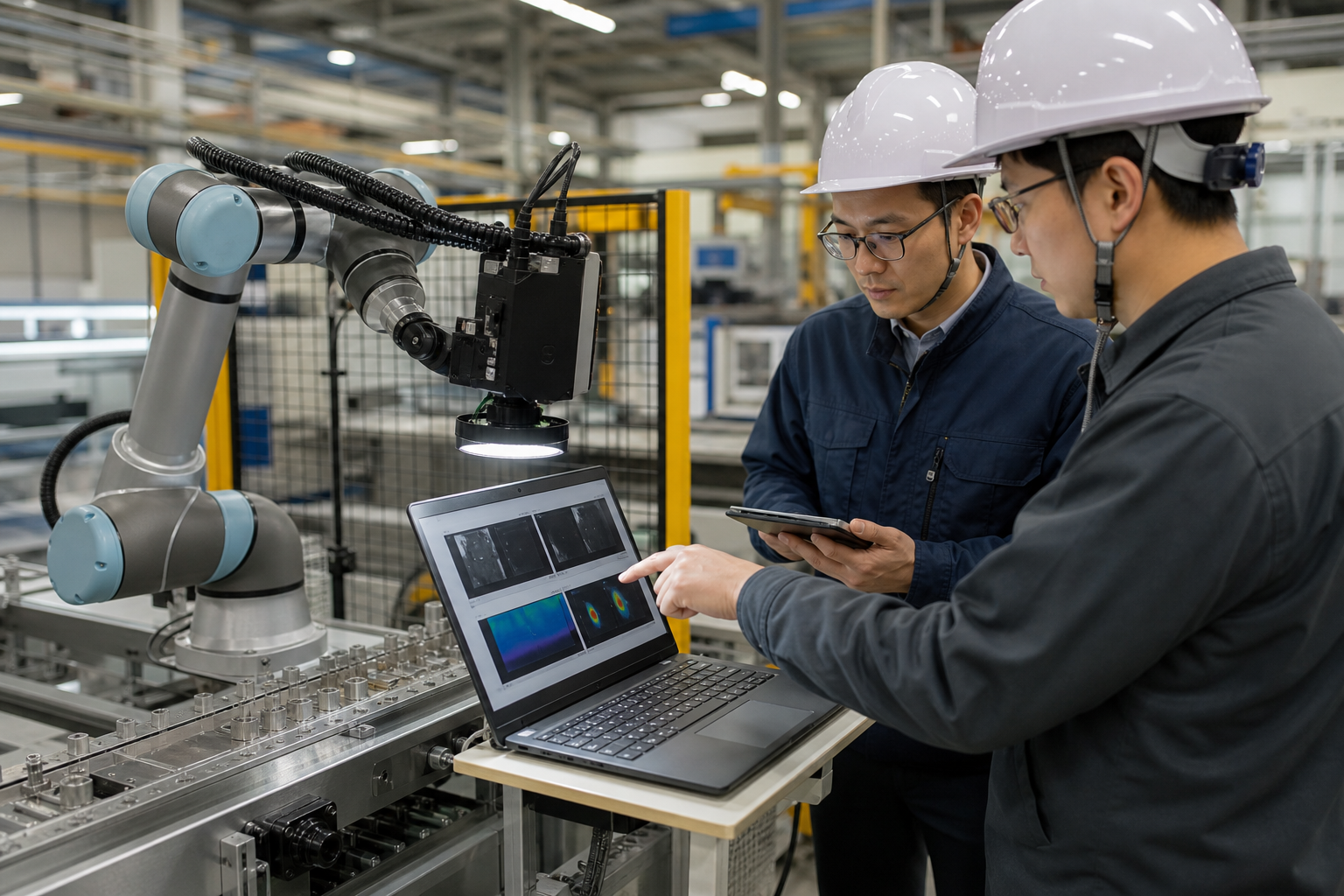
Manufacturing engineers validate a robotic arm and machine-vision AI on a factory line

<Manufacturing AI field validation, Example image 1.1>

Who should look closely

This opportunity is most useful for teams that can explain why Korea is the right operating context, not just why the technology is interesting. A strong application should connect the product, the customer or test environment, the budget request, and the expected outcome. That matters whether the team frames itself around a Korea hardware AI grant or a broader Creative Factory AI support plan.

How to prepare

  1. Read the K-Startup detail page and the attached notice before writing the application narrative.
  2. Map every requested document to a specific eligibility or evaluation point.
  3. Make the budget or workspace rationale concrete: what will be built, tested, introduced to customers, or validated during the support period.
  4. Keep proof of submission, especially when the route is email rather than a fully tracked portal workflow.

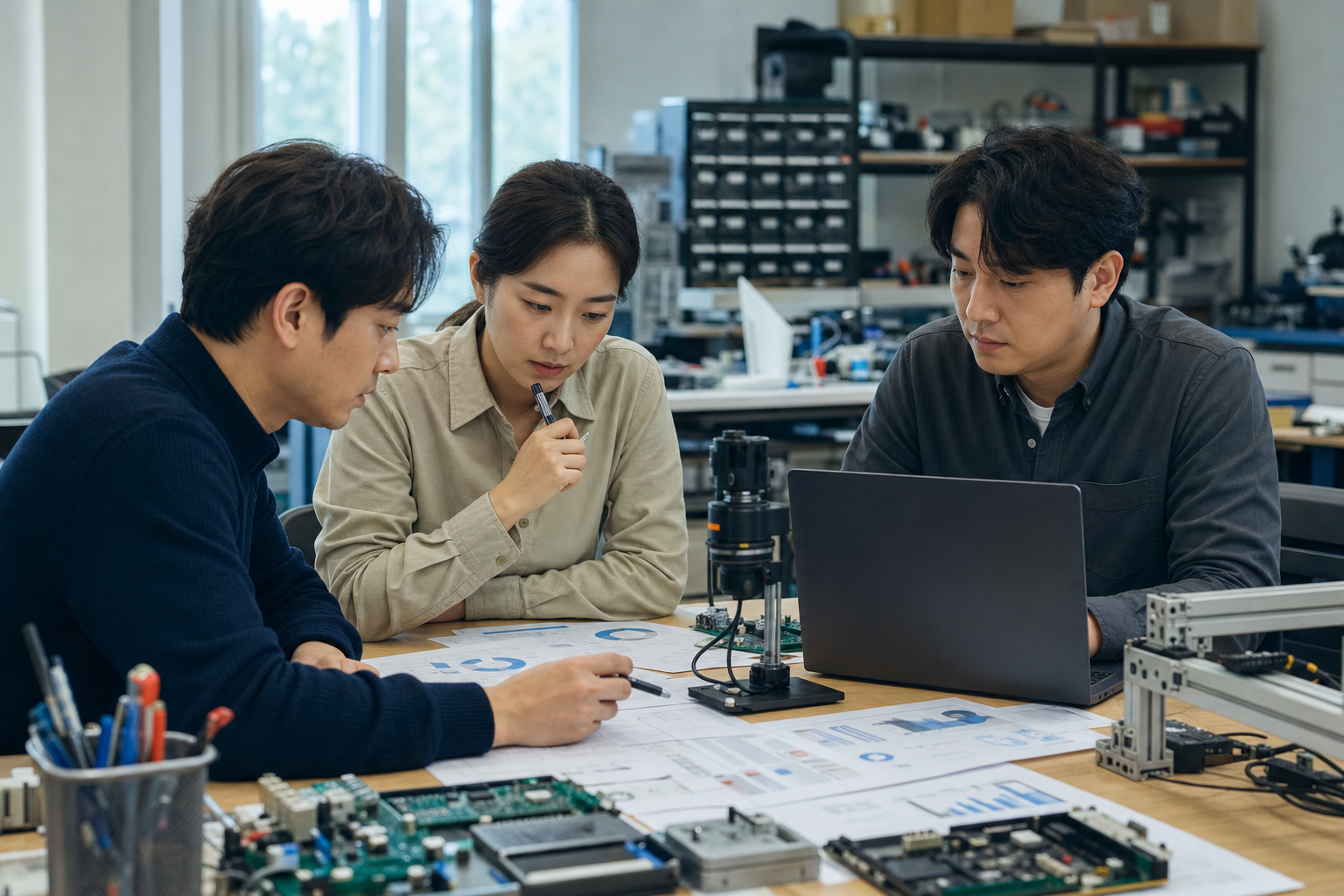
A manufacturing AI startup team reviews prototypes and commercialization application material

<Manufacturing AI commercialization preparation, Example image 3.1>

Final checks before submission

  • The company or founder profile matches the Korea-specific eligibility wording.
  • The application explains the product, the AI component, the market use case, and the requested support in one coherent story.
  • Required signatures, privacy-consent forms, and attachments are complete.
  • The submission timestamp is safely before the Korean deadline.

Use the official K-Startup page as the final authority. If an attached PDF or form differs from the web summary, follow up with the operating institution before submitting.

CEATEC 2026 Support for Korean Digital and AI Startups

The CEATEC 2026 support notice targets Korean digital ICT AI companies preparing for the Japanese market. It plans to select around eight companies and support their participation in CEATEC 2026 in Chiba, Japan. The application window runs from July 23, 2026 to August 4, 2026 at 18:00 Korea time.

The operator is the Global Digital Innovation Network, so applicants should treat this as GDN CEATEC support rather than a generic travel subsidy. The official K-Startup program notice lists booth, travel, workshop, business matching, and possible interpretation support. Applications are submitted through the GDN event page, and event context is available on the CEATEC official site.

Program snapshot: exhibition support plus Japan-market access

Item Summary
Program CEATEC 2026 exhibition support for participating companies
Application window July 23, 2026 ~ August 4, 2026 18:00 KST
Event dates October 13 ~ 16, 2026
Venue Makuhari Messe, Chiba, Japan
Scale Around 8 digital, ICT, or AI companies
Support Booth rental and setup, round-trip airfare, workshop, 1:1 business matching, interpretation if needed

For global readers, this is a Korea-based support program. It is most relevant to companies incorporated in Korea that already have a commercial product and some Japan-market readiness signal.

Eligibility: Japan-ready digital and AI companies

Applicants need a commercial product or service using digital, ICT, or AI convergence technology and must be able to demonstrate it. They also need at least one Japan market readiness signal, such as prior export or sales to Japanese partners, an MOU or NDA, local intellectual property, a Japanese subsidiary or branch, investment from a Japanese VC or institution, or previous participation in a Japanese exhibition. At least one founder or co-founder must be able to participate onsite during the exhibition.

For an AI startup Korea team, the application should explain why CEATEC is the right market-development channel. A model demo alone is not enough; evaluators need to see buyer context, deployment conditions, security or data-handling readiness, and a credible follow-up plan.

CEATEC 2026 preparation — a photorealistic editorial scene of a Korean digital and AI startup team checking booth materials and demo devices

<CEATEC 2026 exhibition preparation scene 2.1>

Evaluation: show evidence, not only ambition

The selection process uses a first quantitative eligibility screen and a second qualitative document review. Missing a required criterion can end the application at the first stage. The second stage relies on external evaluators and ranks applicants based on submitted materials.

Strong applications should connect the exhibition booth to a concrete pipeline: target Japanese customer segments, partner meetings, demo scenarios, pricing or procurement readiness, and post-event follow-up. The notice names GDN Business Team 1 as the contact point at ict@gdinfoundation.com, with phone contacts 031-8039-6756 and 031-8039-6754.

Japan market readiness workshop — a photorealistic editorial scene of a Korean AI team reviewing Japan-market materials and follow-up plans

<Japan market readiness workshop scene 3.1>

Final checklist before applying

  • Confirm whether both the event-page submission and the additional Google Form are required under the notice.
  • Prepare evidence for at least one Japan-readiness condition: partner agreement, local IP, subsidiary, investment, sales, or past exhibition record.
  • Make sure a founder or co-founder can attend CEATEC from October 13 to 16, 2026.
  • Check that the company has not already received overlapping support for the same exhibition from another public program.
  • Prepare an English or Japanese demo kit and a post-event B2B follow-up calendar.

This Korean startup grant is best for teams that can turn a booth into customer discovery, partner validation, or concrete sales conversations in Japan.

Related reading

Daegu Open Innovation PoC Grant: What AI Startups Need to Know

The Daegu PoC grant under Daegu Open Innovation is a Korea-focused support program for startups that already have a concrete collaboration topic with a lead corporate or public-sector partner. According to the K-Startup notice, applications are open from July 21, 2026 at 09:00 to August 7, 2026 at 16:00 Korea time.

This is not a broad idea competition. The notice asks applicants to bring a pre-discussed PoC project and a partner commitment letter. The K-Startup program notice lists support for about two companies, with KRW 15 million in PoC funding per company. Applications are submitted through the Daegu Startup Hub project page, and the operator is the Daegu Center for Creative Economy and Innovation.

Program snapshot: PoC funding tied to a lead partner

Item Summary
Program 2026 Daegu Startup Open Innovation bottom-up PoC program
Application window July 21, 2026 09:00 ~ August 7, 2026 16:00 KST
Scale Around 2 startups
Support KRW 15 million PoC budget, consulting, networking, follow-on links
Application Online submission via Daegu Startup Hub
Contact AX Innovation Team, 053-759-6397, c-lab@ccei.kr

For international readers, this is a Korean startup grant with local operating conditions. A company must either be based in Daegu or commit to moving its headquarters to Daegu within two months after the agreement.

Eligibility: Daegu location plus a real collaboration project

Applicants must satisfy three core conditions. First, the startup must have completed prior collaboration discussions with a lead company, mid-sized firm, SME, public company, or similar partner. Second, it must generally be within seven years of founding; startups in designated new-industry fields can be within ten years. Third, the company must be headquartered in Daegu or be able to relocate its headquarters there within two months after signing the program agreement.

For an AI startup Korea team, the strongest angle is not “we use AI” but “this partner can validate our model or platform in a real workflow.” Data platforms, SaaS tools, security products, and applied AI systems should describe the partner site, available data or environment, success metric, and expected business outcome.

Daegu Open Innovation PoC meeting — a photorealistic editorial scene of a startup team and lead partner reviewing field-validation plans

<Daegu Open Innovation PoC planning scene 2.1>

Application strategy: the partner letter is the core asset

Required documents include the application form and business plan, personal information consent form, lead partner commitment letter, business registration certificate, national and local tax clearance certificates, 2025 financial statement certificate, and employee insurance list. Corporate applicants may need a recent corporate registry extract, and companies relocating to Daegu need a headquarters relocation commitment.

The process moves through eligibility screening, document review, presentation review, and an agreement expected around August. This bottom-up PoC program rewards applicants that can show project validity, technical capability, feasibility, and willingness to collaborate. A thin partner letter is risky; the application should show what the partner will provide, what will be tested, who owns each step, and what evidence will be produced by the end of the PoC.

Daegu PoC execution readiness — a photorealistic editorial scene of a founder and operations manager discussing a prototype test plan

<PoC field-validation readiness scene 3.1>

Final checklist before applying

  • Confirm that the partner can sign the commitment letter and support the proposed test environment.
  • Check whether the headquarters requirement is already satisfied or whether relocation to Daegu is realistic.
  • Tie the KRW 15 million budget to a specific PoC plan, not to general product development.
  • Review tax, closure, debt-default, and participation-restriction conditions before submission.
  • Prepare for a fast start, because the agreement is expected in August and the program is built around execution.

This K-Startup program is best suited to teams that have moved beyond sales exploration and can turn a partner conversation into a measurable field test.

Related reading

Friday, July 24, 2026

Seoul AI Hub Residency 2026: What Startup Teams Should Check

The Seoul AI Hub residency notice on K-Startup is aimed at AI startups and founders preparing AI businesses in Korea. The official K-Startup page lists the application window as July 22, 2026 at 09:00 through August 11, 2026 at 23:59 KST, with online submission through Startup Plus.

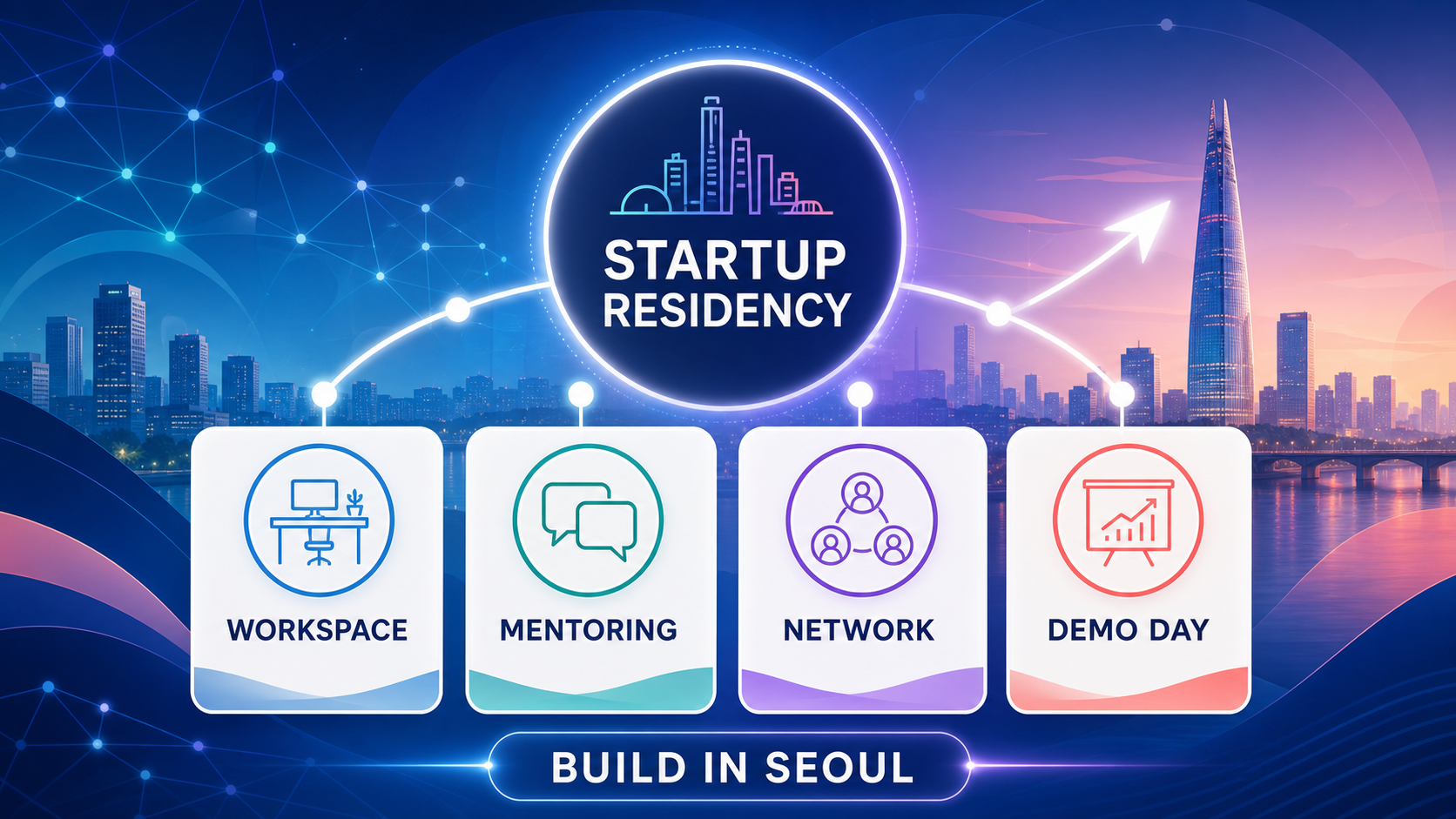
For readers outside Korea, this is best understood as a Korea-based public startup workspace and scale-up program, not a remote grant. The attached Seoul AI Hub guide says up to 21 companies will be selected. Residents receive office infrastructure for an initial one-year term, with annual extension review up to four years, and access to Seoul AI Hub programs such as AX projects, open innovation, global expansion, demand-side and investor matching, and GPU cloud programs. The official Korean source is the K-Startup notice and the attached recruitment guide; applications are submitted through Startup Plus.

Program snapshot: workspace plus AI ecosystem access

This is not simply a cheap office listing. The value is the combination of workspace, meeting rooms, shared infrastructure, and eligibility to participate in Seoul AI Hub programs. A Korea-based AI company that needs customer introductions, investor access, high-performance computing programs, global-market preparation, or structured startup support may find it more relevant than a pure rent comparison.

Item Official notice summary
Program 2026 second Seoul AI Hub new resident company recruitment
Application period July 22, 2026 09:00 ~ August 11, 2026 23:59 KST
Selection scale Up to 21 companies
Target AI startups and prospective founders with AI technology or service plans
Residency term Basic one year, extendable up to four years through review
Application route Online submission through Startup Plus
Contact 02-2135-6814, gone@seoulaihub.kr

For English-language search, the K-Startup AI hub program is best framed as a Seoul startup workspace for Korea-based AI teams rather than a global remote accelerator.

Applicants must be able to register their address at Seoul AI Hub within 30 days after selection. Prospective founders also need to establish the business and register the address within that window.

Eligibility: AI focus, company age, and address transfer

The recruitment guide gives three main eligibility gates. The applicant must have, or be preparing, AI technology or an AI service. The company should have been established in October 2018 or later, or the applicant should be a prospective founder. The selected team must also be able to transfer its registered address to Seoul AI Hub within 30 days after selection.

A team considering a Korea AI startup office should also check the exclusion list before applying. The guide names tax delinquency, debt-default restrictions, suspended or closed businesses, past removal from Seoul startup facilities, prior Seoul AI Hub withdrawal or graduation history, and some overlapping Seoul public workspace support as risk factors. Some exceptions exist, such as ending or giving up another workspace benefit before the new residency contract, so applicants need to read the official guide carefully.

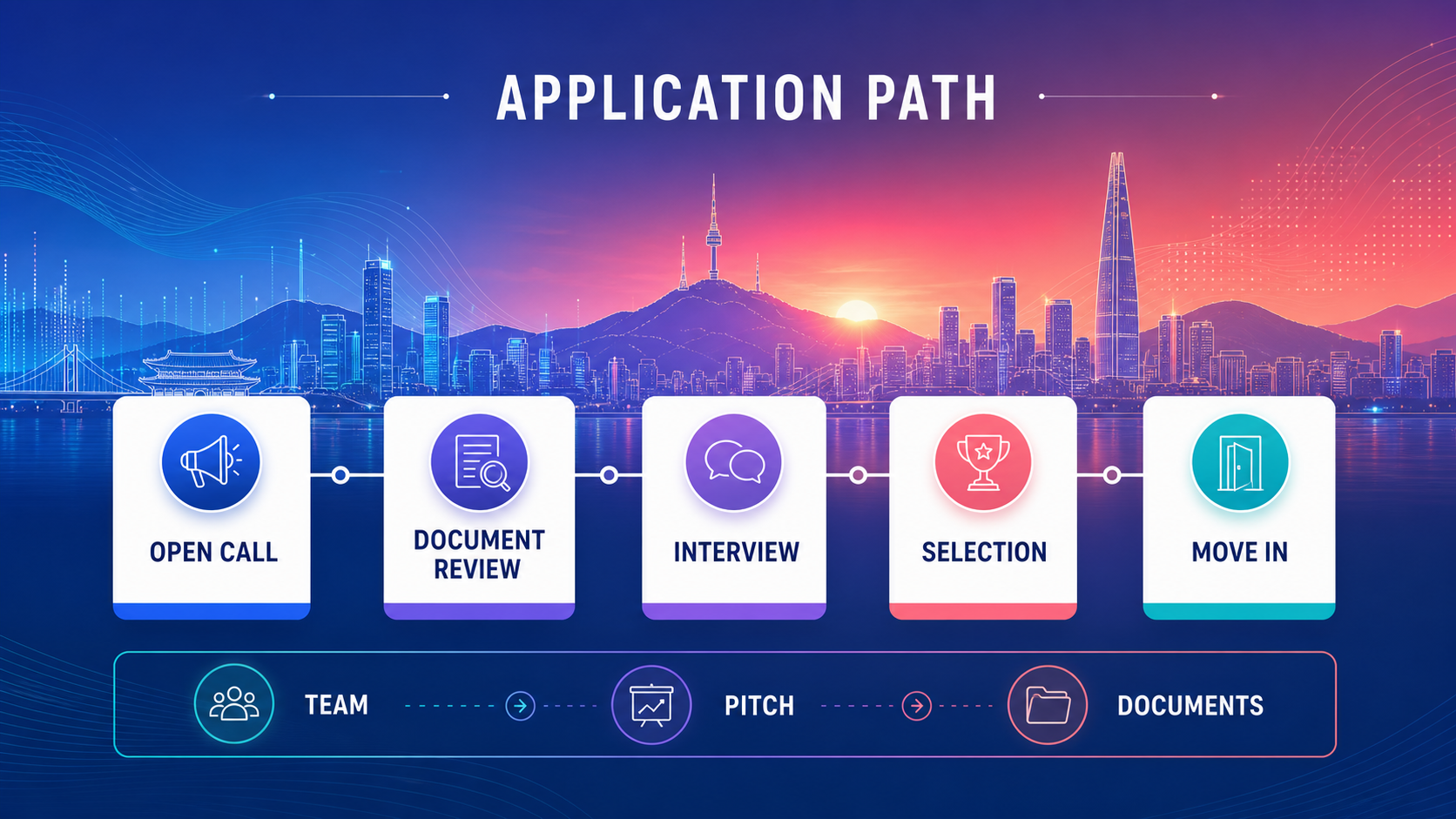
Seoul AI Hub residency timeline — online application, document review, interview, and move-in milestones

<Seoul AI Hub residency timeline 2.1>

Costs and selection: office type, team size, and AI fit

The guide lists 21 available offices across types A through D. The K-Startup page summarizes independent office cost as KRW 6,020 per square meter, VAT excluded. The attached guide breaks that into monthly rent of KRW 4,080 per square meter plus monthly management cost of KRW 1,940 per square meter. Applicants should calculate the preferred office type, resident headcount, six-month prepayment or mid-payment conditions, and VAT before treating the space as inexpensive.

Selection runs through document review and an interview-style presentation. The guide assigns weight to support impact, execution capability, technology, and business potential. A strong application should not stop at model performance. It should connect AI specialization, market size, customer validation, financial stability, and a concrete plan for using Seoul AI Hub's programs.

Seoul startup workspace decision map — eligibility, scale, benefits, and costs for AI teams

<Seoul startup workspace decision map 3.1>

Pre-submission checklist

  • Register and apply through Startup Plus, using the Apply support-program application flow described in the guide.
  • Prepare the resident application and business plan, privacy consent, eligibility confirmation form, and company introduction deck first.
  • Add required documents such as business registration, corporate registry, recent financial statements, social-insurance certificate, and national and local tax certificates where applicable.
  • Confirm whether the company can transfer its registered address and whether the planned resident headcount matches the requested office type.
  • Prepare a short pitch: the guide indicates a five-minute presentation and five-minute Q&A for the interview round.

The best-fit applicant is a Korea-based AI team that can explain why being inside Seoul AI Hub changes its growth trajectory. The application should tie the technology, market, team, and use of hub programs into one practical plan.

Related reading

Manufacturing AI Korea Grant: What Hardware Teams Should Check

The manufacturing AI Korea grant listed on K-Startup is a small but concrete support program for hardware manufacturers applying AI on the factory floor. The official K-Startup page states that applications run from July 22, 2026 at 00:00 to August 7, 2026 at 18:00 KST, with email submission to creativefactory@iact.or.kr.

For international readers tracking Korean public startup programs, the important point is scope. This is not broad cloud-credit funding or a generic software voucher. The notice, run by Kyungpook National University Startup Support Center, selects four companies and offers up to KRW 10 million per company as indirect materials support. The official Korean source is the K-Startup notice and its attached PDF announcement, while the operating center also maintains public information at the Kyungpook National University Startup Support Center site.

Program snapshot: materials for real manufacturing AI products

The attached notice describes support for consumable materials, subsidiary materials, consumable parts, and modules needed for product verification or prototype production. It explicitly excludes asset-like purchases such as general equipment, electronics, machinery, desks, and chairs. It also excludes outsourced development, facility or software rental, repairs, and labor costs.

Item Official notice summary
Program Manufacturing AI technology commercialization support
Application period July 22, 2026 00:00 ~ August 7, 2026 18:00 KST
Agreement period September 1 ~ November 30, 2026, planned
Selection scale 4 companies
Support limit Up to KRW 10 million per company, indirect support
Application route Email submission with the designated forms
Contact 053-219-4105, creativefactory@iact.or.kr

The K-Startup manufacturing AI notice is narrow: Korean hardware AI support is tied to a tangible factory or product outcome, and Korea AI materials support is limited to items that can be purchased for validation or prototyping.

Treat this as a materials-backed validation program. If the spending plan mainly covers SaaS subscriptions, outsourced engineering, or general-purpose equipment, it probably does not match the notice.

Eligibility: Korea-based manufacturing status plus AI deployment

The program targets hardware manufacturing companies that own or are developing AI technology usable in a manufacturing setting. The attached notice says the applicant's business registration should include manufacturing, and the company should be applying AI in the manufacturing field. In-house AI appears preferred, but the notice also allows use of external AI solutions.

A Korean hardware team should check three gates before spending time on the application.

  1. The business registration clearly includes manufacturing.
  2. The AI use case is tied to operations such as process control, inspection, quality management, equipment operation, or production validation.
  3. The company is producing or developing a tangible product for market release, rather than simply distributing or reselling another product.

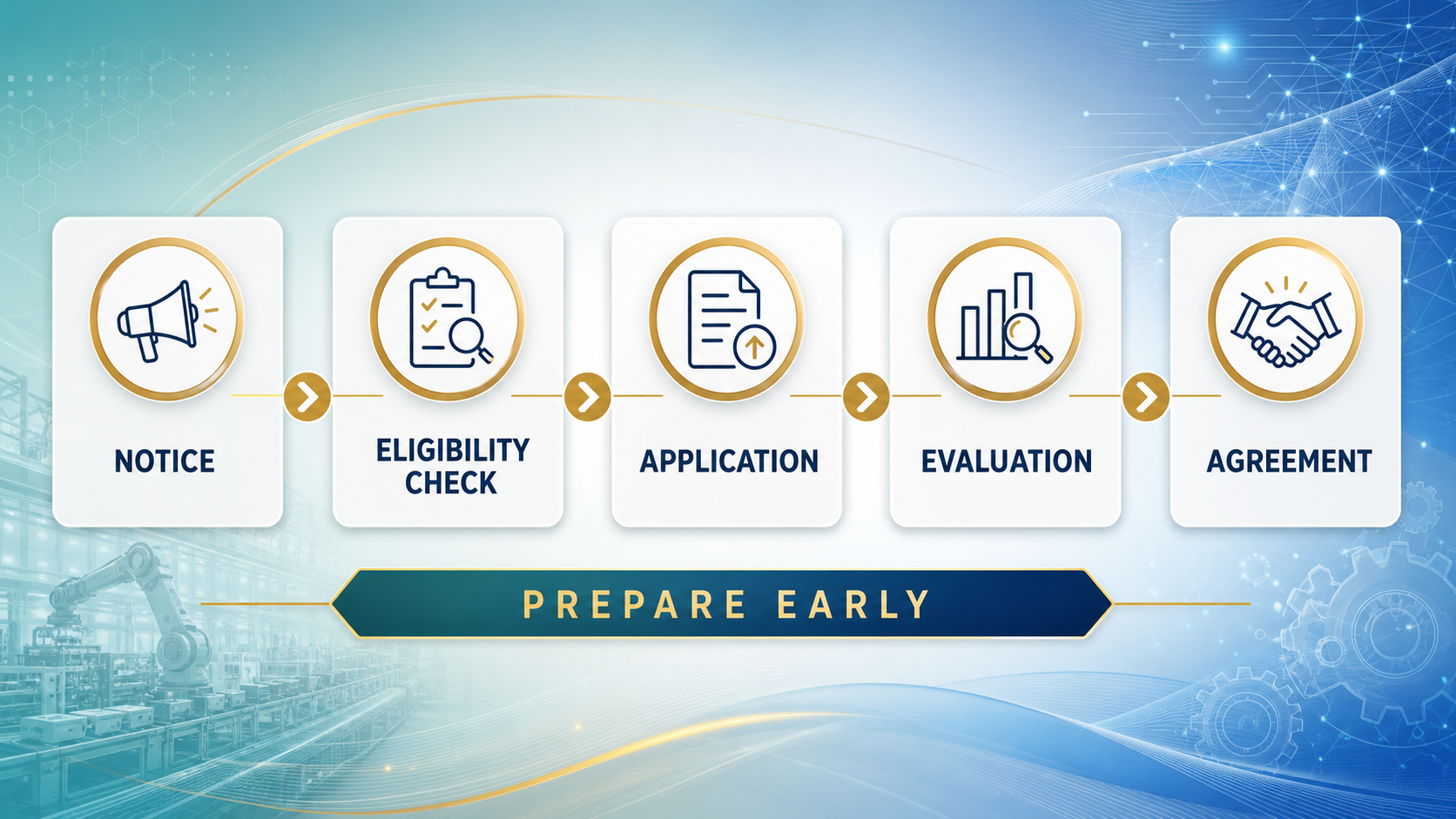
Manufacturing AI Korea grant schedule — application, review, agreement, and execution milestones

<Manufacturing AI Korea grant schedule 2.1>

How to frame the application

The review process combines document screening and an on-site review. The notice assigns the first round to need, completeness, and commercialization potential, then gives the second round heavier weight on execution, team capability, and expected impact. In practice, a strong application should show the current product state, the exact materials needed, and what measurable result can be produced during the short September-to-November execution window.

The application package includes the designated application form, company introduction, program plan, budget plan, privacy consent, integrity pledge, and evidence documents. The notice asks applicants to submit one PDF package by email. Because this is not a portal upload, applicants should avoid last-minute submission and confirm receipt with the program office.

Korean hardware AI support fit check — target companies, supported spending, exclusions, and submission checks

<Korean hardware AI support fit check 3.1>

Pre-submission checklist

  • Use the email subject format requested in the notice: Manufacturing AI support_company name in Korean as specified by the program.
  • Separate supported materials from excluded items before writing the budget table.
  • Check whether the same product is already receiving support from another government, local-government, or institutional program.
  • Verify tax, local tax, social-insurance, and public-subsidy restriction status before submission.
  • Keep the plan realistic: purchasing, validation, and reporting must fit into roughly three months.

The best-fit applicant is not a team with a vague AI idea. It is a Korea-based manufacturer that can show where AI already touches production, why a specific set of materials unlocks validation, and what product outcome will be reported by the end of November.

Related reading

Thursday, July 23, 2026

Korea Pre-TIPS 2026 Second Round: What Tech Startups Should Check

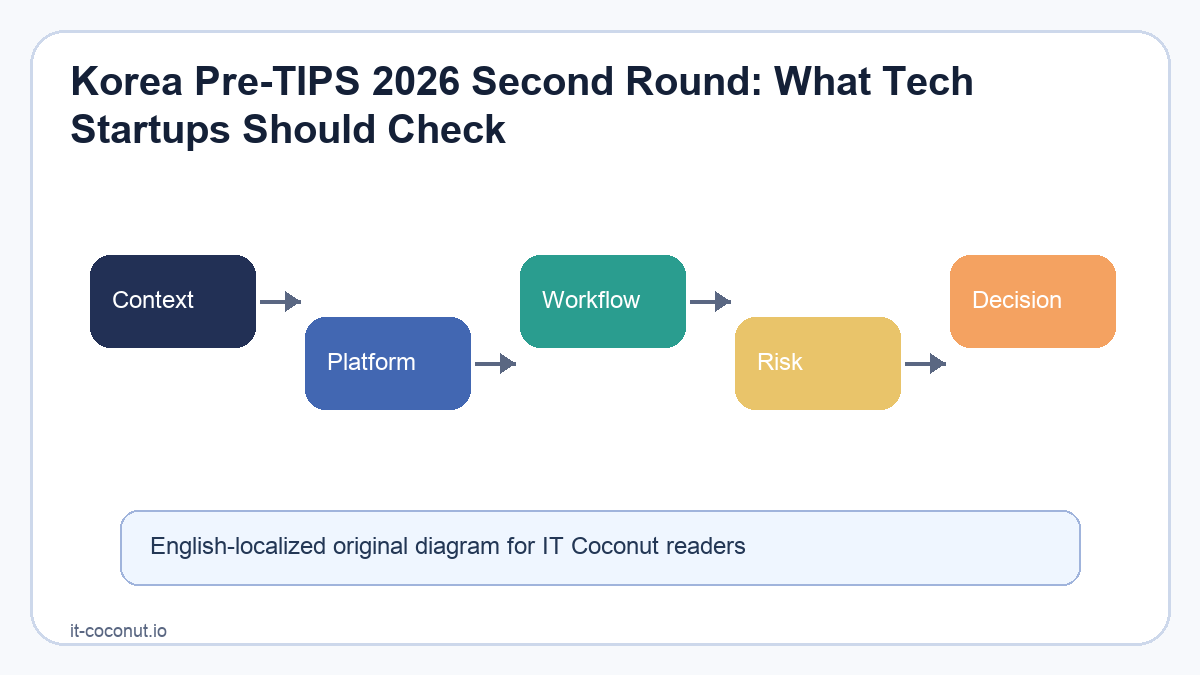
Korea's Pre-TIPS program is useful for founders who are already past the idea stage but not yet ready for the full TIPS track. The 2026 second-round notice targets early companies that have secured outside investment and need a practical bridge toward commercialization. For software, AI, SaaS, and platform startups, the important question is not whether the program sounds attractive. It is whether the team can turn an eight-month grant period into evidence of customer demand, technical readiness, and a stronger follow-on investment story.

The Korean notice lists the application window as July 10 to August 10, 2026, with the Korea Institute of Startup & Entrepreneurship Development as the operating organization. The attached announcement describes a rough selection scale of about 30 companies, a support period within eight months, and business funding averaging around KRW 90 million with an upper range of KRW 100 million. It also describes the target as non-capital-region early-stage companies within three years of founding that have received at least KRW 10 million in investment.

A four-step roadmap for Korea Pre-TIPS, from investment eligibility to selection, commercialization funding, and the next TIPS track

<Korea Pre-TIPS preparation roadmap 1.1>

Who should look closely

Key details at a glance

Reader question Practical takeaway
What this article explains Korea Pre-TIPS 2026 Second Round: What Tech Startups Should Check
Core SEO focus Korea Pre-TIPS 2026, Korea Pre-TIPS funding, TIPS startup program
How to read it Separate the durable signal from vendor messaging, short-term hype, and implementation friction.

The strongest fit is a regional B2B software company with an MVP, a first investor, and a concrete commercialization problem. A SaaS team may need money for security certification, enterprise pilots, IP filing, or customer onboarding. An AI startup may need labelled data, validation costs, cloud spending, or domain experts. A platform company may need evidence that a local industry cluster can become a repeatable market.

This is not a substitute for product-market fit. It is a way to buy time for disciplined evidence building. A strong application should explain why the initial investment matters, what the next eight months will prove, which customers or pilots are already within reach, and how the team will move from Pre-TIPS to TIPS or private follow-on financing.

Application framing

Founders should avoid filling the plan with generic AI language. The stronger story is operational: what will be built, who will use it, what will be measured, and which cost items directly reduce execution risk. The budget should match the announcement's business-purpose categories, while the milestone table should make the selection committee believe the company can produce visible progress before the agreement period ends.

For international readers, Pre-TIPS is best understood as part of Korea's staged startup support system. It is not a prize for a polished pitch deck. It is a public funding layer designed to help promising early companies become credible enough for the deeper TIPS pipeline.

For readers comparing search terms, this article is also relevant to tech startup funding.

Primary sources

Related reading

For broader context, read AI coding agents.

A second useful reference is vibe coding.

Readers following the infrastructure side may also want Claude 4 agentic coding.

References

Gangwon AI Healthcare Grant: K-Startup Applicant Checklist

The Gangwon AI healthcare grant is a targeted Korean startup support program for bio and healthcare companies that want to apply artificial intelligence to real operations. For English-speaking founders, investors, or partners tracking Korea's regional deep-tech programs, the notice is useful because it shows how local governments are moving from broad AI slogans to hands-on implementation support.

According to the K-Startup notice and attached announcement, the application window is July 20, 2026 at 17:00 through July 31, 2026 at 23:59 Korea time. The host organization is the Gangwon Center for Creative Economy and Innovation. Applicants should confirm all final details in the original K-Startup notice and attachment before submitting. As a K-Startup healthcare AI program, it is narrower than a general startup grant and should be evaluated against location, industry, and data-handling requirements.

What the program offers

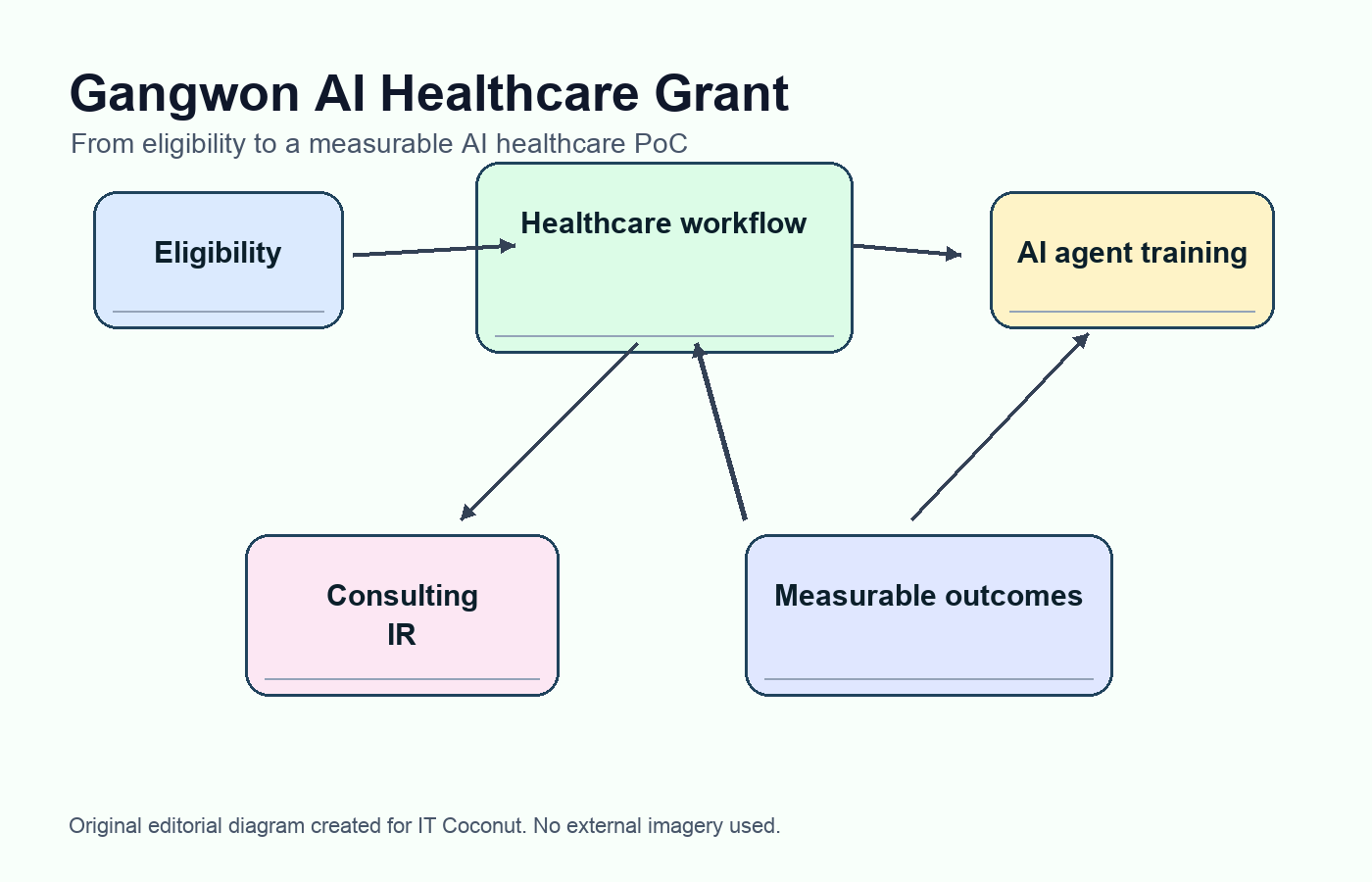
The program supports AI adoption by bio and healthcare startups located in Gangwon Special Self-Governing Province. The attached notice describes a roughly four-month program running from August through December 2026 and a planned cohort of 20 companies.

The support package is closer to an AI adoption program than a pure cash grant. It includes access to an AI server room, AI agent training, technology and commercialization consulting, and investor relations support. That makes it most relevant for teams that already understand a healthcare workflow but need help turning AI into a practical proof of concept.

Item Summary from K-Startup notice and attachment
Program name Gangwon Bio/Healthcare Industry AI Transformation Support Program extension
Application window July 20, 2026 17:00 to July 31, 2026 23:59 KST
Program period August to December 2026, about four months
Host organization Gangwon Center for Creative Economy and Innovation
Planned cohort 20 companies
Target applicants Gangwon-based bio or healthcare startups within seven years of founding

A tabletop startup planning board showing eligibility, healthcare data, AI agent training, consulting, and measurable outcomes for a Gangwon program

<Gangwon AI healthcare startup support flow 1.1>

Who should consider applying

The strongest applicants are likely to have a concrete workflow where AI can reduce friction within four months. Examples include consultation summaries, appointment and intake support, research document organization, institution-facing report automation, medical device operations analytics, or health coaching workflows that still keep humans in the review loop.

Location and age requirements matter. The attachment indicates that a head office, branch, research center, or factory should be located in Gangwon. The K-Startup detail page describes the target as companies less than seven years old. Teams should verify whether any exception, exclusion, or documentation requirement applies to their corporate structure.

The program is also a fit for startups that can describe a small but measurable AI healthcare PoC. A vague plan to “use AI” is weaker than a scoped workflow such as: summarize consultation notes, classify follow-up actions, and have a human manager approve each recommendation before it reaches a patient or partner.

For founders comparing Korean ecosystem programs, this sits near other regional and deep-tech support efforts such as Daegu DEEP-BOUND. The difference is the narrower healthcare and AI adoption focus, which makes it a specific form of Gangwon startup support rather than a general accelerator track. Teams that are building AI-assisted developer or operations workflows can also compare the governance angle with cloud coding agent adoption: in both cases, the value depends on scoped autonomy, review gates, and measurable outcomes.

How a startup should prepare

Start with eligibility. Region, industry, company age, excluded sectors, business status, and any restriction from prior government support programs can disqualify an otherwise strong project. Gather corporate registry documents and location evidence before refining the technical story.

Next, narrow the plan. Healthcare data is sensitive, so a strong proposal should explain what data is used, where it is stored, whether it is anonymized or pseudonymized, and where human review occurs. The AI model name is less important than the workflow before and after AI is introduced.

Then define operating metrics. A four-month program needs outcomes that can be shown during interim and final reviews: shorter report-writing time, reduced repeated inquiries, better draft response quality, faster triage, or improved staff satisfaction. These metrics should be realistic enough to measure with a small pilot.

The program may be especially relevant to:

  • healthcare SaaS and digital health service teams;
  • biomedical research documentation and internal knowledge-search products;
  • hospital, clinic, screening-center, or care-facility automation platforms;
  • privacy-aware AI agent proof-of-concept companies;
  • AI solution vendors that can partner with Gangwon bio and healthcare firms.

Final checklist before submission

  1. Recheck the K-Startup detail page and attached PDF for the final deadline and submission route.
  2. Confirm Gangwon location evidence for a head office, branch, research center, or factory.
  3. Describe the healthcare workflow before naming the model or tool.
  4. Include privacy, security, and human review safeguards for sensitive data.
  5. Keep the four-month deliverable small enough to demonstrate with measurable outcomes.

The simple reading is this: the notice is a short, focused chance for Gangwon bio and healthcare startups to test AI agents and automation in a real operating context. The opportunity is practical, but the eligibility and data-responsibility requirements are narrow enough that teams should validate fit before investing heavily in the application.

References

Daegu DEEP-BOUND: Korea's Global Deep-Tech Startup Program

Daegu DEEP-BOUND is a Korean deep tech program for companies based in Daegu that want help preparing for overseas markets. The 2026 notice is especially relevant to AI, semiconductor, robotics, mobility, bio-healthcare, and other advanced technology teams that already have a serious product but need sharper global positioning.

This is not a general grant for any international founder. It is a Korea-focused K-Startup program, and the eligibility language points to Daegu-based deep-tech companies or Daegu-based companies commercializing public technology from a research and development special zone. For a qualified AI startup Korea opportunity, the program offers market strategy, English IR support, investor meetings, and overseas proof-of-concept connections rather than a simple cash award.

Fast facts for applicants

Item Details
Program 2026 Daegu Global Deep-Tech Support Program, DEEP-BOUND
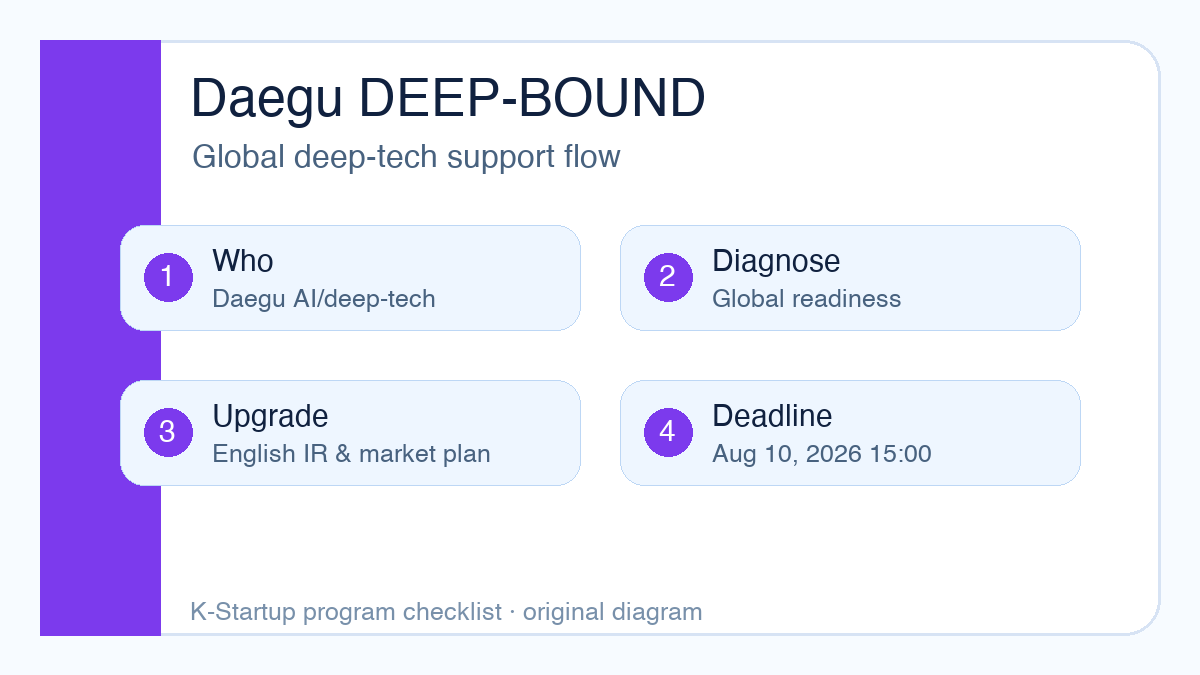
Application window July 16, 2026 18:00 to August 10, 2026 15:00 KST
Application method Email submission to yna@ynarcher.com
Who can apply Daegu-based deep-tech companies in five future industries, or Daegu-based companies commercializing public technology from a special R&D zone
Priority Daegu Innopolis research companies and advanced technology companies may receive priority
Selection schedule Document review on Aug. 12, presentation review on Aug. 18, kickoff on Aug. 25, subject to change
Contact 070-4256-4070 / yna@ynarcher.com

Original diagram summarizing the Daegu DEEP-BOUND program by applicant type, readiness diagnosis, IR upgrade, and deadline

<Daegu DEEP-BOUND support flow 1.1>

The key filter is location and technology fit. If the company is not tied to Daegu or to the public-technology commercialization track described in the notice, this is probably not the right program. If the fit is clear, the deadline gives teams enough time to prepare a focused global expansion narrative.

Who should apply

The strongest applicants are not just “interested in going global.” They can name a target market, describe why the product is difficult to localize alone, and explain what kind of partner, buyer, investor, or pilot site would prove traction. That is especially important for healthcare AI, robotics software, semiconductor tooling, industrial data platforms, and other categories where a foreign buyer needs technical evidence before a sales conversation.

The support package includes global readiness diagnosis, company-specific consulting, national market analysis, global strategy planning, English IR translation and redesign, global IR and investor matching, online demo day participation, overseas PoC demand matching, local institution and buyer meetings, and follow-on support. In plain English, global PoC support is the centerpiece: the program is useful if a startup can define what it wants a foreign customer or partner to test.

This context also matters for English-speaking readers who follow the Korean IT market. Korea's regional startup programs are often tied to local industry clusters, not only national policy themes. Daegu's emphasis on bio-healthcare, robotics, mobility, semiconductors, and AI reflects that cluster-based approach.

Application checklist

  1. Confirm that the company is based in Daegu or fits the public-technology commercialization route stated in the notice.
  2. Map the product to one of the listed future industries, such as AI, semiconductors, robotics and mobility, or bio-healthcare.
  3. Prepare the official application form and keep the file name aligned with the notice.
  4. Attach the business registration certificate, corporate registry documents where applicable, company introduction material if needed, and privacy consent documents.
  5. State the target country, buyer type, pilot hypothesis, required data or equipment, and expected timeline.
  6. After sending the email, keep a record of the submitted files and confirm receipt if possible.

The selection schedule is compact: document review on August 12, presentation review on August 18, and DEEP-BOUND kickoff on August 25. The notice says the presentation review and kickoff are planned offline, so a founder or senior operator should be ready to participate in person.

What to watch before submission

The exclusion list covers gambling-related sectors, tax delinquency, financial account restrictions, false documents, infringement of another party's technology or intellectual property, and companies restricted from government support programs. A public-technology commercialization applicant should also clarify ownership, licensing, and usage rights before presenting the business plan.

For AI startups, avoid describing the product only as a model or demo. A better application explains the overseas workflow: who uses the system, what data is needed, what risk is reduced, what metric will prove success, and which partner can validate it. The same discipline applies to agentic AI products, industrial platforms, and software-heavy hardware companies.

The deadline is August 10, 2026 at 15:00 KST. Email submission sounds simple, but attachment mistakes are common. Check the form, consent document, company evidence, and presentation availability before sending.

References

Korea Open Innovation Grant: 2026 Bottom-Up Startup Checklist

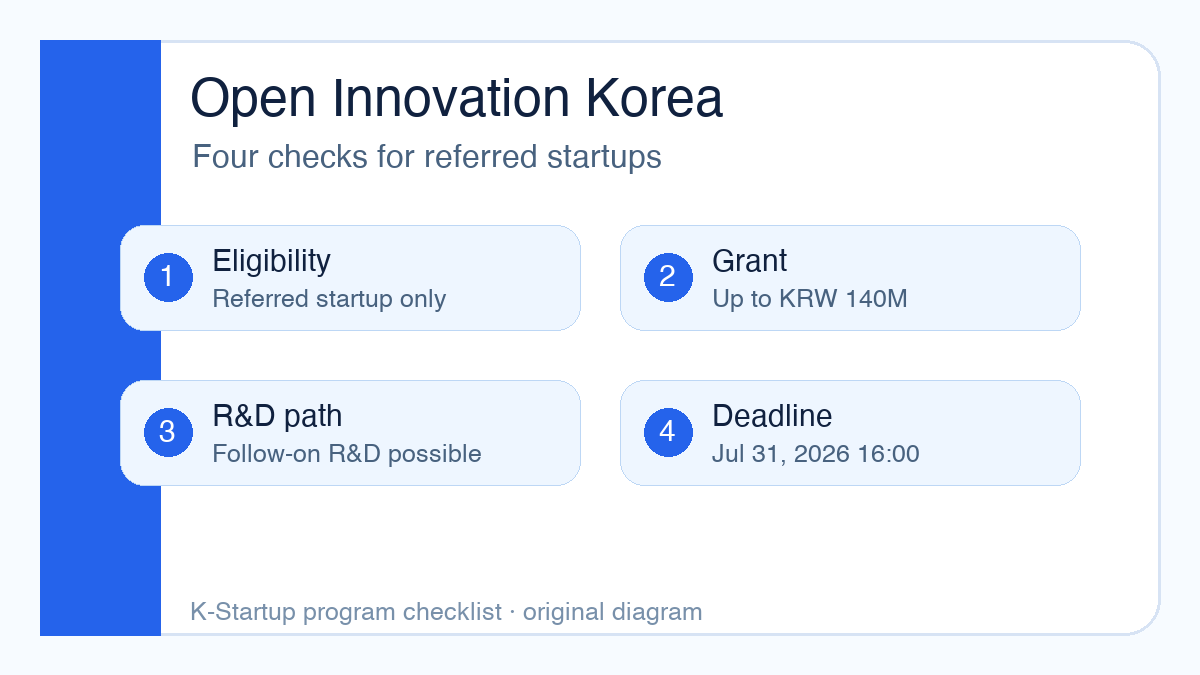
Korea's 2026 Open Innovation Bottom-Up startup program is not a broad public call. It is a closed K-Startup program for startups already recommended by selected demand-side companies or public institutions. For founders tracking open innovation Korea opportunities, this one only matters if your team is building software, data infrastructure, security tooling, platform technology, or an AI product with a Korean corporate partner.

The headline support is a collaboration grant of up to KRW 140 million per startup. The money is meant for developing and validating a product, service, or technical solution with the demand-side partner. Follow-on R&D support may be available through separate Korean government programs, but that part depends on each program's requirements and is not automatic.

Fast facts for applicants

Item Details
Program 2026 Open Innovation Support, second Bottom-Up call
Application window July 20, 2026 13:00 to July 31, 2026 16:00 KST
Application channel Online submission through K-Startup
Who can apply Startups recommended by selected demand-side programs and meeting Korea's startup eligibility rules
Expected selection scale Around 50 startups
Main support Up to KRW 140 million for collaboration work, plus growth programs and possible R&D linkage
Project period Within seven months, expected September 2026 to March 2027
Program contact Daegu Center for Creative Economy & Innovation, 053-759-8149 / 053-756-7610

Original diagram summarizing Korea's Open Innovation Bottom-Up startup program by eligibility, grant, R&D path, and deadline

<Open Innovation Bottom-Up applicant checklist 1.1>

For English-speaking founders, the most important context is the referral requirement. This is a Korean startup grant, but it is not designed for overseas companies or unrelated applicants browsing public notices. The applicant must be part of a selected open innovation track and must satisfy Korean startup-law eligibility rules.

Who should take this seriously

The best fit is a referred startup that already has a concrete collaboration theme with a Korean demand-side partner. Examples might include enterprise workflow software, industrial data platforms, cybersecurity products, or AI features that need a real corporate environment for proof-of-concept work. The program is about validating a collaboration, not simply pitching a standalone product.

That makes the application different from a generic accelerator form. The evaluation looks at understanding of the partner's problem, the startup team's technical capability, feasibility of the collaboration plan, and whether the partnership can continue after the subsidized period. Teams used to writing about agentic AI or software delivery should translate those claims into specific milestones, interfaces, data requirements, and decision points.

The notice also allows startups up to seven years old, with possible consideration for new-industry startups up to ten years old. The attached notice lists new-industry areas such as artificial intelligence, big data, service platforms, and cybersecurity. If your company is near the seven-year line, check the official startup confirmation rules before investing time in the application.

Submission checklist

  1. Confirm that your company was recommended by one of the selected Bottom-Up demand-side programs.
  2. Make sure the legal representative can complete the K-Startup account, identity verification, and company verification steps.
  3. If a startup confirmation certificate is required, apply early; the notice warns that issuance can take time.
  4. Use the official business plan form. A different form can exclude the application from evaluation.
  5. Prepare corporate registry documents, ID verification material, business registration certificates, and startup confirmation documents where required.
  6. Press the final submit button before the deadline. Saving a draft is not the same as submitting.

The timing is tight. The notice states that new applications close at exactly 16:00 KST on July 31. If an applicant has already entered the application-writing stage and received a project number before 16:00, some edits and uploads may be possible until 18:00, but relying on that grace period is risky.

Practical risks before you apply

The program has strict overlap limits with other Korean open innovation and deep-tech programs. The attached notice lists projects that cannot be performed at the same time, including other Open Innovation types, Deep-Tech Value-Up, global corporate collaboration programs, and several super-gap startup tracks. A company already moving toward another agreement should check conflicts before submitting the required commitment letter.

The pitch should be led by the startup representative. The evaluation focuses on collaboration understanding, team expertise, feasibility, and sustainability. A strong software or platform startup should show what data, APIs, deployment environment, security controls, and acceptance metrics the partner will use during the collaboration.

Treat the KRW 140 million ceiling as a planning boundary, not the story. The stronger story is a credible path from a Korean corporate problem to a tested product, a follow-on commercial relationship, and, where eligible, later R&D support.

References

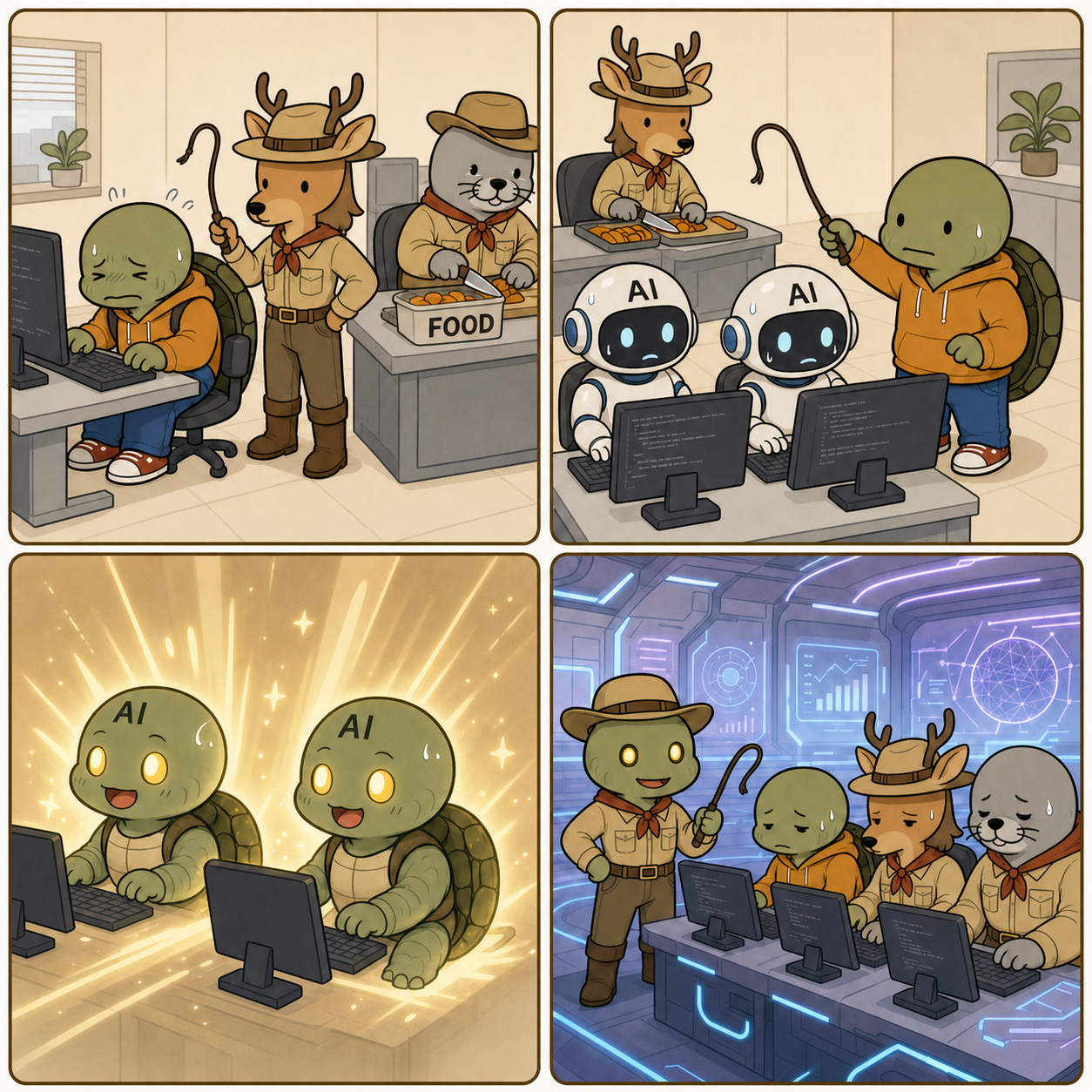
404 Dev Room 30 - Taming

Series · 404 Dev Room Webtoon · Ongoing Episode 30 · 404 Dev Room 30 - Taming The trainer in the AI coding room has changed. <...