Yann LeCun is one of the most useful people to read when the AI industry starts sounding too certain. He does not deny that chatbots and LLMs have become powerful products. His sharper question is whether next-token prediction, even at enormous scale, is enough for machines that need to understand the physical world, plan actions, and operate safely outside text. That is why LeCun matters now: LeCun world models, robotics, and open AI sovereignty are moving from research seminars into product strategy.
His credentials are not a side note. The ACM Turing Award profile says LeCun received the 2018 A.M. Turing Award with Geoffrey Hinton and Yoshua Bengio for “conceptual and engineering breakthroughs that have made deep neural networks a critical component of computing.” Meta’s official AI profile describes him as a researcher best known for deep learning and the convolutional network method, widely used in image, video, and speech recognition.
Why LeCun is back at the center of the AI conversation
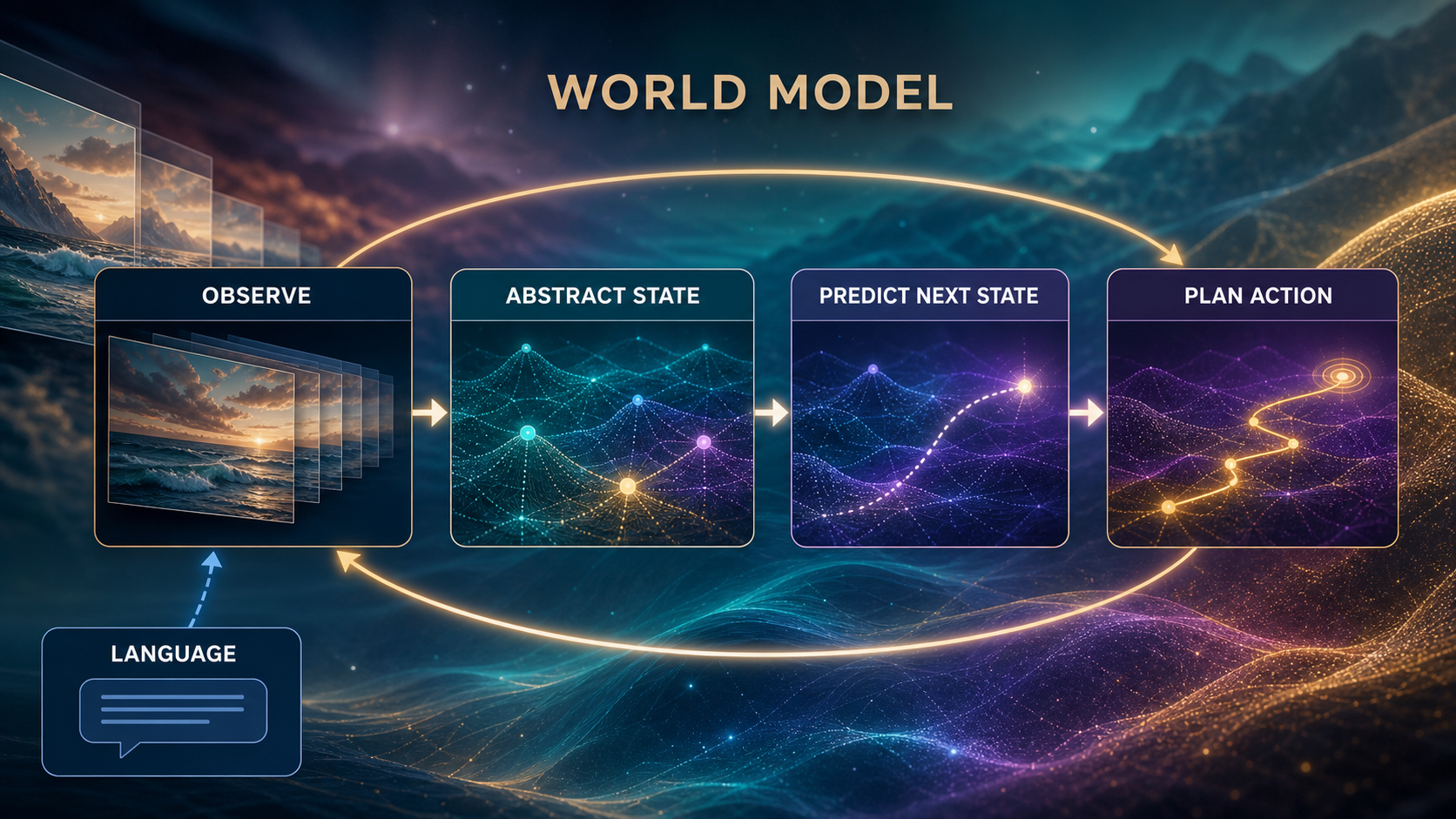
LeCun’s current public argument has three parts. First, JEPA, or Joint Embedding Predictive Architecture, is meant to learn useful abstract representations rather than recreate every missing pixel or token. Second, video-based systems such as V-JEPA 2 point toward AI that can reason about physical dynamics and plan actions. Third, Project Tapestry reframes open AI as a sovereignty issue, not only a developer preference.
| Thread | LeCun’s question | Why it matters |
|---|---|---|
| Deep learning foundations | How did neural networks become practical computing infrastructure? | CNNs and the Turing Award explain the long arc of his influence |
| World models | Can AI predict how the world changes, not only what word comes next? | JEPA and V-JEPA 2 target perception, prediction, and planning |
| Open AI | Should frontier models be controlled by a handful of private labs? | Project Tapestry connects open models with cultural and institutional sovereignty |
From convolutional networks to JEPA
A compact way to describe LeCun’s early impact is this: he helped make neural networks useful for seeing. Convolutional networks gave machine learning systems a practical way to detect local visual patterns and build them into higher-level representations. Modern vision systems are much larger, but the idea that perception depends on layered features remains central.
JEPA asks the next question. Meta’s I-JEPA announcement says the model predicts abstract image representations rather than reconstructing pixels directly. The same announcement says Meta trained a 632-million-parameter visual transformer with 16 A100 GPUs in under 72 hours and reported strong low-shot ImageNet performance with only 12 labeled examples per class. The point is not simply efficiency. The deeper bet is that intelligence depends on learning meaningful representations of what is predictable, not wasting capacity on every noisy detail.
That framing also matters for agentic AI. An agent that acts in the world needs more than fluent answers. It needs to anticipate what will happen if it opens a door, moves a robot arm, changes a workflow, or chooses one plan over another. LeCun’s world-model argument is aimed at that missing layer: prediction and planning before action.
V-JEPA 2 and Project Tapestry
In 2025, Meta introduced V-JEPA 2 as a 1.2-billion-parameter video world model for visual understanding, prediction, and zero-shot robot planning with unfamiliar objects. The announcement frames world models around three capabilities: understanding observations, predicting how the world will evolve, and planning actions that achieve a goal. That is a different center of gravity from the familiar contest over who can produce a more polished answer in a text box.
This does not mean language models suddenly become irrelevant. LLMs are already strong at coding, summarization, and information access, and they may remain the orchestrating layer in many systems. But physical-world AI, industrial automation, robotics, and embodied agents need memory, perception, prediction, and planning alongside language. That is why a world-model agenda cannot be reduced to another round of model efficiency benchmarks.
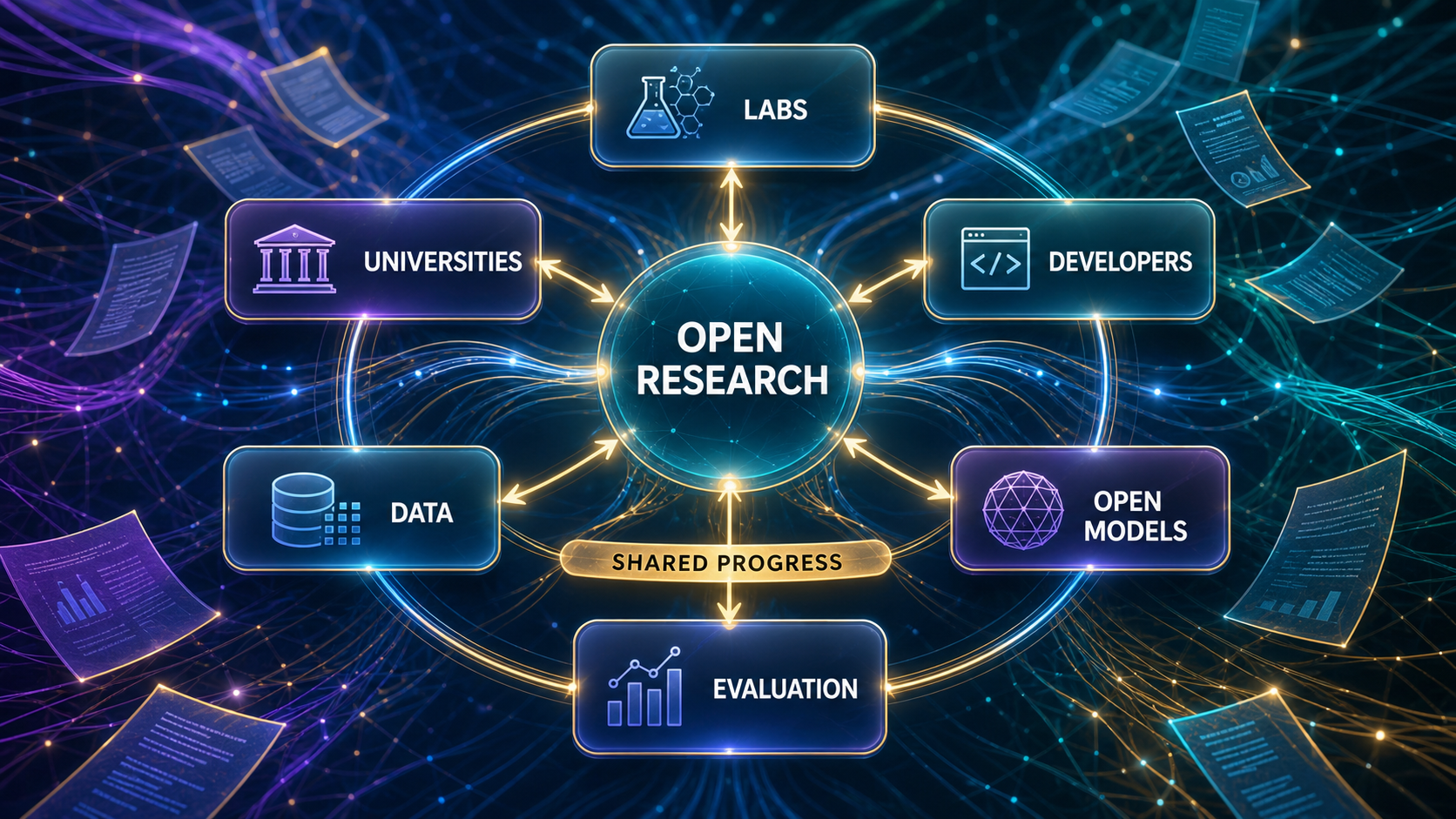
Project Tapestry brings the political and institutional side into the picture. The AI Alliance announcement in April 2026 describes Project Tapestry as an open-source platform for distributed, globally federated training of frontier open models. It also says LeCun joined the AI Alliance and Project Tapestry as Chief Science Advisor. The stated goal is to let institutions, industries, and nations help build open base models while retaining control over data and local priorities.
LeCun’s point is not that LLMs are useless. The more practical question is what architecture should sit around and beyond them if AI systems must represent reality, predict consequences, and plan safely.
The limits of the argument and the reason to watch it
There are real caveats. JEPA and world models are compelling research directions, but they are not yet mature replacements for the current LLM product ecosystem. V-JEPA 2’s robot-planning claims should be read through its experimental setup and benchmarks, not as proof that general robotics is solved. Open AI can broaden access, but it also needs serious work on safety evaluation, misuse prevention, licensing, and data governance.
Still, LeCun is worth following because he combines two roles that rarely sit together. He helped build the deep-learning revolution, and he is also one of the loudest voices arguing that its current form is not the final destination. CNNs helped machines see. JEPA and world models ask whether machines can learn enough about the world to imagine consequences before acting. To understand AI in 2026, it is not enough to watch bigger LLMs. The next question is whether AI can model the world it is supposed to change.



No comments:
Post a Comment