Processors in phones, vehicle controllers, network equipment, and cloud servers need an invisible design standard if they are to share a software ecosystem. Arm is not a conventional semiconductor vendor that manufactures and sells finished chips at scale. It licenses instruction sets, CPU designs, and system IP, then collects royalties when partners ship chips containing that technology. The model gives Arm access to broad markets without owning fabrication plants, but it also creates tension because a customer can become a competitor.
This Arm company review goes beyond the familiar description of an energy-efficient mobile CPU company. It asks how Armv9, Neoverse, Compute Subsystems (CSS), and developer tools form one computing platform, and how data-center AI and Arm's move into production silicon may alter its neutral IP role. Financial figures follow FY2026 disclosures. This is not investment advice.
How Arm CPU IP produces recurring economics
Arm Investor Relations reports the company's current ecosystem and operating metrics.
Arm earns license and other revenue plus royalty revenue. A chip designer pays for access to a CPU core, GPU, system IP, or an architectural license. Once products containing that design ship, Arm earns royalties according to volume and contract terms. Because a single design generation can remain in phones and embedded devices for years, earlier research and development can produce a long revenue tail.
| Revenue engine | What customers buy | Recognition point | Main variable |
|---|---|---|---|
| License | Cores, architecture, and CSS rights | Contract and delivery milestones | Number and scope of large deals |
| Royalty | Shipped chips using Arm IP | After partner shipments | Volume, chip value, royalty rate |
| Software and support | Tools and engineering support | Over the contract | Developer adoption and platform breadth |
The quality of the model comes from the interaction between these engines. Partner products enlarge the software ecosystem; a larger developer base strengthens the case for the next customer to select Arm. Arm reports more than 350 billion Arm-based chips shipped and over 22 million software developers. Its presence in 99% of smartphones is not merely share. It represents accumulated operating-system support, compilers, applications, validation tools, and switching costs.
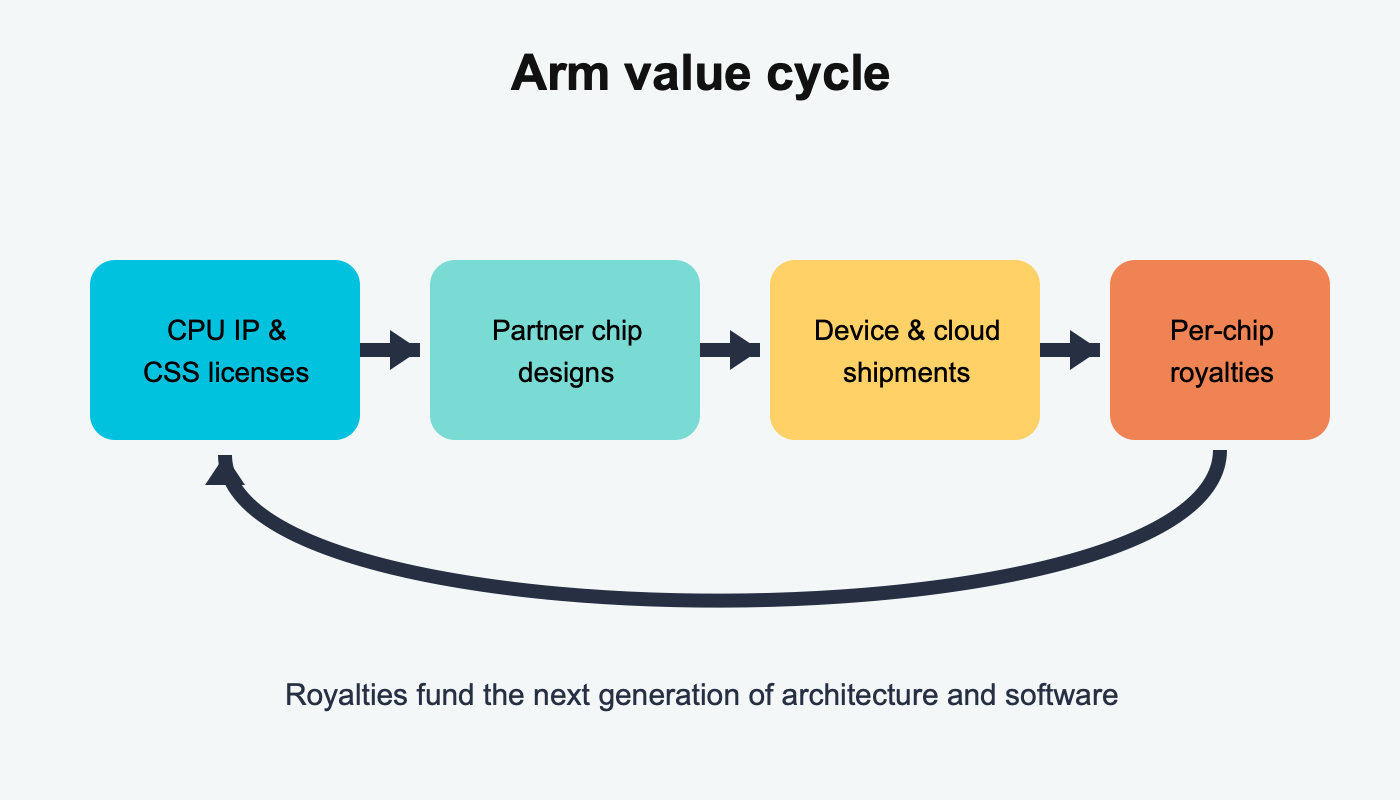
The two streams should not be mistaken for identical subscriptions. License revenue moves with the timing of large agreements, while royalties respond to phone and consumer-device demand and partner shipments. Related-party revenue connected with SoftBank and the structure of the China business also deserve separate attention. A high gross margin does not eliminate cyclicality or customer bargaining power.
Armv9, CSS, and Arm AGI CPU expand the boundary
Armv9 royalties are a useful indicator of adoption in higher-value products.
Arm's FY2026 results release provides the primary record for the new silicon direction.
Armv9 strengthens security, vector processing, and AI workloads. When new cores enter premium products with higher royalty rates, mix can improve even without a dramatic increase in unit shipments. CSS packages CPUs, interconnect, memory, and validated system blocks so customers can shorten development. Customers concentrate differentiation elsewhere, while Arm captures a larger part of each design.
Neoverse is central in data centers. AWS Graviton and Google Axion have made power efficiency and customization competitive dimensions in general-purpose computing once dominated by x86. Even when accelerators such as NVIDIA Blackwell receive the attention, CPUs still prepare data and control networking, storage, and services. Arm is not trying simply to replace GPUs; it is expanding its share of host and data-movement layers around AI systems.
The Arm AGI CPU announced in 2026 marks a deeper shift because Arm is moving from supplying designs to offering production silicon. The company says it had no material FY2026 revenue impact. Success could add high-value data-center revenue and real system-optimization knowledge. Yet existing chip customers may believe their supplier is moving downstream as a competitor. The balance between ecosystem neutrality and greater value capture will define the next phase.
Software compatibility remains decisive. Server operators evaluate container images, observability tools, security agents, database extensions, and incident experience—not CPU benchmarks alone. Operational friction can slow a technically superior platform. Conversely, managed cloud services can hide architecture differences and let Arm adoption grow without end users noticing the transition.
What Rene Haas and FY2026 figures reveal
CEO Rene Haas has pushed Arm from a mobile-centered company toward a broader computing platform. The strategy combines wider architecture licensing, more complete CSS blocks, and higher value per chip in automotive, cloud, and AI. He must also protect the neutrality that motivates many competing partners to choose the same architecture.
Arm's FY2026 Form 20-F reports revenue of $4.92 billion, up 23% from $4.007 billion. License and other revenue increased 25% to $2.307 billion, while royalty revenue rose 21% to $2.613 billion. Research and development expense climbed to $2.776 billion from $2.071 billion, showing that the move into data centers, AI, and silicon carries a substantial cost.
| FY2026 metric | Result | Interpretation |
|---|---|---|
| Total revenue | $4.920 billion | 23% year-over-year growth |
| License and other | $2.307 billion | Larger contracts and design scope |
| Royalty | $2.613 billion | Better Armv9, cloud, and automotive mix |
| R&D expense | $2.776 billion | Investment in next-generation IP and silicon |
Royalty growth was not merely a phone rebound. Arm says data-center royalty revenue more than doubled, with Armv9 and richer product mix also contributing. Manufacturing advances determine transistor economics, while Arm sells system architecture and software compatibility above them. The two layers are complementary, as shown by adjacent innovation in AI server connectivity and advanced infrastructure.
Risks, counterarguments, and conclusion
Customer concentration and related parties come first. Arm depends on product schedules and negotiations at major semiconductor and cloud customers, while SoftBank remains the controlling shareholder. China adds export controls, regulation, and local-entity complexity. RISC-V is another pressure point: it need not replace the full Arm ecosystem to reduce bargaining power in selected embedded or accelerator-control workloads.
Arm's own silicon creates channel conflict. The more successful Arm AGI CPU becomes, the more existing customers may worry that a critical supplier is learning finished-product economics. Execution and valuation are also risks. Growth and gross margin are strong, but rising R&D, stock compensation, and uneven license timing must be considered alongside non-GAAP results.
Arm's moat is not one CPU core. It is the reinforcing cycle among licenses, shipment royalties, developer tools, and operating-system compatibility. The central question is whether Arm can preserve its neutral standard while increasing value per chip through CSS and production silicon.
Arm is evolving from a “chipless semiconductor company” into a provider of a computing platform plus selected silicon. Smartphones remain the ecosystem and cash foundation; cloud, automotive, and AI provide the direction of growth. Power efficiency and software continuity are technical advantages, while partner trust is the scarcest commercial asset. The most useful indicators are Armv9 penetration, data-center royalties, CSS adoption, Arm AGI CPU customer response, and cash generation relative to R&D—not shipment volume alone.