Series · Tesla FSD Technical Analysis
Episode 2 · Tesla FSD Technical Analysis 2 - Data, OTA and the Safety Test
Tesla FSD Technical Analysis 2 - Data, OTA and the Safety Test
This series tests Tesla FSD's implementation against public sources. Part 1 established that driving inference happens inside the vehicle. That raises the next questions: Does Tesla upload continuous video from millions of cars? Who pays for connectivity? How can OTA replace a large AI model? And is the architecture objectively advanced enough to deserve its reputation?
Does every video go to a server: how fleet learning works
The short answer is selective collection, not continuous raw streaming. Uploading every high-resolution camera for an entire trip would make cellular and storage costs prohibitive. Tesla has repeatedly described local processing followed by transmission of short clips or telemetry selected for particular safety events and learning conditions.
Tesla's rideshare privacy notice says external-camera ADAS processing stays in the vehicle by default. It describes two classes of transmissible recordings: safety events and fleet learning. Safety-event clips can be up to 30 seconds and may be linked with account, time and location metadata after a collision, airbag deployment or emergency stop. Fleet-learning clips help recognize lanes, signs and traffic lights and are described as not linked to the account. Policies for privately owned vehicles vary by region and consent settings, so both “every video is always uploaded anonymously” and “no video ever leaves the car” are misleading.
The learning loop is roughly:
- Engineers define a failure scenario, such as a yellow light in glare, an unusual work zone or a motorcycle cutting in.
- Vehicles select candidate clips and associated vehicle state matching the condition.
- Servers label, filter and organize training and evaluation sets.
- Data centers retrain models and run simulation, closed-loop and vehicle regression tests.
- A passing version is distributed over OTA and real-world performance is observed again.
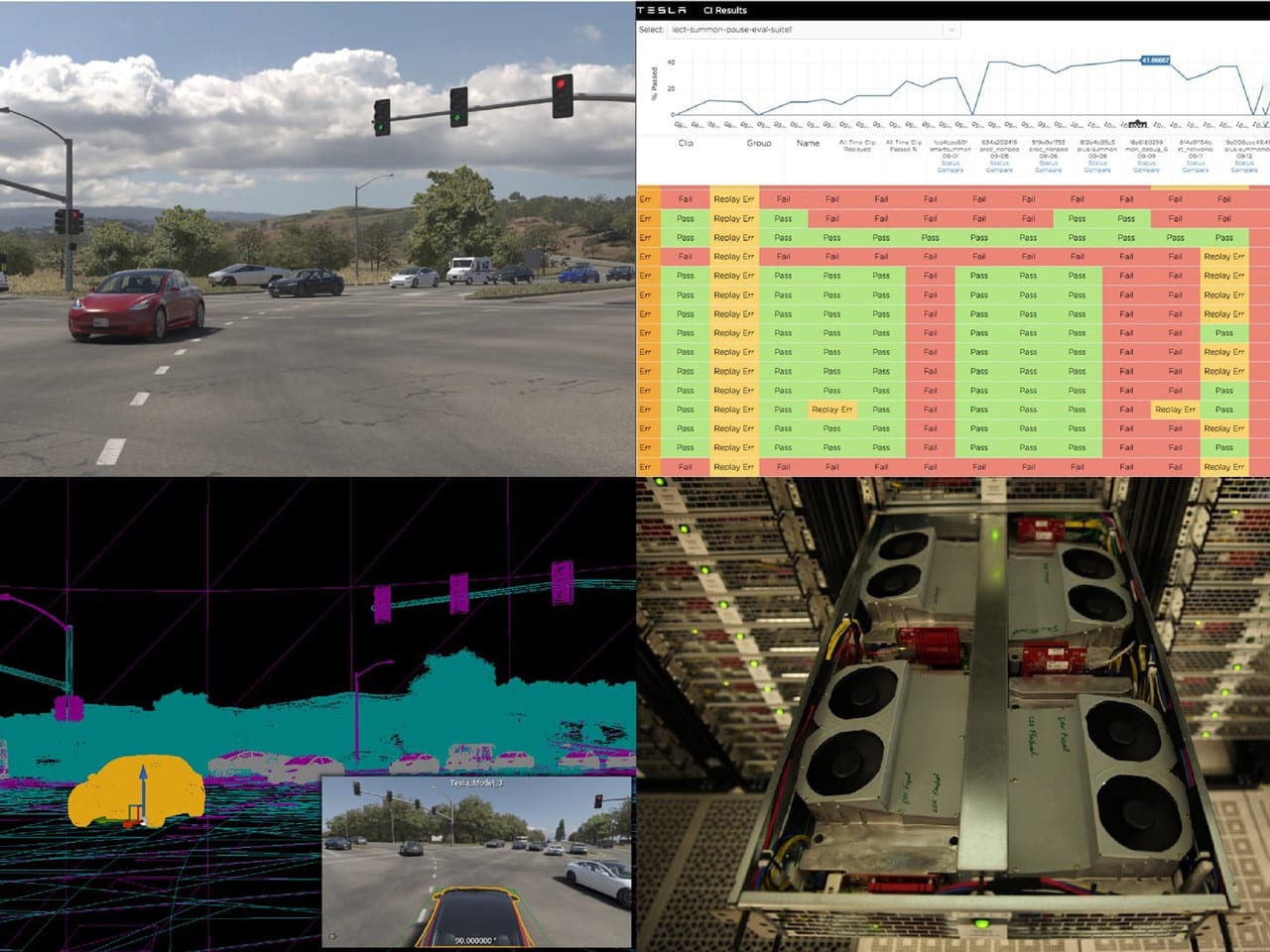
In Evaluation Infrastructure, Tesla describes placing anonymized characteristic clips into large test suites, generating realistic graphics and sensor data and running hardware-in-the-loop evaluation. This data engine is Tesla's most important asset. The decisive advantage is not camera count alone, but how quickly failures become targeted data, new training and regression tests that prevent old problems from returning.
Who pays for mobile data?
Tesla vehicles have cellular modems and use local carriers. Owners do not activate a separate smartphone-style data plan for FSD learning traffic. According to Tesla Connectivity, Standard Connectivity is included for eight years from new delivery and provides core maps, navigation and access to OTA. Important safety updates continue over the vehicle's cellular connection.
In the United States, Premium Connectivity is $9.99 per month or $99 per year and adds cellular live-traffic visualization, satellite maps, streaming and browser features. FSD works without Premium Connectivity. Tesla states this directly in its FAQ. Pricing and included periods vary by country.
| Data function | Included or operated by Tesla | Optional owner payment |
|---|---|---|
| On-device FSD inference | Runs on vehicle hardware | Unrelated to Premium |
| Important safety updates | Delivered by cellular | No separate mobile plan |
| General OTA | Accessible to all vehicles; Wi-Fi commonly recommended for large downloads | Owner's Wi-Fi environment |
| Selected learning data | Sent according to consent, policy and event conditions | No per-upload charge |
| Satellite maps, live traffic and streaming | Limited without Premium | Premium Connectivity |
How does OTA replace the model?
OTA for a car is more than an app update. It is deployment to a safety-critical embedded system. The vehicle downloads signed packages, verifies integrity and installs firmware, neural networks, maps or control software only when installation conditions are satisfied. Tesla's FSD support page says even subscription activation requires completion of an OTA update.
It would be speculation to claim every update distributes a full model over cellular. Tesla does not publicly detail package sizes, delta-update mechanisms or partition layout. What is confirmed is that all vehicles have access to OTA and feature availability varies by hardware, software, region and model year. Download speed is less difficult than safe recovery, power-loss tolerance, signature verification, hardware branching and regression testing.
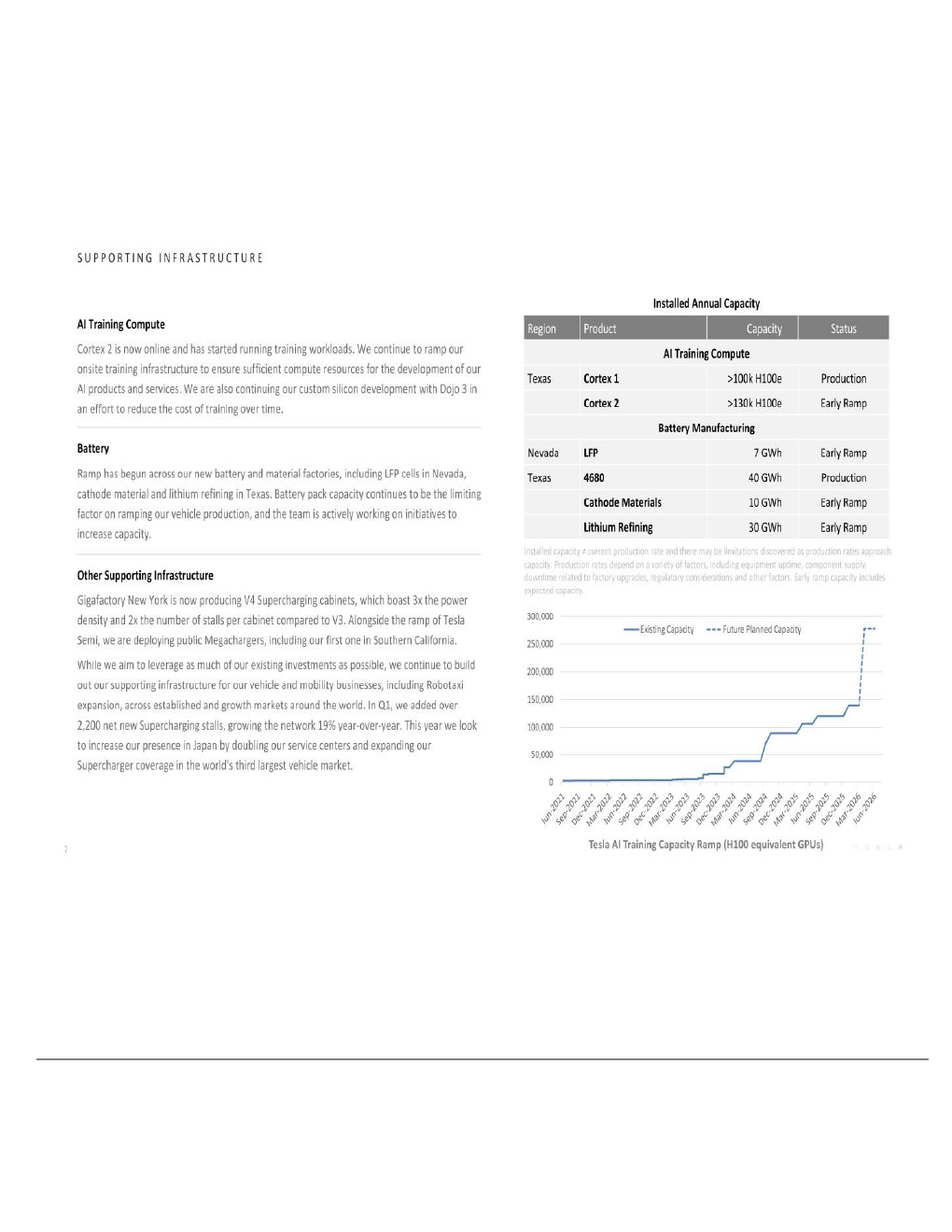
Tesla's Q1 2026 investor update says FSD v14.3 improved reinforcement learning for long-tail cases, enhanced its vision encoder for low-visibility scenes, and rewrote the AI compiler and runtime to reduce inference latency by up to 20%. It demonstrates vertical integration across chips, compilers, runtime, vehicles and training infrastructure. “Up to 20%,” however, is an internal company comparison, not an independently reproduced road-test result.
An objective assessment of Tesla FSD's technical lead
There are strong reasons to rate the technology highly:
- A very large compatible fleet that doubles as a learning and evaluation sensor network
- Time-aware multi-camera integration, occupancy modeling and planning in one evolving AI stack
- Vertical integration of inference chips, compiler, runtime, vehicle control, OTA and training compute
- Consumer Level 2 assistance across an unusually broad range of city streets and highways
- A fast data engine from failure discovery through retraining, regression evaluation and redeployment
That does not prove Tesla has the world's most advanced fully autonomous system. Consumer FSD remains supervised Level 2. The NHTSA PE25012 opening document lists complaints and crashes involving red-light entries, movement into opposing lanes and incorrect lane selection. An open investigation is not a final defect finding, but it shows regulators are examining whether drivers received enough warning and time to respond to unexpected behavior.
Tesla's FSD Safety Report reports lower collision rates with FSD engaged. Its aggregation is not a randomized comparison with identical roads, vehicle ages, driver populations, interventions and crash definitions. Selection bias matters because drivers may activate FSD more often on suitable roads. Waymo, by contrast, operates driverless Level 4 within bounded areas and publishes geographically matched human benchmarks using peer-reviewed methods. “Broad supervised Level 2” and “bounded driverless Level 4” optimize different problems and should not be reduced to one league table.
Tesla's technology stack is advanced, but product naming and the actual responsibility level must remain separate. Current FSD must not be treated as full autonomy, and company safety statistics should be read beside independent evidence.
Does faster-than-human reaction guarantee safety?
Computers do not tire, can watch several directions and can issue control commands quickly. That potential is real. Safety, however, is not one average reaction-time number. What matters is how quickly a system detects camera degradation from glare, fog or dirt; what it does when lights, signs and human directions conflict; and how early it communicates an unexpected intention to the supervising driver.
IIHS emphasizes that Level 2 cannot replace the driver and that over-trust can delay intervention. It also finds limited independent evidence that partial automation, by itself, reduces crashes beyond separate collision-avoidance features. Tesla's fleet learning is therefore both a technical strength and an ethical burden: an incomplete product is monitored by ordinary customers on public roads.
Where Hyundai and Kia need to push harder
Hyundai is not a sensor laggard. Its HDA owner documentation describes fusion of a forward camera, front and corner radar and navigation for highway lane centering, speed and distance control and assisted lane changes. Radar is a defensible engineering choice for distance measurement and adverse conditions. Yet HDA2 is mainly restricted to supported controlled-access roads and does not expose one consumer product across the variety of urban intersections and unstructured scenes that Tesla attempts.
The comparison is not about sensor count.
| Dimension | Tesla FSD (Supervised) | Hyundai HDA2 |
|---|---|---|
| Automation level | Supervised Level 2 | Supervised Level 2 |
| Main operating scope | Broad city, road and highway scenarios | Supported controlled-access highway sections |
| Sensor strategy | Camera-centric, configuration varies | Camera, radar and navigation fusion |
| Strength | Fleet data, integrated AI, OTA iteration | Conservative domain, sensor redundancy, production quality |
| Public challenge | Independent safety data, over-trust, visibility and intersection failures | Urban expansion, software iteration speed, data loop |
Hyundai and Kia should not simply copy a camera-only design. They need consent-based failure-data collection, common software across vehicle lines, large-scale simulation and regression evaluation, faster OTA deployment and safety metrics that outsiders can reproduce.
Tesla FSD deserves a high technical rating. It changed the industry's reference point by connecting chips, cars and data centers into a product that keeps learning after sale. But advanced is not the same as finished. Red-light and low-visibility failures remain, and the driver remains responsible. Hyundai and Kia already have strong sensor and manufacturing foundations. The next challenge is to add a faster software and data loop—and transparent safety validation—to compete for trustworthy autonomy across a much wider road domain.