Showing posts with label Junior developer. Show all posts

Thursday, July 23, 2026

Hiring Junior Developers in the AI Era: What Evidence Matters

Hiring junior developers has become harder because the old signals are noisier. A resume that lists React, Spring, AWS, or Python no longer tells an interviewer how much the candidate understood, how much the model generated, and how well the candidate handled the result. AI usage is not a problem by itself. The problem is when the candidate cannot explain the choices, failures, and verification behind the output.

A good interview therefore moves from tool names to project evidence. Why did you choose the problem? What did you cut from scope? Which data model changed? Where did authentication or deployment become difficult? What did you test? What would you rebuild?

Three questions that reveal more than a stack list

Key details at a glance

Reader question Practical takeaway
What this article explains Hiring Junior Developers in the AI Era: What Evidence Matters
Core SEO focus junior developer interview, AI project portfolio, developer hiring signals
How to read it Separate the durable signal from vendor messaging, short-term hype, and implementation friction.

The first question is how the candidate follows AI technology trends. The useful answer is not a list of product names. It is an experiment: what changed in the workflow, what failed, and what the candidate learned about security, context, cost, or quality.

The second question is how far the candidate has taken an individual project. A small deployed service with logs, tests, and a clear trade-off can say more than a polished demo. The interviewer wants to know whether the candidate can move from idea to usable artifact.

The third question is what boundary the candidate owned in a team project. Teamwork is not just being friendly. It is knowing what you were responsible for, how you coordinated with others, and how you handled disagreement without hiding risk.

Evidence beats confidence

For candidates, the practical move is to leave a trail of evidence: commit history, README decisions, screenshots, test results, incident notes, deployment notes, and a short explanation of how AI was used. That kind of evidence is more credible than pretending every line was written by hand.

The earlier discussion of vibe coding matters here. AI can help juniors build more, but hiring still rewards people who can explain why the result works, when it fails, and how they would improve it in a team. There is no single correct path, but there are better signals of ownership.

What interview evidence can show

A junior candidate does not need to prove senior-level architecture judgment. The stronger signal is whether the candidate can explain a small decision, name the trade-off, and show how they checked the result. A pull request, a bug note, or a deployment checklist can be more useful than a long list of frameworks.

What AI changes in the hiring loop

AI coding assistants raise the baseline speed of producing code, but they also make evidence harder to read. Hiring managers therefore need to ask how the candidate validated generated code, where they rejected a suggestion, and what risk they noticed before merging. The interview becomes less about memorized syntax and more about judgment under tool-assisted work.

Practical hiring takeaway

For small teams, the safest junior hire is not the person who promises to know everything. It is the person who can make uncertainty visible early, ask precise questions, and leave behind work that another teammate can review without detective work.

For readers comparing search terms, this article is also relevant to team project evidence.

Related reading

For broader context, read AI coding agents.

A second useful reference is the earlier discussion of vibe coding.

Readers following the infrastructure side may also want Claude 4 agentic coding.

References

Junior Developers in the AI Era: Growth Beyond Generated Code

AI has not made software engineering effortless. It has changed the cost structure of producing code. Screens, APIs, tests, and glue code that once took days can now appear in hours. That is a genuine productivity shift, but it can also mislead junior developers into confusing generated output with product competence.

The useful question is no longer “Can I make a feature?” It is “How much of the product loop can I understand and own?” Requirements, design trade-offs, data safety, authentication, testing, deployment, monitoring, and user feedback all matter more when code itself becomes cheaper.

Code is cheaper; judgment is not

Key details at a glance

Reader question Practical takeaway
What this article explains Junior Developers in the AI Era: Growth Beyond Generated Code
Core SEO focus AI developer productivity, harness engineering, product architecture
How to read it Separate the durable signal from vendor messaging, short-term hype, and implementation friction.

A generated implementation can compile and still be wrong. It may ignore an edge case, leak data through a permission boundary, create a migration risk, or solve a product problem that users do not actually have. That is why basic engineering knowledge has not lost value. Git, testing, databases, networks, deployment, cloud costs, and observability are the lenses that let a developer judge generated work.

In that sense, AI coding agents raise the bar rather than lowering it. They give juniors more leverage, but they also produce more surface area to verify.

From vibe coding to harness engineering

The next growth step is building the harness around AI work. A harness includes a clear task brief, a small scope, fixtures, tests, linting, review checkpoints, deployment safety, and rollback paths. Loop engineering is the discipline of watching the AI result, feeding back concrete failures, and knowing when to stop generating and start debugging.

That is a different skill from simply asking for code. It requires product architecture: understanding how a user flow becomes data changes, how those changes interact with infrastructure, and where the organization accepts risk. The junior developer who learns this becomes more valuable even if everyone has access to the same models.

A better growth target

The goal is not to compete with AI at typing. The goal is to become the person who can take a vague product need, split it into safe steps, use AI where it helps, reject it where it harms, and deliver something that survives real users. AI productivity is now a starting line. The differentiator is the ability to connect decisions across the whole project.

For readers comparing search terms, this article is also relevant to junior developer growth.

Related reading

For broader context, read the earlier overview of AI coding agents.

A second useful reference is vibe coding.

Readers following the infrastructure side may also want Claude 4 agentic coding.

References

Junior Developers Before AI: What Startups Actually Looked For

Before AI coding assistants changed the tempo of software work, small companies already had a difficult problem: hiring junior developers without the luxury of long training pipelines. In startups and smaller businesses, the question was rarely “Is this person already complete?” It was closer to “Can this person learn in public, communicate clearly, and turn uncertainty into progress without adding chaos to the team?”

The Korean original is written from the perspective of a CTO who spent about a decade hiring and working with junior developers in startup and small-company environments. That context matters. Big tech, research labs, game studios, and enterprise public-sector projects can judge candidates differently. But the small-team lesson travels well.

Hiring was about potential, not polish

Key details at a glance

Reader question Practical takeaway
What this article explains Junior Developers Before AI: What Startups Actually Looked For
Core SEO focus junior developer hiring, startup CTO hiring, developer questions
How to read it Separate the durable signal from vendor messaging, short-term hype, and implementation friction.

A certificate, school name, or framework list could be a signal of effort, but it rarely proved production readiness. Real work meant reading unfamiliar code, handling Git conflicts, narrowing failures, checking requirements with product people, and admitting when a task was stuck. For a junior developer, reliability and honest communication were technical assets.

Small companies also had a fragile education model. Seniors were busy, onboarding was uneven, and juniors often did not yet know how to explain what they did not understand. That made self-directed learning valuable, but not in the performative sense of studying all night. The valuable version was curiosity tied to the product: asking why a design fails, where data can be lost, or what a user will experience when the happy path breaks.

Questions were an underrated skill

The best juniors did not ask vague questions and wait. They described what they tried, what they expected, what happened instead, and where they were uncertain. That gave seniors something concrete to respond to and reduced the emotional cost of collaboration.

This is still relevant in the age of vibe coding. AI can generate more code than a junior could write by hand, but it does not remove the need to frame the problem, inspect the result, and surface risk early. The pre-AI lesson was never just about typing speed. It was about responsibility for the task.

The lesson that survived

Work naturally accumulated around people who could turn ambiguity into decisions. That was unfair at times, but it revealed the difference between someone who only completes assigned steps and someone who gradually understands the project. For juniors, the durable advice is simple: build evidence that you can learn, ask well, communicate risk, and finish work in a way that lowers the team's uncertainty.

For readers comparing search terms, this article is also relevant to project execution.

Related reading

For broader context, read AI coding agents.

A second useful reference is the earlier discussion of vibe coding.

Readers following the infrastructure side may also want Claude 4 agentic coding.
References

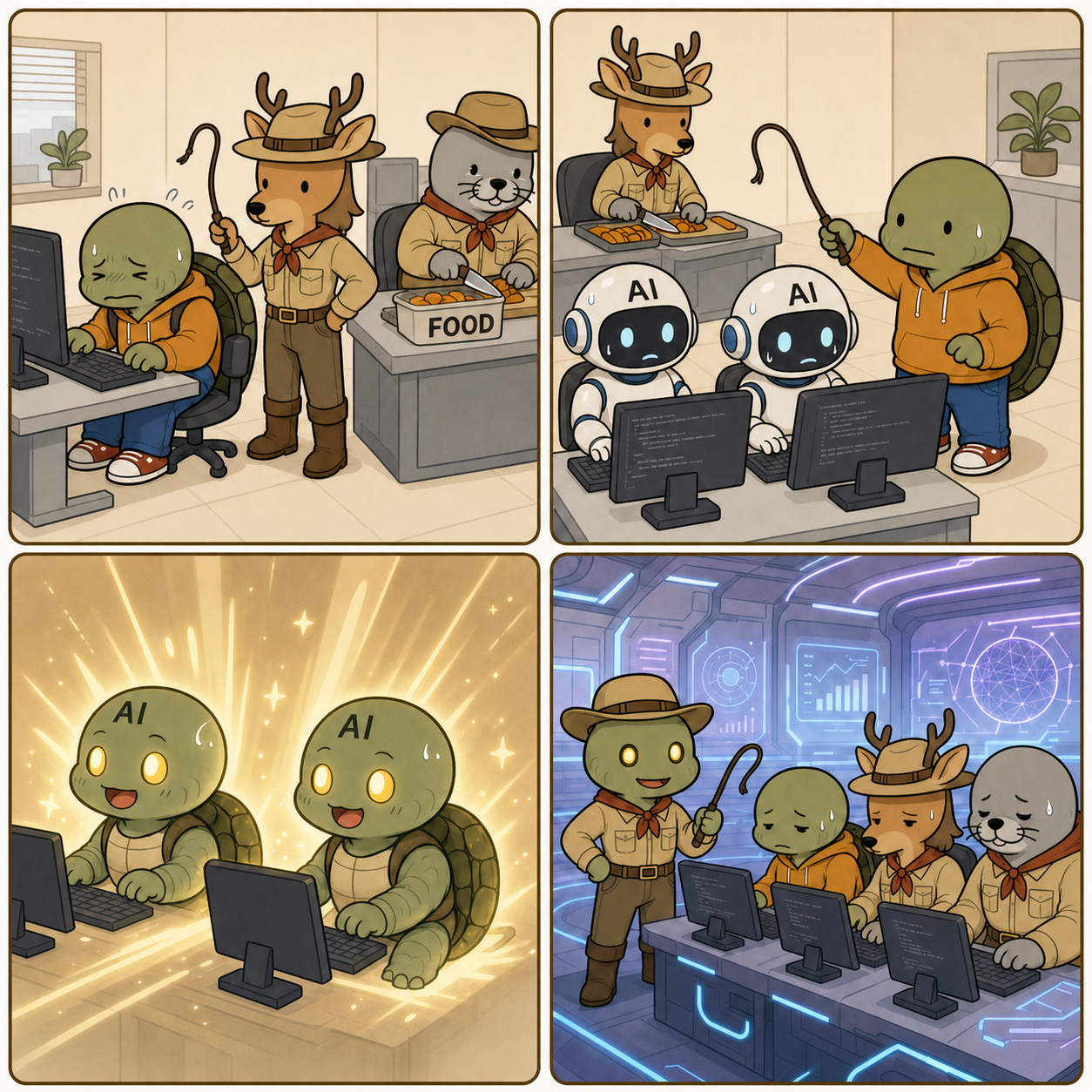
404 Dev Room 30 - Taming

Series · 404 Dev Room Webtoon · Ongoing Episode 30 · 404 Dev Room 30 - Taming The trainer in the AI coding room has changed. <...