AI frameworks, the end of coding, binary assets, Software 2.0, and the AI coding recipe all point to a post-human-framework transition.
If part 1 was about the history of human-centered frameworks, part 2 is about how AI may redefine what a framework is.
1. An unfamiliar framework raises the learning curve for AI
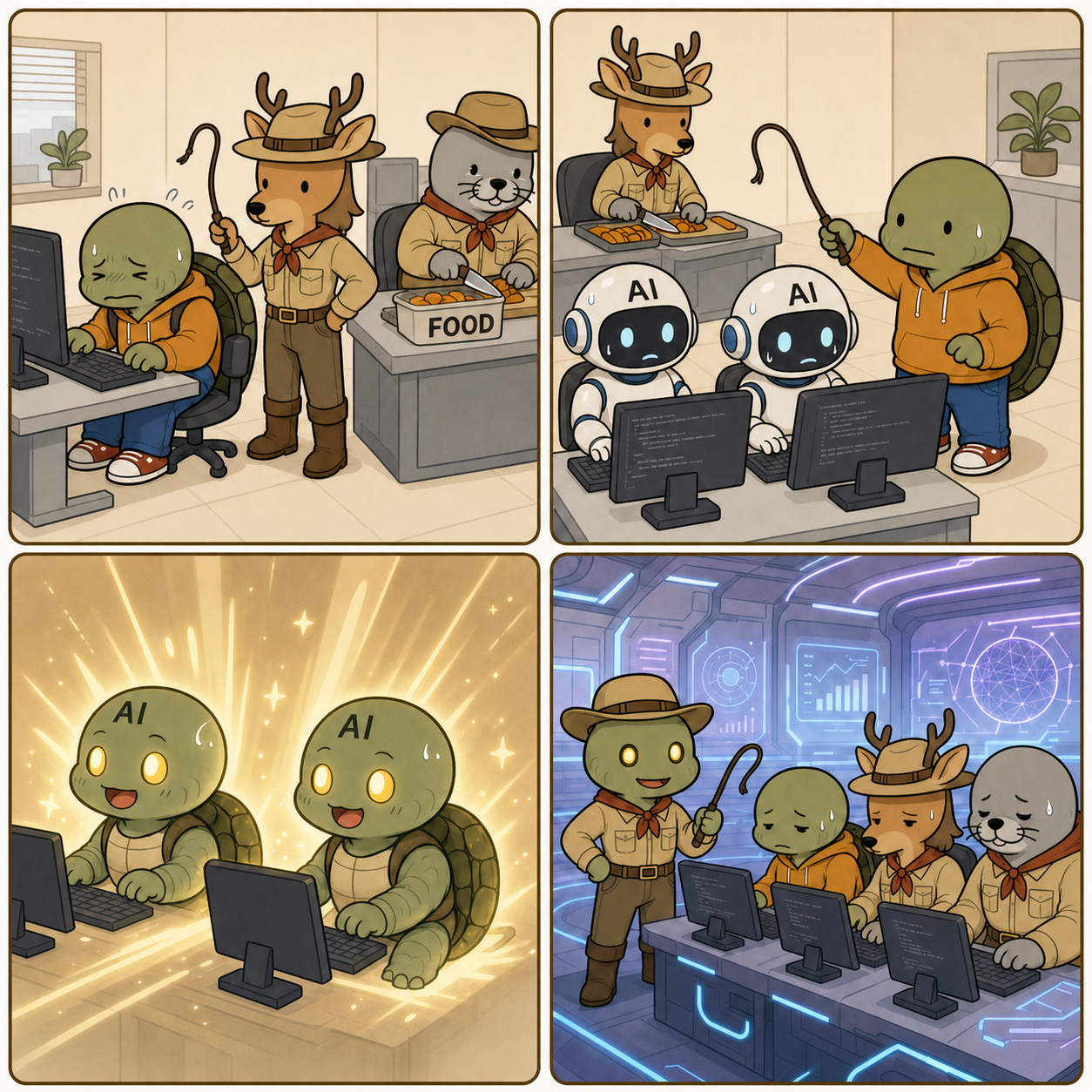
For a human developer, a framework is something to learn. It may be difficult at first, but with manuals, examples, and team habits, it becomes comfortable. For AI, a framework is different. A model does not understand a framework in the same way a person does. It reconstructs patterns from repeated code, documentation, open source projects, issues, and answers.
That difference matters. Technologies used around the world have higher probability mass. Python, JavaScript, SQL, REST, HTML, Docker, PostgreSQL, and React have abundant public examples. A private company framework, internal DSL, or undocumented component system is a much stranger language for the model.
Strong harnesses, tests, type systems, code review, and permission limits can block many mistakes. But that protection has a cost. The prompt must keep explaining internal rules. Context must carry exceptions. Every unfamiliar abstraction consumes tokens and creates another verification loop. A framework that improved human productivity can become a learning curve for AI.
| Technology choice | Effect on human developers | Effect on AI |
|---|---|---|
| Widely known standard stack | Easier hiring and collaboration | More training examples, easier prediction |
| Internal framework | Fits internal work | More errors if context is missing |
| Excessive abstraction | Reduces repeated human work | Makes execution paths harder to infer |
| Strong test harness | Prevents human mistakes | Guards AI output |
| Private DSL | Expresses business concepts | Raises token cost when examples are scarce |
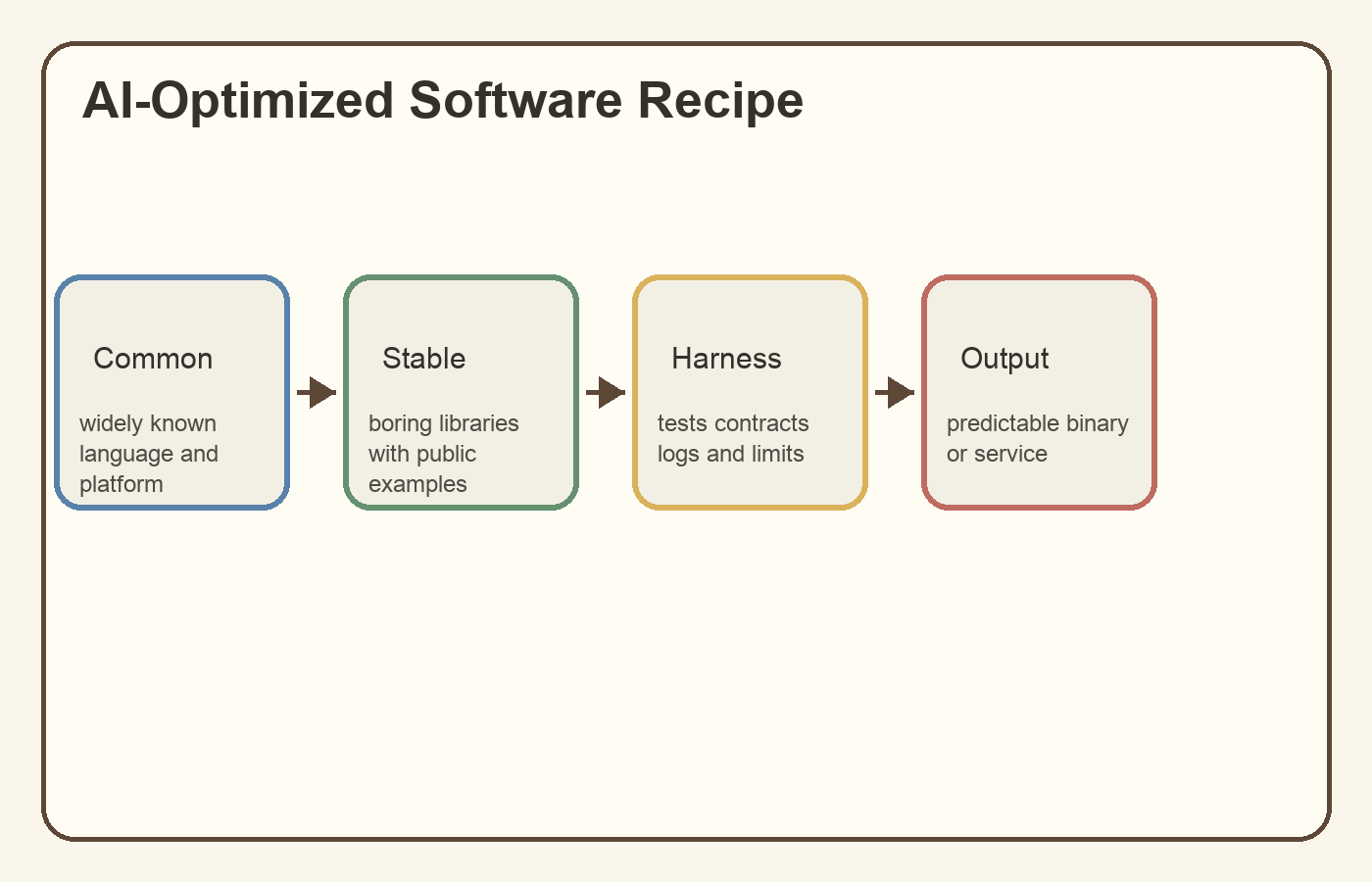
Good design in the AI coding era may therefore look less like a beautiful new framework and more like a recipe the model can predict reliably. Boring, widely known combinations may outperform elegant abstractions. That is also an important lens for practical vibe coding and the broader Software 3.0 transition.
2. The most common technology combinations become AI recipes
GitHub Octoverse 2024 shows Python rising to the top of GitHub usage while Jupyter Notebooks and generative AI projects expanded. That is more than a popularity ranking. Public code is a map for AI. The more code, documentation, examples, and failure discussions exist, the easier the path is for a model.
Stack Overflow Developer Survey 2024 points in the same direction. Developers depend heavily on API and SDK documentation, and tools such as Docker, npm, and PostgreSQL remain widely used. If AI is going to code efficiently, it will likely prefer combinations that the world has already made common, documented, and testable.
The most mature languages and platforms humanity created may be reorganized into AI manuals. A web service recipe might look like TypeScript, React, Node, PostgreSQL, Docker, Playwright, OAuth, and REST or GraphQL. A data product recipe might look like Python, FastAPI, PostgreSQL, Pandas, PyTorch, Docker, OpenAPI, and CI tests. The core value is not novelty. It is probability.
An AI coding recipe is not about chasing the newest tool. It is about choosing combinations that models have seen often, that have many public examples, and that can be tested at clear boundaries.
In that light, the claim that new frameworks for humans may stop appearing becomes plausible. For human developers, a new framework can be a new productivity tool. For AI, a new framework is an under-learned probability space.
3. AI may learn executable assets, not its own human-style framework
If AI optimizes for efficiency, does it need to create its own React or Django? Humans need abstraction. We name things, create layers, write manuals, and memorize examples. AI can work differently. What it needs is not a structure that is pleasant for humans to read. It needs a representation that reliably produces desired behavior.
Andrej Karpathy’s Software 2.0 makes this point sharply. Karpathy describes classical software as Software 1.0, written directly by people in languages such as Python or C++. Software 2.0 is written in a much less human-friendly language, such as neural network weights. Dataset and architecture define a search space, and training acts like a compiler that produces the final network. This is the stage before what many now call Software 3.0.
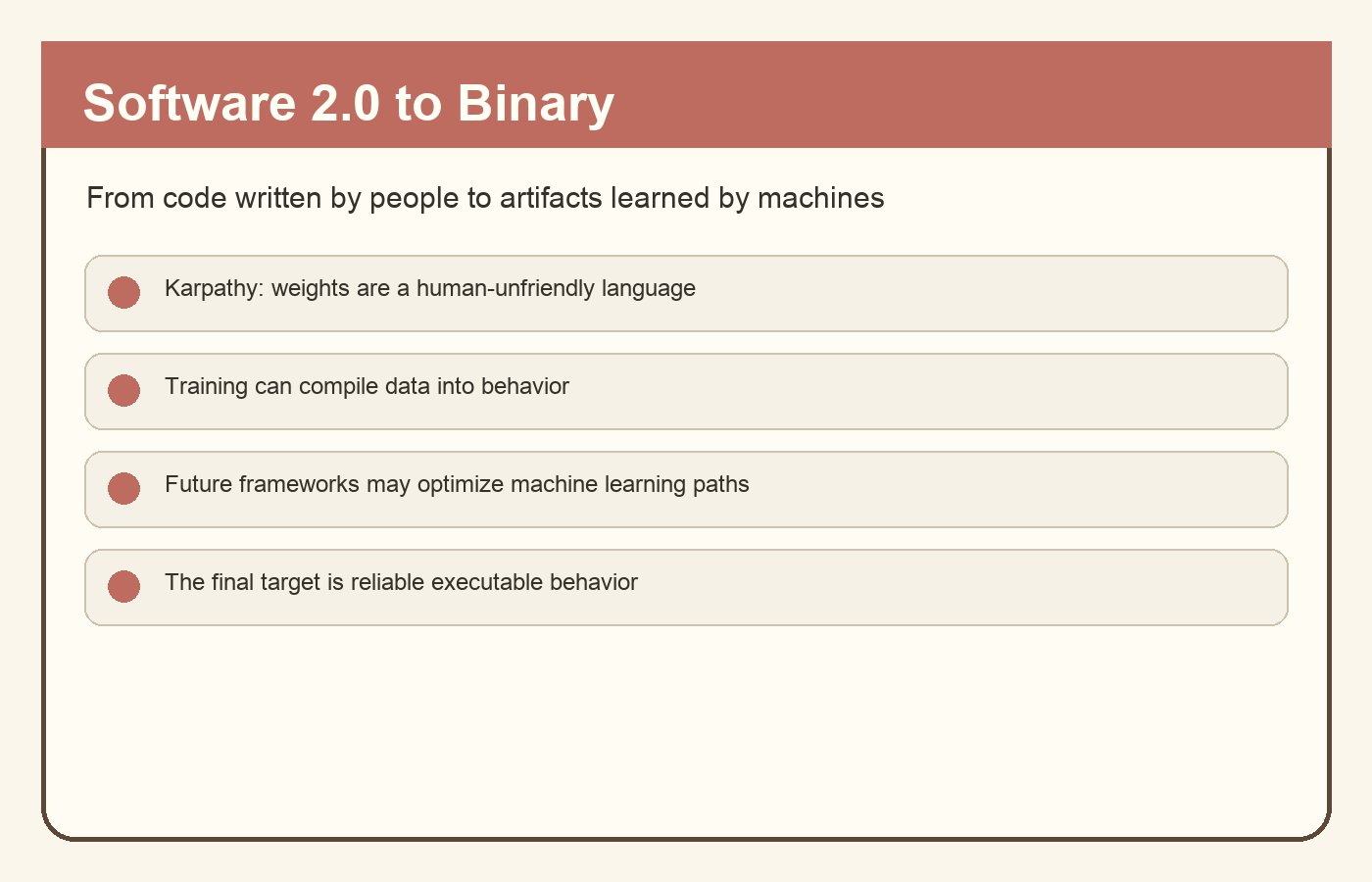
Push that frame further and future AI does not need a human-readable framework of its own. It may work directly with functioning binary assets, model weights, executable function bundles, validated service blocks, and evaluation harnesses. For humans, source code is an explanation. For AI, the working behavior itself can become the training target.
This does not mean coding disappears tomorrow. Today’s AI still writes code, compiles it, tests it, and runs it. But that pipeline may exist because of humans and the current computing stack. Learning coding, writing code, compiling, installing, and running may be a long chain built around human comprehension.
4. Code itself may be a human interface
Code feels natural to us because we grew up inside programming culture. But code is not a law of nature. It is a notation humans created to control machines. C, Java, Python, JavaScript, and SQL all exist so people can read, write, discuss, and modify instructions. The computer ultimately wants executable state change, not a pretty source file.
In his Y Combinator talk, Karpathy describes Software 3.0, natural language programming, and the LLM operating system. Natural language remains a human-friendly interface. But under that interface, execution may involve model calls, tools, memory, permissions, datasets, evaluators, and runtime environments, not only text code.
At some future point, coding itself may fade from the center. More precisely, the act of humans directly writing source code may move to the edge. If AI can create and verify reliable executable assets directly, source code becomes a less necessary intermediate form.
| Current pipeline | Why humans needed it | Possible AI-era replacement |
|---|---|---|
| Translate requirements into code | Humans needed to instruct machines | Natural language, examples, simulations, policies |
| Coding | Humans specified execution rules | Models create executable assets directly |
| Compilation | Human code became machine format | Training or synthesis produces executable behavior |
| Install and runtime | Humans prepared environments | Standard in-memory execution environments |
| Debugging | Humans found logical errors | Evaluators and repair loops handle more of it |
The end of coding is not a romantic prediction. It is a cold technical possibility. If source code is a human-friendly intermediate representation, domains with fewer humans may keep less of that representation.
5. AI frameworks bloom only when bugs approach zero
This does not mean every program disappears soon. We are still at the very beginning of AI frameworks. Current AI development tools remain human-centered. A person writes prompts, reads code, checks tests, approves deployment, and accepts responsibility. Today’s AI frameworks are collaboration harnesses, not full replacements.
A true AI-native framework needs one more condition: the bug rate of AI-generated programming assets must approach zero. If the artifacts used for learning contain many bugs, then the AI’s executable assets can inherit that pollution. A small logical error can be compressed, regenerated, and redeployed quietly.
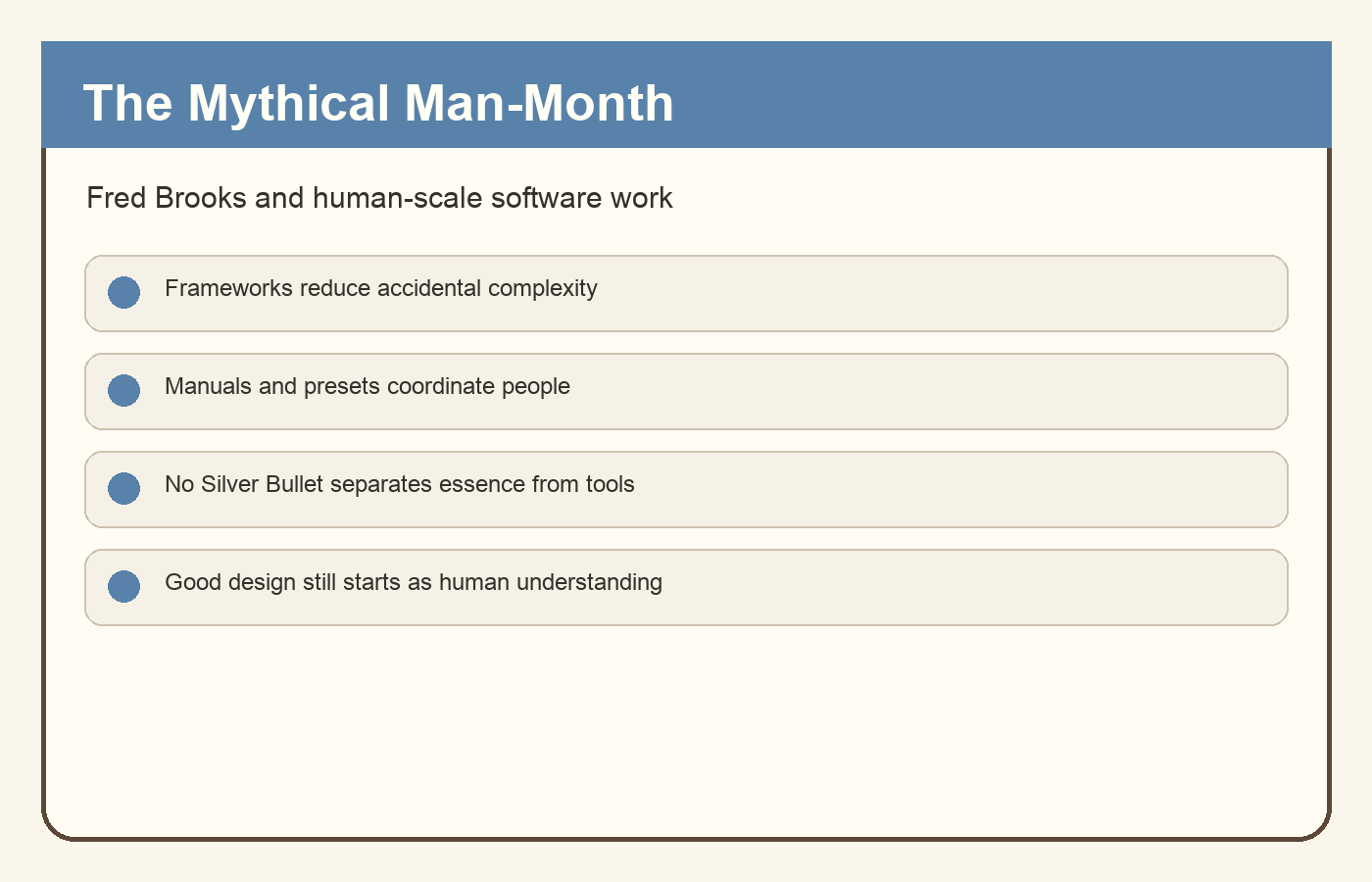
Brooks’ essential complexity returns here. Less code does not remove the difficulty of payments, healthcare, law, security, accounting, permissions, responsibility, or exceptions. Future AI frameworks may deal with those complexities through evaluations, simulations, safety constraints, policies, datasets, and executable assets instead of human-readable code.
A post-code world cannot arrive safely while generated assets remain noisy. If AI learns from buggy artifacts, it may produce faster, but it may also spread errors faster.
6. What disappears may not be programming, but the program itself
Marc Andreessen’s old phrase “software is eating the world” described how software absorbed industry after industry. The next question is whether AI eats the form of software itself.
Coding, bugs, and analog logical mistakes may be the germs of a digital world built by humans. Humans translate intentions into code, compile code, install it, run it, and then fix the bugs that appear. That detour was powerful for decades, but it is not necessarily eternal.
One distant day, programming may not be the thing that disappears. The program itself may disappear. Users may not install apps. Organizations may not choose frameworks. Developers may not design folder structures. Instead, the needed executable asset may appear in memory, be verified, be used, and vanish.
That future framework will not be a manual humans read. It will define what assets a model may generate, what constraints must hold, what evaluations must pass, and what execution boundaries cannot be crossed. The end of human-centered frameworks is therefore the beginning of AI frameworks.
The conclusion is not that developers vanish tomorrow. It is that the central question changes. Instead of asking whether a framework makes coding easier for humans, we will ask whether it lets AI create executable assets with a lower error rate.
| Era | Core question | Representative tools | Durable value |
|---|---|---|---|
| Human development | How can people build faster? | Frameworks, manuals, components | Productivity, collaboration, reuse |
| AI-assisted development | How can people use AI safely? | Prompts, tests, harnesses, agents | Verification, control, responsibility |
| AI executable asset era | How can AI create working assets directly? | Models, evaluations, policies, in-memory assets | Error rate, reliability, immediacy |
The end of frameworks is not the end of tools. It is the end of an era in which tools primarily helped humans write code more easily. What comes next may not be an easier framework, but software assets people no longer need to read.