Series · Project Management in the AI Era
Episode 3 · Project Management in the AI Era 3 - The Project AI Agent
Project Management in the AI Era 3 - The Project AI Agent
The final part of Project Management in the AI Era reconnects traditional stages and modern tools into one AI feedback loop. The bottleneck left by Part 2 was not simply a bad method. It was the volume of information and the number of transformations people had to maintain.
Hundreds or thousands of requirements were collected and traced, converted into screens, reviewed by planners and domain owners, redrawn as design and HTML, implemented as behavior, and then connected back to tests. At every handoff, the same intent was copied into another form. Waiting, interpretation loss and defects accumulated.
AI attacks this volume barrier directly. It can structure low-resolution requirements, inspect large relationship graphs and continuously draft screens, design, code and tests. This article uses the author's working pipeline to separate production, translation and traceability that AI can already replace from meaning, risk and acceptance that still require human judgment.
The bottleneck was information volume and repeated translation
Modern methods ask for more evidence because evidence reduces failure: requirement IDs, traceability matrices, screen states, design systems, API contracts, test cases, PR review, release records and observability. Every new control also adds relationships that must stay synchronized.
| Bottleneck | Repeated human translation | Typical loss |
|---|---|---|
| Requirements | Meetings, RFPs and manuals into IDs and acceptance criteria | Omission, conflict, version confusion |
| Screen design | Business intent into state and user flow | Approval queues and happy-path bias |
| Design and publishing | Screen specifications into visual files and HTML/CSS | Duplicate labor and interpretation loss |
| Implementation | UI and API into domain behavior, authorization and errors | Mismatch, defects and rework |
| Testing | Runtime behavior back into requirements, defects and releases | Repetition and orphan tests |
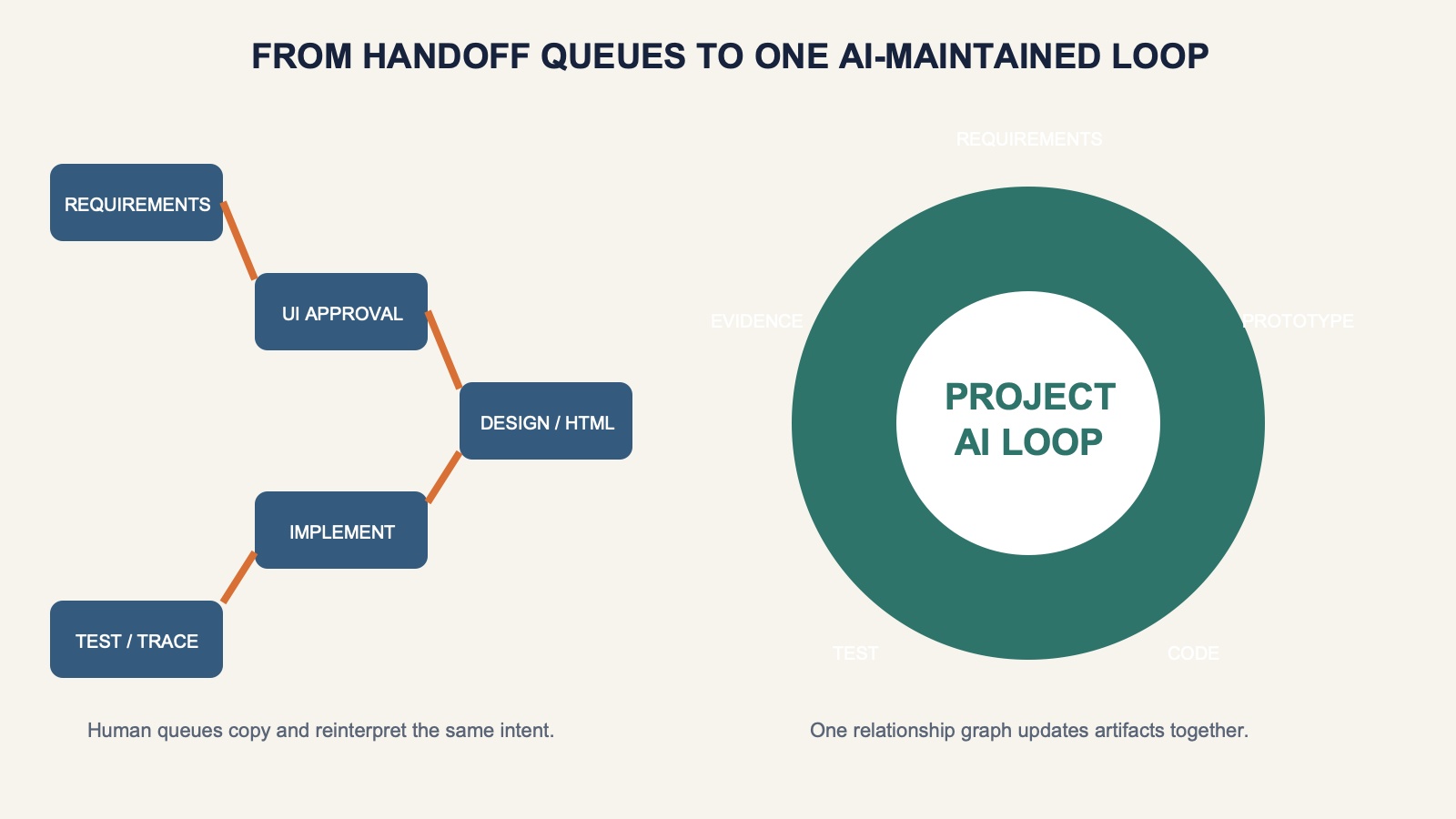
The revolution is not that an AI summarizes one document faster. It can read and update relationships across text, screens, code, tests and operational evidence in the same context. A person cannot continuously remember a thousand requirement links. A machine can repeatedly evaluate identifiers and change graphs.
The author judges routine business mockups and wireframes from tools such as Claude Design and Stitch to have reached human production quality. For repetitive production, they can replace output from roughly the lower 60 percent of practitioners. This is not benchmark data. It is an assessment from the author's own outputs, and it does not erase brand strategy, user research or novel interaction design.
Implementation is already 100 percent AI-executed in the author's current project scope. That does not mean a universal software-industry replacement rate. It means the author no longer types production implementation directly, instead controlling SPECs, agents, tests and review. As the earlier MoAI ADK analysis explains, the key is not unlimited model freedom. It is a repository harness connecting knowledge, contracts, execution and verification.
Requirements to prototype become one conversation
The old flow analyzed RFPs and meetings, created a requirements specification, produced a screen list and screen design, redrew that work in Figma, converted it into HTML and only then showed the user behavior. A wrong interpretation could survive for weeks.
Text models can normalize source material, identify duplicates and conflicts, separate functional and nonfunctional requirements, and draft acceptance criteria and questions. The important capability is not generating more documents. It is bidirectional traceability: a changed requirement should expose affected screens, APIs, domain rules, tests and releases.
Claude Design points toward conversational UI production, team editing, design systems and web capture in one environment. Google Stitch generates UI from text and images and supports handoff toward design and development. Google later described a direction that connects Stitch output with tools such as AI Studio and Antigravity.
Google Antigravity is an agentic development platform that plans, executes and verifies across editor, terminal and browser. Stitch and Antigravity are not one product. The former focuses on UI generation and design flow; the latter on agentic development execution. Together they illustrate how the person who states the requirement and the person who sees executable behavior no longer need to be separated by several document stages.
A prototype is not a production system. Empty, loading, error, unauthorized, duplicate-submit and timeout states still matter, as do accessibility, privacy and audit. Yet planners, domain owners, designers and developers can inspect the same moving artifact and record decisions much faster than they can circulate static documents.
The author's solo AI project pipeline
The author operates the path from requirement analysis to executable prototype as one repository workflow:
- Structure requirements, terms and unresolved questions from RFPs, meetings and current manuals.
- Derive features and screen states and validate wireframes in Claude Design.
- Hand off to Figma or Stitch when a richer visual stage is required.
- Design architecture including quality attributes and deployment constraints.
- Define domain boundaries, invariants, state transitions, authorization and failure meaning.
- Use MoAI to convert domain analysis into SPECs with completion conditions, changed components and tests.
- Let agents implement while tests, static analysis and review repeat.
- Present an executable preview for stakeholder acceptance and return feedback to requirements.
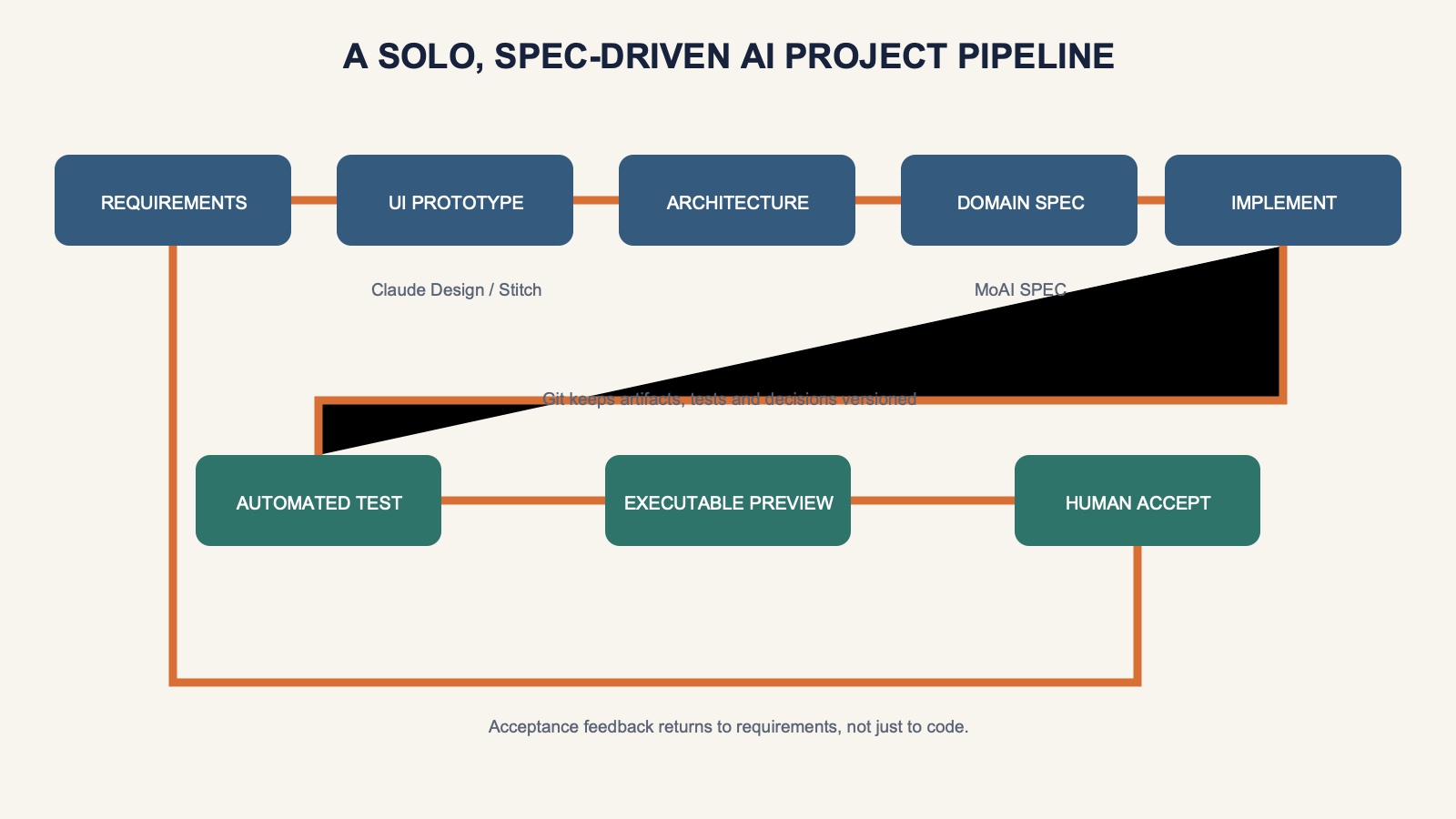
A list of tools is not a pipeline. REQ-117 must connect to UI-023, domain policy POL-08, API-014, TC-308, a PR and a release. When evidence fails, work must return to the wrong requirement or design decision rather than patching code alone.
This case cannot be treated as an organization-wide productivity statistic. The author has experience designing domains and architecture, can evaluate results and controls a small decision system. Large organizations retain regulatory approval, separation of duties, data permissions and many stakeholder queues. Even so, one person can now manage draft production and synchronization that previously crossed several roles. That materially changes the boundary of expertise.
Design through transition becomes an AI-and-Git evidence pipeline
Fast generation does not finish a project. Output must connect by version to SPECs, code, tests, infrastructure, release notes, deployment and rollback records. Git supplies the time axis for that evidence.
Each PR can layer type and static analysis, unit, contract and regression tests, dependency and security checks, AI code review and preview deployment. CodeRabbit's review documentation describes PR summaries, potential bug, security and quality findings, and incremental review for new commits. Practical CodeRabbit AI PR review still requires a distinction between probabilistic advice and deterministic checks.
Static analysis and tests return reproducible results for defined rules and inputs. AI review interprets a wider repository context but can be wrong. “CodeRabbit passed” is not a complete quality claim. The relevant question is which tests, security rules and human approvals accompanied it.
AI has also lowered the TA knowledge barrier. It can explain and draft Git workflows, CI/CD, logs, metrics, traces, dashboards, alerts, WAS and database settings, and diagnosis plans. In the author's work, the barrier to accessing and implementing TA knowledge has effectively disappeared.
Production authority has not disappeared. Security, cost, SLOs, capacity and incident command still need an owner. Network separation, privacy and legacy constraints in financial and public environments make approval and independent verification more important. AI can execute a destructive mistake quickly, so small reversible changes, least privilege, approval gates, audit and rollback remain essential. The AWS Operational Excellence Pillar remains relevant because it emphasizes observation, small change and operational readiness.
Human acceptance is the final accountability bottleneck
The automatable surface continues to expand: syntax and types, static analysis, unit, contract and regression tests, known security rules, initial PR review, deployment and rollback records. One question remains after the pipeline turns green: does the system fit the real work?
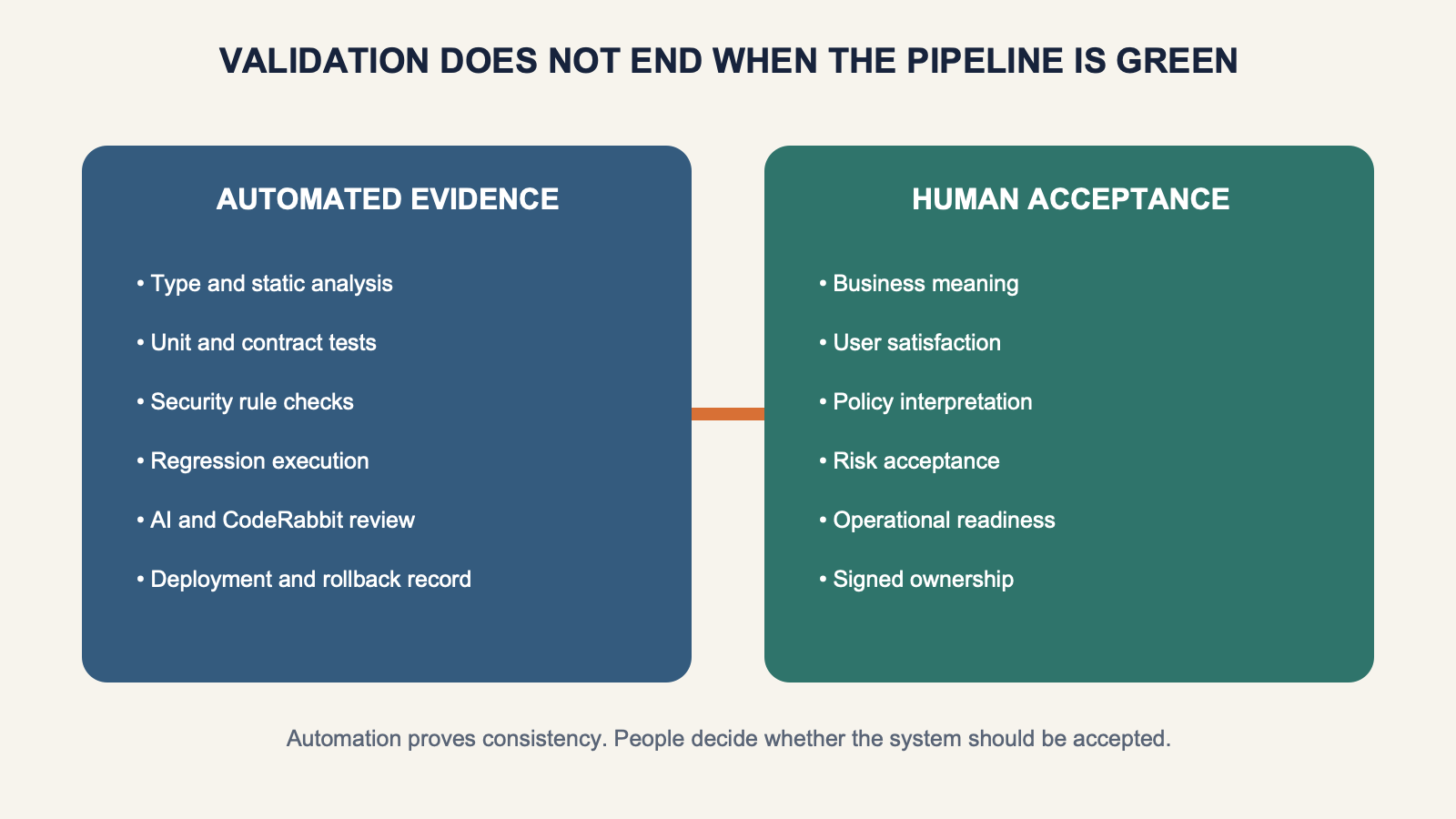
People decide business meaning, user satisfaction, whether exceptions are reasonable, how law and policy apply, which risk is acceptable, and whether operations can recover the service. UAT is not literally the only remaining test. Exploratory testing, accessibility, regulatory validation and recovery rehearsal remain necessary. Final business acceptance is nevertheless the responsibility AI finds hardest to replace.
Running code and accepted business capability are different. Representative users must work with realistic data and failure scenarios, accept the result, and sign who owns the risk before the last gap closes.
Human methods finally bloom at AI speed
Requirements management, traceability, design standards, TDD, code review, CI/CD and observability are knowledge accumulated from human failure. Under Korea's short schedules and overwhelming management volume, people could rarely keep every document, code path and test synchronized. Saying the methods “failed” does not mean they lacked value. It means human time and cognition could not execute them completely.
AI does not abolish those methods. It makes their original ambition more executable by updating requirements, screens, code, tests and operational evidence together. Human management knowledge is beginning to bloom because it has met machine processing speed.
The likely next step is one project AI agent connecting requirements, prototypes, architecture, domain design, implementation, testing, deployment and observation. This is not a claim that one complete product already exists. It is a forecast based on the integration direction shown by Claude Design, Stitch, Antigravity, MoAI, Git and verification tools.
The core skill for IT professionals also moves. Direct production speed matters less than understanding how AI performs project work, what evidence supports its decisions, where it fails and what must exist before a result can be accepted. harness engineering and the ability to govern AI delivery become baseline professional capabilities.
The core of AI project management is not adopting requirements automation and AI project validation separately. It is connecting them to design, implementation and release evidence, then closing business meaning through human acceptance testing. Project management in the AI era is not the deletion of stages. It is the execution of accumulated human methods at AI speed, with deliberate automation boundaries and explicit human approval points.



No comments:
Post a Comment