Amazon is an unusual combination of online retailer, logistics operator, cloud provider, advertising platform, and AI company inside one corporation. Consumers see product search and Prime delivery, while AWS supplies a crucial share of enterprise value. A more complete description is that Amazon predicts demand with software, operates warehouses and delivery networks in the physical world, and sells the computing capabilities developed through that process to outside organizations. In the generative-AI era, those capabilities are expanding into Trainium chips, the Bedrock model layer, and agent operations.
This Amazon company review does not isolate e-commerce revenue from AWS. It asks how Jeff Bezos's long-term investment principle became delivery speed, custom silicon, data centers, and advertising under Andy Jassy, and why rapid AWS AI infrastructure growth creates both a moat and a heavy cash burden. Financial figures follow the official second quarter of 2026, ended June 30.

One operating system from retail to AWS AI infrastructure
Amazon's first advantage is not sheer size but a repeatable operating system. Software links listings, payments, recommendations, inventory placement, warehouse automation, last-mile delivery, and service. Sellers using Marketplace and Fulfillment by Amazon increase selection and logistics density. Prime members purchase more frequently, and advertisers reach people near a transaction. Lower unit costs and faster delivery reinforce demand.
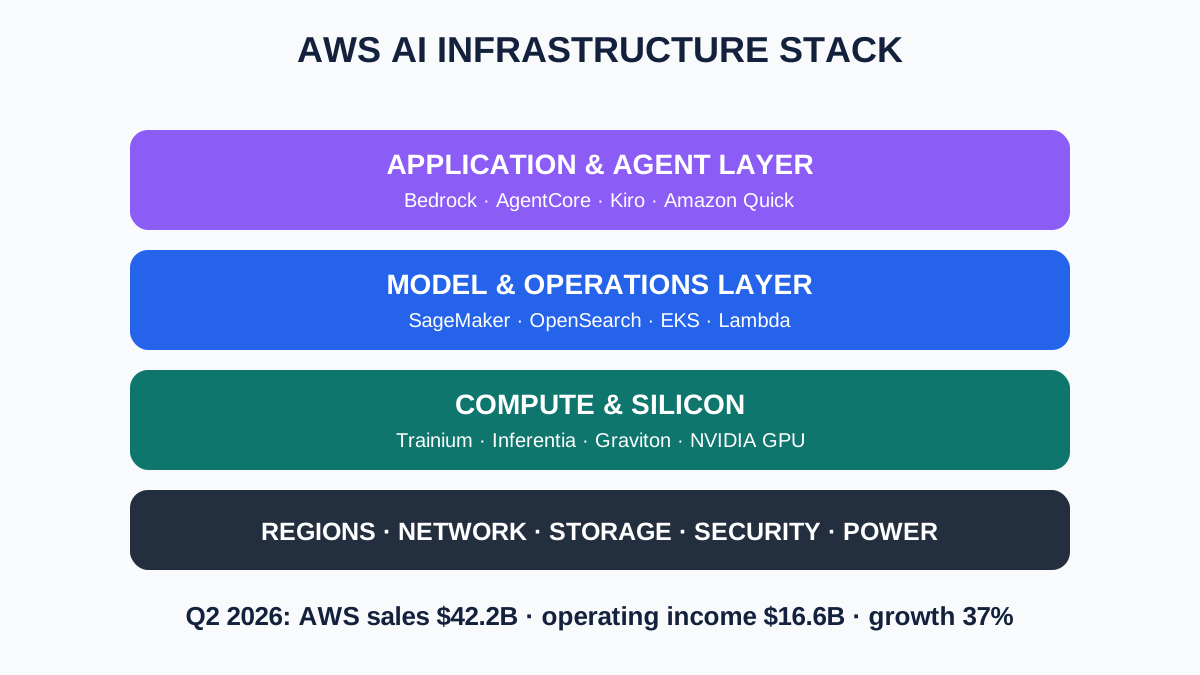
AWS emerged as Amazon standardized internal infrastructure problems. Instead of preparing servers again for each project, it exposed computing, storage, and databases through APIs, allowing customers to trade initial capital spending for usage charges. AWS now competes as more than EC2. Regions, networking, storage, databases, Kubernetes, serverless computing, security, analytics, and AI appear on one operating surface.
| Layer | Representative products | Customer value | Amazon economics |
|---|---|---|---|
| Physical foundation | Regions, data centers, networks, S3 | Capacity, durability, global placement | Scale and long-lived assets |
| Compute | EC2, Graviton, Trainium, GPUs | Choice for general and AI workloads | Supply and cost control through silicon |
| Platform | EKS, Lambda, SageMaker, OpenSearch | Development and operations automation | More usage and switching costs |
| Models and agents | Bedrock, AgentCore, Kiro, Quick | Multi-model access, permissions, action | Higher-value AI consumption |
| Consumer and industry | Stores, Ads, Alexa, logistics, Leo | Transactions and physical delivery | Data and distribution outside Cloud |
The official Amazon Bedrock documentation emphasizes managed access to multiple leading models with security and governance, rather than one proprietary model. Customers can change providers or divide tasks by model while retaining AWS identity, networking, logs, and data. AWS does not need to own the best foundation model if it owns a valuable selection gateway and operating foundation.
That position makes the NVIDIA AI factory both partner and competitor. AWS offers NVIDIA GPUs at scale while using Trainium and Inferentia to bring some training and inference economics onto internal silicon. Customers receive choice; AWS gains differentiation and negotiating leverage. Mature CUDA software and migration cost mean that price-performance claims alone do not guarantee custom-chip adoption.
Andy Jassy's platform strategy and the Q2 2026 numbers
Jeff Bezos's emphasis on long horizons and customer obsession created a culture willing to build infrastructure ahead of immediate profit. Andy Jassy, who led AWS before becoming chief executive, has combined that principle with a stronger focus on operating efficiency. Amazon adjusted excess logistics capacity after the pandemic and improved regional inventory placement while investing aggressively again in AI data centers. It is cutting unit cost in one system while adding assets for expected demand in another.
According to Amazon's official Q2 2026 results, net sales grew 20% to $200.6 billion and operating income rose 43% to $27.5 billion. North America generated $116.2 billion of sales, International $42.2 billion, and AWS $42.2 billion. AWS grew 37%, its fastest rate in 18 quarters, and produced $16.6 billion of operating income—about 60% of Amazon's consolidated operating income.
| Q2 2026 metric | Result | Interpretation |
|---|---|---|
| Net sales | $200.6 billion | 20% year-over-year growth |
| Operating income | $27.5 billion | 43% year-over-year growth |
| AWS sales | $42.2 billion | 37% year-over-year growth |
| AWS operating income | $16.6 billion | About 60% of total operating income |
| Trailing-12-month free cash flow | $7.6 billion outflow | Reversed from $18.2 billion inflow as AI investment rose |
Net income of $62.6 billion should not be treated as ordinary operating performance. It included $53.4 billion of pre-tax other income, primarily related to Amazon's Anthropic investment. Operating income and cash flow better isolate the core businesses. Trailing-12-month operating cash flow rose 33% to $161.4 billion, yet free cash flow turned into a $7.6 billion outflow. Amazon attributed a $66.1 billion year-over-year increase in net property and equipment purchases primarily to AI investment.
AWS's profit contribution explains why Amazon directs more capital toward data centers. It also creates a timing gap: equipment consumes cash first, while contracted usage becomes revenue over years. If AI demand expands as forecast, construction becomes a moat. If customer optimization or model efficiency reduces capacity needs, depreciation and power commitments weigh on returns.
The Trainium, Bedrock, and Anthropic vertical stack
The Trainium ecosystem centers on AWS's accelerator for training and large-scale inference; Inferentia focuses on inference economics. The Neuron SDK connects these chips to tools such as PyTorch, Hugging Face, and vLLM. The official release said both AWS's AI business and chips business exceeded $25 billion annual revenue run rates and were growing at triple-digit percentages. Multi-year, multi-gigawatt Trainium commitments from Anthropic and OpenAI suggest the chip has moved beyond internal experimentation into the supply strategy of major model builders.
Graviton provides an earlier example of the same approach. Amazon designs general-purpose Arm CPUs to improve EC2 price-performance and diversify supply. It said Graviton5 delivers up to 25% more compute performance than Graviton4 and that 98% of the top 1,000 EC2 customers use Graviton. The Arm CPU IP platform lets a cloud operator preserve a standard instruction ecosystem while differentiating hardware.
Bedrock is the model market above the chips. AWS said it added more than ten managed foundation models during Q2, including offerings from OpenAI, Anthropic, and Google DeepMind, and that hundreds of thousands of customers use Bedrock. AgentCore supplies runtime, permissions, payments, search, and observability for agents. SageMaker, OpenSearch, and Lambda cover training, data, and execution. Consumption can spread through multiple AWS services from the accelerator to the agent.
AWS's AI moat is less the intelligence of one model than the ability to provide regions, power, networking, custom chips, multi-model APIs, and enterprise operations together. The deeper the integration, the more customers must weigh convenience against lock-in.
The Anthropic relationship is strategically important and financially complicated. Amazon gains from investment appreciation, while AWS is Anthropic's large computing provider and Bedrock distributor. The relationship can accelerate Trainium's ecosystem, but it also raises questions about economic concentration, conflicts, and equal treatment within a nominally multi-model platform.
Capital, concentration, regulation, and the final assessment
Capital and power are the first risk. An AI data center needs more than chips: grid connections, cooling, fiber, land, permits, and long purchase commitments are necessary. AWS AI Factories, which place dedicated environments at customer facilities, address sovereignty requirements but add project complexity and lengthen asset payback. The free-cash-flow outflow is the clearest indicator of this transition.
Competition and customer concentration are second. Microsoft Azure and Google Cloud combine models, workplace software, and custom chips. Large AI labs bring substantial revenue but also negotiating leverage and capacity-commitment risk. As customers combine clouds with their own facilities, workload retention matters more than a headline market-share estimate.
Reliability and security are third. An AWS failure can interrupt thousands of companies, while agents that make payments and infrastructure changes increase the damage from excessive permissions or prompt attacks. Region isolation, least privilege, audit, and recovery architecture matter more than the length of a product catalog. A managed layer does not remove the customer's design responsibility.
Regulation and labor form the fourth risk. Marketplace fees, Amazon's relationship with third-party sellers, advertising placement, logistics labor, and data use are separate regulatory surfaces. As AI automates recommendations, pricing, warehouses, and service, Amazon inherits responsibilities for discrimination, explainability, and workforce transition alongside efficiency gains.
Amazon transferred operating lessons from commerce and logistics into Cloud and is now extending AWS into a vertical AI stack of chips, models, and agents. Q2 2026 AWS sales of $42.2 billion, growth of 37%, and operating income of $16.6 billion demonstrate the strategy's strength. The trailing free-cash-flow outflow of $7.6 billion demonstrates that growth is not free. Durable indicators include diversification of external Trainium customers, recurring Bedrock usage, power and facility utilization, cash-flow recovery, Anthropic concentration, reliability and security, and whether the interaction among retail, advertising, and Cloud creates real customer value.