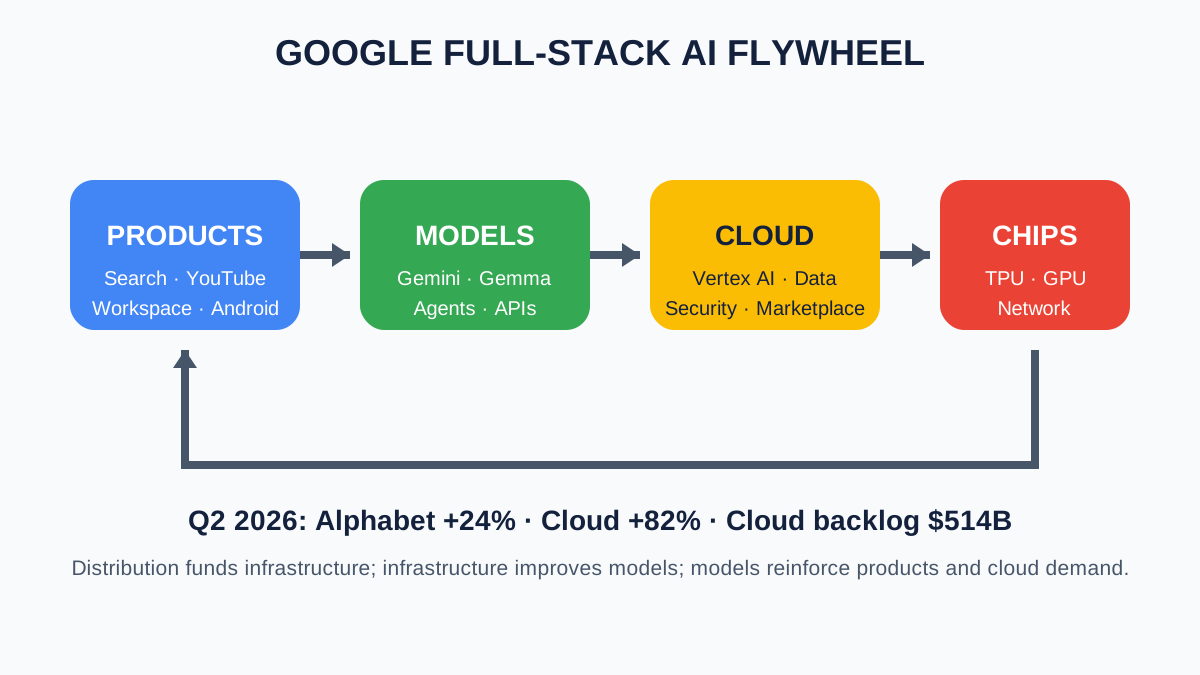
Calling Alphabet a search-advertising company identifies its current cash engine, but it does not fully explain where the company is spending money or what it is trying to defend. Google Search and YouTube are enormous distribution networks. Gemini is the model layer entering that distribution. Google Cloud is the business through which outside companies buy access to related models, data, security, and operations. TPUs and Google's global network sit beneath those layers, giving the company some control over cost and supply. Alphabet's defining feature is the way these seemingly separate assets reinforce one another.
This Alphabet company review connects technology and business economics rather than forecasting the stock. It asks why the search company founded by Larry Page and Sergey Brin is investing simultaneously in custom chips, models, cloud infrastructure, and agents under Sundar Pichai, and whether that investment widens the advertising moat or primarily raises capital intensity. Financial and usage figures follow the company's official Q2 2026 remarks published on July 22, 2026.
From search distribution to a full-stack Google AI platform
Google began by connecting user questions to web documents. Advertising beside search results matches marketers with moments of relatively clear intent, while massive traffic enables measurement and experimentation. YouTube extends discovery into video and combines advertising with subscriptions. Android and Chrome provide access points; Maps, Gmail, and Workspace extend Google into daily and professional activity. This distribution lets the company test a new AI feature with hundreds of millions of people unusually quickly.
Generative AI strengthens and destabilizes that structure at the same time. If an AI answer replaces a results page, traditional links and ad formats may weaken, and a long generated response costs much more to compute than an old-style query. If people ask more difficult questions more frequently, however, Google receives more opportunities to understand intent and connect services. Integrating AI Overviews and AI Mode into one Search experience reflects the need to defend the existing engine while learning the economics of the new interface.
| Layer | Representative assets | Business role | Central tension |
|---|---|---|---|
| Consumer distribution | Search, YouTube, Android, Chrome | Users and advertising demand | AI answers versus the open web |
| Models | Gemini, Gemma, DeepMind research | Reasoning, multimodality, agents | Training cost, inference cost, safety |
| Enterprise platform | Google Cloud, Vertex AI, Workspace | Usage, seats, long contracts | Competition with AWS and Microsoft |
| Infrastructure | TPUs, GPUs, data centers, network | Performance, supply, unit cost | Power, depreciation, capital spending |
| Long-duration options | Waymo and Other Bets | Entry into new markets | Persistent operating losses |
The Gemini ecosystem is not one chatbot. The same model family appears in the consumer app, Search, Workspace, developer APIs, and Google Cloud enterprise products. Open Gemma models create a connection with local and research ecosystems. Vertex AI and Gemini Enterprise combine enterprise data, evaluation, permissions, cost controls, and agent deployment. The strategy assumes that a company with distribution and operations can get closer to real work than a model vendor selling intelligence alone.
This position invites a direct comparison with the Microsoft AI platform. Microsoft connects Azure, Microsoft 365, and GitHub to enterprise workflows. Google combines consumer distribution through Search and YouTube with Workspace, analytics, and custom TPUs. Both are trying to turn data, identity, delivery, and cost control into platform value beyond the model, but they begin from different customer relationships.
Sundar Pichai's integration challenge and Q2 2026 acceleration
Larry Page and Sergey Brin made search quality and computing at scale part of Google's technical culture. The creation of Alphabet in 2015 was a way to distinguish the mature Google business from long-duration experiments. Sundar Pichai's current task is harder: protect search-advertising cash flow while moving DeepMind research, Gemini products, Cloud sales, data-center construction, and regulatory responses at compatible speeds.
According to Alphabet's official Q2 2026 CEO remarks, quarterly revenue grew 24% year over year, Search and Other grew 17%, and YouTube advertising grew 13%. Google Cloud was the standout. Cloud revenue grew 82%, while backlog reached $514 billion. Management's case is that AI infrastructure and enterprise-solution demand are now entering reported performance, not merely raising expectations.
| Official Q2 2026 metric | Result | Interpretation |
|---|---|---|
| Alphabet revenue growth | 24% | Advertising, Cloud, and AI products expanded together |
| Search and Other growth | 17% | Core engine grew during the AI transition |
| YouTube advertising growth | 13% | Video distribution retained ad demand |
| Google Cloud growth | 82% | AI infrastructure and solutions accelerated |
| Google Cloud backlog | $514 billion | Visibility and supply obligations expanded together |
Usage figures reveal the breadth of the system. Alphabet reported 950 million monthly Gemini app users, model API processing of about 22 billion tokens per minute, and more than nine million monthly developers. AI Mode passed one billion monthly users. Management said nearly 90% of the Fortune 100 use Gemini Enterprise, while the Agent Development Kit approached 70 million cumulative downloads. These metrics have different definitions and cannot be added, but they show unusual reach across consumers, developers, and companies.
Adoption metrics do not prove revenue quality on their own. A free user and a paid token have different economics; a pilot and an enterprise standard have different retention. Cloud backlog also becomes revenue on schedules affected by supply and implementation. Buyers and investors should care less about how many people tried a product than about repeat usage, inference unit cost, renewals, and measurable work outcomes.
The strength and cost of combining TPUs, Gemini, and Cloud
Google used machine-learning-specific Cloud TPUs internally for years before offering them broadly to Cloud customers. Their purpose is not to eliminate NVIDIA GPUs. Custom silicon gives Google another supply option and a way to co-optimize hardware, compilers, models, and data centers for large recurring workloads. GPUs remain necessary because customers bring CUDA software and diverse models. The product advantage comes from offering both while optimizing selected Google workloads vertically.
Google Cloud tries to turn those heterogeneous resources into one enterprise operating layer. Data sits in BigQuery and databases; models run through Vertex AI and Gemini APIs; identity, audit, and threat controls govern access. An enterprise agent must do more than generate sentences. It must reach approved data, call tools, execute actions, and leave an accountable record. Governance and integration therefore determine production adoption at least as much as benchmark performance.
The promise of integrated chips, models, data, security, and agent platforms also overlaps with the Palo Alto Networks review of AI security. Prompts, models, data pipelines, and agent actions become new attack surfaces as workloads grow. Google is making Wiz integration and threat intelligence part of the Cloud case, but owning many security products is not the same as applying consistent protection across a customer's environment.
Alphabet's moat is less one model benchmark than its ability to connect Search, YouTube, and Android distribution with DeepMind research, TPUs, networking, and Cloud sales. The same integration concentrates immense capital requirements and regulatory responsibility inside one company.
Capital intensity is the central change. Longer reasoning, video generation, enterprise agents, and Cloud contracts require more servers and data centers. Insufficient capacity loses revenue despite demand; excessive construction raises depreciation and power costs before usage arrives. Management's statement that it reduced AI Mode response cost is technical progress, but it also signals that search economics require continuous optimization.
Advertising, regulation, the open web, and the final assessment
Advertising transition is the first risk. Direct AI answers can reduce clicks to publishers and websites. Google says AI features send billions of clicks to the web each week, but traffic quality and revenue distribution matter as much as volume. A weaker publishing ecosystem would eventually leave Search with less fresh information to index and cite.
Antitrust and platform regulation are the second risk. Search defaults, advertising technology, Play distribution, and data combinations face scrutiny across jurisdictions. The more tightly Google integrates products, the more regulators may see advantages that competitors cannot reproduce. Contract limits, remedies, or structural separation could affect product roadmaps and profitability directly.
Competition and model commoditization are third. OpenAI, Anthropic, Meta, and open models can narrow performance gaps rapidly. Google's response is to distribute models through Search and Cloud immediately and lower cost through TPUs. If customers favor multi-model systems, however, data portability, evaluation, and standard interfaces become more valuable than lock-in to one model.
Other Bets and organizational complexity form the fourth risk. Waymo and similar projects create valuable long-term options but require capital and management attention. Running advertising, Cloud, consumer hardware, autonomous vehicles, and foundational research together enables technical sharing; it can also blur accountability and investment priorities.
Alphabet is a full-stack platform that invests search-advertising cash in AI infrastructure, uses that infrastructure to improve Gemini and Cloud, and returns the result to consumer products and enterprise demand. Q2 2026 revenue growth of 24%, Cloud growth of 82%, and $514 billion of backlog show a powerful flywheel. The durable indicators are not user counts alone. Advertising yield and web traffic in AI Search, recurring paid tokens, backlog conversion, actual TPU economics, data-center returns, and the regulatory limits placed on integration will determine whether the loop compounds.