SynthID Detector is not a magic machine that can judge all AI content. More precisely, it is a verification portal that looks for SynthID watermarks embedded in images, audio, video and text generated by Google AI tools. As generative media enters newsrooms, advertising, education material and internal documents, that distinction matters.
A convincing image or voice clip can lose its context once its production history disappears. Teams need clues about who made it, whether it was edited, and which model ecosystem it came from. SynthID’s core idea is to embed a signal that humans do not perceive and that preserves content quality, then let a detector read that signal later.
AI watermarking should be understood as an additional evidence layer for explaining provenance, not as a one-click verdict on truth and falsehood.
Background
Google announced SynthID Detector in May 2025, describing a portal that brings detection across images, text, audio and video into one place. The announcement says SynthID has been applied across Google generative products such as Gemini, Imagen, Lyria and Veo, and that more than 10 billion pieces of content had already been watermarked.
DeepMind describes SynthID as embedding digital watermarks directly into AI-generated images, video, audio and text. For images and video, the watermark is designed to preserve quality while remaining detectable after common transformations such as cropping, filters, frame-rate changes and lossy compression. For audio, it is designed to remain detectable after changes such as added noise, MP3 compression and speed changes.
Text watermarking works differently. Large language models generate text by assigning probabilities to candidate next tokens. SynthID text watermarking adjusts those probability patterns in a way readers should not notice, leaving a statistical signal that a detector can later analyze.
How it works
A user uploads an image, audio file, video or text to the portal. The Detector scans for a SynthID signal. If it detects one, it highlights portions that are more likely to be watermarked. Google says audio results can identify specific segments, while image results can indicate likely regions.
The advantage is that the signal is not a visible sticker. A label at the bottom of an image can be cropped out, and file metadata can disappear during copying or platform transfer. An embedded watermark is hidden inside the content signal, so it can leave clues after sharing and editing.
| Method | Strength | Weakness |
|---|---|---|
| Visible label | Immediately understandable | Can be cropped or removed |
| File metadata | Simple to implement | Often lost across platforms |
| SynthID watermark | Hidden in the content signal | Requires ecosystem support for embedding and detection |
| Human review | Can judge context | Hard to scale consistently |
Structure

For a newsroom or brand team, the real question is rarely just “is this AI?” They need to know which tool produced the asset, what changed during editing, and whether the context is safe to publish. Detector results provide one technical clue for that broader decision.
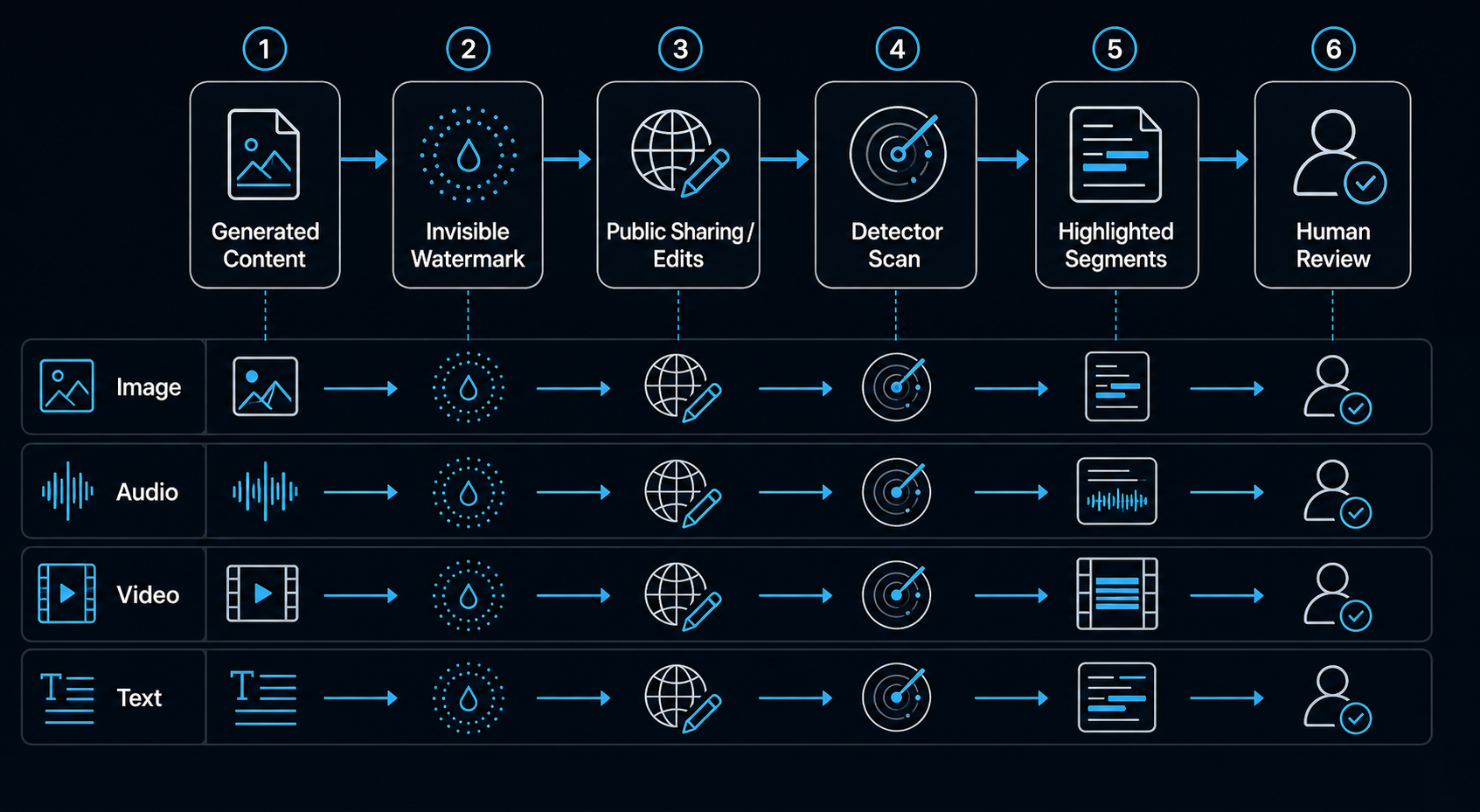
The diagram shows the watermark entering at generation time and being read again after sharing, compression or editing. The last step remains human review because a detection result does not replace contextual judgment.
Checkpoints
First, the absence of a watermark does not prove human authorship. SynthID is a system for detecting signals inserted by supported generation tools. It is not a universal truth detector for every model or for every attempt to remove provenance signals.
Second, ecosystem adoption matters. Google has pointed to collaboration around NVIDIA Cosmos preview NIM microservices and a partnership with GetReal Security. The more generation tools and verification platforms can write and read the same kind of signal, the more useful provenance verification becomes.
Third, privacy and copyright remain separate questions. A watermark can indicate generation history, but it does not automatically resolve training-data rights, likeness permission or publication approval. Organizations need watermark checks, usage permission records, edit history and release approval workflows together.
SynthID Detector points to a clear direction. As generative media quality improves, verification becomes less about guessing from appearance and more about reading signals left at creation time alongside records from distribution. For content teams, the better question is not “does this look AI-made?” but “can we explain its origin and editing history?”
Sources: Google SynthID Detector announcement, Google DeepMind SynthID overview