Calling NVIDIA a graphics-card company is not technically wrong, but it no longer describes the center of the business. The unit NVIDIA sells is much larger than one GPU. It designs accelerators, CPUs, high-speed interconnects, Ethernet, storage processors, rack systems, compilers, libraries, and enterprise software as one system so a data center can behave like a very large computer. That is the reasoning behind management's term “AI factory.”
This NVIDIA company review connects the technology to the economics rather than forecasting the stock. It looks beyond Blackwell GPU arithmetic to examine how the CUDA platform, NVLink, and Spectrum-X create customer switching costs. It also asks why explosive data-center revenue increases dependence on TSMC, high-bandwidth memory, advanced packaging, and export policy. Financial figures follow the official first quarter of fiscal 2027, ended April 26, 2026.
An NVIDIA AI factory is a system, not merely a GPU
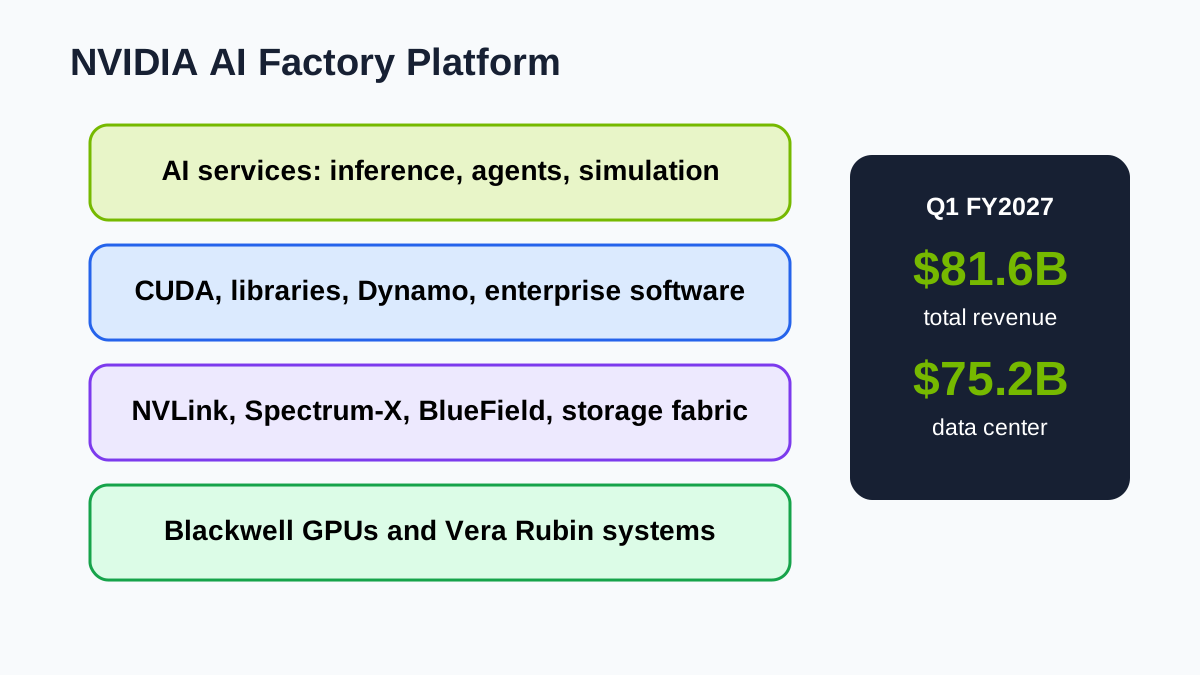
Training or serving an AI model requires more than fast matrix multiplication. Thousands of accelerators must divide work, retrieve data from memory and storage, isolate failed nodes, and deploy a finished model reliably. NVIDIA puts a product at each bottleneck. Blackwell performs the computation; NVLink and NVLink Switch connect processors inside a rack; Spectrum-X Ethernet and InfiniBand carry traffic between racks; and BlueField DPUs offload networking, security, and storage.
| Layer | Representative technology | Customer outcome | NVIDIA outcome |
|---|---|---|---|
| Accelerated compute | Blackwell GPU, Grace CPU | Training and inference throughput | High-value system revenue |
| Connectivity | NVLink, InfiniBand, Spectrum-X | Efficient scaling across GPUs | More of the system design |
| Systems | DGX, GB200/GB300 NVL racks | Validated power, cooling, and cabling | Faster deployment and wallet share |
| Software | CUDA, TensorRT, Dynamo, NIM | Development, deployment, optimization | Ecosystem and recurring software |
CUDA is not one tool that calls a GPU. It is an accumulated development environment of compilers, mathematical and communication libraries, profilers, and industry frameworks. A customer compares not only chip prices but existing code, trained staff, and proven operating procedures. Those accumulated assets make the cost of replacing the platform much greater than replacing one fast chip.
The design also intersects with the Arm computing platform. AI servers still need host CPUs and control processors. Grace CPU, BlueField, and the Vera CPU in Vera Rubin show NVIDIA extending optimization into general compute and data movement around the accelerator. The relevant product metric is moving from peak performance of one component to the cost and reliability of producing one useful token across an entire rack.
Jensen Huang's platform strategy and an $81.6 billion quarter
Co-founder and CEO Jensen Huang expanded parallel graphics computation into general accelerated computing. A crucial choice was continuing software investment through successive chip cycles. When deep learning accelerated after CUDA had spread through research and development communities, NVIDIA already offered a compatible computing base. The present strategy expands that reinforcing loop from a chip into a complete data center.
NVIDIA's FY2026 full-year results provide the annual baseline for the latest quarterly growth and platform transition.
According to NVIDIA's Q1 FY2027 results, revenue reached $81.615 billion, up 85% year over year and 20% sequentially. Data Center revenue was $75.2 billion, up 92% year over year and approximately 92% of the total. Edge Computing contributed $6.4 billion. GAAP gross margin was 74.9%, and GAAP operating income was $53.536 billion.
| Q1 FY2027 metric | Result | What it indicates |
|---|---|---|
| Total revenue | $81.615 billion | 85% year-over-year growth |
| Data Center | $75.2 billion | About 92% of total revenue |
| Edge Computing | $6.4 billion | Gaming, PCs, automotive, robotics |
| GAAP gross margin | 74.9% | Scarcity and platform mix |
| GAAP operating income | $53.536 billion | Operating leverage at scale |
NVIDIA also changed reporting to Data Center and Edge Computing. Inside Data Center, Hyperscale covers major public clouds and consumer-internet companies, while ACIE includes AI clouds, industry, enterprise, and sovereign AI. The shift shows a company that began with gaming GPUs defining demand less by the chip purchased and more by the location where AI is produced.
Concentration is simultaneously strength and warning. A change in a few hyperscalers' capital plans, or better economics from their internal accelerators, could change growth quickly. The movement of selected inference to devices, visible in Qualcomm edge AI, also changes the optimum division between cloud and edge. NVIDIA participates through RTX, automotive, robotics, and edge-model optimization, but that does not remove the current dependence on Data Center.
The conditions behind Blackwell and Vera Rubin leadership
Blackwell's value appears most clearly at system scale. A large model does not fit in one GPU's memory, so tensors and mixture-of-experts workloads are distributed. Communication delay and congestion can leave expensive accelerators waiting. NVIDIA combines NVLink, network switches, and the NCCL communication library to reduce idle time and raise utilization of the whole system.
For inference, software such as Dynamo routes requests and coordinates prompt processing with token generation. Batching, caching, precision, and routing can change cost per token on identical hardware, which makes software optimization a material part of total cost of ownership. Open models, NIM microservices, and enterprise support aim to shorten the time from receiving hardware to running a production service.
Vera Rubin is not simply a replacement GPU. It combines Vera CPU, Rubin GPU, NVLink, networking, and BlueField-4 STX in a platform transition. A fast cadence delivers performance but pressures customers' power, cooling, rack design, and depreciation plans. If a new system arrives before the previous generation has produced sufficient returns, customer economics are more complicated than benchmark leadership suggests.
NVIDIA's moat is not the speed of one GPU. It is the ability to move code, communication, rack design, and operations along one roadmap. The premium will be tested to the extent that customers can separate those layers through open software and standard Ethernet.
Supply chain, China, concentration, and the conclusion
Supply chain is the first risk. NVIDIA is fabless and relies on partners for wafers, advanced packaging, HBM, and system assembly. Demand cannot become shipments when one stage lacks capacity. China and export controls are the second risk. NVIDIA's Q2 FY2027 revenue outlook of $91.0 billion, plus or minus 2%, assumes no Data Center compute revenue from China. Compliance products add engineering and inventory risk, while tighter rules can remove market access.
Internal customer chips are the third risk. Microsoft, Google, Amazon, and major AI companies are partners as well as accelerator designers. NVIDIA answers with generality, rapid releases, and ready-to-use software, but custom silicon can offer advantages for a stable workload at extreme scale. Power and economics are the fourth risk. AI factory bottlenecks now include substations, cooling water, land, and permits. If application demand fails to follow installed capacity, customer capital-spending adjustments will reach NVIDIA orders.
NVIDIA has evolved from a GPU supplier into a platform company selling design rules and operating software for AI data centers. The $81.6 billion quarter demonstrates the scale of that change, not a permanent growth rate. The useful indicators are customer concentration, networking and software expansion, the cost of moving from Blackwell to Vera Rubin, demand excluding China, supply capacity, and customers' cost per useful token. If the platform continues to improve customers' AI returns, the moat deepens. If hardware supply outruns usage, elevated expectations become the first source of risk.




No comments:
Post a Comment