Cloudflare’s Cloudflare Sandboxes, highlighted during Agents Week, is close to the idea of giving every AI agent its own computer. Cloudflare describes Sandboxes as persistent, isolated environments with a shell, filesystem, and background processes. They can start on demand and pick up where they left off.
This is a continuation of the Cloudflare Containers direction, but with a different emphasis. Cloudflare’s earlier Workers containers plan already showed the company trying to narrow the gap between serverless execution and ordinary container workloads. Containers brought ordinary programs to a serverless-style platform. Cloudflare Sandboxes focus on the environment an AI agent needs to run tools and preserve state. The phrase agentic cloud is useful because it captures a shift from app-centered cloud infrastructure to worker-centered cloud infrastructure.
Background
Cloudflare explains the scale problem by noting that if even a fraction of knowledge workers run several agents in parallel, platforms may need capacity for tens of millions of simultaneous sessions. Traditional cloud architecture is good at one app serving many users. AI agents are different: each user’s task may need its own files, tool permissions, execution history, and recovery state.
A support agent resolving a ticket end-to-end, a research agent reading hundreds of sources, or a coding agent running tests all need more than a model call. They need a small workspace. If Cloudflare Workers AI addressed model calls and edge execution, Sandboxes address the isolated workshop where agents actually act.
| Element | Ordinary serverless function | Cloudflare Sandboxes perspective |
|---|---|---|
| State | Short request lifecycle | Files and progress per task |
| Execution | Function invocation | Shell, processes, tool execution |
| Isolation | Request and tenant protection | Agent workspace protection |
| Operations | Traffic scaling | Session concurrency and cost control |
Principle
An AI agent runtime has three parts. The model reads intent and decides the next action. Tools provide the ability to act: shell commands, file reads, browsers, and APIs. State records what has been created, which command failed, and what should happen next.
Cloudflare Sandboxes productize the boundary around tools and state. Imagine a customer-support agent analyzing a bundle of logs. It may create temporary files, decompress archives, run scripts, and summarize results. If the task takes time, it needs background processes. If the user returns later, it needs to continue from the previous state. That is the job of a persistent sandbox.
Giving an agent a shell and filesystem is both powerful and risky. Execution permissions, network access, file retention, and logging policy must be designed together, or the automation boundary becomes hard to control.
Structure
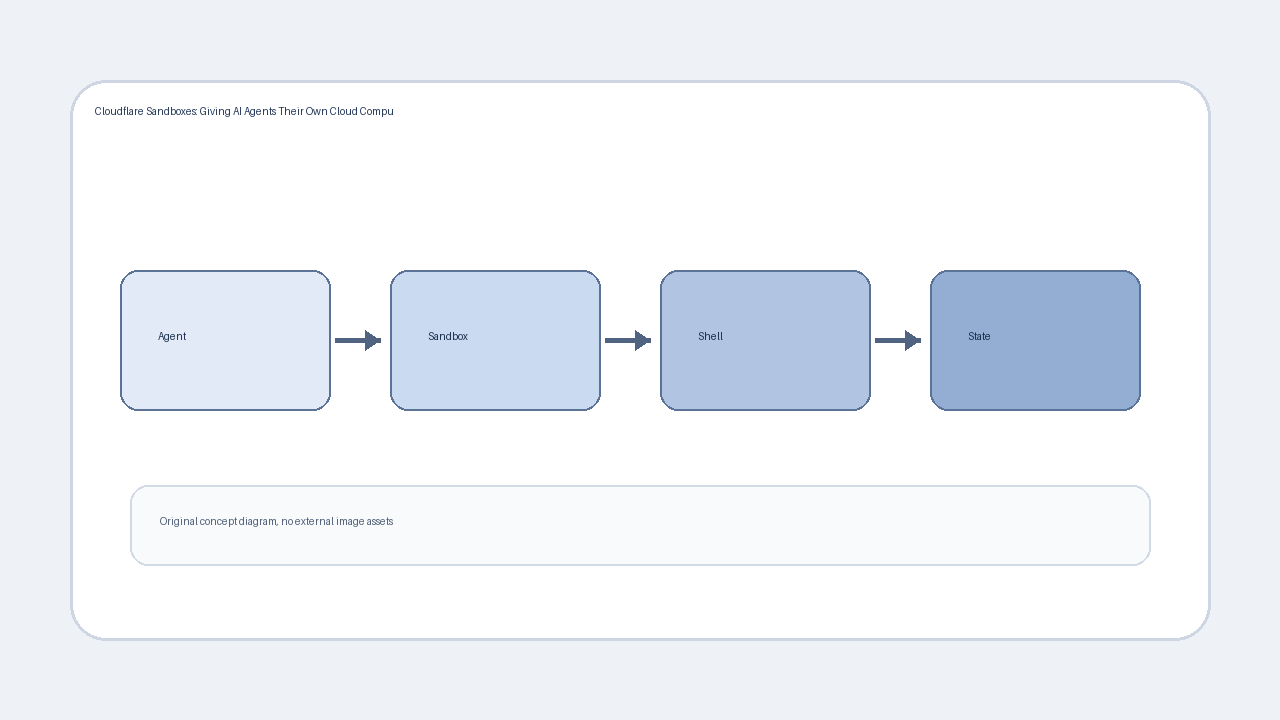
Agent is the decision-making layer. Sandbox is the isolated compute space. Shell represents command execution, and State represents files and progress records. The key point is that the agent does not have to start from scratch every time; it can continue work inside a limited environment.
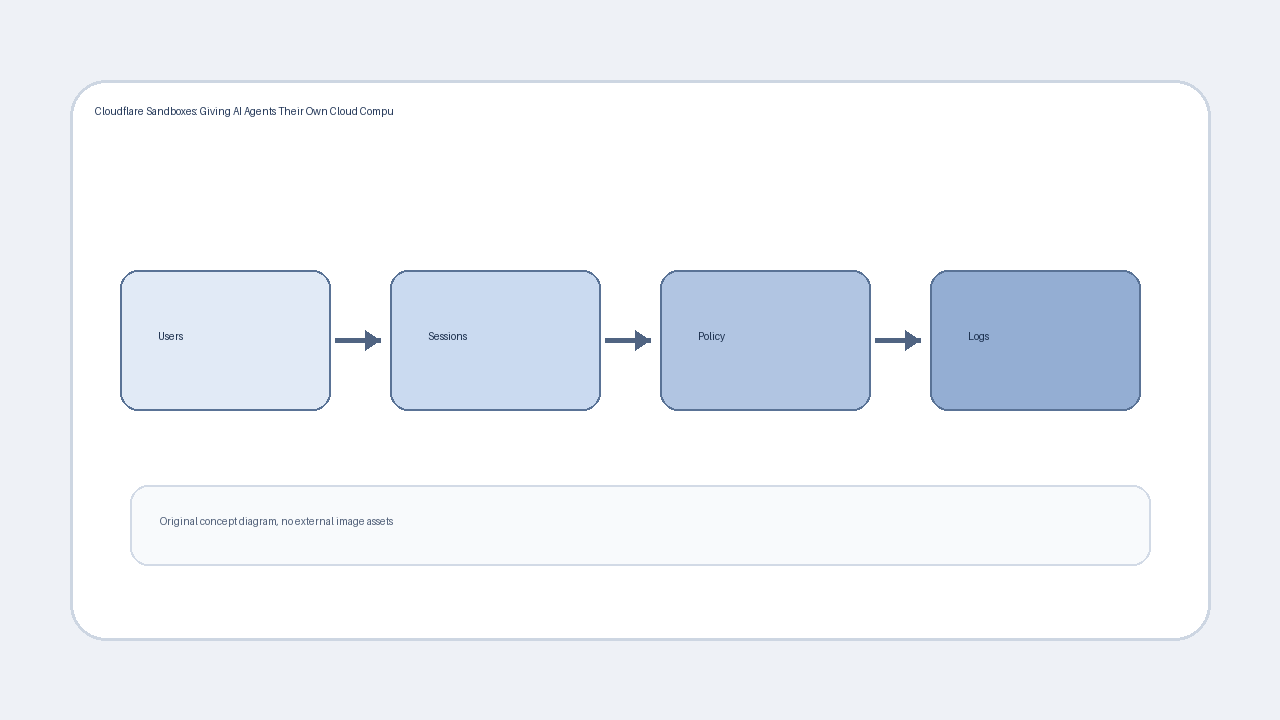
The second diagram is the operator view. As Users grow, Sessions can grow dramatically. Policy defines which tools and networks are allowed. Logs make later investigation possible. In an agentic cloud, the important metrics are not only request volume but session time, retained state, and recovery rate.
Checkpoints
A sandbox is both a security product and a cost product. Stronger isolation helps safety, but long sessions and retained files create cost. Teams need task TTLs, file-size limits, and network policies.
Not every agent needs a shell. Simple FAQ answers or classification jobs may be better handled by function calls. Sandboxes fit code execution, file processing, and long-running research where state matters.
Auditability is central. If a company cannot see which command ran or which file left the environment, adoption becomes difficult.
Cloudflare Sandboxes point to a clear direction. AI agents are no longer just model calls; they require isolated execution spaces and operating policy. Agent platforms may compete less on model lists and more on safely opening, maintaining, and closing many workspaces.



No comments:
Post a Comment