Anthropic’s Claude Sonnet 5 matters because a lower-cost Sonnet-class model is being positioned for longer, more autonomous work. Anthropic calls Sonnet 5 its most agentic Sonnet model yet, able to plan, use tools such as browsers and terminals, and run autonomously. With Xcode Claude Agent SDK integration, coding agents are moving deeper into the IDE rather than staying in a separate terminal or chat window.
The earlier Claude Code iOS Simulator workflow showed how agents can help inspect app screens. This article focuses on the deeper change: how Xcode long-running agents change the work unit and the developer’s role.
Background
Anthropic announced Claude Sonnet 5 on June 30, 2026, saying it improves over Sonnet 4.6 in reasoning, tool use, coding, and knowledge work, while approaching Opus 4.8-level capability at lower prices. The launch pricing was listed at $2 per million input tokens and $10 per million output tokens through August 31, 2026, moving later to $3 and $15. Pricing matters because long-running work consumes large inputs: files, command output, logs, and retries.
The Xcode announcement is more operational. Anthropic says Xcode 26.3 introduces native integration with the Claude Agent SDK, the same harness that powers Claude Code. The integration includes subagents, background tasks, and plugins. For Apple platform developers, Xcode already combines build settings, simulators, signing, and distribution. Bringing the agent into that environment is therefore more than a convenience feature.
| Change | Meaning | Watchpoint |
|---|---|---|
| Claude Sonnet 5 | Stronger agent behavior in a Sonnet-tier model | Long-task cost and review time |
| Xcode integration | Work happens inside Apple development flow | Project permissions and signing assets |
| Subagents | Roles can be split across tasks | Responsibility can become hard to trace |
| Plugins | Team tools can connect directly | Unvalidated automation can run too freely |
Principle
The Xcode Claude Agent SDK takes advantage of the fact that an IDE is not only an editor; it is an execution environment. If a developer asks, “Fix the payment failure path on this screen and strengthen UI tests,” an agent can plan, edit files, and run builds or tests. A long-running coding agent is less about one answer and more about progress, checkpoints, and recovery after failure.
Subagents divide the work further. One can inspect SwiftUI views, another can improve tests, and another can update documentation. The developer does not disappear; the developer defines boundaries, expected outputs, and approval criteria. That is why project execution in the AI era increasingly looks like architecture, testing, and review design rather than prompt writing alone.
The strength of an IDE-native agent is rich context. The risk is the same rich context. Project settings, signing material, local paths, and build logs are nearby, so permission boundaries must come first.
Structure
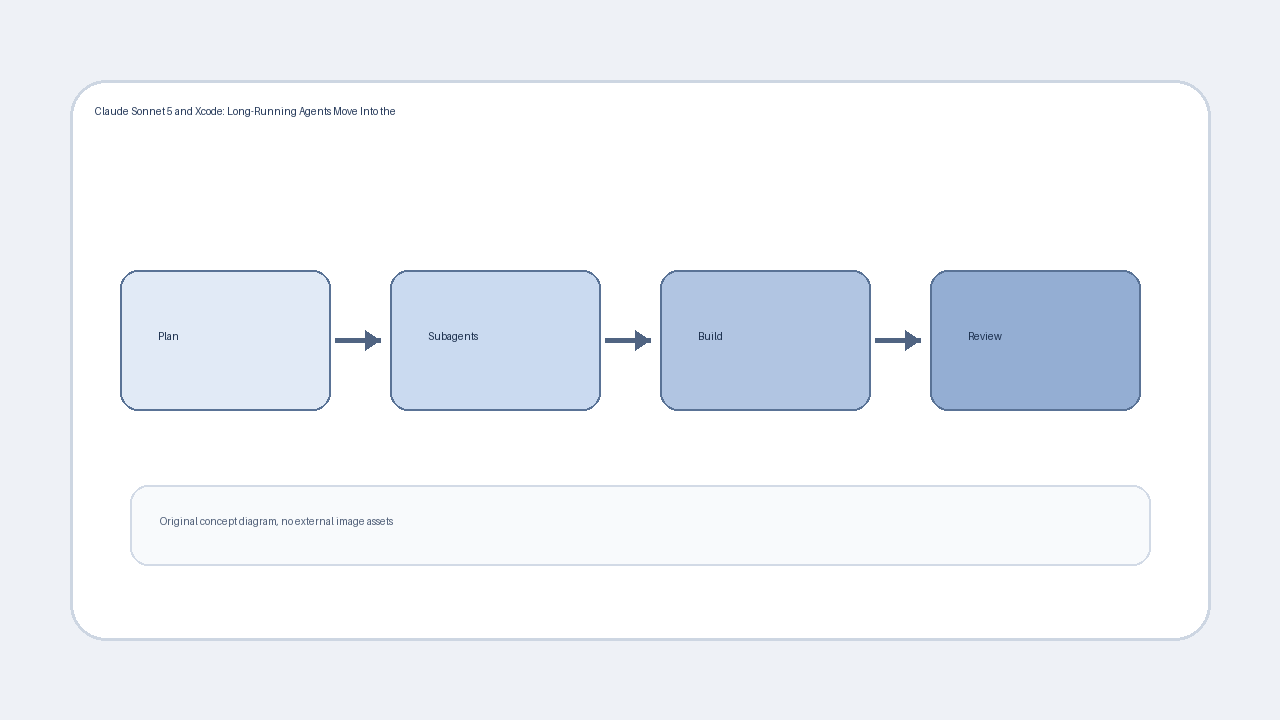
Plan is where the developer states the target and constraints. Subagents represent separated work such as UI, tests, and documentation. Build means Xcode build and test execution. Review is the human gate that checks the evidence. For this structure to be safe, each stage needs logs and diffs that can be inspected.
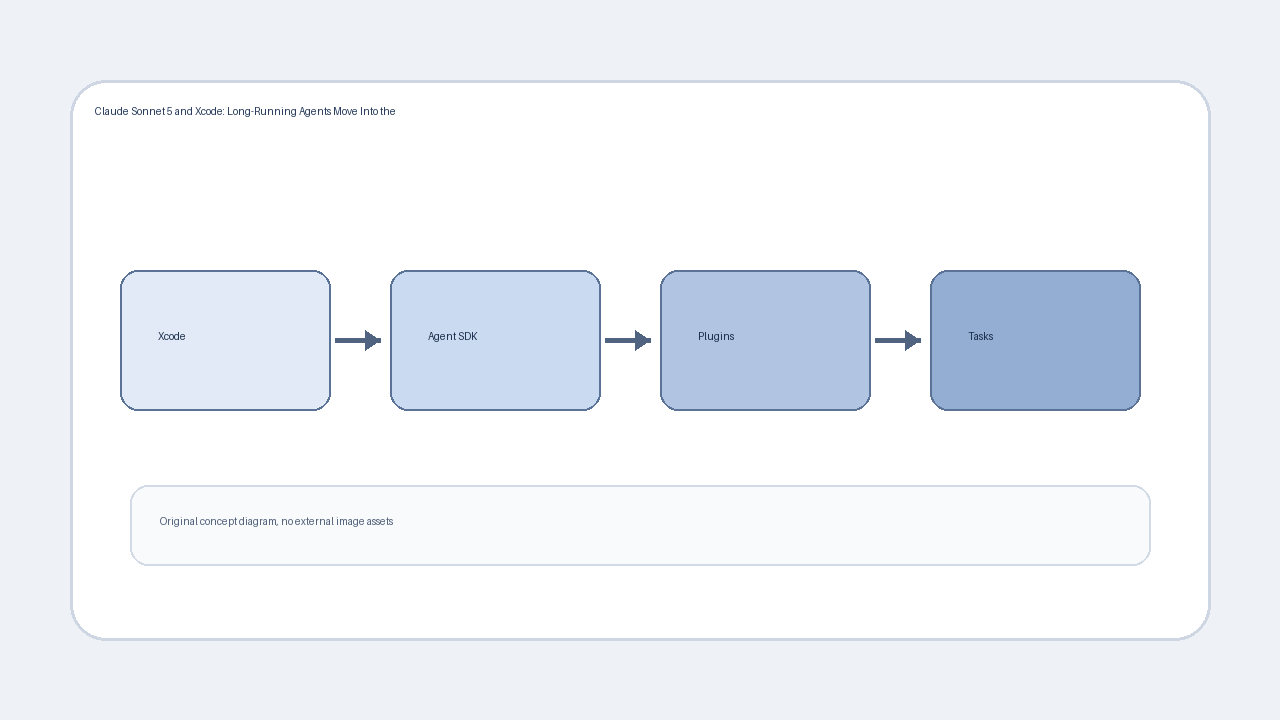
The second diagram shows why an IDE-native agent should not be treated as a simple chatbot. Xcode is a combined environment for editing source, configuring builds, running simulators, and preparing distribution. Agent SDK is the harness that reads and acts inside that environment, while plugins and background tasks are the connection points for team automation.
Checkpoints
Long-running work needs intermediate review. The longer an agent runs, the more widely a wrong assumption can spread through a codebase. Large changes should be split into smaller checkpoints and test groups.
Apple development assets should be separated from normal code-editing permissions. Certificates, provisioning profiles, and deployment authority should not be handled with the same privileges as source changes. If automation can touch build and release scripts, read-only and write-capable paths should be clearly separated.
Subagents can make responsibility harder to follow. If the system cannot show which subagent produced which change, review becomes harder rather than easier.
Claude Sonnet 5 and Xcode integration point to a clear direction. Coding agents are becoming an operational layer inside the IDE. Developers can delegate more code work, but strong teams will design permissions, tests, and review gates before they expand automation.




No comments:
Post a Comment