Series · Learning in the AI Era
Episode 1 · Learning in the AI Era 1 - How Knowledge Becomes Yours
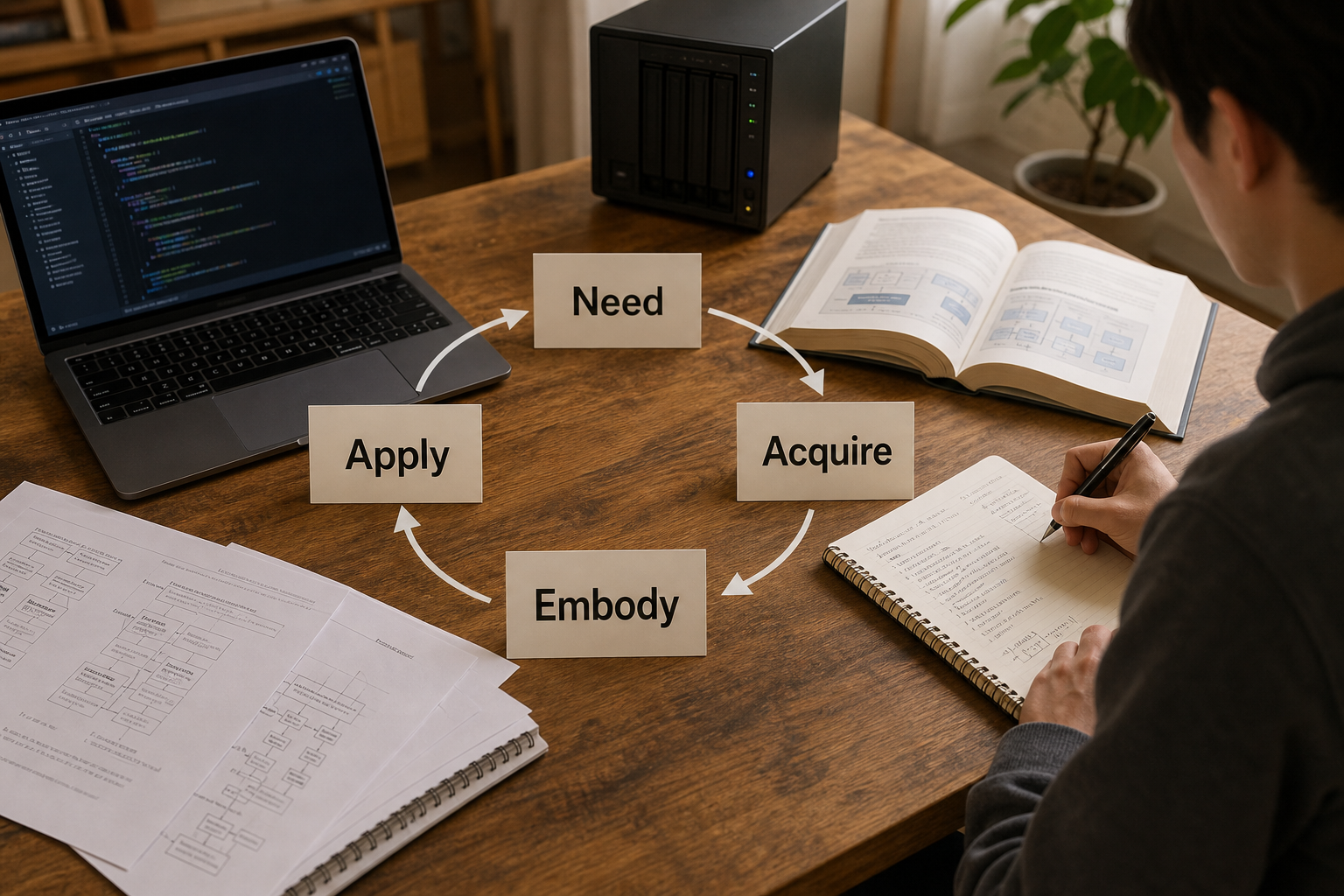
For a developer, studying is not about collecting certificates. It is about expanding the range of unfamiliar problems that can be solved with your own hands. This two-part series follows the path from recognizing a need to acquiring knowledge, embodying it, and applying it to a new problem. Part 1 describes the learning structure that mattered before AI and the route by which repeated experience becomes full-stack transfer skill.
The developer learning method described here is not a trick for consuming more material. It is a process for selecting what a problem requires and turning it into embodied knowledge.
1. Learning starts with recognizing a need
The first step of studying is not opening a book. It is the moment you recognize, “I need to understand this to solve my problem.” Without that need, saving a course list or buying a book rarely becomes actual learning.
Developers begin studying when a problem arrives. A deployment fails, a data model becomes tangled, or the contract between a screen and an API breaks. The good question is not “How do I study the whole web?” but “What exact concept, API, or tool would remove this bottleneck?”
Recognizing a need determines both direction and depth. “Study web development” is too broad; “this week, implement token issuance, validation, and expiration” is executable. The same sentence helps when using AI: it turns a stream of answers into a bounded learning unit.
2. Knowledge that flows in can flow out
The second step is acquiring knowledge. Books, official documentation, courses, videos, and other developers’ writing can all be useful inputs. But time spent watching a screen is not the same as knowledge retained in your head.
Developers especially pay a price when they skip reading for themselves. A search summary or video explanation is a starting point, not an API contract. Read the original input and output conditions, exceptions, versions, and permissions so you can explain why the code works.
Dunlosky and colleagues’ review of learning techniques rates practice testing and distributed practice as promising approaches rather than simple rereading. Karpicke and Roediger’s retrieval-practice study likewise describes retrieval from memory as important for durable learning. In developer terms, close the documentation and explain the API or rewrite a small example without looking at it.
3. Knowledge becomes yours through embodiment
After acquisition comes embodiment. To embody knowledge means you can rebuild the core from the beginning and narrow down why it fails. For developers, the best embodiment tool is often not a huge side project but a small project that can actually finish. A deliberately scoped mini project is more useful than another passive tutorial because every hidden assumption becomes an error you can observe.
If you are learning authentication, a sufficient exercise might be:
- Store users in a local database.
- Issue a short-lived access token at login.
- Validate its signature, expiration, and permissions on a protected API.
- Test an invalid token, an expired token, and a token with insufficient permission.
The screen can remain simple. What matters is starting the server, modeling data, sending requests, and reading logs and failure responses. If you only copy and run a snippet, you have observed knowledge; you have not embodied it.
4. Only embodied knowledge can be applied
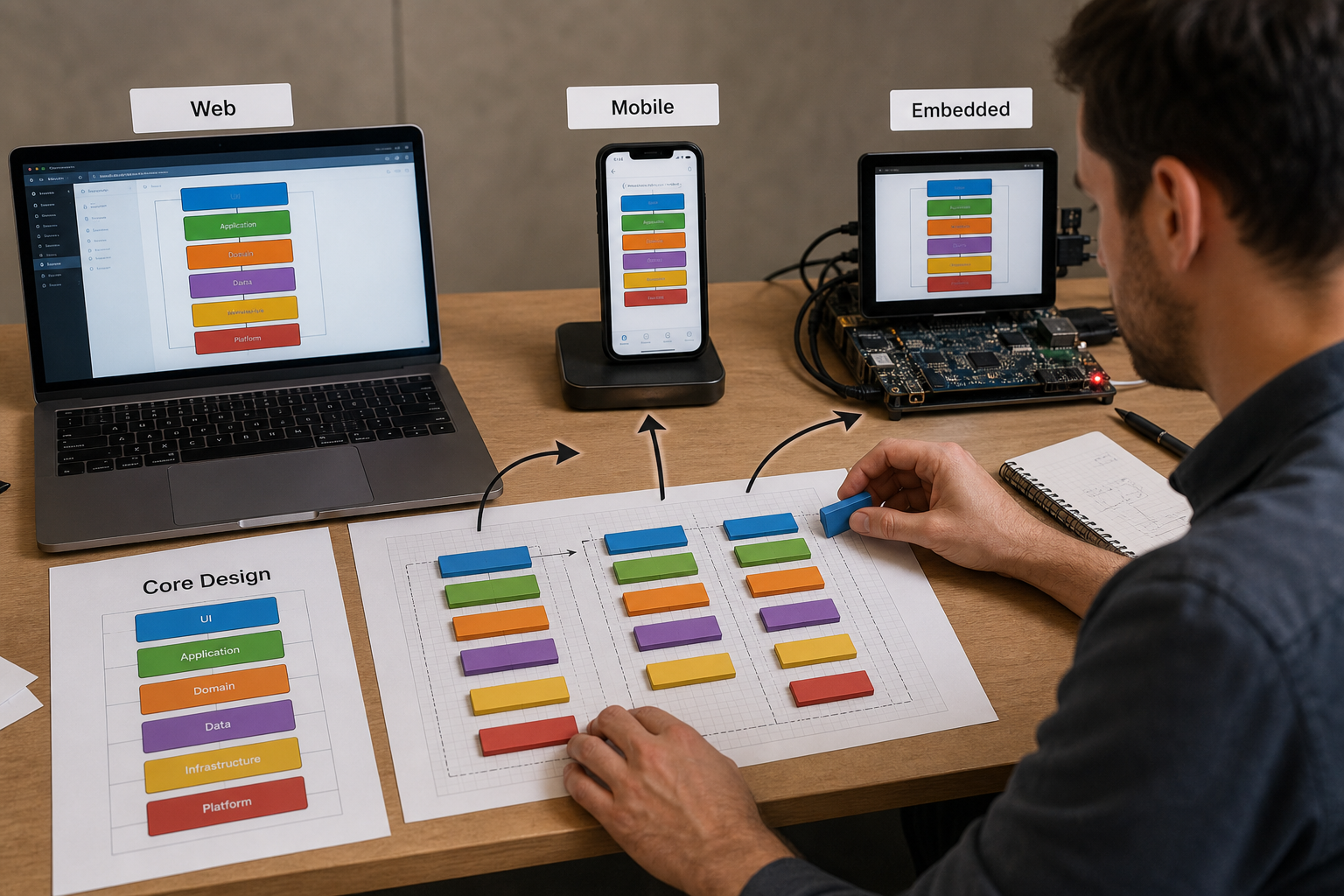
Application is not pasting existing code into another project. It is redesigning a principle under new constraints. When a web developer adds a mobile app with Flutter, the work is not just memorizing new syntax; it is transferring state, events, networking, and deployment into another platform’s language.
With embodied knowledge, the question changes from “How do I draw this button?” to “Where does state live, which boundary does the event cross, and how do I recover from failure?” Without embodiment, a developer remains at the level of combining framework examples and has to search again after every small requirement change.
5. Repetition creates a specialty
Repeated projects reveal which problems you solve most often. One developer becomes strong at data models and query optimization, another at UI state and accessibility, and another at message queues and distributed systems. A specialty is not a title chosen in advance; it is the trace left by problems solved repeatedly.
Do not trade away breadth for depth. Go deep in a specialty while touching other languages and runtime environments enough to compare design choices. After several small projects, you start asking not only “Where should this feature go?” but also “Is this the right boundary for the feature?”
6. Full-stack means transfer, not a list of tools
In Korea, full-stack commonly means working on both the frontend and backend. That is useful in practice, but the heavier meaning of full-stack is closer to transferring a solution into an unfamiliar technology and reaching application level quickly.
I do not define a full-stack developer as someone who knows every technology. I define one as a practitioner who can use a focused experiment of roughly two weeks to connect an unfamiliar technology to a real task. This does not mean mastering everything in two weeks. It means finding the core contract in official documentation, building a small environment, recording failures, comparing the result with an existing design, and applying it in a narrow scope.
This transfer skill becomes even more important in Part 2. AI dramatically speeds up knowledge acquisition, but it does not automatically perform embodiment and application for you.
Conclusion: the unit of study should become an artifact
Developer learning moves from recognizing a need to acquiring, embodying, and applying knowledge. Reading documentation and watching a video are necessary inputs, but a small server, screen, data model, or test must be completed before the knowledge becomes your tool. Repeated embodiment creates a specialty, and transferring that specialty across languages and platforms creates full-stack ability.
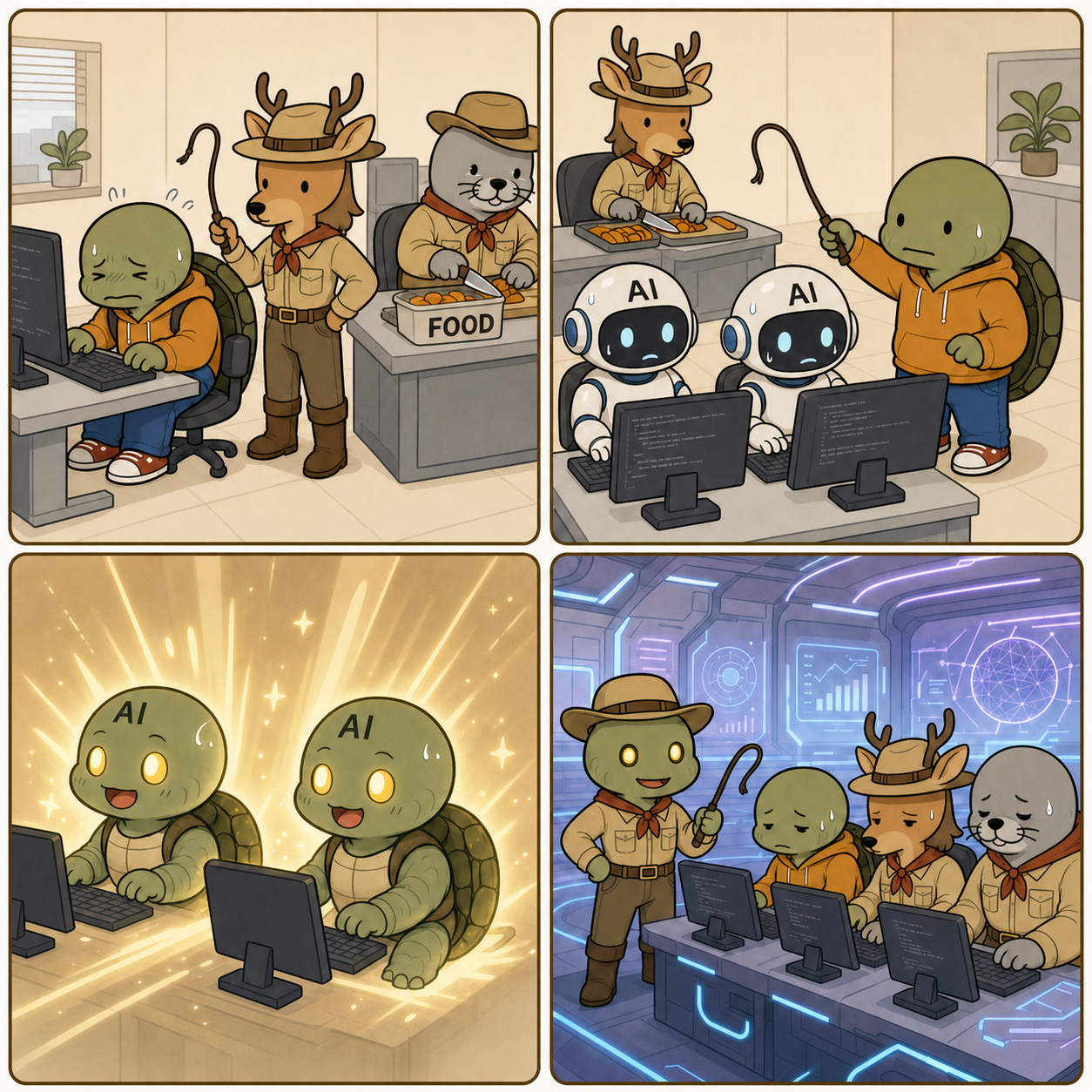
Part 2 examines how AI compresses this structure and how to use it as a partner for investigating sources rather than as an answer vending machine.



No comments:
Post a Comment