Series · Learning in the AI Era
Episode 2 · Learning in the AI Era 2 - The People Who Eat the Golden Apple
Part 1 described studying as recognizing a need, acquiring knowledge, embodying it, and applying it. AI does not remove this sequence; it compresses the time spent acquiring and exploring knowledge. The question in the AI era is therefore not “Did studying end because AI produced an answer?” but “Am I turning that answer into my own knowledge and capability?”
AI-assisted learning here does not mean copying an answer. It is an AI-era learning method and an AI learning method for developer growth: use the model to accelerate exploration, then attach verification and a small implementation so knowledge application actually happens.
1. AI separates learning depth, not just learning speed
AI makes it faster to locate documentation, unpack an unfamiliar term, and create a skeleton example. In the past, search felt like walking through every floor of a department store; now a coordinator can select plausible items in front of you. That is a real productivity gain, but if you do not know why the items were selected, you cannot dress yourself next season.
Developers can move in two directions:
| Direction | How AI is used | What remains |
|---|---|---|
| Source investigator | Keeps asking for evidence, structure, and failure conditions, then verifies | Embodied design and transfer skill |
| Result consumer | Prompts, copies the output, and moves to the next problem | Tool-dependent manipulation |
Both people may use the same AI. The difference is whether experiments and explanations follow the answer, or whether learning ends on the response screen.
2. From a Google department store to an AI coordinator
Imagine wanting to dress like a stylish British gentleman without knowing the vocabulary. A search engine can open hundreds of pages, but the user still has to discover words such as top hat, gold-rim glasses, cufflinks, wing collar, and bow tie. If you do not know the categories, you cannot even formulate the right search query.
Software problems work the same way. Search “login is broken” and you get sessions, JWT, cookies, CORS, CSRF, OAuth, proxies, and expiration policies in one pile. Before AI, developers had to walk through that department store, extract terms, combine examples that only looked similar, and discover what they did not know through compiler errors.
An AI coordinator can ask:
That exchange does not merely provide an answer. It creates categories for the problem. Once categories exist, official documentation and code searches become more precise. AI’s first value is often discovering the missing words, not producing the final sentence.

3. How to question AI until you reach 97 percent
This is not a request to trust the answer. It is a request to interrogate why it was produced. When you receive code, use a question set like this:
- What problem does this implementation solve, and what does it not solve?
- Where are the official documents for each class, function, or protocol?
- Show normal, boundary, and failure inputs separately.
- Compare two alternatives and the criteria for choosing between them.
- Break the idea into a 30-minute experiment I can reproduce myself.
This treats AI as a source of evidence and counterexamples, not as a teacher to obey. “Following AI to 97 percent” does not mean memorizing 97 percent of its text. It means explaining the structure in your own words, checking it with a small implementation, and correcting what fails.
4. Why result consumers stop quickly
Imagine someone who asks AI for a casual outfit after receiving one satisfactory recommendation, then goes home without asking why. They have an outfit for today, but not the ability to assemble one for a different situation. Copying code, running it, and stopping is the same state.
It is fast in the short term. But when a version changes or a requirement shifts, the developer must ask the same question again and cannot tell where to begin verification. A source investigator connects a new tool to existing design principles; a result consumer starts over whenever the tool changes.
Microsoft Research’s 2025 survey of knowledge workers examined the relationship between generative-AI use, perceived cognitive effort, and critical review. It did not prove that AI necessarily reduces human thinking; it was a self-reported survey with clear limitations. It does, however, justify deliberately designing verification instead of assuming that a fluent answer has been learned. For evidence on learning strategies, compare Dunlosky and colleagues’ review with retrieval-practice research.
5. The AI learning loop of a source investigator
A deep AI user does not ask one question and stop. They decompose the problem and use AI in turn as a documentation finder, opposing reviewer, experiment designer, and code reviewer. The final judgment and execution remain their responsibility.
| Stage | Developer action | What AI can do | What the developer must do |
|---|---|---|---|
| Need | Write the problem in one sentence | Find missing conditions | Set goal and scope |
| Acquire | Read sources and principles | Map terms, compare, summarize | Check originals and record provenance |
| Embody | Build a minimum project | Generate examples and failure cases | Run, log, and test |
| Apply | Transfer it to another platform | Propose alternatives and counterexamples | Judge quality, security, and operations |
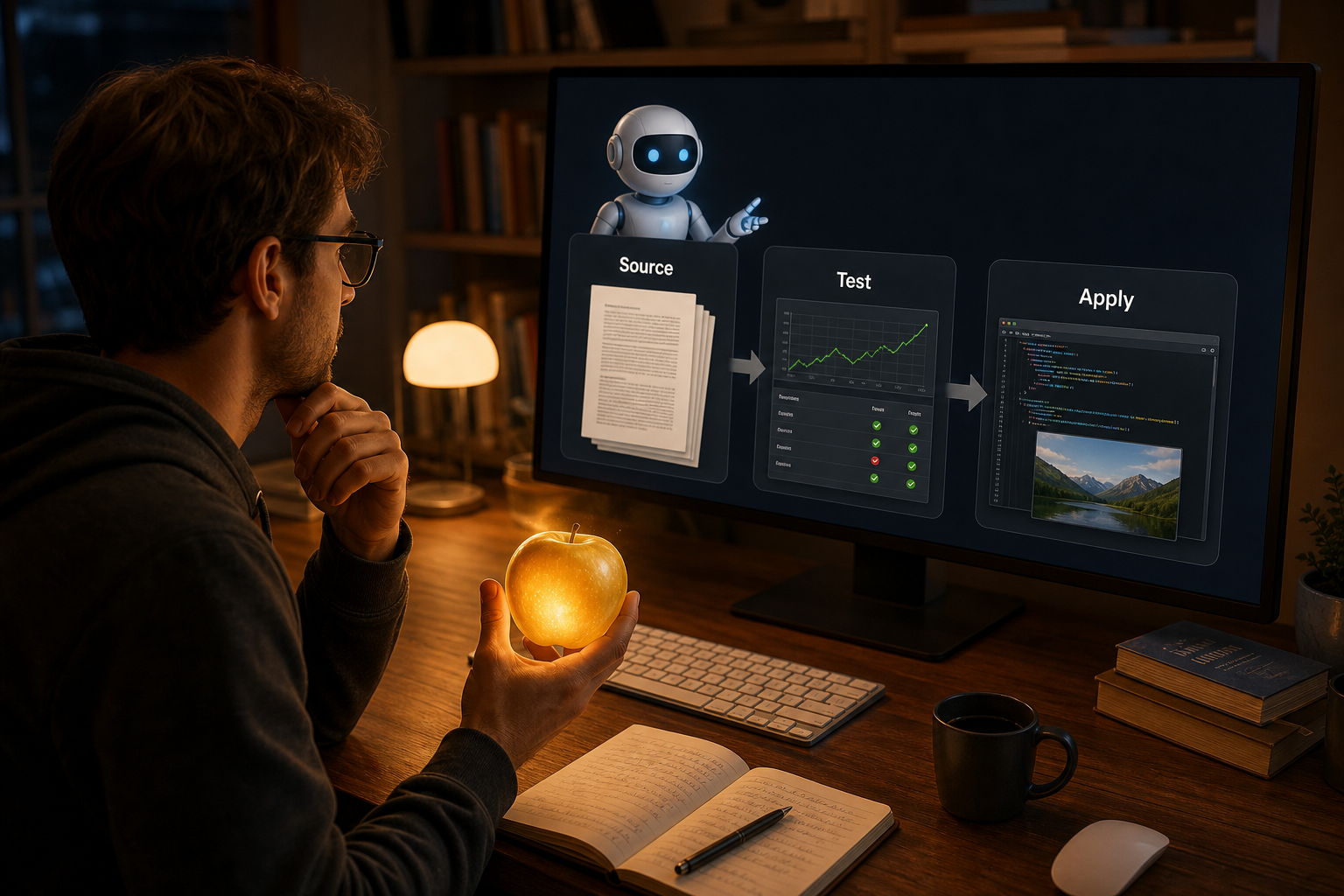
This loop turns AI from autocomplete into a learning environment. The important variable is not the number of prompts but whether each prompt connects to code, sources, and an experiment.
6. You have to eat the golden apple
AI lowers the entrance to knowledge that developers once found difficult to reach: operating-system APIs, unfamiliar languages, hardware documentation, and design patterns. But lowering the entrance does not make the ability yours automatically.
We are holding a golden apple. One choice is to eat it, analyze its taste and ingredients, and learn to choose the next apple yourself. The other is to leave it in the living room and keep admiring it. The first person investigates and embodies knowledge with AI; the second consumes AI-generated results.
The golden apple also decays. Today’s example becomes stale when a library changes, and an AI answer can be wrong when its context disappears. The AI-era learner therefore does not merely save answers; they turn answers into designs and execution records through verification.
Conclusion: AI changes the standard of studying, not the need to study
The sequence of acquiring, embodying, and applying knowledge remains. What changes is the speed and breadth of exploration. The advantage now lies not in receiving a brilliant answer but in connecting it quickly to sources, experiments, and design.
The future developer is not somewhere between a person who memorizes everything and a person who only prompts. It is the direction of a source investigator: recognize the need, use AI to reach the source, embody the result by hand, and apply it to a different problem.



No comments:
Post a Comment