Anyone who has lived with a 2019 Intel MacBook knows the pattern. A few browser tabs, a video call, and a build job are enough to wake the fans, heat the bottom case, and drain the battery faster than expected. Those Macs were good computers, but they did not feel like the quiet, long-lasting, consistently fast notebooks people now associate with Apple laptops.
The turning point was, in practical terms, the 2020 M1. One correction matters, though: the iPhone does not use M series chips; it uses Apple’s A series. The broader change was that Apple took the Arm-based SoC design discipline it had refined in iPhone and iPad, then pushed it into the iPad Pro and Mac at laptop and desktop scale.
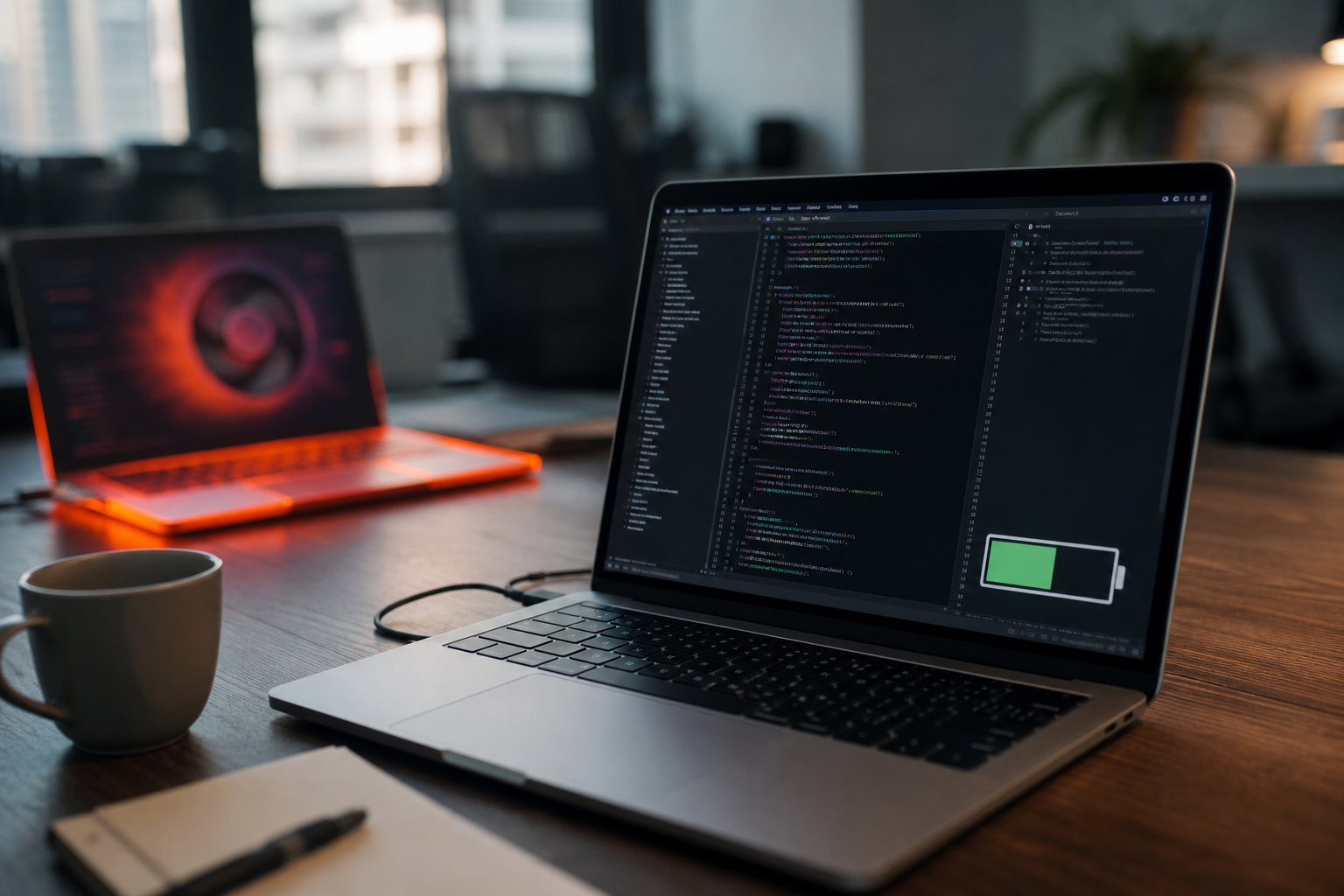
M1 changed not just speed, but sustained performance
When Apple announced M1 in 2020, it described the chip as the first SoC designed specifically for the Mac. The same event introduced the M1 MacBook Air, 13-inch MacBook Pro, and Mac mini. The important change was not merely a new CPU vendor. CPU, GPU, Neural Engine, memory, security, and I/O moved into a tightly integrated system.
That is why the user-visible difference felt larger than a benchmark jump. Apps launched faster, battery-mode work stayed responsive, and heat and fan noise dropped. The fanless MacBook Air became a normal development and productivity machine for many workloads, which would have sounded unrealistic in the later Intel MacBook era.
So the instinct is mostly right. Mac thermals, battery life, and quiet sustained performance became dramatically stronger after M1. But the exact fact check is narrower: iPhone did not become an M-series device, and iPad is split across A and M chips depending on model. M1 was not the origin of every Apple device’s silicon strategy; it was the moment the Mac’s identity changed.
| Area | Common Intel-era MacBook feel | M-series shift |
|---|---|---|
| Thermals | Fans could ramp under builds, meetings, and heavy browsing | Higher performance per watt and quieter daily workloads |
| Battery | Heavy work could drain the battery quickly | Better sustained work away from power |
| Architecture | CPU, GPU, memory, and controllers were more separated | SoC plus unified memory reduced data-movement overhead |
| Developer experience | Mobile work often meant charger anxiety | IDE, terminal, browser, and chat became more portable |
From M1 to M4: Apple’s change was a roadmap, not one chip
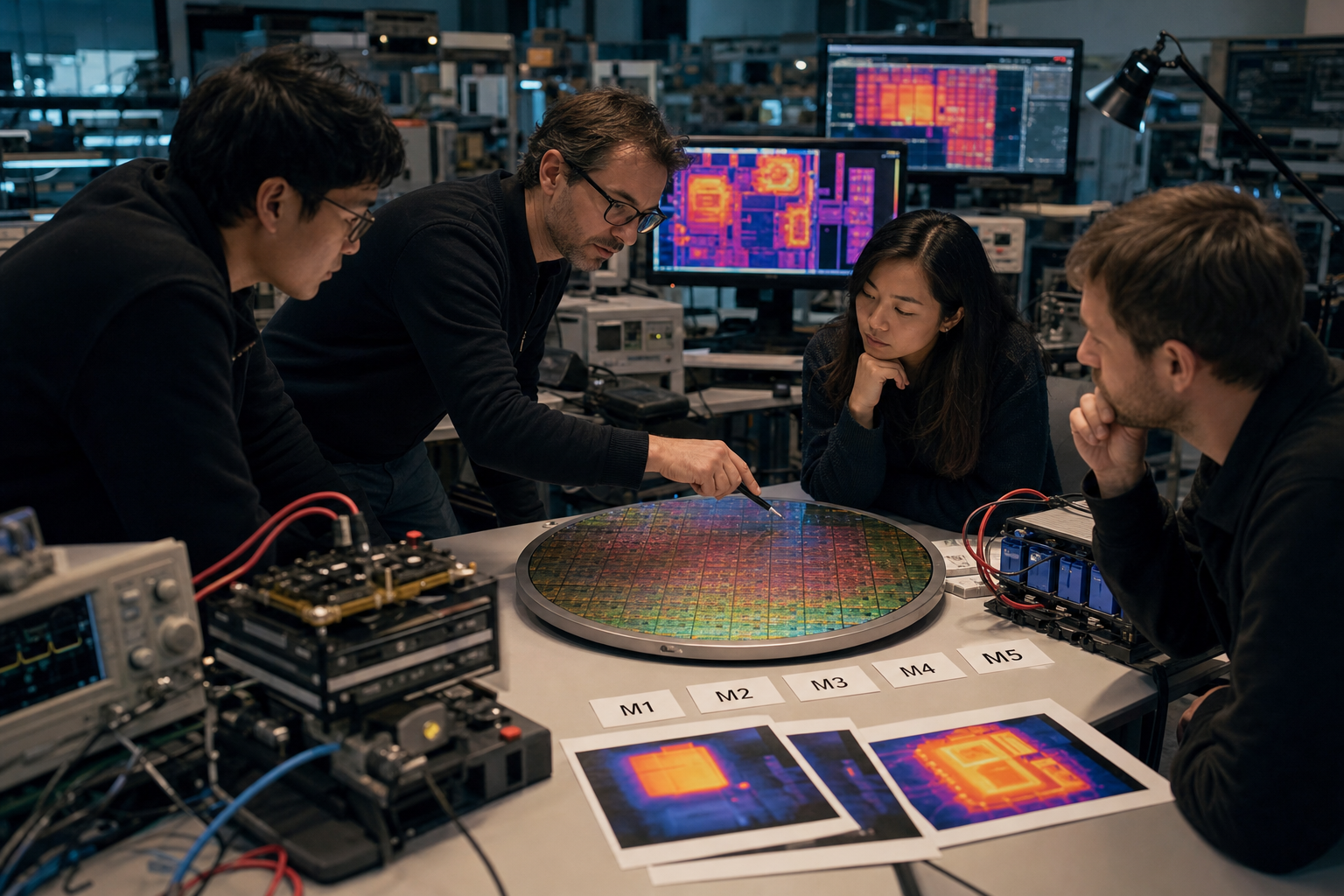
M1 proved the transition. Apple promised a two-year Mac transition, and the Mac line quickly moved toward Apple Silicon. M1 Pro and M1 Max then showed that the architecture was not only for efficient thin laptops; it could scale into pro video, development, and graphics workloads.
M2 was more of a broadening generation than a revolution. Memory bandwidth, media engines, GPU options, and product coverage improved. The user expectation changed from “this one model is unusually efficient” to “a modern MacBook should usually be quiet and long-lasting.”
M3 brought 3nm manufacturing and a new GPU direction, including Dynamic Caching, hardware-accelerated ray tracing, and mesh shading. M4 moved the emphasis toward local AI. Apple’s M4 announcement describes second-generation 3nm technology, up to a 10-core CPU, a 10-core GPU, Dynamic Caching, and a 38 TOPS Neural Engine.
| Generation | Launch meaning | What changed |
|---|---|---|
| M1 | 2020 Mac transition | Apple broke Intel dependence and redesigned the Mac around an SoC |
| M2 | Wider rollout | The M1 experience spread across more products and memory/media options |
| M3 | 3nm and GPU architecture | Better graphics and rendering foundations |
| M4 | AI and efficiency emphasis | Neural Engine, memory bandwidth, and power efficiency moved forward |
A 2025 arXiv study evaluating Apple Silicon M-series SoCs for HPC gives a useful outside view. It found that M1 through M4 benefit from unified memory and low power use, with M4 reaching a measured 2.9 FP32 TFLOPS peak in the study and power ranges around a few watts to about 20W. The same paper also notes limits, including the lack of native FP64 support on the GPU. That is the key nuance: Apple does not win every absolute-performance contest. It wins by delivering unusually strong performance inside a thin, quiet, battery-powered device.
The people: Johny Srouji and the architects who left
It would be wrong to turn M series into a one-person myth. Still, Johny Srouji is the public face of Apple silicon. Apple says he joined in 2008 to lead development of A4, the first Apple-designed SoC, after senior processor roles at Intel and IBM. He holds bachelor’s and master’s degrees in Computer Science from Technion.
In 2026 Apple named Srouji Chief Hardware Officer. The expanded role covers not only Apple silicon but also batteries, cameras, storage controllers, sensors, displays, modems, and other hardware technologies. That matters because the MacBook experience is not created by a chip alone. It comes from silicon, battery, thermals, software, manufacturing, and product design working together.
Another frequently mentioned figure is Gerard Williams III. Reports describe him as a former Apple lead chip architect who left in 2019 to co-found Nuvia, which Qualcomm acquired in 2021. Nuvia’s work later connected to Qualcomm’s custom Oryon CPU and Snapdragon X push. CRN reported in 2026 that Williams had left Qualcomm. Based on public reporting, the safest current description is that he is a former Apple/Nuvia/Qualcomm CPU architect whose next corporate role has not been clearly established in public sources.
| Person | Apple relevance | Later path |
|---|---|---|
| Johny Srouji | Led Apple silicon organization from A4 through the M-series era | Apple Chief Hardware Officer as of 2026 |
| Gerard Williams III | Reported former Apple lead chip architect connected to major A-series work | Nuvia co-founder, Qualcomm after acquisition, reported Qualcomm exit in 2026 |
How long can Apple keep the lead?
In the near term, especially for developer laptops, Apple’s advantage is hard to dismiss. macOS, Xcode, battery design, display, SoC, unified memory, and power management are optimized inside one product stack. Windows laptops offer broader hardware choices and stronger discrete GPU options, but matching Apple’s combination of portability, silence, battery life, and consistent performance remains difficult.
The advantage is not permanent. Qualcomm’s Oryon-based Windows on Arm systems, AMD and Intel’s efficiency-focused x86 laptops, and NVIDIA’s GPU ecosystem all pressure Apple from different directions. Local AI and graphics-heavy work can favor discrete GPUs. Games, CUDA, and enterprise compatibility remain Windows strengths.
So the M-series lead is best defined narrowly: performance per watt, quiet sustained laptop work, and battery-mode productivity. On that axis, Apple likely remains strong for another one or two generations, roughly two to four years. But if Windows on Arm improves compatibility while x86 notebooks keep cutting power use, the gap can narrow.
From a working IT perspective, the reason to stay on Mac is not just taste. It is performance behavior. A machine that can run an IDE, browser, terminal, messaging apps, and background services without constantly demanding a charger or spinning up fans changes the workday. Apple’s counterattack was not simply prettier hardware; it was making quiet performance feel normal.




No comments:
Post a Comment