Astera Labs connectivity sits in a less visible but increasingly important part of the AI stack. GPUs, CPUs, memory, network cards, and storage devices only deliver value when data can move among them reliably. As AI servers grow denser, AI server connectivity becomes a product category of its own.
Astera Labs is a semiconductor company, but its pitch is broader than chips alone. It sells PCIe, CXL, and Ethernet-based connectivity products, plus software that helps hyperscale data centers observe and diagnose those links. This review looks at the company as an infrastructure enabler rather than a consumer technology brand.
What problem Astera Labs solves
AI servers are full of high-speed links. A GPU must talk to CPUs, memory, storage, network adapters, and other accelerators. At small scale, this sounds like a hardware design detail. At data center scale, signal quality, latency, thermal behavior, and observability can shape the economics of an entire AI cluster.
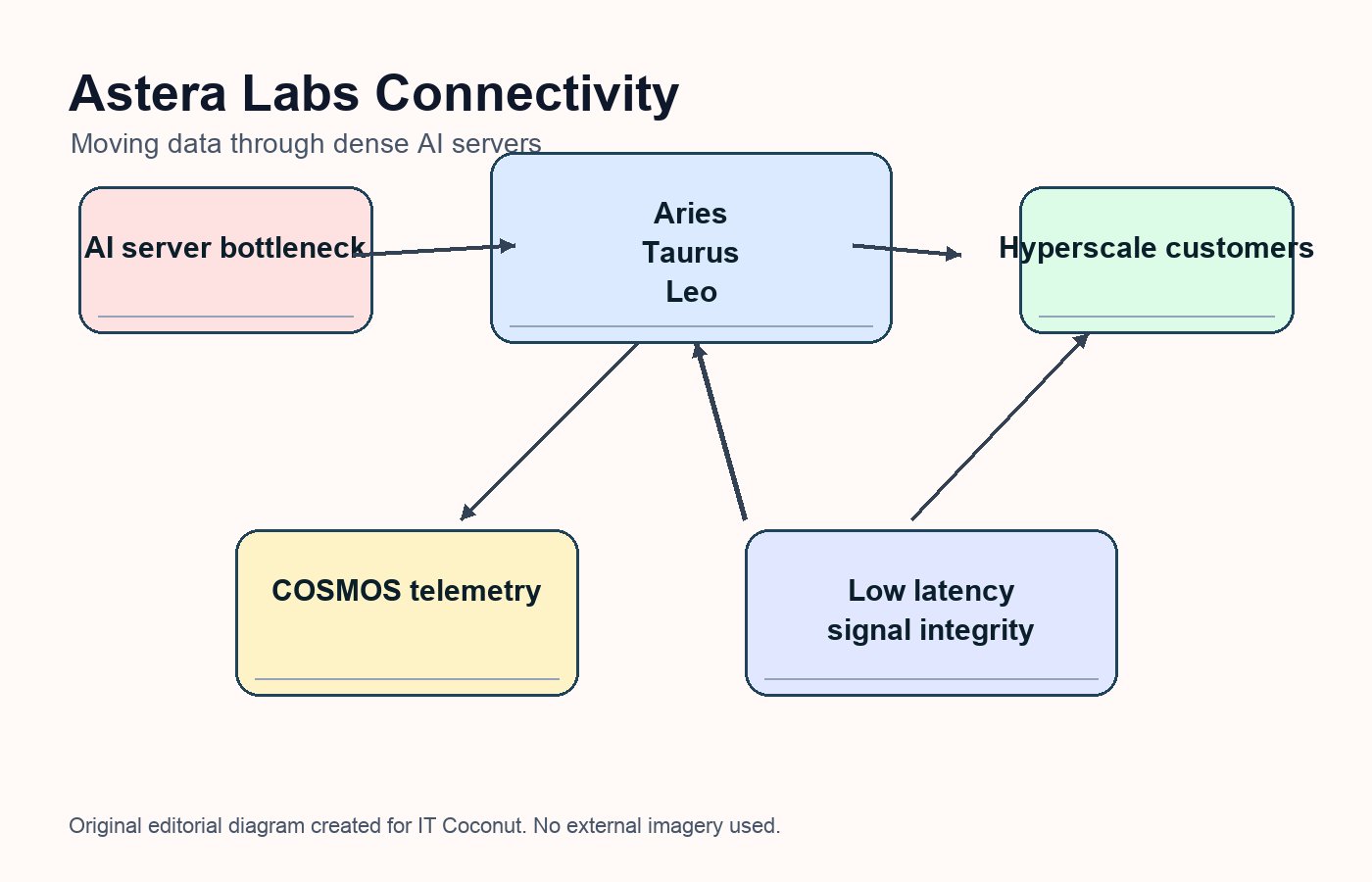
Astera Labs sells connectivity solutions for cloud and AI infrastructure. Its customers are mainly hyperscalers and system OEMs. Hyperscalers run massive cloud and internet platforms; system OEMs design and build servers, boards, modules, and rack systems for those environments. Astera products are not purchased by end users. They are embedded inside the systems that make large AI platforms work.
The company uses the phrase Intelligent Connectivity Platform. In filings, that platform combines high-speed mixed-signal semiconductor products with COSMOS software. The products can appear as ICs, boards, or modules. The software adds telemetry, diagnostics, and predictive analytics so infrastructure teams can understand what is happening across large deployments.
That is why Astera Labs is relevant to readers following AI infrastructure. The market conversation often starts with GPUs, but GPU clusters are only as good as the system around them. As NVIDIA Blackwell and other accelerator generations push more bandwidth and memory demand into the rack, connectivity becomes a strategic layer. The same operational pressure also shows up in edge containers, where infrastructure design has to match the workload instead of treating compute as a generic commodity.
PCIe, CXL, Ethernet, and COSMOS
PCIe is the high-speed serial interface used inside servers to connect CPUs, GPUs, storage, and network devices. CXL builds on the PCIe physical layer to support low-latency links and memory coherence among CPUs, accelerators, and memory expansion devices. Ethernet remains the foundation for much of data center networking.
Astera Labs maps its product families onto those links. Aries is a PCIe/CXL Smart DSP Retimer family. A PCIe retimer cleans up high-speed signals after they travel across boards, connectors, or cables. As PCIe speeds rise, signal integrity becomes harder to maintain. In AI servers packed with accelerators, a retimer can affect system stability, power, and latency.
Taurus is described as an Ethernet Smart Cable Module. Large AI training clusters move data and synchronization traffic across many nodes, so cables and modules become part of the operational system rather than passive accessories. Leo addresses CXL memory connectivity, a field that could become more important as servers try to expand and pool memory for AI, analytics, and database workloads.
The newer Scorpio direction points toward AI data center fabric switching. Together, Aries, Taurus, Leo, and Scorpio suggest that Astera Labs wants to cover more of the path between chips, boards, racks, and data centers.
COSMOS software is the part that makes the story less like a commodity component supplier. Filings describe COSMOS as embedded in connectivity products and integrated into customer systems. Telemetry and diagnostics matter because hyperscale infrastructure teams need to detect weak links, predict faults, and debug enormous fleets without manual inspection.
Business model and financial profile
Astera Labs earns revenue when its connectivity products are designed into customer platforms and then shipped into cloud and AI infrastructure deployments. That makes design wins and customer roadmaps important. A product can be technically strong, but revenue depends on whether it is included in server designs that hyperscalers and OEMs actually deploy.
The financial profile differs sharply from an infrastructure company such as CoreWeave GPU cloud. Astera Labs does not need to own a huge fleet of data center assets. It invests heavily in R&D and relies on semiconductor supply chains, packaging, testing, and customer qualification cycles.
| Metric | 2024 | 2025 | Q1 2026 | Read-through |
|---|---|---|---|---|
| Revenue | about $396M | about $853M | about $308M | growth reflects AI infrastructure connectivity demand |
| Gross profit | about $303M | about $645M | about $235M | potential for a high-margin fabless model |
| Net income | about $83M loss | about $219M income | about $80M income | profitability improved materially in 2025 |
| R&D | about $201M | about $304M | about $126M | product generations and software investment remain large |
| Property and equipment, net | about $36M | about $92M | about $97M | far lighter asset base than data center infrastructure companies |
The asset-light profile can be powerful when products are adopted broadly. It also creates different risks: missed standards transitions, delayed customer platforms, competition on power or latency, and supply-chain constraints can all affect results.
Why the company is worth tracking
Astera Labs is worth tracking because AI infrastructure bottlenecks are moving from raw accelerator count to system design. More GPUs create more paths for data to travel. That increases the value of signal integrity, memory expansion, cable management, fabric switching, and fleet observability.
The opportunity is to become a trusted connectivity layer inside hyperscale AI systems. A customer that adopts one product family may consider others in later server generations, especially if COSMOS software helps infrastructure teams see and manage problems more clearly.
The risks remain significant. PCIe, CXL, and Ethernet continue to evolve. If Astera misses a timing window, or if a competitor offers better latency, power, cost, or availability, design wins can shift. CXL also needs broad ecosystem adoption before its full promise shows up in production data centers.
The practical takeaway is simple: Astera Labs makes the AI stack easier to understand beyond the GPU headline. The future of AI servers depends not only on faster chips, but also on whether the links among chips, memory, racks, and operators can scale without becoming the next bottleneck.



No comments:
Post a Comment