CoreWeave GPU cloud is worth watching because the bottleneck in generative AI is no longer just the model. It is also the ability to rent large clusters of GPUs with predictable networking, storage, and operations. CoreWeave has built its story around a specialized AI infrastructure cloud rather than a general-purpose cloud portfolio.
This is a technology and business review, not investment advice. Financial figures are rounded from CoreWeave's 2025 Form 10-K, first-quarter 2026 Form 10-Q, IPO prospectus, and SEC XBRL company facts.
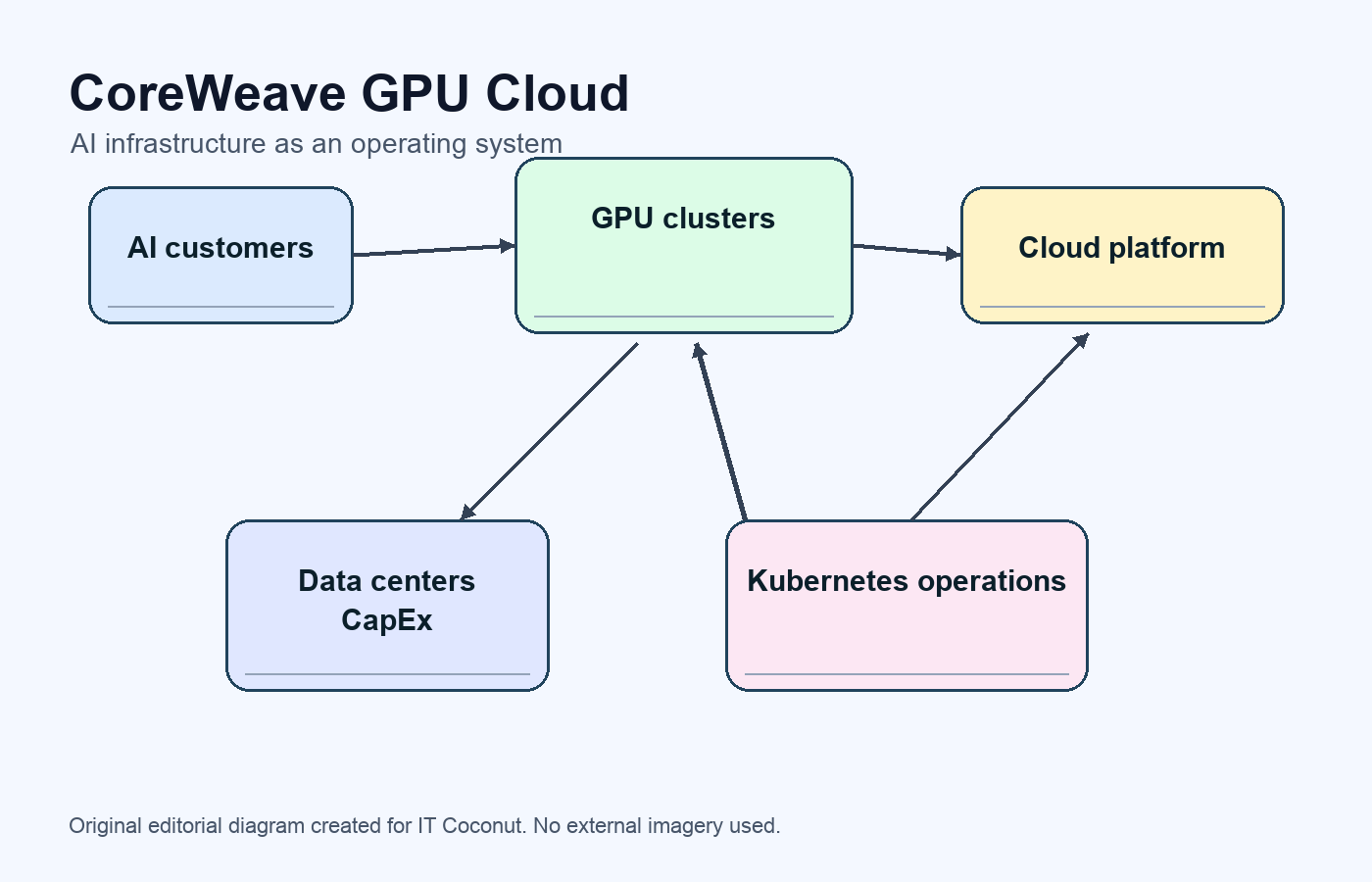
What CoreWeave actually sells
CoreWeave sells high-performance cloud infrastructure for AI and other compute-heavy workloads. Its customers include AI-native companies, enterprise teams, research organizations, and software providers that need to train or serve models at scale. The product is not a generic virtual machine bundle. It is a managed environment where GPU clusters, storage, networking, monitoring, and capacity planning are packaged as a service.
That distinction matters. In AI infrastructure, a contract is often tied to scarce hardware, data center power, cooling, and long-term capacity commitments. CoreWeave's economics depend less on casual server usage and more on whether expensive GPU capacity can be deployed, kept busy, and renewed by large customers.
The company's filings describe the CoreWeave Cloud Platform as integrated software for provisioning cloud AI infrastructure, orchestrating AI workloads, and monitoring hardware fleets in purpose-built data centers. That language points to the heart of the business: GPUs alone are not enough. Customers also need the infrastructure to behave like a reliable product.
The same theme appears in NVIDIA Blackwell and other accelerator cycles. Faster chips only turn into business value when networking, scheduling, storage, and operations keep up.
The technical layer: GPUs, Kubernetes, and operations
CoreWeave's technical position is best understood as a stack. At the bottom are data centers, power, cooling, racks, GPU servers, DPUs, and high-speed networks. Above that sit GPU instances, storage, and networking abstractions. Above those is the software layer for provisioning, orchestration, monitoring, and recovery. Customer training pipelines and inference services run at the top.
CoreWeave Kubernetes Service, or CKS, is a key part of that stack. The IPO prospectus describes it as a fully managed cloud container management and orchestration service with automation designed for AI workloads. Kubernetes is the standard platform for deploying and scaling containers, but AI clusters add specialized requirements: GPU scheduling, distributed training reliability, checkpoint handling, and inference scaling.
The hard part is not only buying enough GPUs. It is making thousands of accelerators available in the right topology, with low failure rates and predictable performance. A small networking or storage issue can delay a long training run. GPU memory, bandwidth, checkpoint storage, image distribution, and cluster observability all affect cost and customer trust.
CoreWeave's advantage is focus. A general cloud provider must support a broad universe of workloads. CoreWeave narrows the surface area around AI and high-performance computing, which can make capacity deployment and customer support more specialized. The trade-off is concentration risk: if AI infrastructure demand slows or a major customer reduces spending, the impact can be sharp.
Financial profile and leadership signals
CoreWeave's founders and executives matter because this is a capital allocation business as much as a software platform. The IPO prospectus identifies Michael Intrator as co-founder, CEO, president, and board chair; Brian Venturo as co-founder and chief strategy officer; and Brannin McBee as co-founder and chief development officer. Their decisions shape how aggressively the company expands data center capacity, signs long-term supply commitments, and balances growth against financing risk.
The numbers show the same tension.
| Metric | 2024 | 2025 | Q1 2026 | Read-through |
|---|---|---|---|---|
| Revenue | about $1.92B | about $5.13B | about $2.08B | rapid growth from AI infrastructure demand and large contracts |
| Net loss | about $863M loss | about $1.17B loss | about $740M loss | depreciation, interest, and expansion costs remain heavy |
| R&D | about $56M | about $352M | about $104M | software and operations investment is rising |
| Property and equipment, net | about $11.92B | about $30.56B | about $36.42B | data center and GPU assets dominate the balance sheet |
| Cash used for property and equipment | about $8.70B | about $10.31B | about $7.70B | growth depends heavily on CapEx execution |
The most important line is not revenue; it is AI data center CapEx. CoreWeave can look like a software company from the outside, but its balance sheet behaves like infrastructure. Capacity must often be financed before the revenue arrives. That can be attractive when demand is strong and utilization is high, but risky when hardware generations shift, financing costs rise, or customers change plans.
Why CoreWeave matters, and what to watch
CoreWeave matters because it shows where the AI market is maturing. After the first wave of model building comes a second question: who can run those models reliably, at scale, and at a cost customers can plan around? Specialized GPU clouds answer that question directly.
The upside is clear. More companies need AI training, inference, rendering, simulation, and data processing capacity without building their own data centers. CoreWeave can turn cluster operations, Kubernetes, observability, and capacity commitments into a differentiated product. That position also connects naturally to programmable compute trends, where infrastructure becomes more specialized for the workload it serves.
The risks are just as clear. Customer concentration, debt, GPU supply, data center power, depreciation, and hyperscaler competition can all pressure the model. Older GPU fleets may also lose economic value quickly when a new accelerator generation arrives.
The balanced view is that CoreWeave is one of the clearest examples of AI infrastructure becoming its own market category. Its growth is impressive, but the quality of that growth depends on utilization, contract durability, operating reliability, and balance-sheet discipline.




No comments:
Post a Comment