OpenAI’s GPT-5.2-Codex, introduced in late 2025, is more than another “better at code” model. OpenAI describes it as an agentic coding model optimized for professional software engineering and defensive cybersecurity. In parallel, Codex reached general availability and became a connected product across the editor, terminal, cloud, and Slack under a single ChatGPT account.
The important shift is the unit of work. Earlier AI coding tools mostly suggested completions or short snippets. GPT-5.2-Codex and the Codex SDK focus on reading an issue, understanding a repository, running tests, and handing back a change as a reviewable pull request. AI coding is moving from personal productivity into team change management.
Background
In its Codex general availability announcement, OpenAI said the Codex cloud agent had evolved since its May 2025 research preview into a coding collaborator connected across editor, terminal, and cloud. The same post said GPT-5-Codex served more than 40 trillion tokens in the first three weeks after launch, and that almost all OpenAI engineers now use Codex internally. Those numbers are not just promotional signals. They suggest development teams are attaching AI to the real flow of software changes rather than treating it as a separate answer box.
GitHub shows the same pressure from another angle. GitHub announced that Copilot coding agent now starts work 50% faster, and described a workflow where developers assign issues, use an Agents tab, or mention the agent in a pull request comment. The agent works in a cloud-based development environment, makes changes, runs tests, and pushes. The market is therefore competing less on a single model name and more on the interface for delegating work. GPT-5.2-Codex sits in that race by combining model, CLI, SDK, and cloud execution.
| Dimension | Earlier AI coding | GPT-5.2-Codex-style workflow |
|---|---|---|
| Input | Short prompt or code fragment | Issue, repository, conversation context |
| Execution | Generates an answer | Edits files, runs commands, tests changes |
| Output | Code snippet | Pull request, logs, reproducible change |
| Management focus | Prompt quality | Permissions, sandboxing, review, audit trail |
Principle
The Codex SDK is not merely an API for calling a model. Its more interesting role is letting teams embed the agent loop inside their own tools. If a user says, “Look at this payment failure log and narrow down the cause,” the agent can inspect repository structure, find related tests, propose a patch, and run validation commands in the terminal. If the result is poor, it can iterate inside the same loop. Codex Slack integration brings the same workflow into a team conversation: mention @Codex in a thread, let it gather context, choose the right environment, and return a link to the completed task in Codex cloud.
The model does not have to own every decision. The practical value is that repeatable development procedures can be broken into smaller, executable steps. The adoption question is not only “How smart is it?” but “Which changes can it make, and where does a human approve?”
Consider a small backend team debugging intermittent 500 errors. A developer can provide logs, recent pull requests, and reproduction notes. The agent can add a failing test, inspect suspicious files, propose a fix, and open a pull request. Deployment approval, customer-data access, and vulnerability disclosure should still remain under explicit team policy.
Structure
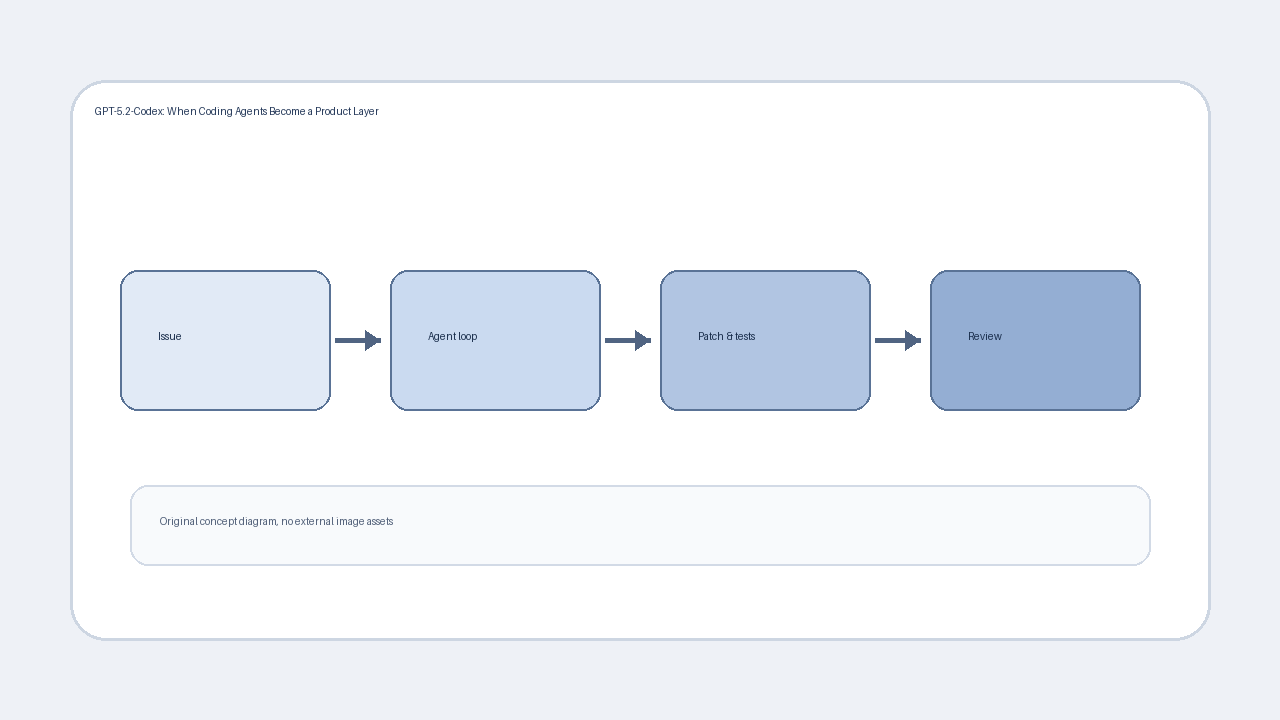
The left side of the diagram is the input: an issue, log, or Slack conversation. The agent loop in the middle repeatedly reads repository context, edits files, runs commands, and interprets results. The review stage on the right is where humans check intent and test evidence. The point is not that the model removes engineers; it converts repeatable work into reviewable artifacts.
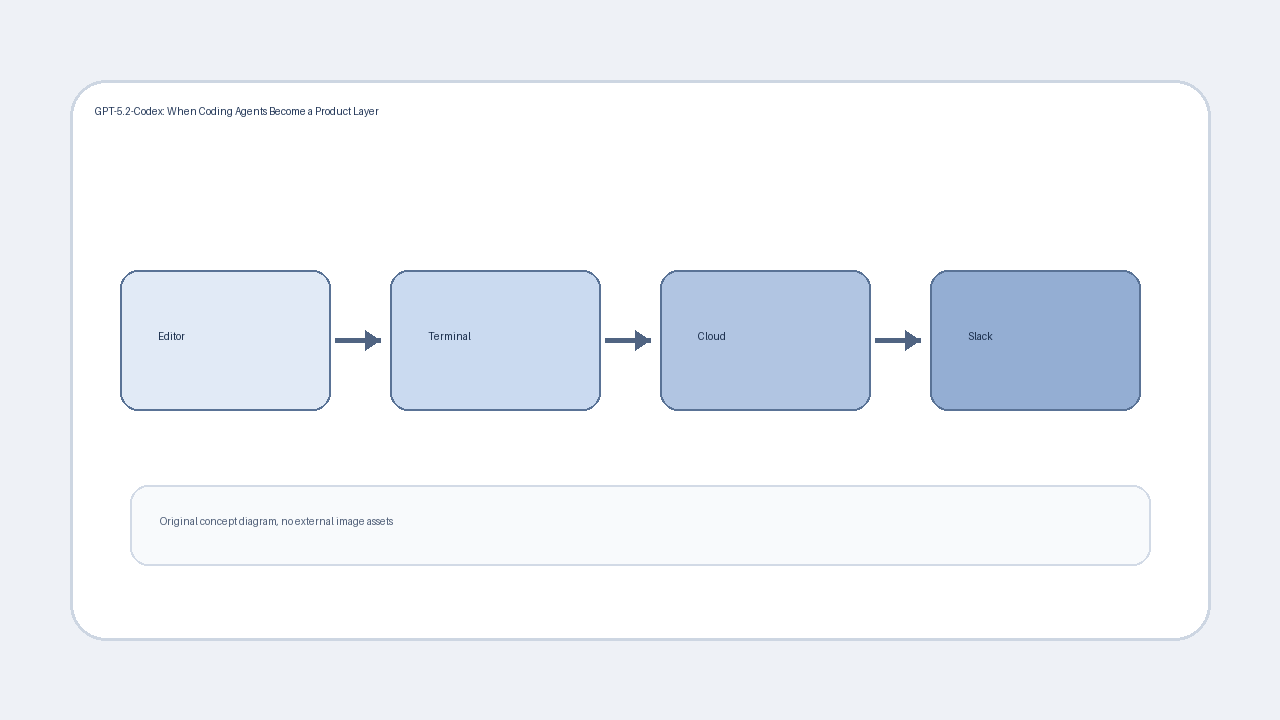
The second diagram shows that GPT-5.2-Codex is not confined to one interface. The editor fits immediate changes, the terminal fits local commands, the cloud fits long-running delegated work, and Slack fits team requests and follow-up. As those surfaces connect, AI developer productivity depends less on raw typing speed and more on how work is routed.
Checkpoints
Security boundaries come first. As an agentic coding model gains access to terminals and repositories, it can get close to secrets, customer data, and deployment permissions. Without per-task sandboxing, least privilege, and logs, the productivity gain can turn into operational risk.
Benchmarks and real repositories are not the same thing. Even if GPT-5.2-Codex is optimized for complex refactors and long-horizon work, weak tests can let a plausible but wrong patch pass. Teams with fragile review and testing practices should strengthen those systems before expanding automation.
Cost should be measured by iteration, not just token price. Long context, repeated command execution, failed attempts, and review cycles all consume time and money. A safer rollout starts with small bugs in low-permission repositories, then expands toward larger refactors and security tasks.
GPT-5.2-Codex matters because it makes delegated software work feel like a product layer. The best starting point is a clear issue, a small pull request, a strong test suite, and a human review gate. Broader automation should follow only after those basics are measurable.



No comments:
Post a Comment