Gemini Interactions API becoming generally available signals a design change in AI applications. Instead of treating each request as a stateless call with a long prompt attached, developers can model the work as an interaction with server-side state. That matters for assistants, multimodal applications, and long-running workflows where each step depends on what happened before.
The older generate-content pattern put much of the burden on the client. The application had to rebuild conversation history, attach tool outputs, manage files, and decide how much context to resend. A stateful interaction contract moves more of that lifecycle into the platform.
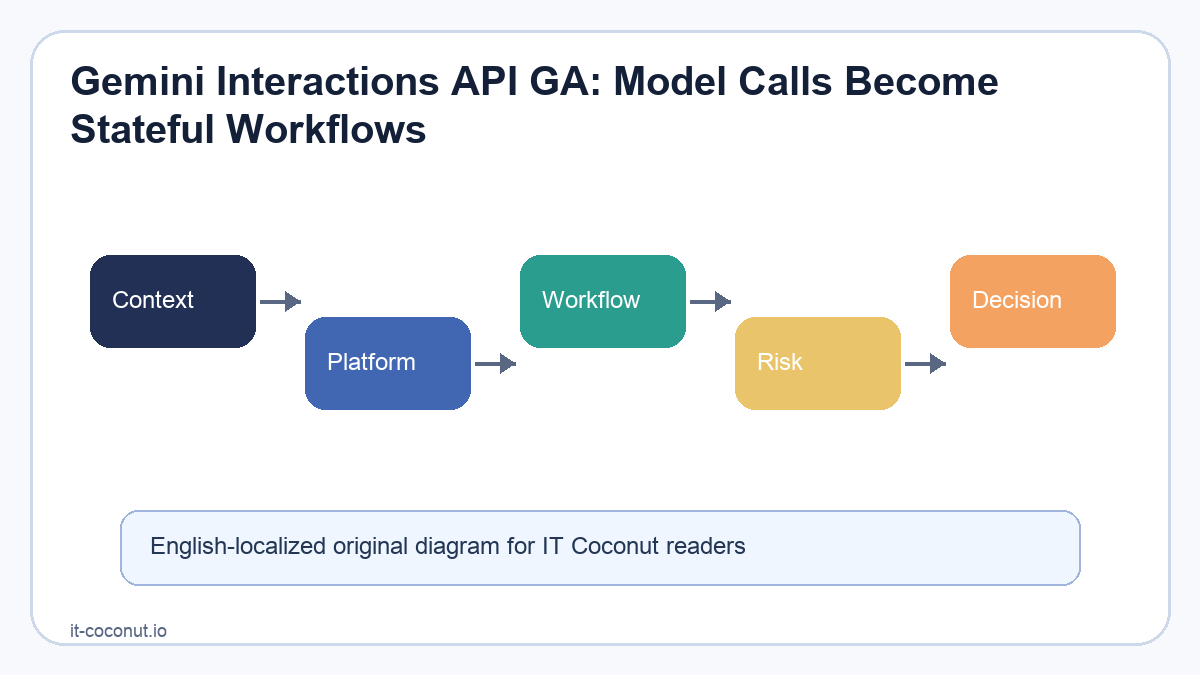
Why state belongs in the API design
Key details at a glance
| Reader question | Practical takeaway |
|---|---|
| What this article explains | Gemini Interactions API GA: Model Calls Become Stateful Workflows |
| Core SEO focus | Gemini Interactions API, server-side state AI, background execution |
| How to read it | Separate the durable signal from vendor messaging, short-term hype, and implementation friction. |
| Real AI workflows are multi-step. A model may read a file, call a tool, receive a result, ask for approval, and then continue. If the client must reconstruct everything each time, the application becomes fragile and cost can become harder to predict. Server-side state creates a clearer object to reason about: the interaction itself. |
Background execution extends the same idea. Some jobs should return a handle first and a result later. That is a better fit for code review, analysis, media processing, or document workflows than forcing every step into one synchronous response.
What developers should watch
Stateful APIs are powerful, but they also create product obligations. Teams need policies for retention, privacy, deletion, access control, and audit logs. They also need to understand which models and storage options are supported. A GA label does not remove the need for architecture review.
The broader point is shared with practical AI developer workflows: robust AI products are built around state, tools, permissions, and evaluation, not just a more capable model response.
For readers comparing search terms, this article is also relevant to Gemini API workflows.
Primary sources
Related reading
For broader context, read AI coding agents.
A second useful reference is Claude 4 agentic coding.
Readers following the infrastructure side may also want OpenAI Codex cloud agent.




No comments:
Post a Comment