gpt-realtime voice agents: API changes that make production voice apps more practical is less about another feature name and more about a shift in operating patterns. The most important signal in the recent material is that models and services are moving from one-off generation into real workstreams. Readers should ask what bottleneck this reduces and what new responsibility it creates before focusing on the branding.
For adjacent context, see our notes on agentic AI and Runway Gen-4.
Background
The official material around gpt-realtime points toward deployable workflows rather than quick demos. The primary announcement explains the product direction and scope, while this supporting reference adds details that developers and operators need to check before adoption. Cost, permissions, latency, and data-handling boundaries have to be considered during product design, not after launch.
| Watch point | Why it matters |
|---|---|
| Input | Work can start from text, voice, video, web requests, or engineering artifacts. |
| Processing | Models, runtime layers, and policy controls increasingly move as one system. |
| Outcome | The result can be customer support, generated media, software changes, or chip-design efficiency. |
How it works
In plain terms, gpt-realtime takes a user request, attaches the context needed to act, lets a model or specialized runtime make intermediate decisions, and returns an output that a person or system can review. In customer support, that might mean listening to a question, checking an order record, and drafting an answer for approval. In software development, a large issue can be split into parallel work on implementation, testing, and documentation. In semiconductor manufacturing, the same idea appears physically: rearranging wiring and power delivery so a chip can run more efficiently within tight area and thermal limits.
The key issue is not automation by itself. The product quality comes from control points: where a human approves, what data can leave the system, and where the workflow returns when it fails.
Structure

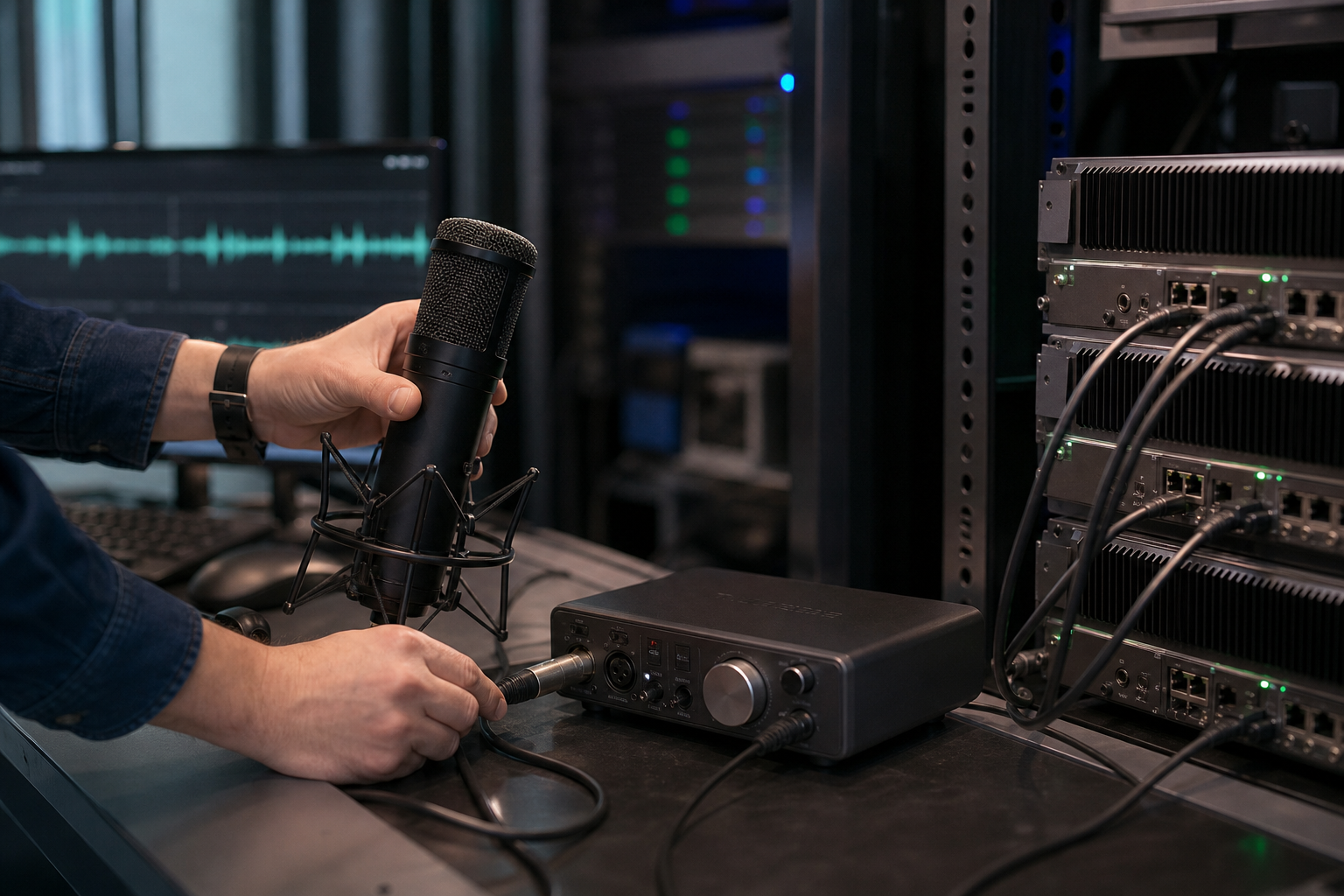
The first image shows the operating environment of a real-time voice service, while the second shows microphones, audio interfaces, and edge servers connected in a technical lab. A production design must combine this hardware path with cost tracking, permission scope, log retention, and recovery after failure.
Checkpoints
- When adopting gpt-realtime, measure usage cost and latency first. Real-time processing and long-running agent tasks can behave very differently at production scale than in a small demo.
- Realtime API becomes more convenient as it gains broader data access, but broader access also requires audit logs and a way to revoke actions.
- Claims around voice agents should be read with their conditions attached. Model choice, hardware, input length, and network location can change the outcome.
- In an early market, standards and vendor features move quickly. Keeping replaceable boundaries is usually safer than binding the whole workflow to one provider-specific feature.
The practical value of gpt-realtime is workflow connectivity, not simply smarter output. For now, teams that design small tests around permissions, cost, and validation will learn more than teams that chase the flashiest demo.
In practical discussions, useful terms include gpt-realtime, Realtime API, voice agents, SIP calling, MCP servers




No comments:
Post a Comment