Enterprise security grew for years by purchasing a different product for each problem: firewalls, endpoints, cloud configuration, and security operations. Attackers do not respect those product boundaries. They can enter SaaS with a stolen account, move to a cloud workload, and extract data through legitimate administration tools. Generative AI and autonomous agents add more blind spots by connecting models, data, plugins, and APIs. More products do not necessarily produce stronger defense; fragmented policy and telemetry can create the opposite result.
This Palo Alto Networks review asks whether a company built on the next-generation firewall can unite network, cloud, security operations, AI, and identity into one operating system. Strata, Prisma Cloud, Cortex, and Prisma AIRS provide credible technical foundations. Recent expansion through CyberArk and Chronosphere greatly broadens the scope, but acquisition-driven growth must be separated from organic growth, and the real cost of integrating a complex portfolio must remain part of the assessment.
This is not investment advice. It evaluates technology, the business model, leadership, financial performance, and risk using official product documents, earnings releases, and SEC filings. Fiscal years and dollar figures follow company reporting, and non-GAAP measures are considered separately from GAAP results.
From a firewall company to three security platforms
Palo Alto Networks began in 2005 when Nir Zuk founded a company around an application-aware next-generation firewall. Instead of relying only on port numbers, its differentiated policy recognized the actual application, user, and content. Strata now combines hardware and software firewalls, cloud-delivered security services, and SASE to cover branches, remote users, data centers, and internet traffic. Whereas the Cloudflare connectivity cloud provides connectivity and application services across a global network, Strata has expanded around the depth of enterprise security policy and threat prevention.
The second pillar, Prisma Cloud, occupies the CNAPP category from code entering a repository through cloud configuration, workloads, containers, APIs, and runtime. Connecting development-time vulnerabilities to production exposure paths lets teams prioritize exploitable issues rather than count every finding equally. The difficulty is overlap: native cloud controls, independent CNAPP vendors such as Wiz, and numerous developer scanners address parts of the same problem. A single console does not automatically create one coherent operating experience.
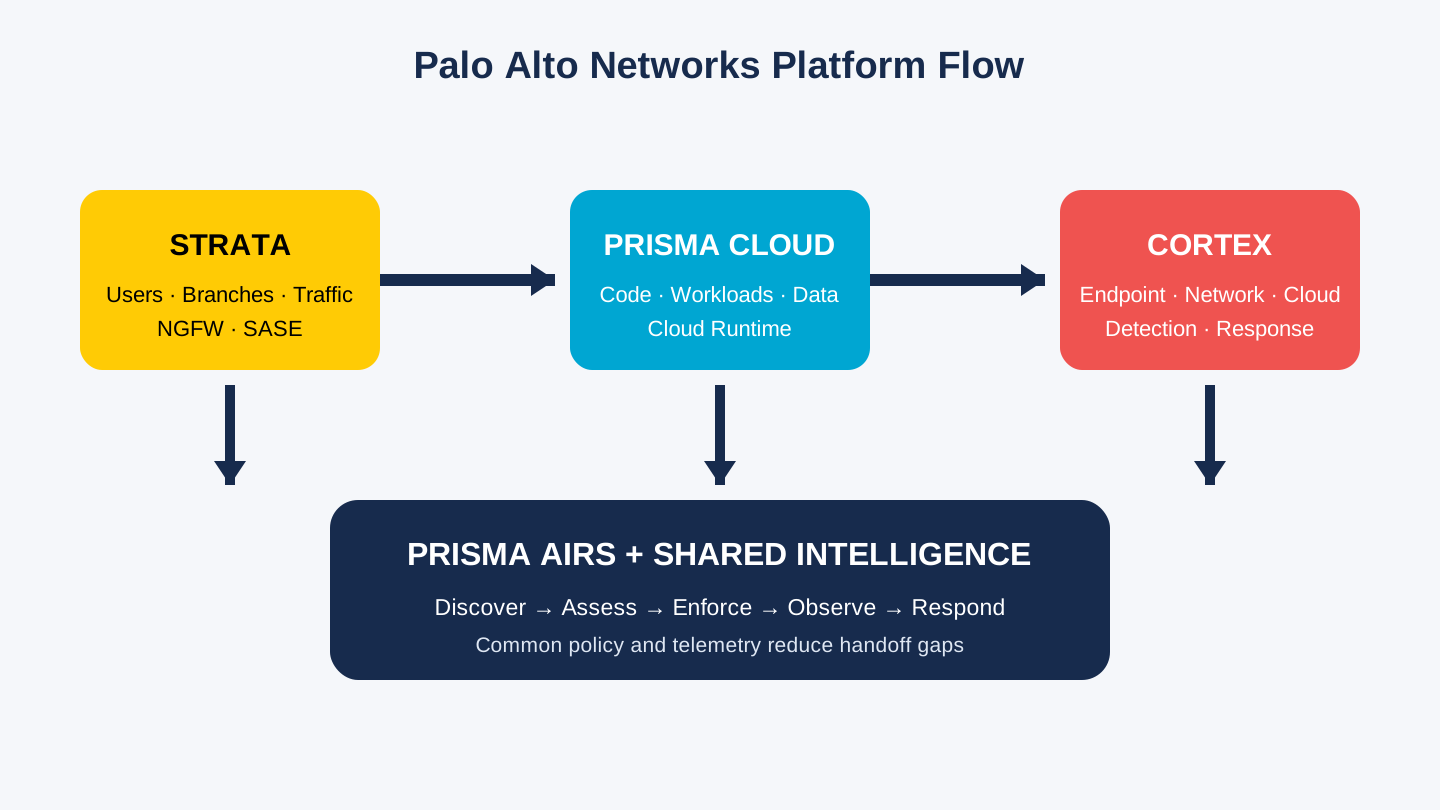
The third pillar, Cortex, aggregates endpoint, network, and cloud alerts and automates analysis and response. XDR links many signals into incidents. Cortex XSIAM aims to extend beyond SIEM log search by combining detection, investigation, automation, and attack-surface management. Palo Alto Networks' official Cortex security operations overview describes connected data from code and cloud through the SOC. That puts Cortex directly against the CrowdStrike Falcon platform. The contest turns less on feature lists than on data quality, detection precision, investigation time, and the cost of replacing existing tools.
| Platform | Protection scope | Value of sharing | Execution risk |
|---|---|---|---|
| Strata | Users, branches, data centers, internet traffic | Unified application, threat, and user policy | Firewall and SASE migration burden |
| Prisma Cloud | Code, cloud configuration, workloads, APIs | Links developer risk to runtime exposure | Duplicate developer tooling and alerts |
| Cortex | Endpoints, logs, incidents, response | Signal correlation and automated investigation | SIEM/EDR migration and data cost |
| Prisma AIRS | Models, data, prompts, agents | Lifecycle policy and runtime enforcement for AI | Fast-changing standards and false positives |
The economic argument for security platformization is not merely a smaller product count. Reusing the same assets, identities, threat intelligence, and policy can turn a discovery in one layer into a response in another. If licensing is bundled while data models and operating screens remain separate, however, customers receive lock-in and migration cost instead of integration. Platformization should therefore be tested with operating measures such as duplicate-alert rates, mean investigation time, and policy-deployment time, not the contract structure.
Prisma AIRS and the security boundary for agentic AI
An AI application is not one model. It is a compound system connecting user input, retrieval data, vector stores, models, tools, and external APIs. Prompt injection can enter through input, a poisoned model file can reach deployment, or an agent can invoke permitted tools in a harmful sequence. A traditional firewall may see the HTTP session but cannot automatically understand prompt meaning, model provenance, and an agent's delegated authority.
The official Prisma AIRS overview presents AI Model Security, AI Red Teaming, AI Runtime Firewall, and API Intercept as one lifecycle. The development stage scans models and supply chains; predeployment testing exercises multistep attacks; runtime controls inspect prompts, responses, data flows, and agent behavior. Product documentation in 2026 includes agent discovery, multi-turn attack testing, privilege-misuse detection, runtime rate limiting, and unique transaction IDs. The important shift is from treating AI security as a vague harmful-text filter to treating it as asset discovery, authorization, observation, and enforcement.
The operating flow can be understood in five stages:
- Discover models, datasets, applications, and agents across cloud accounts and development pipelines.
- Scan model formats, supply-chain inputs, configuration, and known vulnerabilities before deployment.
- Test prompt injection, tool misuse, and multi-agent interactions through red teaming.
- Inspect prompts, responses, and tool calls at runtime, then enforce policy appropriate to purpose, user, and session.
- Send enforcement reasons and transaction IDs into Cortex and logging systems for investigation and policy improvement.
The design has limits. Semantic inspection introduces latency and cost, while false positives that block legitimate work encourage users to bypass the protected route. Encrypted data, regional privacy rules, and contracts with model providers can prevent an organization from sending every context item to one vendor. Agent identity and delegation also have to connect with an authorization layer such as Okta Identity Security. Inspecting AI traffic does not make Palo Alto Networks responsible for business approvals or model quality.
Reading expansion through people, acquisitions, and numbers
Founder Nir Zuk had been a firewall engineer at Check Point and NetScreen, and he started Palo Alto Networks from the technical problem of application-centric policy. Nikesh Arora, who became CEO in 2018 after business and investment roles at Google and SoftBank, has led the expansion from a product company to a subscription platform portfolio. The founder's product invention and the current leadership's acquisition strategy offer different strengths, but rapid expansion continually tests organizational and technical integration.
According to the official third-quarter FY2026 results, revenue for the quarter ended April 30, 2026 was $3.002 billion, up 31%. CyberArk and Chronosphere contributed $388 million. Next-Generation Security ARR rose 60% to $8.1 billion, including $1.6 billion from those two acquisitions, and RPO rose 36% to $18.4 billion. Those contributions explain why the headline percentages cannot be treated as the growth rate of the pre-acquisition business.
| Metric | Official Q3 FY2026 figure | Interpretation caveat |
|---|---|---|
| Quarterly revenue | $3.002 billion | Up 31%, including acquired revenue |
| Subscription and support revenue | $2.408 billion | Recurring revenue outweighs product revenue |
| NGS ARR | $8.1 billion | Up 60%, including $1.6 billion from acquisitions |
| RPO | $18.4 billion | Contract visibility, not current revenue |
| GAAP operating loss | $183 million | Versus $219 million operating income a year earlier |
| Operating cash flow | $871 million | Distinct from adjusted free cash flow |
GAAP operating loss was $183 million and GAAP net loss was $177 million in the same quarter. Non-GAAP operating income was $814 million, while adjusted free cash flow was $910 million. The Form 10-Q shows that stock compensation, acquired-intangible amortization, acquisition costs, and convertible-note valuation create a large gap between GAAP and adjusted measures. Cash generation is strong, but recurring adjustments should not all be dismissed as one-time costs.
CyberArk adds privileged access and machine identity; Chronosphere adds cloud-native observability. The strategic picture of joining identity and telemetry to network, cloud, and SOC controls is persuasive. Execution requires integrating different agents, data stores, pricing units, and partner ecosystems. If cross-selling feels compulsory, customers who prefer neutral integrations may resist the bundle.
The conditions for platformization and the final assessment
The largest opportunity is integrated operation for enterprises short of security people and engineering capacity. If Strata finds a risky session, Prisma Cloud identifies the exposed workload path, Cortex investigates the incident, and Prisma AIRS blocks a related agent action, the platform becomes more than the sum of its parts. Unit 42 threat intelligence can also return quickly into detection rules and response playbooks.
Four risks remain. First, Microsoft, Cisco, Fortinet, CrowdStrike, and cloud providers compete with their own bundles and data advantages. Second, accounting, technology, and cultural integration after large acquisitions can take longer than planned. Third, concentrating policy and telemetry in one vendor expands the blast radius of outages, price changes, and security incidents. Fourth, AI threats and standards change so quickly that today's feature advantage may not last. The Form 10-Q likewise identifies competition, product vulnerabilities, acquisition integration, long sales cycles, international regulation, and service disruption as material risks.
Define independent success criteria before signing a platform agreement. During a 90-day period, measure duplicate alerts, mean detection/investigation/recovery time, policy exceptions, data-retention cost, and the recovery path for vendor outages. A lower tool count alone can hide a loss of visibility.
The final assessment is positive, with integration still to prove. Palo Alto Networks is one of the few vendors able to connect a network-security installed base, Prisma Cloud's development and runtime context, Cortex incident data, and Prisma AIRS lifecycle controls. Q3 FY2026 contract metrics and cash flow support that expansion. Yet acquisitions account for a substantial portion of headline growth, and the gap between GAAP losses and adjusted profit remains large.
The buying question is not which vendor has the longest feature list. Customers should verify whether separate security teams truly share the same assets and policy, whether automation remains explainable to analysts, and whether individual products can still be selected or replaced. When all three conditions hold, security platformization becomes an operating system that reduces complexity. When they do not, a very large product bundle becomes another source of complexity.



No comments:
Post a Comment