Calling Apple an iPhone manufacturer identifies its largest source of revenue, but it does not fully explain how the company competes. Apple combines chips, operating systems, devices, app distribution, payments, subscription services, and physical stores into one experience. From the moment a customer activates a new device, identity, photos, messages, health data, and purchases begin to connect, while developers reach that customer through a shared toolchain and distribution network. The integration creates convenience and security, but it also raises switching costs and platform power.
This Apple company review focuses on the economics of Apple vertical integration rather than a product-specification contest. It examines how the hardware-software model established by Steve Jobs is being extended under CEO John Ternus through Apple silicon, Services, and the Apple Intelligence strategy. It also asks whether formidable cash generation can absorb AI execution delays, regulation, and China supply-chain risk. Financial analysis uses Apple's official fiscal second quarter ended March 28, 2026.
Apple's trademark guidelines expressly prohibit an unlicensed third-party publication from using the Apple logo or Apple-owned graphic icons. This independent review therefore does not reproduce the logo and is not authorized, sponsored, or approved by Apple.
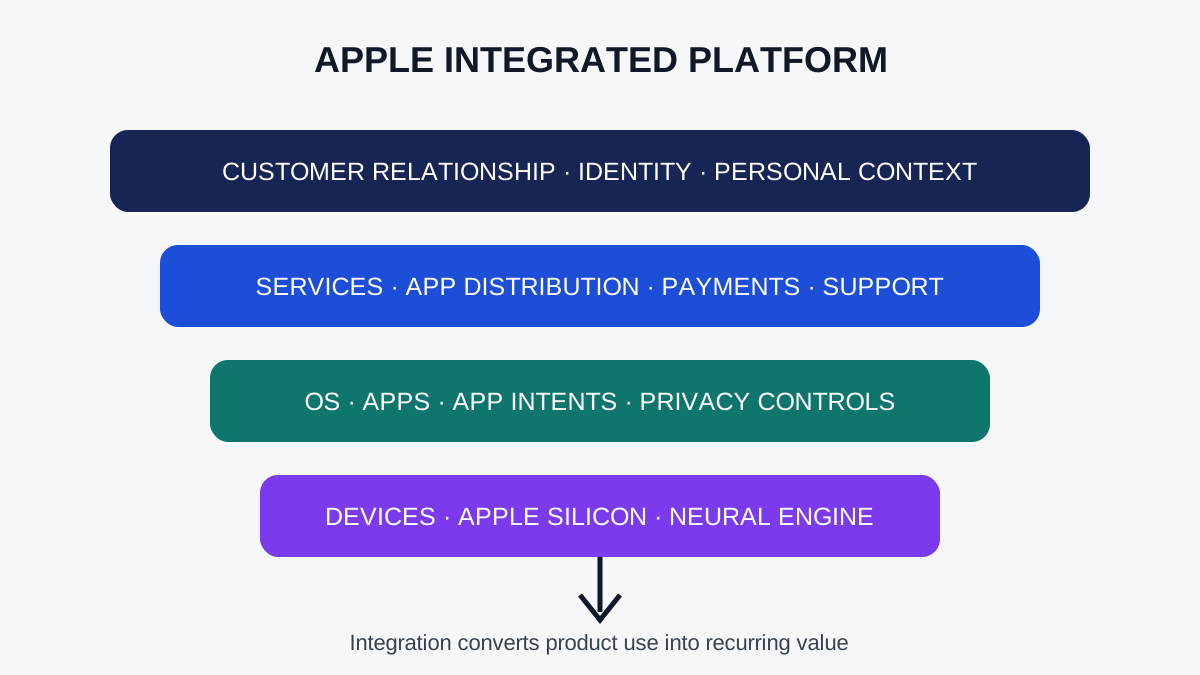
Apple vertical integration turns device sales into customer relationships
Apple began in personal computers, but the key economic unit today is not one device. It is the relationship between a user and a set of devices. The iPhone is the center for cameras, communications, and authentication. Macs and iPads expand the work surface, while the Watch and AirPods add health, notification, and voice touchpoints. iCloud synchronizes data, the App Store supplies software, and AppleCare, Music, TV, and payment services add recurring revenue. Satisfaction with one product increases the probability of choosing the next.
Apple silicon is the technical foundation of this integration. Co-designing CPUs, GPUs, the Neural Engine, media engines, and memory around operating-system requirements allows Apple to tune battery life, heat, camera processing, and machine-learning features more precisely than a generic collection of components. As our Apple M-series analysis explained, performance per watt is not merely a benchmark advantage. It enables thinner devices, longer battery life, and a common development framework.
| Integrated layer | Representative assets | Customer value | Apple's economics |
|---|---|---|---|
| Silicon | A and M series, Neural Engine | Performance, battery, security | Component differentiation and cost control |
| Operating systems | iOS, macOS, watchOS, visionOS | Continuity and consistent permissions | Feature distribution and switching cost |
| Devices | iPhone, Mac, iPad, Watch, AirPods | More personal-computing touchpoints | Premium hardware revenue |
| Distribution and services | App Store, iCloud, AppleCare, media | Simpler purchasing, backup, subscriptions | Recurring revenue and high gross margin |
| Intelligence | Apple Intelligence, Siri AI, PCC | Personal context with privacy | Upgrades and service retention |
Services cushions hardware cycles. As the installed base expands, storage, warranties, app commissions, search placement, and media subscriptions generate revenue even when new iPhone sales slow. Yet access to those services remains coupled to Apple devices. A customer facing the transfer of several devices and years of data may reject a cheaper competing product because migration is expensive. A convenient ecosystem and lock-in are two sides of the same design.
The Apple Intelligence strategy tests privacy and model competitiveness together
Apple's 2026 Siri AI announcement describes three broad layers. Smaller tasks use Foundation Models, the Spotlight index, and App Toolbox on the device. Requests needing larger models go to Private Cloud Compute. When a task needs current information or broad knowledge, a system orchestrator selects the relevant capability. For an assistant working across personal messages, email, and photos, data minimization and execution permissions matter as much as a model score.
Apple Machine Learning Research says the third generation of Apple Foundation Models contains two on-device models and server models for Private Cloud Compute. AFM 3 Core is a dense model of roughly three billion parameters, while Core Advanced adds stronger multimodal capabilities. Apple's disclosure that it built the model family in collaboration with Google is pragmatic. Apple does not need to monopolize every piece of foundation research if it can differentiate through devices, operating systems, personal context, and a secure execution layer.
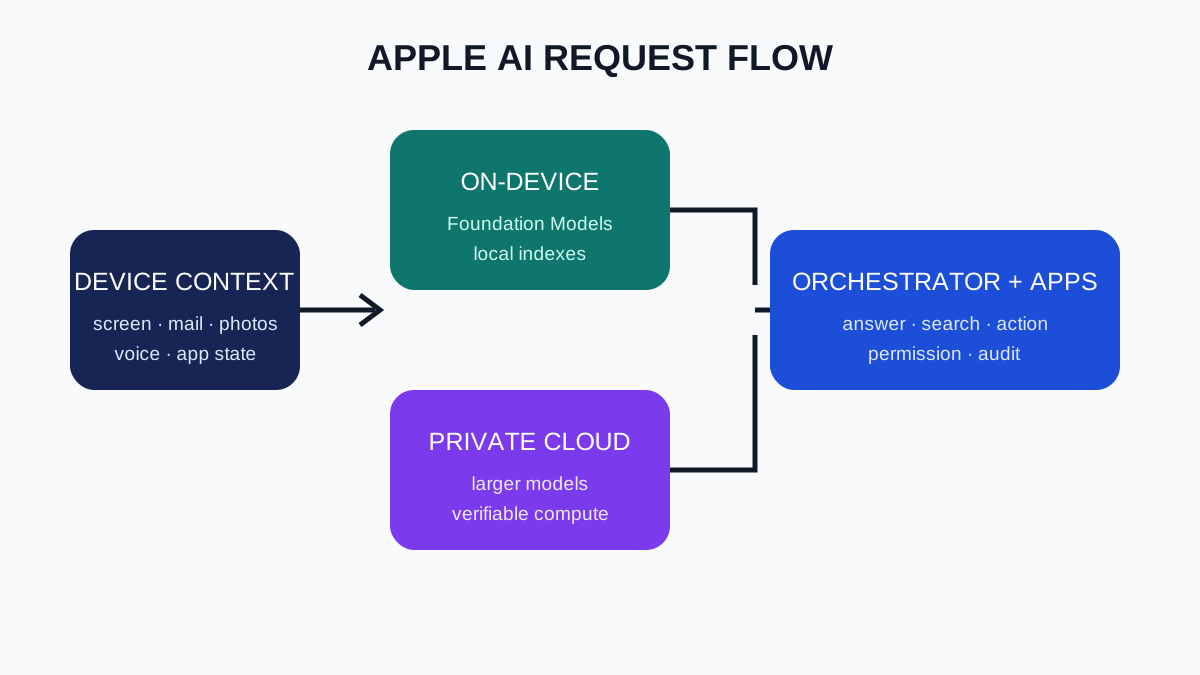
The design has three advantages. First, handling frequent tasks on a device can reduce latency and server cost. Second, Apple-controlled hardware security and verifiable server images provide a stronger privacy case for sensitive personal context. Third, if App Intents and system frameworks mature, developers can expose useful actions without rebuilding an entire application around a new AI interface.
Execution risk is equally substantial. An AI assistant must work outside demos across languages, old data, ambiguous contacts, and incorrect screen states. Apple already paid a credibility cost for delayed Siri capabilities, and the 2026 architecture still must pass developer testing and beta use. On-device models face memory and power constraints; server models increase data-center investment and reliance on outside model expertise. A stronger privacy promise also raises the standard for error explanations, auditability, and security verification.
The economics differ from the Google AI platform and the Microsoft AI platform. Google and Microsoft directly sell model consumption through cloud APIs and enterprise software. Apple has more indirect economics: intelligence should improve device replacement demand, satisfaction, app use, and service retention. Supported-device reach, task-completion rates, developer adoption, and customer retention therefore matter more than a model leaderboard alone.
Q2 FY2026 shows both a powerful cash engine and concentration risk
In Apple's official Q2 FY2026 release, revenue reached $111.2 billion, up 17% year over year, while diluted earnings per share rose 22% to $2.01. Apple said total revenue, iPhone revenue, and EPS set March-quarter records, while Services reached an all-time revenue high. Those results support management's argument that the hardware installed base and recurring services can grow together.
| Official Q2 FY2026 metric | Result | What it means |
|---|---|---|
| Revenue | $111.2 billion | 17% year-over-year growth |
| Diluted EPS | $2.01 | 22% year-over-year growth |
| First-half operating cash flow | $95.3 billion | Large capacity for investment and returns |
| First-half share repurchases | $48.6 billion | Capital returns and a lower share count |
| Cash and equivalents at March 2026 | $45.6 billion | Capacity to absorb supply and regulatory shocks |
The official consolidated statements show roughly $95.3 billion of operating cash flow during the first half of fiscal 2026 and about $5.2 billion of property, plant, and equipment purchases. Apple spent approximately $48.6 billion on share repurchases during the same period. Apple generates extraordinary cash with less owned physical infrastructure than a hyperscale cloud provider because manufacturing is largely delegated to supply-chain partners while design, software, brand, and distribution capture the value.
That asset-light structure does not eliminate operational risk. Advanced fabrication depends heavily on TSMC, while memory, displays, and assembly rely on a limited group of suppliers and Asian production networks. Forecast errors, tariffs, export controls, or geopolitical disruption can affect component availability, price, and launch timing simultaneously. Custom-chip design does not become a product without manufacturing partners executing the process roadmap.
Revenue concentration also matters. Services is growing, but the iPhone remains the main gateway into the ecosystem and its cash flow. Longer smartphone replacement cycles, stronger Chinese premium brands, or AI capabilities that fail to motivate upgrades could slow hardware and services together. The installed base is a moat; it does not completely isolate the company if the central entry point weakens.
Final assessment across regulation, supply chains, and AI execution
Platform regulation is the first risk. App Store commissions and payment rules, default applications, browser engines, and data access face competition-policy scrutiny in the United States, Europe, and elsewhere. Wider outside payments and alternative distribution may reduce commissions while making security accountability more complicated. Excessively closed controls can also limit developer innovation and consumer choice. Apple must show that security benefits correspond to concrete threat models and proportionate rules.
Leadership transition is the second risk. Tim Cook made Apple one of the world's strongest cash generators through supply-chain execution and Services expansion before moving to executive chairman in 2026. CEO John Ternus must preserve that efficiency while redesigning interfaces, form factors, and developer relationships for the AI era. Maintaining an existing operating system and discovering the next computing touchpoint require different skills.
Capturing generative-AI value is the third risk. If models become commodities, Apple can select among providers and integrate them into device experiences. If an AI assistant becomes a more important user gateway than the operating system, outside model companies may own the relationship. Apple's defense is not exclusive ownership of one model. It is the ability to use personal context safely, complete actions in apps, and work consistently across devices.
Apple is not simply a company that assembles components. It is a platform that controls layers from silicon to services in order to design customer experience and economics together. Q2 FY2026 revenue of $111.2 billion and a Services record show that the structure remains powerful. Its durable indicators extend beyond iPhone unit sales: Apple Intelligence task completion, supported devices and languages, the quality of Apple Services growth, sustainable developer rules, resilience in China and the supply chain, and whether the post-transition leadership can add a new product category to the installed base.




No comments:
Post a Comment