Meta began as the Facebook company, but its economic substance today is an advertising platform operating several social graphs and recommendation systems. Facebook, Instagram, Messenger, WhatsApp, and Threads collect different relationships and content, while machine learning selects the posts and advertisements people see. Meta's core product was a massive prediction system before generative AI arrived. The company is now extending that system into conversational Meta AI, creation tools, and glasses.
This Meta company review looks beyond model announcements. It examines how founder and CEO Mark Zuckerberg uses advertising cash flow to fund data centers, Muse Spark, AI glasses, and Reality Labs. It asks whether distribution to more than 3.5 billion daily users can become an AI-platform advantage and weighs that opportunity against immense capital spending, privacy, content safety, and hardware losses. The latest detailed financial baseline is Meta's official first quarter ended March 31, 2026.
The Meta AI platform begins with social distribution and advertising learning
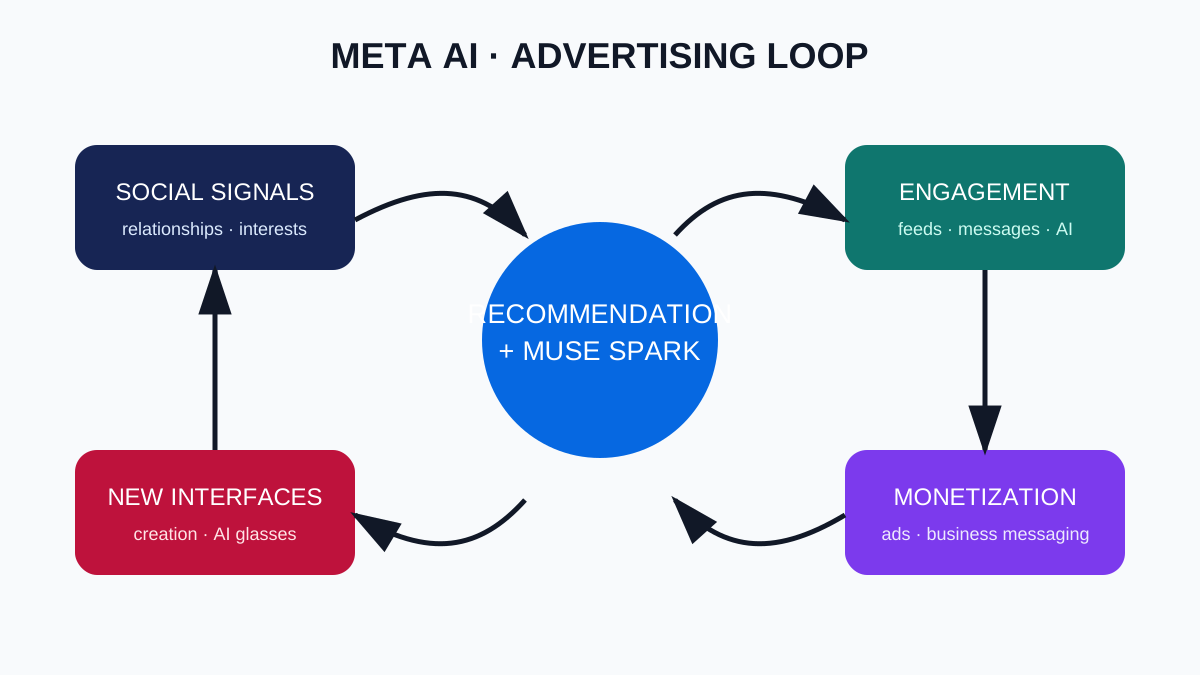
The strongest asset of the Meta advertising business and its AI transition is not the number of apps but its scale of relationship, interest, and behavior signals. Instagram captures creators and interests; Facebook maps friends, groups, and local relationships; WhatsApp and Messenger hold conversations; Threads carries public discussion. Recommendation models use these signals to order feeds and Reels and estimate conversion probability. Better recommendations increase attention and advertising opportunities, while additional reactions improve the models again.
Generative AI adds three functions to this loop. Users can ask, search, and create without leaving an app. Creators can increase supply through text, image, and video tools. Advertisers can automate creative production and targeting. According to the official Muse Spark announcement, the model starts in the Meta AI app and website and extends across WhatsApp, Instagram, Facebook, Messenger, Threads, and AI glasses. The strategy embeds a model inside existing behavior rather than centering on a standalone API.
| Layer | Representative assets | User and customer value | Meta's economics |
|---|---|---|---|
| Relationships and content | Facebook, Instagram, Threads | Discover people, interests, creators | Engagement and proprietary signals |
| Messaging | WhatsApp, Messenger | Personal, group, and business conversation | Business messaging and payment options |
| Intelligence | Recommendation, Muse Spark, Meta AI | Search, conversation, creation, action | Engagement, ad efficiency, new touchpoints |
| Advertising | Advantage+ and measurement | Customer discovery and automation | Core revenue and cash flow |
| Hardware | Meta Glasses, Quest | Hands-free visual and voice access | Next interface with high investment cost |
The structure resembles the Google AI platform, but the data and monetization differ. Google begins with search intent and Cloud consumption; Meta begins with relationship- and interest-driven feeds and ad auctions. Microsoft attaches AI to work documents and development tools, while Meta treats the frequency of daily conversation, creation, and discovery as its advantage. For each company, the moat is less the model itself than its combination with distribution, data, and advertising or subscription economics.
Muse Spark and AI glasses target the interface after the smartphone
Meta has long faced the risk of not controlling mobile operating systems. Apple's privacy-policy changes showed how one outside platform rule can materially affect advertising measurement. Meta's investment in Quest and glasses is not simply a bid for hardware sales. If AI on a wearable device can understand what a user sees and hears through cameras and microphones, Meta may own an interaction point in front of smartphone applications.
The official Meta Glasses announcement says Muse Spark powers Meta AI in the glasses from launch in the United States and Canada, with visual understanding, calendar help, pedestrian navigation, and live translation. Glasses let people ask, capture, and listen without taking out a phone. Response speed, battery life, camera privacy, and social acceptance therefore determine the product together.
The Muse Spark model is the first result from the AI stack rebuilt by Meta Superintelligence Labs. Meta chose a small, fast model for reasoning and multimodal work inside products, with larger successors planned. Serving billions of people across applications and glasses makes inference cost, latency, safety filters, local languages, and recommendation provenance as important as the best benchmark. The more powerful personalization becomes, the more clearly users must understand and control which data was used and why.
Meta's open-model history expanded its developer ecosystem, but the 2026 strategy is more mixed. Muse Spark is available through a private API preview to selected partners, and Meta says it hopes to open-source future models. Openness increases external innovation and standards influence, but competitors can use the technology and safety and licensing obligations remain. Closure preserves product differentiation, but it can weaken the broad developer trust created by Llama.
Q1 2026 shows both advertising power and AI capital intensity
In Meta's official Q1 2026 results, revenue rose 33% year over year to $56.31 billion, operating income reached $22.87 billion, and operating margin was 41%. Net income, including a one-time tax benefit, was $26.77 billion. Ad impressions increased 19%, while average price per ad rose 12%. Usage and monetization improved together.
| Official Q1 2026 metric | Result | Interpretation |
|---|---|---|
| Revenue | $56.31 billion | 33% year-over-year growth |
| Operating income and margin | $22.87 billion and 41% | Strong profitability during AI investment |
| Family daily active people | 3.56 billion | Distribution grew 4% year over year |
| Ad impressions and average price | Up 19% and 12% | Engagement and demand expanded together |
| Quarterly capital expenditures | $19.84 billion | Data-center and server investment accelerated |
| 2026 capital-expenditure outlook | $125–145 billion | AI capacity and component costs reflected |
Family of Apps generated $55.91 billion of revenue and $26.90 billion of operating income. Reality Labs produced only $402 million of revenue and lost $4.03 billion from operations. The advertising apps clearly finance hardware and long-duration research. Even if glasses grow, hardware with components, distribution, and returns is unlikely to achieve the economics of advertising software.
The spending outlook marks a larger change. Meta expects $125 billion to $145 billion of 2026 capital expenditures. Advertising recommendations, generative models, and AI assistants all require accelerators, networking, power, and data centers in advance. Infrastructure becomes a competitive advantage if demand arrives as planned; if model efficiency improves faster than demand or monetization is late, depreciation and power contracts pressure profit. The relationship with the NVIDIA AI factory is similarly double-sided: strategic supplier and central cost structure.
Meta's Q1 net income and EPS include an $8.03 billion one-time tax benefit. Operating performance is better judged through 33% revenue growth and a 41% operating margin; the tax effect should not be treated as recurring earnings.
Final assessment across privacy, content, and investment discipline
Privacy and regulation are the first risk. As a personal AI uses messages, location, visual input, and interests, usefulness and surveillance concerns rise together. Consent, purpose limitation, protection of minors, political advertising, cross-border transfers, and competition law can constrain product design. Compliance is not merely legal overhead. It changes the context a model may access and the accuracy of advertising measurement.
Content quality is the second risk. Generative tools can increase useful creative supply and low-cost spam, scams, impersonation, and synthetic content at the same time. Optimizing only short-term engagement can erode trust and make advertisers fear for brand safety. Provenance, watermarking, impersonation defenses, creator compensation, and recommendation transparency are conditions of platform economics, not optional additions to AI features.
Founder control and investment discipline form the third risk. Mark Zuckerberg's voting control supports long-duration spending, but outside shareholders have limited ability to redirect Reality Labs and hyperscale AI investment. If the vision is right, Meta can build a new platform without quarterly pressure. If it is wrong, losses can persist. The board and management should explain returns through AI revenue, advertising lift, device retention, and unit inference cost rather than user scale alone.
Competition is the fourth risk. TikTok and YouTube compete for video attention; Apple and Google control mobile gateways; OpenAI, Google, and Anthropic seek the AI-assistant relationship. Messaging economics vary by region and regulation, while glasses require excellent hardware and fashion-partner execution. Meta's social graph is formidable, but an old relationship advantage does not automatically transfer to a new interface.
Meta is a platform that uses advertising profits to construct AI infrastructure, uses that AI to improve recommendations, advertising, and creation, and then attempts to establish Meta AI and glasses as new touchpoints. Q1 2026 revenue growth of 33% and a 41% operating margin demonstrate financial capacity, while $125–145 billion in planned annual capex and Reality Labs losses reveal the scale of expectations. Durable indicators extend beyond Family user counts: repeat Muse Spark use and cost, real advertiser conversion lift, WhatsApp business monetization, AI-glasses retention, trust in generated content, data-center returns, and regulatory execution will decide whether Meta becomes a personal AI platform.



No comments:
Post a Comment