Software 3.0 is a useful phrase because it names a change many developers can already feel. Programming is no longer only about typing code into an editor. Increasingly, it is about describing goals, giving context to a large language model (LLM), letting tools act on a codebase, and then deciding whether the result is safe, useful, and worth keeping.
Andrej Karpathy has been one of the clearest voices for that shift. He co-founded OpenAI, led AI work at Tesla, built widely used educational material such as nanoGPT, and later founded Eureka Labs. In his Sequoia Ascent 2026 summary, he framed the new era around Software 1.0, Software 2.0, and Software 3.0. The important point is not the label itself. It is the kind of engineering discipline the label requires.
What Karpathy means by Software 3.0
Karpathy’s three-part framing is simple enough to remember:
| Era | Main unit of work | What the developer controls |
|---|---|---|
| Software 1.0 | Source code | Explicit instructions written by humans |
| Software 2.0 | Neural-network weights | Behavior learned from data and training objectives |
| Software 3.0 | Prompts, context, tools, and delegation | What an LLM is asked to do, what it can access, and how its output is checked |
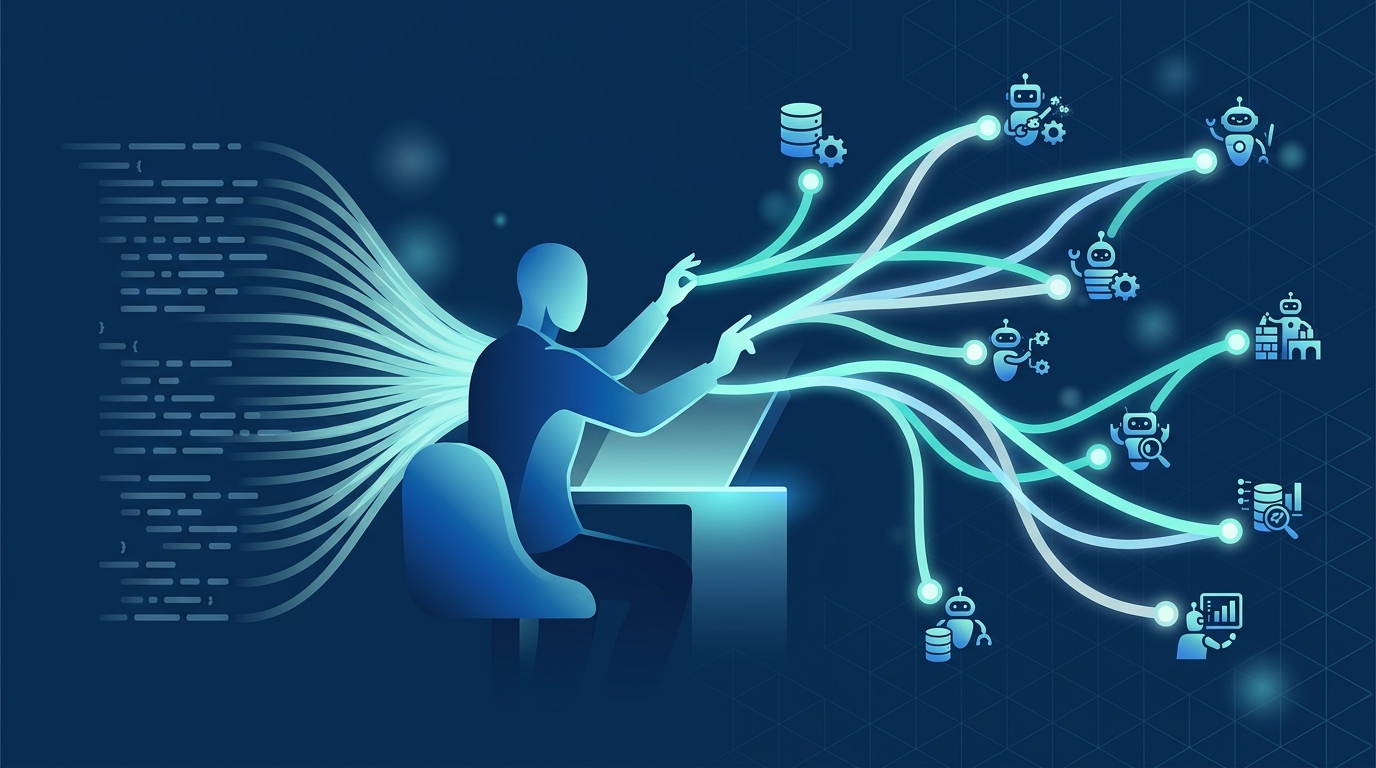
In his words, “The unit of programming changed from typing lines of code to delegating larger ‘macro actions’.” That sentence captures why AI coding agents feel different from autocomplete. An agent may inspect files, edit several modules, run tests, and revise its own answer. The developer’s work moves upward: define the task, constrain the tool, read the diff, check the tests, and decide whether the system still makes sense.
This is also where LLM programming becomes a slightly misleading phrase. The model is not simply another compiler target. It is a probabilistic system that can be brilliant in one step and strangely wrong in the next. Karpathy calls these systems “jagged, alien tools,” a phrase that is more useful than either hype or dismissal.
Agentic engineering is not vibe coding
Karpathy separates professional agentic engineering from casual vibe coding. That distinction matters. Vibe coding can be a productive way to explore an idea quickly, especially when the stakes are low and the user can throw away the result. Agentic engineering is what begins when the output has to survive review, deployment, security constraints, and maintenance.
A good agentic workflow usually has four parts:
- A bounded task. The agent should know what success looks like and what it must not change.
- Readable context. Specs, tests, docs, and examples matter more when a model is acting across a codebase.
- Tool limits. File access, network calls, credentials, and deployment rights should be explicit.
- Independent verification. Tests, code review, logs, and human reasoning remain part of the system.
That is why Karpathy’s line “You can outsource your thinking, but you can’t outsource your understanding” lands so well. It is tempting to treat the model’s confident output as understanding. In production work, that is backwards. The stronger the tool becomes, the more important it is for a person to know what was delegated and why.
This connects with the broader move toward agentic AI. Teams are not only buying smarter chat interfaces. They are redesigning development, operations, support, and analysis around AI agent workflows that can take multi-step action. Without permission boundaries and rollback paths, faster action can just create faster mistakes.
Verifiability decides where agents help most
Karpathy also emphasizes verifiability: AI systems improve fastest in domains where outputs can be checked. Code is a strong example because a change can be compiled, tested, linted, benchmarked, and reviewed. Math has similar properties. Customer strategy, product taste, ethics, and organizational trade-offs are harder because there is no single test suite that proves the answer is right.
For developers, the practical lesson is not “use agents everywhere.” It is “push agents toward work where feedback is concrete.” Good candidates include test generation, small refactors, dependency upgrades, documentation drafts, log analysis, and narrow bug investigations. Riskier candidates include security-sensitive rewrites, ambiguous product decisions, data migrations, and architecture changes that lack tests.
Agentic systems need supervision most when their output looks plausible but cannot be checked quickly. The danger is not only that the answer is wrong; it is that the team may stop asking how it knows.
This is why engineering culture matters. A team with clear tests, small pull requests, readable documentation, and reversible deployments can use agents more safely. A team without those foundations may experience the same tools as a source of hidden fragility.
The developer’s role moves up the stack
The optimistic reading of Software 3.0 is not that developers disappear. It is that the routine unit of work changes. More time goes into framing tasks, reading generated changes, designing feedback loops, and deciding what should never be automated. The craft becomes less about remembering every API call and more about shaping a system that can be trusted under change.
There is also a product-design implication. Karpathy argues that software users are starting to include agents, not only humans. That means APIs, command-line tools, structured data, stable logs, and machine-readable documentation become part of the user interface. If an agent is expected to operate a product, the product has to expose actions and state in ways a machine can inspect.
The concise takeaway is this: Andrej Karpathy gives us a language for a real transition, but not a permission slip to stop understanding our systems. Agentic engineering works best when it combines delegation with verification. The future developer may type fewer lines, but the responsibility for judgment, taste, safety, and meaning still belongs to people.



No comments:
Post a Comment