Daegu DEEP-BOUND is a Korean deep tech program for companies based in Daegu that want help preparing for overseas markets. The 2026 notice is especially relevant to AI, semiconductor, robotics, mobility, bio-healthcare, and other advanced technology teams that already have a serious product but need sharper global positioning.
This is not a general grant for any international founder. It is a Korea-focused K-Startup program, and the eligibility language points to Daegu-based deep-tech companies or Daegu-based companies commercializing public technology from a research and development special zone. For a qualified AI startup Korea opportunity, the program offers market strategy, English IR support, investor meetings, and overseas proof-of-concept connections rather than a simple cash award.
Fast facts for applicants
| Item | Details |
|---|---|
| Program | 2026 Daegu Global Deep-Tech Support Program, DEEP-BOUND |
| Application window | July 16, 2026 18:00 to August 10, 2026 15:00 KST |
| Application method | Email submission to yna@ynarcher.com |
| Who can apply | Daegu-based deep-tech companies in five future industries, or Daegu-based companies commercializing public technology from a special R&D zone |
| Priority | Daegu Innopolis research companies and advanced technology companies may receive priority |
| Selection schedule | Document review on Aug. 12, presentation review on Aug. 18, kickoff on Aug. 25, subject to change |
| Contact | 070-4256-4070 / yna@ynarcher.com |
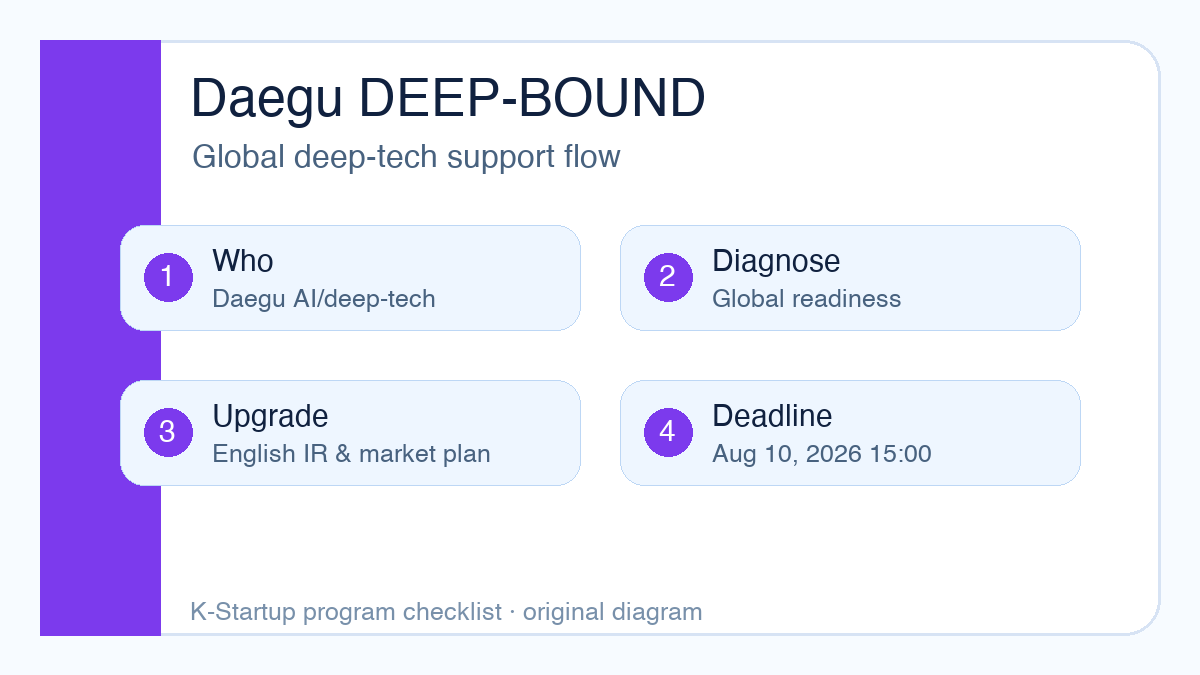
The key filter is location and technology fit. If the company is not tied to Daegu or to the public-technology commercialization track described in the notice, this is probably not the right program. If the fit is clear, the deadline gives teams enough time to prepare a focused global expansion narrative.
Who should apply
The strongest applicants are not just “interested in going global.” They can name a target market, describe why the product is difficult to localize alone, and explain what kind of partner, buyer, investor, or pilot site would prove traction. That is especially important for healthcare AI, robotics software, semiconductor tooling, industrial data platforms, and other categories where a foreign buyer needs technical evidence before a sales conversation.
The support package includes global readiness diagnosis, company-specific consulting, national market analysis, global strategy planning, English IR translation and redesign, global IR and investor matching, online demo day participation, overseas PoC demand matching, local institution and buyer meetings, and follow-on support. In plain English, global PoC support is the centerpiece: the program is useful if a startup can define what it wants a foreign customer or partner to test.
This context also matters for English-speaking readers who follow the Korean IT market. Korea's regional startup programs are often tied to local industry clusters, not only national policy themes. Daegu's emphasis on bio-healthcare, robotics, mobility, semiconductors, and AI reflects that cluster-based approach.
Application checklist
- Confirm that the company is based in Daegu or fits the public-technology commercialization route stated in the notice.
- Map the product to one of the listed future industries, such as AI, semiconductors, robotics and mobility, or bio-healthcare.
- Prepare the official application form and keep the file name aligned with the notice.
- Attach the business registration certificate, corporate registry documents where applicable, company introduction material if needed, and privacy consent documents.
- State the target country, buyer type, pilot hypothesis, required data or equipment, and expected timeline.
- After sending the email, keep a record of the submitted files and confirm receipt if possible.
The selection schedule is compact: document review on August 12, presentation review on August 18, and DEEP-BOUND kickoff on August 25. The notice says the presentation review and kickoff are planned offline, so a founder or senior operator should be ready to participate in person.
What to watch before submission
The exclusion list covers gambling-related sectors, tax delinquency, financial account restrictions, false documents, infringement of another party's technology or intellectual property, and companies restricted from government support programs. A public-technology commercialization applicant should also clarify ownership, licensing, and usage rights before presenting the business plan.
For AI startups, avoid describing the product only as a model or demo. A better application explains the overseas workflow: who uses the system, what data is needed, what risk is reduced, what metric will prove success, and which partner can validate it. The same discipline applies to agentic AI products, industrial platforms, and software-heavy hardware companies.
The deadline is August 10, 2026 at 15:00 KST. Email submission sounds simple, but attachment mistakes are common. Check the form, consent document, company evidence, and presentation availability before sending.




No comments:
Post a Comment