Project-management software spent decades recording tasks, owners, and deadlines. That is no longer enough when generative AI writes code and summarizes documents. If an agent is to read requirements, design decisions, incident history, and conversations before taking action, it needs a context layer that explains how an organization’s work fits together.
This Atlassian company review asks whether the business best known for Jira and Confluence can become an AI collaboration platform through Rovo and Teamwork Graph. Its central asset is not a proprietary frontier model but the relationships among work, knowledge, people, and code. Product complexity, dependence on cloud migration, agent authority, and substantial stock-based compensation must still be evaluated separately from the growth narrative.
This is not investment advice. It evaluates technology, the business model, leadership, financial performance, and risk using Atlassian’s official engineering material, shareholder letters, and SEC filings. ARR and AI usage are operating measures, not GAAP revenue.

From Jira to an organizational context platform
Mike Cannon-Brookes and Scott Farquhar founded Atlassian in Sydney in 2002. Jira began with issue tracking for software teams, Confluence holds team knowledge, Jira Service Management handles service requests, Loom captures asynchronous video, and Trello provides visual work management. After Farquhar stepped down as co-CEO in March 2026, Cannon-Brookes became sole CEO, while Tamar Yehoshua leads product and AI strategy as Chief Product and AI Officer.
The portfolio’s strength lies less in one application than in the links among records. A Jira issue points to a Confluence design, connects to a Bitbucket or GitHub code change and deployment, and ties a service incident to the responsible team and asset. The GitLab DevSecOps platform integrates code through deployment and security in one delivery flow. Atlassian instead tends to form a collaboration context layer across several development and business tools.
Teamwork Graph expresses those relationships in a form AI can use. Connecting people, teams, goals, work, documents, conversations, and code as entities and relationships can give a question such as “Which decisions led to this incident?” more context than keyword search alone. Atlassian’s official Q3 FY2026 shareholder letter describes a graph joining OKRs in Goals, workflows in Jira, knowledge in Confluence, conversations in Loom, and code repositories.
| Layer | Atlassian components | Context supplied | Main failure point |
|---|---|---|---|
| Work records | Jira, Jira Service Management | Issues, requests, status, ownership | Stale tickets and conflicting status |
| Knowledge and conversation | Confluence, Loom | Decisions, explanations, meeting context | Duplicates and missing access controls |
| Relationship layer | Teamwork Graph | People, work, knowledge, and code links | Incorrect entity links and bias |
| AI execution | Rovo Chat, Studio, Dev | Search, reasoning, automation, coding | Excess authority and error propagation |
| External connection | Marketplace, Rovo MCP Server | Third-party apps and AI clients | Wider tool surface and supply-chain risk |
As the graph deepens, switching cost and product value can rise together. A customer using Confluence, Service Collection, and Rovo alongside Jira contributes more connected context and creates more cross-sell potential than a Jira-only account. More data does not guarantee correct context, however. A former employee’s access, private HR documents, obsolete design decisions, and duplicate customer records can lead an agent to combine the wrong evidence with great confidence.
How Rovo Long Horizon changes agent architecture
Rovo combines Search, Chat, Agents, and Studio to find organizational information and complete multi-step work. Rovo Dev can take a Jira specification, find code context, and prepare a change and pull request. Rovo MCP Server lets external AI clients call Jira and Confluence tools. In July 2026, Atlassian disclosed more than five million MCP tool calls per working day and over one million monthly users. Those are not paid-revenue measures, but they indicate that exposing business systems as agent tools has moved beyond a small experiment.
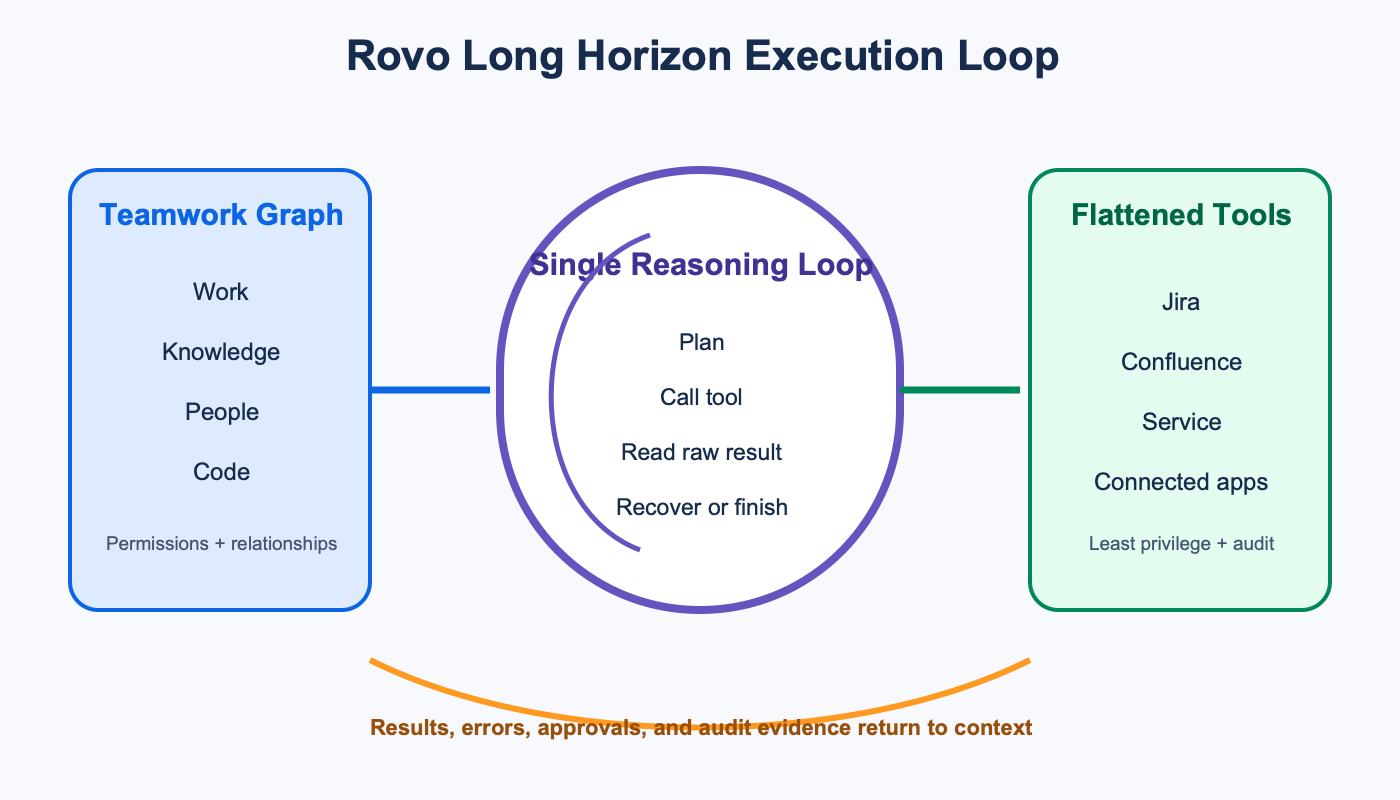
Atlassian’s June 2026 Long Horizon engineering explanation makes the architecture choice unusually concrete. The previous Hybrid Orchestrator delegated work to product-specific subagents for Jira, Confluence, Slack, and other systems, then combined their summaries. That worked for quick isolated tasks, but raw responses and errors were compressed during handoffs, and every product multiplied prompt maintenance and model-migration work.
Long Horizon replaces that design with one model, one context, and one iterative loop. Product tools are flattened so the same model calls them directly, while progressive disclosure loads only the detailed schemas needed at a given point. The model reads a raw response or error in the same context, then retries or chooses another path. Atlassian combines a budget of more than 100 iterations, context management at 95% of the token limit, and live progress updates for longer work.
- The system assembles organizational, timezone, conversation, and applicable skill context.
- It selects relevant tools and progressively exposes detailed schemas.
- The model calls a tool directly and reads the raw result or error in the same reasoning context.
- It evaluates completion, returns an answer, or revises the plan for another iteration.
- The platform observes tool calls, permissions, failures, and recovery as one trajectory.
In Atlassian’s offline evaluation, accuracy rose from 71% for the prior architecture plus model updates to 77% for Long Horizon. Confluence task completion improved 23% on a relative basis. Simple questions had somewhat slower initial response, but live progress reduced perceived latency by 37%, according to the company. These are internal evaluations rather than independent benchmarks. They nevertheless support a practical lesson: context loss, tool-schema cost, and error recovery can constrain an agent as much as base-model intelligence.
Flattening tools under one model is not a universal solution. If a broad authority surface enters one context, prompt injection or a mistaken tool choice can have a larger blast radius. Read, draft, constrained write, and high-risk change permissions should be separated, with human approval for deletion, deployment, or customer communication. A Rovo progress display is an operating status, not a complete explanation of hidden reasoning, so sources and actual execution results must remain independently visible.
Q3 FY2026 numbers and the two sides of cloud migration
For the quarter ended March 31, 2026, Atlassian reported Q3 FY2026 revenue of $1.8 billion, up 32% year over year. Cloud revenue exceeded $1.1 billion and grew 29%, while remaining performance obligations reached $4.0 billion, up 37%. The company ended the quarter with 55,913 customers above $10,000 in Cloud ARR, a 10% increase. Its SEC-filed Q3 results provide these operating and accounting measures.
| Metric | Official Q3 FY2026 figure | Interpretation caveat |
|---|---|---|
| Total revenue | $1.8 billion | 32% year-over-year growth |
| Cloud revenue | More than $1.1 billion | 29% growth, including migration effects |
| RPO | $4.0 billion | 37% growth; contracted, not yet recognized revenue |
| Service Collection ARR | More than $1.0 billion | Above 30% growth; not GAAP revenue |
| Customers above $10K Cloud ARR | 55,913 | Proxy for larger-account expansion |
| Restructuring scope | About 10% of staff | Efficiency opportunity and execution shock |
Service Collection passed $1 billion in ARR, grew more than 30%, and reached over 65,000 customers, including more than half the Fortune 500, according to Atlassian. Service customers using AI resolved issues 13% faster and resolved 20% more issues than non-AI users. Teamwork Collection customers used roughly twice as many AI credits per paid user and had twice as many active agents as comparable standalone-product customers. Rovo customers growing ARR at about twice the rate of non-Rovo customers suggests that AI may assist bundle expansion.
Part of the growth still comes from the large move from Data Center to Cloud and from price and edition increases. Customers face the end of Data Center support in March 2029 and must choose cloud, isolated cloud, or another provider. Migration creates cost and risk for regulated customers, and its contribution to growth can fade after the transition. Product competitiveness therefore has to be separated from the effect of a forced timetable.
Atlassian announced a restructuring affecting about 10% of its workforce in March 2026 and estimated related charges of $225 million to $236 million. It said resources would concentrate on AI, enterprise, and System of Work. Efficiency can improve operating leverage, but fewer people in support and integration can increase execution risk during large migrations and acquisitions. Stock-based compensation also deserves separate attention when evaluating GAAP profitability and dilution.
Conditional strength in the AI collaboration market
Atlassian’s strongest advantage is the real work history of development and service teams. Microsoft has Office, Teams, GitHub, and Azure distribution; ServiceNow owns enterprise service workflows; Salesforce begins with customer data and front-office actions; GitLab controls much of the software delivery chain. Atlassian must compete with all of them while connecting to them. Marketplace and MCP improve openness but also expose the platform to third-party model, security, and pricing changes.
Planned acquisitions of The Browser Company and developer-productivity analytics vendor DX would extend Atlassian into the work surface and engineering measurement. If a browser becomes an agent workspace and DX measures the effect of AI coding tools, Atlassian could connect a Jira issue to code, deployment, and outcome. This also meets the competition over where application context lives and how it is searched, illustrated by the MongoDB developer data platform. If those products do not integrate cleanly with existing identity, search, and Teamwork Graph controls, the company will merely add products and administrative complexity.
Do not begin a Rovo deployment with organization-wide write access. Evaluate read-only search and source verification first, then separate drafting, bounded changes, and human-approved changes. Measure stale-document rate, incorrect permission inheritance, errors by tool, reversibility, and cost per completed task.
The final assessment is conditionally positive. Jira and Confluence’s installed base, Teamwork Graph’s relationship context, real Rovo tool-call volume, and cloud revenue growth give Atlassian a credible route beyond issue tracking. Long Horizon, in particular, demonstrates a specific engineering choice that reduces lossy subagent summaries and lets the same context recover from tool errors.
Three tests decide the long term. Collections and Rovo must generate organic expansion after migration effects weaken; Teamwork Graph must deepen without sacrificing permissions and data quality; and Atlassian must reduce product complexity while restructuring and integrating acquisitions. For an organization with disciplined work records, this can become a powerful context platform. If permissions and documents are already chaotic, AI will amplify collaboration debt faster than it resolves it.



No comments:
Post a Comment