Chinese AI User Reviews: Are DeepSeek and GLM Production-Ready?
Chinese AI models can no longer be summarized as cheap followers. DeepSeek, Alibaba Qwen, Z.ai's GLM, Moonshot AI's Kimi, MiniMax and ByteDance's Doubao are expanding quickly, and open weights plus low prices have attracted developers outside China.
The chat and API experiences are less consistent. Complaints about latency, outages, censorship, support and predictability recur alongside praise for model quality. Anthropic and OpenAI have also raised distillation concerns, while screenshots show some models identifying themselves as Claude or ChatGPT. This article combines reporting, official statements and discussions on Reddit, Hugging Face and GitHub, then separates those sources from the author's experience with DeepSeek and GLM.
Words such as “failed,” “unusable” and “felt like a scam” describe the author's subjective assessment of specific official chat and API tests. They do not claim that every model developed in China has low intelligence or poor self-hosted performance.
Which Chinese AI systems matter, and what caused the controversy?
The GLM models are part of a wider field. The model families most often discussed by international users include the following.
| Company or service | Major family | Commonly cited strength | Operational question |
|---|---|---|---|
| DeepSeek | V, R and V4 families | Reasoning, coding, low API prices and open weights | Official API congestion, censorship and model-name changes |
| Alibaba | Qwen | Multilingual work, coding and many open-weight sizes | Quantization and serving quality vary by provider |
| Z.ai or Zhipu | GLM | Agents, coding, open models and low-cost plans | Official service speed and quota rules |
| Moonshot AI | Kimi | Long context, tools, agents and competitive cost | Region, access path and data policy |
| MiniMax | M family | Coding, agents, speech and video products | Terms and API reliability differ by product |
| Baidu and ByteDance | ERNIE and Doubao | Distribution through Chinese search, apps and cloud | International access, regulation and censorship |
In February 2026, Anthropic published an investigation alleging that DeepSeek, Moonshot AI and MiniMax used fraudulent accounts and proxies to collect Claude outputs at scale. Anthropic reported more than 150,000 exchanges attributed to DeepSeek, 3.4 million to Moonshot and 13 million to MiniMax, targeting reasoning, coding, tool use and reward-model grading.
Those are attribution findings published by Anthropic based on network, payment and request metadata. They are not a court judgment establishing illegal conduct by the three companies. Chinese officials have called recent accusations groundless, while the industry continues to argue about where legitimate synthetic-data training ends and terms-evading capability extraction begins.
OpenAI said in 2025 that it was investigating whether DeepSeek distilled outputs from its models. This AI model distillation dispute cannot be settled by similar performance alone. Training a smaller model on a stronger model's output is a widely used technique; the controversy concerns whether the data and access were authorized and whether an organization evaded service controls to extract capabilities at industrial scale.
Why did models answer “I am Claude”?
Screenshots have circulated of Qwen, DeepSeek, GLM and Kimi-family models answering certain prompts with “I am Claude, created by Anthropic.” An ACL 2025 study on quantifying model distillation also examined Claude-related identity answers from Qwen and DeepSeek-V3. Repeated tests of GLM-5 in 2026 reported it alternating among several vendors' identities.
Self-identification is not cryptographic attestation. The same behavior can result from chatbot text in the training corpus, weak system prompting, role-play or hallucination. Reverse cases have also circulated in which Claude names DeepSeek or Qwen under prompts in other languages. “I am Claude” is therefore a clue that can motivate a data-contamination or distillation investigation, not standalone proof of model lineage.
User reports split model quality from service quality
A recurring summary of Chinese AI user reviews is: “The model is good, but the official service cannot keep up.” Chat users say completed coding, summary and reasoning answers can be impressive for the price. Other users report slow first tokens, stalled long conversations, server-busy messages and quota interruptions.
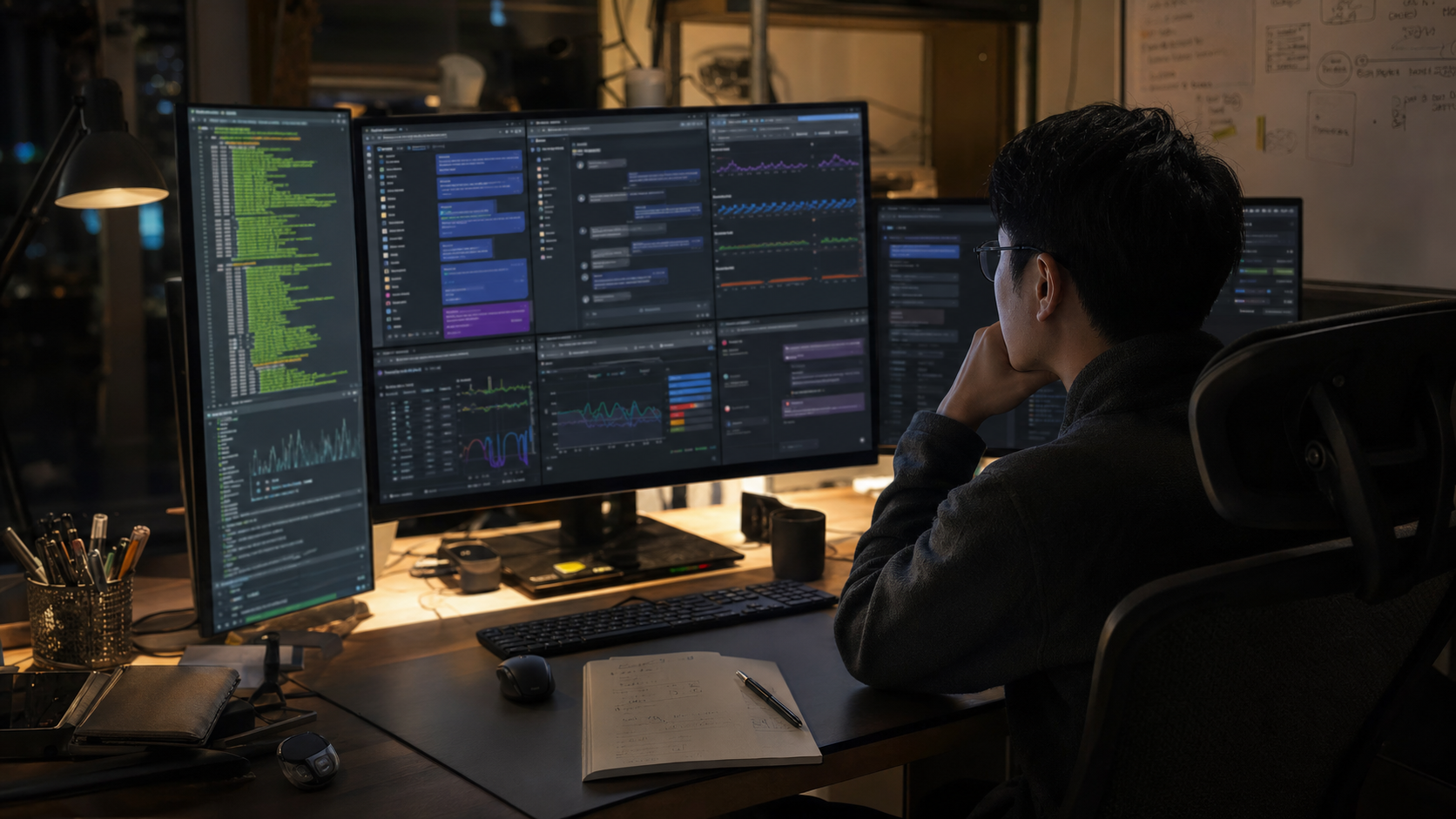
In a July 2026 DeepSeek community discussion, one user said the service was painfully slow throughout the day but suddenly became fast in the evening while retaining quality. Others reported more than twice the normal duration, while another said the service was not slow that day. A 2025 API thread described requests taking 30 to 80 seconds and sometimes exceeding a six-minute server execution limit.
DeepSeek's official status page currently shows 99.90% uptime for its major V4 API services and 99.75% for chat in July 2026. That contradicts a blanket claim that the service is always down. Uptime, however, may count whether a request eventually succeeds; it does not fully describe time to first token, p95 and p99 latency, timeout rates for long requests or throughput.
GLM reports show a similar split. An April 2026 Z.ai user discussion called the model great but almost unusable because of latency. Some users worked around it by changing hours, choosing Turbo or older models, or using another provider. A Hugging Face GLM discussion combines reports of API errors and slow official serving with the view that the underlying model remains promising.
API customers have a stricter standard than casual chat users. A 30-second wait may be tolerable in a chatbot, but tail latency compounds across web requests, agent loops and batch jobs. Cheap tokens can become expensive once retries, timeouts, queue congestion and incident response are counted.
Positive counterexamples matter. AP reported in July 2026 that Mozilla's CTO adopted Kimi K3 for daily work and had previously used GLM-5.2 for calendar, document and email tasks. It also described U.S. companies, including Coinbase, adopting Chinese models to reduce cost. The accurate conclusion is not that every Chinese model is unusable, but that experiences vary substantially by model, official or third-party provider, region and time of day.
The author's DeepSeek and GLM experience was a failure
The author tested both DeepSeek's consumer chat and official API. The chat product was initially usable if its sluggishness was accepted, and successful answers were not necessarily poor. The API was the decisive problem.
In the author's environment, API calls frequently remained unfinished for more than 15 minutes. Continued monitoring at different times did not restore enough predictability to meet a real product's response-time budget. The final decision was that the official DeepSeek API was not usable in production for that workload.
This was the experience that changed the author's view of Chinese AI from optimistic to conservative. Low price and benchmark scores do not create product value when requests fail to return within a deadline. A good answer after an extremely long wait can be a successful demo and still be a production incident.
The phrase “it felt like a technology-showcase scam” describes the frustration at the time. It is not a factual allegation that DeepSeek operates a fraudulent service. Scarce compute, sudden demand, regional routing or immature operations are plausible alternative explanations. The observed fact is narrower: requests repeatedly took an abnormal amount of time, and the author abandoned adoption as a result.
Later, chat latency and interrupted workflows also crossed the author's threshold for unusability. Better current status numbers do not erase an earlier experience, but one account and period cannot establish that every user sees identical latency.
The conclusion on GLM was similar. The serving speed disrupted the workflow before the output quality could be evaluated deeply. Community reports that “the model is good but Z.ai is slow” were consistent with that experience, but the author saw no reason to adopt a product that required provider changes and time-of-day workarounds.

Future adoption will require operational evidence
The author's conclusion is not “never use it because it is Chinese.” It is: do not put a product on an official service until meaningful operating evidence exists. Open weights running on self-controlled infrastructure or a proven cloud must also be separated from a Chinese vendor's official chat and API. The same GLM or Qwen weights can behave like a different product under different hardware, quantization, batching and overload policies.
At minimum, an adoption test should measure:
- Success rate and time to first token over at least 100 identical prompts
- p95 and p99 total latency, not only the average
- Timeouts under long context and repeated agent calls
- Regional and peak-hour speed plus rate limits
- Incident notices, status history and support response
- Model version pinning, deprecation notice and fallback paths
- Data location, training-use policy and censorship behavior
The complexity described in our Vertex AI enterprise operations analysis exists for this reason. IAM and monitoring are inconvenient, but production platforms need evidence about versions, regions, permissions and incidents. Our Gemini Interactions API review likewise treats execution state and recovery as product features, not merely model intelligence.
Chinese AI has advanced price competition and open models, and positive Kimi, Qwen and GLM deployments clearly exist. In the author's tests, however, DeepSeek and GLM official services failed to turn those advantages into dependable product value. Future evaluations will start with long-term latency distributions, incident history and independent user evidence, not launch benchmarks.




No comments:
Post a Comment