Midjourney V8.2 Review: Images, Video, API and Pricing
Midjourney remains unavoidable in any serious comparison of AI image generation services. While ChatGPT Images and Google's Nano Banana emphasize precise instruction following and conversational editing, and Adobe Firefly targets enterprise production, Midjourney has continued to specialize in aesthetics and rapid style exploration.
As of July 27, 2026, the newest image model is Midjourney V8.2, released on July 24. The official version documentation, however, still identifies V8.1 as the default. This review separates the newest released model from the current documented default and checks how far Midjourney has progressed from images into video and enterprise integration.
The official service is midjourney.com and it is available on the web and through Discord.
The short conclusion: Midjourney remains excellent for rapidly exploring visually attractive candidates, but it still lacks a generally available public API and enterprise controls such as SSO and seat administration.
Midjourney's strengths and the current position of V8.2
Midjourney generates images from text and visual references, then carries style and taste across work through Style References, Moodboards and Personalization. Its web editor supports Remix, inpainting, Pan, Zoom Out and Retexture, while the Niji family specializes in anime and illustration.
Its distinctive strength is not literal assembly of every prompt token. It is the ability to reinterpret a prompt as a visually attractive scene. Advertising concepts, fashion, architecture, fantasy and editorial imagery often arrive with strong lighting, material, color and visual density before the user specifies every photographic detail.
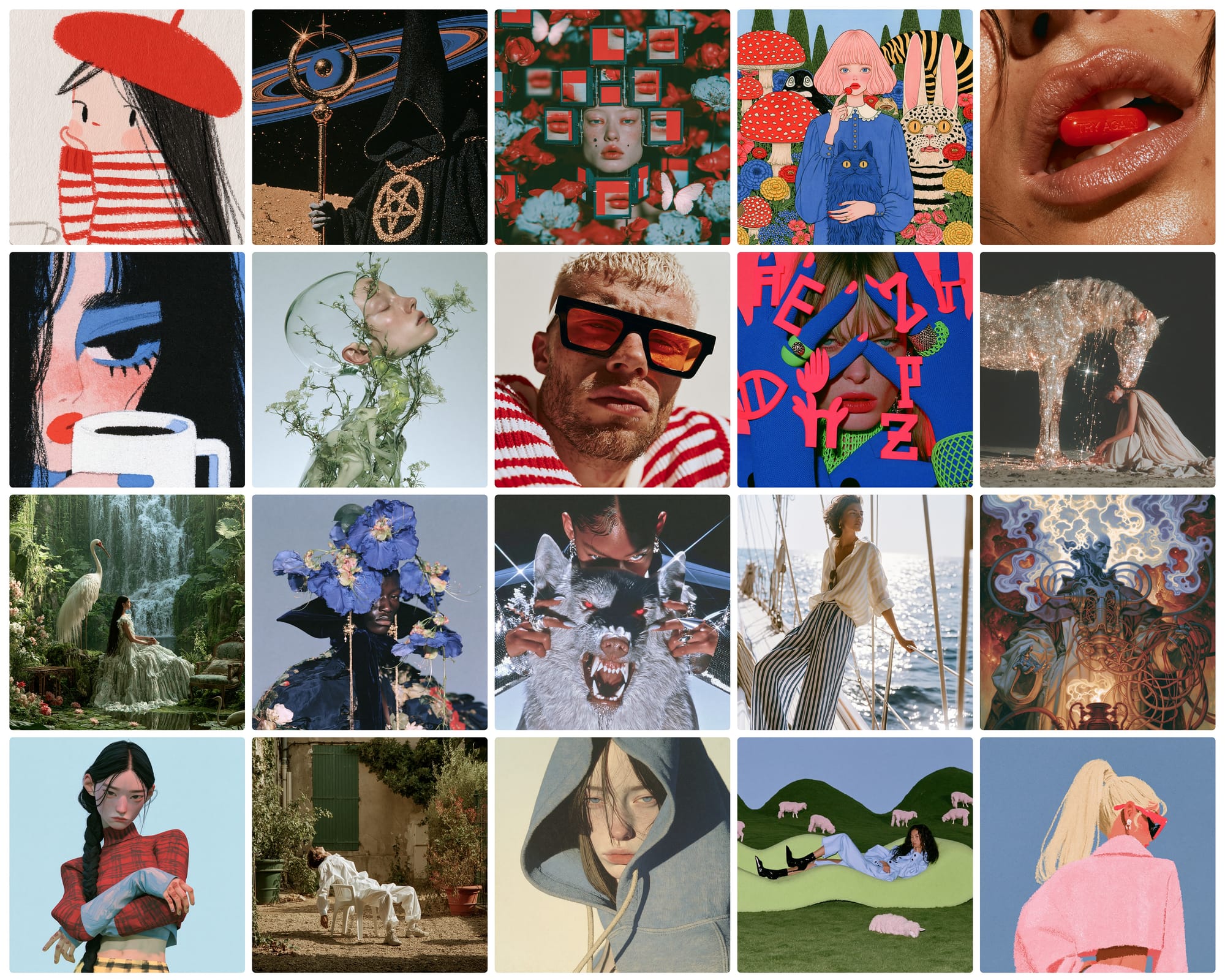
The official V8.2 announcement focuses on aesthetics, image quality and personalization: bolder and more sophisticated output, fewer random low-quality results, better understanding of a user's ratings and a larger pool for building personalization profiles. It does not publish an independent benchmark, so those claims should not be converted into an unsupported percentage lead over competitors.
V8.1 became the default in June 2026. According to the official Version documentation, standard jobs are roughly four to five times faster than earlier versions. Midjourney's announcement says SD images appear in about four seconds and HD images in about 12 seconds. V8.1 can generate 2K images without upscaling, consuming about 0.8 GPU minutes for SD and 1.3 minutes for HD.
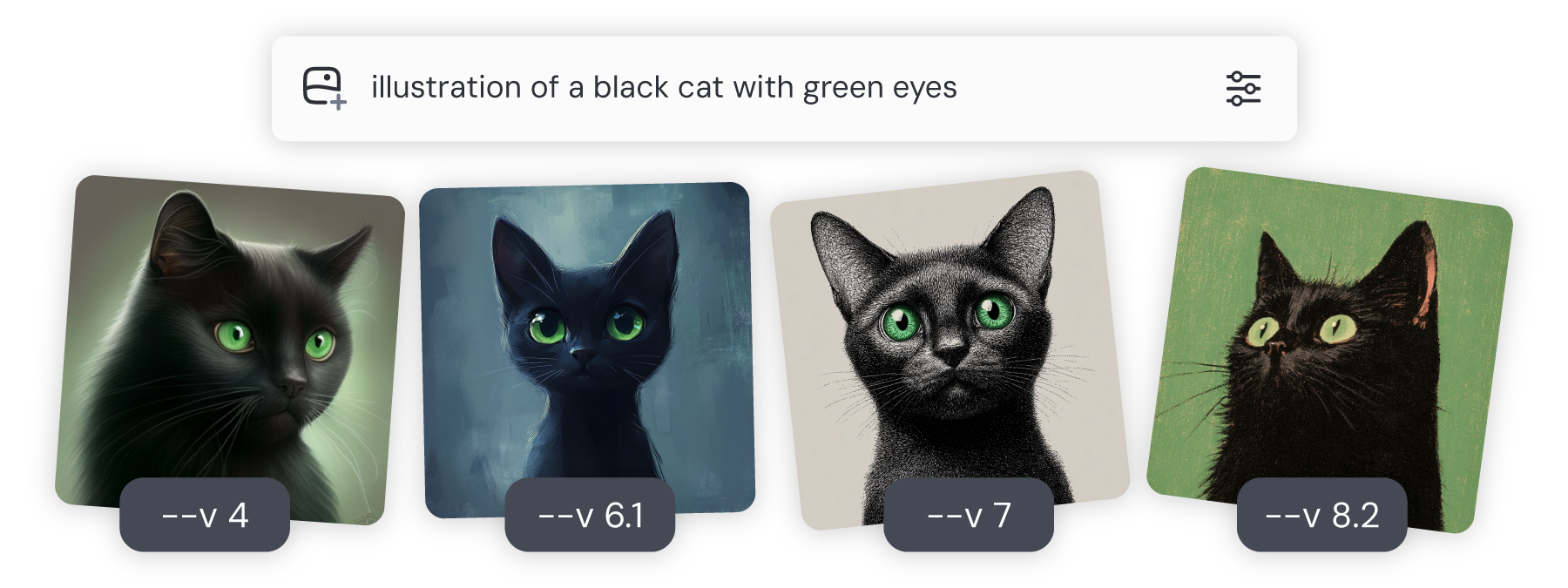
The newest version has not absorbed every older capability. Omni Reference in the V8.1 workflow still relies on V7, and applying Pan, Zoom Out or region editing to an HD image can reduce the intermediate result to SD. For labels, long text and exact interface layout, where instruction fidelity matters more than visual interpretation, ChatGPT Images or Nano Banana may be a better fit.
From image to video: how far has Video progressed?
Midjourney introduced V1 Video in 2025 and described a long-term goal of real-time open-world simulation. The current product is closer to image-to-video than a complete video-production system. It starts with a Midjourney or externally uploaded image and adds motion.
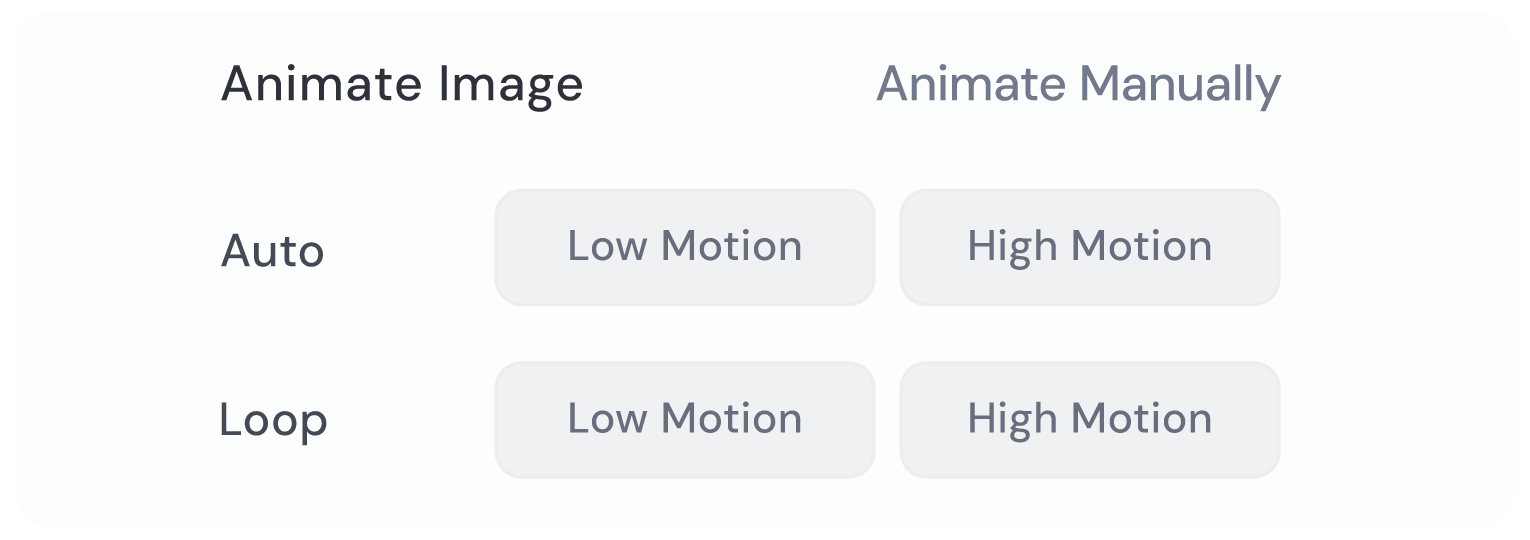
The current official Video documentation lists the following capabilities.
| Item | Current support |
|---|---|
| Initial duration | 5 seconds |
| Extension | Four 4-second extensions, up to 21 seconds |
| Resolution | SD around 480p, HD up to 720p |
| Motion | Low Motion and High Motion |
| Controls | Auto, Manual, Raw, Loop, start and end frames |
| One SD result | About 2 GPU minutes |
| One HD result | About 7 GPU minutes |
The default four-result batch consumes eight minutes for SD or 26 minutes for HD. Users who need to conserve time should select one result with --bs 1. High Motion increases subject and camera movement, but it also raises the chance of distorted objects or anatomy.
Midjourney Video is not yet a direct replacement for Runway Gen-4 or Google Veo. Its ceiling is 720p and 21 seconds, and scene-level control remains more limited than in video-first platforms. Its advantage is continuity: a creator can animate a finished Midjourney composition without moving its style and framing into another service.
Fact-checking enterprise API access and pricing
As of July 27, 2026, there is no generally available public Midjourney API that a developer or company can use without a special arrangement. Midjourney opened an Enterprise API Survey in July 2025, but that was an application and requirements survey, not a general API launch.
The official Community Guidelines say that, apart from rare explicitly granted exceptions, Midjourney does not provide an API or third-party applications and prohibits automation of interactions with the service. Unofficial Discord relays and browser automation are not supported enterprise integrations and can put an account at risk.
Corporate support is also narrow. Organizations purchasing at least 50 annual Pro or Mega subscriptions may ask about consolidated billing, but Midjourney says it does not provide seat administration, SSO, negotiated terms or participation in vendor and security review processes.
Current Midjourney pricing follows the official plan comparison below.
| Plan | Monthly | Annual equivalent | Fast GPU | Relax Mode | Stealth |
|---|---|---|---|---|---|
| Basic | $10 | $8/month | 3.3 hours | None | No |
| Standard | $30 | $24/month | 15 hours | Unlimited images | No |
| Pro | $60 | $48/month | 30 hours | Unlimited images and SD video | Yes |
| Mega | $120 | $96/month | 60 hours | Unlimited images and SD video | Yes |
Annual billing is 20% cheaper but paid upfront. Fast time does not roll over, and extra time costs $4 per hour. Creations may be visible in the public community, so private work requires Stealth on Pro or Mega. A company with more than $1 million in annual gross revenue must use Pro or Mega for commercial work, and regional taxes can be added.
Competitor comparison and final assessment
Reducing image quality to one ranking hides the actual decision. Advertising concepts, exact text, iterative editing, API automation and video production are different tasks.
| Service | Main strength | Price and availability | Main limitation |
|---|---|---|---|
| Midjourney V8.2 | Default aesthetics, Style Reference, Moodboards, personalization | $10–120/month, web and Discord | No public API, SSO or seat management |
| ChatGPT Images | Instruction fidelity, text, conversational editing | Subscription and official image API | Different approach to mass style exploration |
| Nano Banana 2 | Multiple references, multimodal edits, 4K and Google integration | About $0.067 for a 1K API image | Aesthetic preference varies by task |
| Adobe Firefly | Photoshop and Express integration, enterprise workflow | From $9.99/month, enterprise support | Pure visual quality varies by task |
| Runway | Connected image and professional video models | Free trial, paid from $15/month | Credits disappear quickly in video work |
API prices are not identical product units. Google lists a 1K Nano Banana 2 image at roughly $0.067. OpenAI lists a 1024-square GPT Image 1 result at $0.011 to $0.167 depending on quality. Midjourney uses subscription GPU time rather than per-image API billing, so a service cannot calculate request-level costs in the same way. Where deployment, IAM and APIs are central, our Google AI and Vertex AI analysis shows why Google, OpenAI or Adobe is more practical.
Midjourney is a strong recommendation for designers exploring advertising, branding, fashion and game concepts with a person selecting the final image. Companies needing API embedding, SSO, auditability, request-level unit economics or video beyond 1080p should evaluate another platform first.
Midjourney has not fallen behind in image generation. V8.2 reinforces aesthetics and personalization, while Video links static creation to motion. Its enterprise-platform gap remains equally clear. The fairest assessment is: top-tier as a hands-on visual exploration tool, but incomplete as an automatable enterprise image infrastructure.



No comments:
Post a Comment