The web development history of Korea is not a simple story of newer frameworks replacing older ones. PHP, ASP, JSP, EJB, Struts, custom servlet frameworks, Spring, Spring Boot, Node.js, and modern frontend stacks all had their moments. Yet in Korea’s large enterprise market, especially finance and public-sector systems, Java Spring remained unusually durable.
That pattern is not only about developer taste. In the Korean IT market, large banking, insurance, card, tax, procurement, and government systems value stability, staffing, documentation, audits, vendor accountability, and long-term maintenance. A framework can be technically elegant and still lose if a project cannot hire enough people to operate it for ten years.
The early web rewarded speed more than architecture
In the late 1990s and early 2000s, the web was still rough. A team could build useful services by rendering HTML, accepting forms, storing data, and showing lists. CGI, Perl, PHP, ASP, and early JSP fit that environment because they made dynamic pages possible without the heavy architecture that came later.
PHP’s appeal was practical. The official PHP history describes its growth from personal homepage tooling into a language for dynamic web pages. It was easy to deploy, common on shared hosting, and natural to mix with HTML and MySQL. For communities, small commerce sites, bulletin boards, and early content systems, that mattered more than formal architecture.
ASP served a similar role for organizations already invested in Windows Server, IIS, Visual Studio, and Microsoft databases. In office-heavy environments, Classic ASP could turn internal business workflows into web screens quickly.
| Period | Common technologies | Why they spread | Typical weakness |
|---|---|---|---|
| Late 1990s | CGI, Perl | Direct connection to web servers and early web scripts | Harder to structure and maintain |
| Late 1990s–2000s | PHP | Easy hosting, fast page development, CMS ecosystem | Weaker fit for layered enterprise systems |
| Late 1990s–2000s | ASP | Productive in Microsoft-centered organizations | Strong dependency on the Microsoft stack |
| Early 2000s | JSP and Servlet | Java became credible for server-side business systems | View and business logic often became tangled |
This period matters because it created the first split. Smaller public web services often optimized for speed. Large business systems began optimizing for operational control.
Enterprise Java became heavy, then Spring made it usable
By the early and mid-2000s, Java web development in Korea had become more organized but also heavier. EJB promised container-managed transactions, security, pooling, and distributed components. That sounded attractive for banks, insurers, and government systems, where reliability and transaction integrity were central.
The cost was complexity. XML configuration, slow deployment, container dependency, and difficult testing made many systems painful to build. Apache Struts helped web applications adopt the Model-View-Controller pattern, but large projects still accumulated configuration and project-specific conventions.
Many Korean systems also built custom servlet frameworks. A company or project would create its own common controller, action layer, data-access pattern, authentication module, logging rule, and message convention. This was understandable at the time. Open-source frameworks were less mature, and institutions had specific requirements. Over time, those internal frameworks often became legacy knowledge traps.
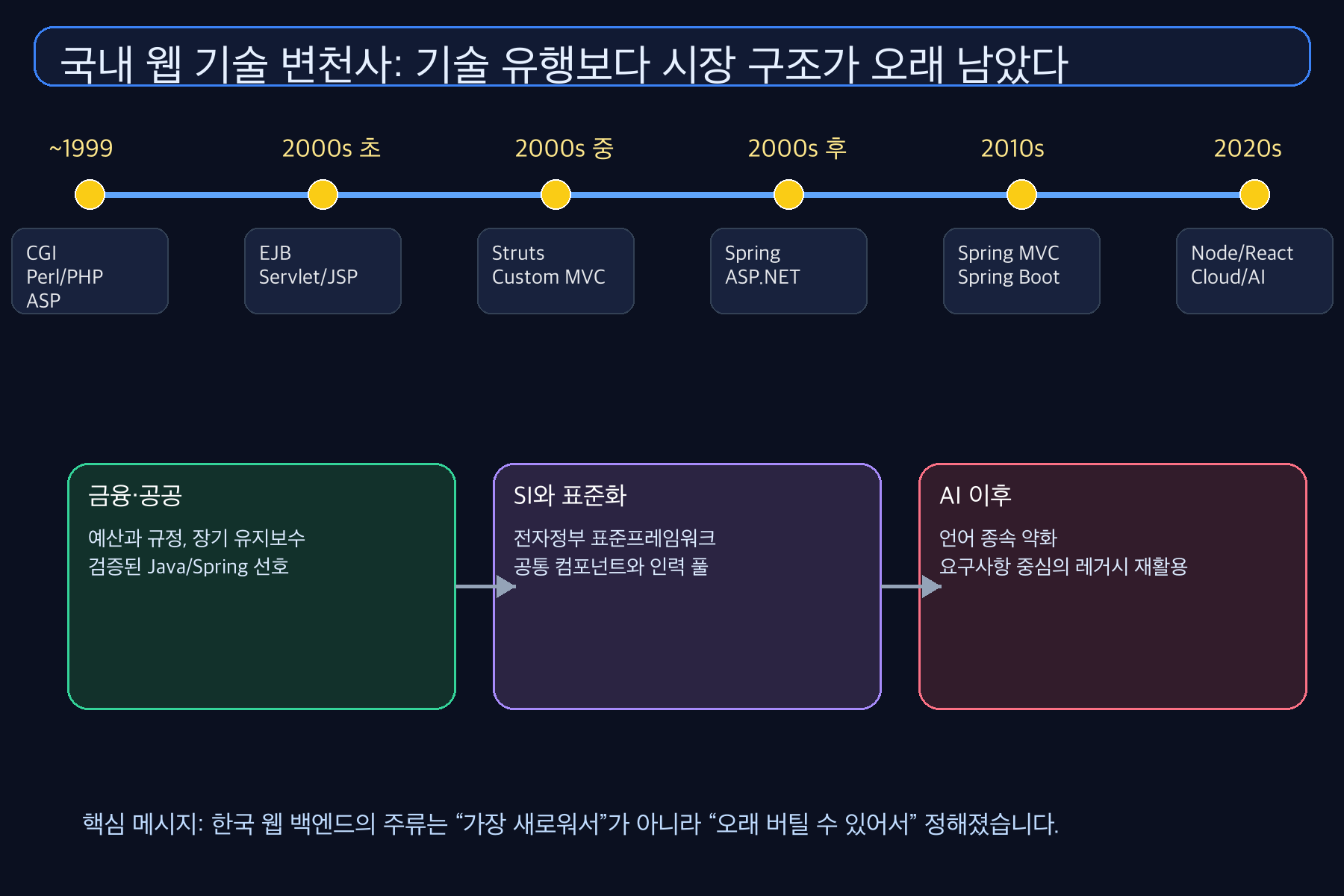
Spring became influential because it offered a better middle path. It kept the Java talent pool and enterprise ecosystem but reduced some of the heaviness of classic enterprise Java. Dependency injection, transaction abstraction, MVC patterns, data access, security integration, and testing support made large Java applications more manageable.
Spring Boot later reinforced that position. The official Spring Boot project page describes it as a way to create stand-alone, production-grade Spring applications with embedded servers, starter dependencies, auto-configuration, metrics, and health checks. In cloud and container environments, that made Java applications easier to package and operate.
In Korea, public-sector standardization also mattered. The eGovFrame ecosystem helped normalize a Spring-based development model across many government projects. Once a large labor market forms around a stack, the stack keeps being selected partly because the people, training, documentation, and operating patterns already exist.
Node.js changed the edge before it changed the core
The 2010s changed web development most visibly on the frontend. jQuery gave way to AngularJS, React, Vue, TypeScript, Next.js, and server-rendered frontend frameworks. Backends increasingly served JSON APIs instead of rendering every page. That opened more space for Node.js.
The official Node.js description emphasizes its asynchronous, event-driven runtime, which is well suited to network applications with many concurrent connections. Node also let teams use JavaScript or TypeScript across frontend and backend work, which helped startups, product teams, internal tools, backend-for-frontend layers, and real-time features move quickly.
Global surveys show the strength of that ecosystem. The Stack Overflow Developer Survey 2024 reported high usage for Node.js and React among professional developers. But that global pattern should not be read as proof that every Korean core banking or public administration system moved to Node. In many large systems, Node entered around the edges: admin tools, API gateways, frontend build systems, BFF services, dashboards, or experiments.
| Decision factor | Where Node and frontend stacks are strong | Where Java Spring remains strong |
|---|---|---|
| Early build speed | Product experiments, prototypes, frontend-heavy services | More ceremony but predictable structure |
| Hiring pool | Large JavaScript and full-stack community | Deep SI, finance, and public-sector Java workforce |
| Operations | Fast-moving ecosystem, organization-specific practices | Mature patterns for long-running enterprise systems |
| Audits and documentation | Depends heavily on team process | Familiar templates and project governance |
| Core transactions | Possible with strong design | Long-tested in regulated environments |
The point is not that one stack won. It is that different parts of the market selected for different risks.
AI may make old stacks last longer, not shorter
AI coding tools are changing the story in an unexpected direction. In the past, an old framework created a hard barrier: if fewer developers knew it, the system became harder to change. With AI, unfamiliar codebases become somewhat easier to read, summarize, test, and refactor. That does not remove the need for experts, but it lowers the entry cost.
This could make legacy modernization less dramatic. Instead of rewriting a large Spring, Struts, ASP.NET, or PHP system just because the stack feels old, teams may use AI to map dependencies, generate tests, explain flows, identify risky modules, and plan smaller migrations. Old code becomes easier for tools to inspect.
There is a catch. AI does not own production incidents. It does not understand an institution’s legal duties, audit history, customer impact, or political constraints by default. A generated migration plan still needs humans who understand the business rules and operating risks.
For Korea’s large systems, the likely future is mixed. Java and Spring will remain important where stability, staffing, and governance matter. Node.js and TypeScript will keep expanding where speed, frontend integration, and product iteration matter. AI will sit across both worlds, helping teams read old code and build new interfaces faster.
The deeper lesson is that web development history is not only a history of frameworks. It is a history of who pays for software, who operates it, who can hire for it, and who is responsible when it fails. That is why old technologies survive, and why new ones do not replace them everywhere at once.
Why the stack still matters for AI adoption
AI coding tools can suggest code in almost any language, but the surrounding stack still shapes what teams can safely ship. A Spring-heavy organization usually has existing deployment conventions, logging patterns, security filters, transaction boundaries, and review habits. Replacing those overnight is rarely realistic.
A practical transition path
The more plausible path is gradual: keep stable Java and Spring systems where reliability matters, use Node.js where product iteration and frontend integration benefit from it, and introduce AI tooling around tests, migration notes, and code review. That makes the historical stack a foundation rather than a cage.
Reader takeaway
Korea's web stack is not simply old versus new. It is a layered result of public-sector requirements, enterprise procurement, developer education, hosting habits, and now AI-assisted development. Understanding that history makes technology choices less ideological and more practical.
Why enterprise teams keep familiar foundations
Legacy is not always inertia. In enterprise systems, a familiar stack also carries hiring pipelines, incident habits, deployment scripts, security review patterns, and vendor support. That background explains why a technically newer option does not automatically replace Java and Spring overnight.
How AI coding changes the transition
AI assistants make it easier to prototype in unfamiliar frameworks, but production migration still depends on tests, observability, and organizational confidence. The practical opportunity is using AI to reduce migration friction while keeping the operational discipline that made the older stack durable.




No comments:
Post a Comment