Datadog is worth revisiting because observability is expanding in the AI era. The old monitoring question was whether a server, API, database, or user session was healthy. AI services add model latency, token cost, GPU utilization, tool calls, agent behavior, data exposure, and security events to the same operational surface.
Datadog's strategy is to gather those signals into a broader observability and security platform, then add AI assistants and analysis layers on top. Bits AI, the Datadog MCP Server, Adaptive ML, and security analyst features all point in that direction.
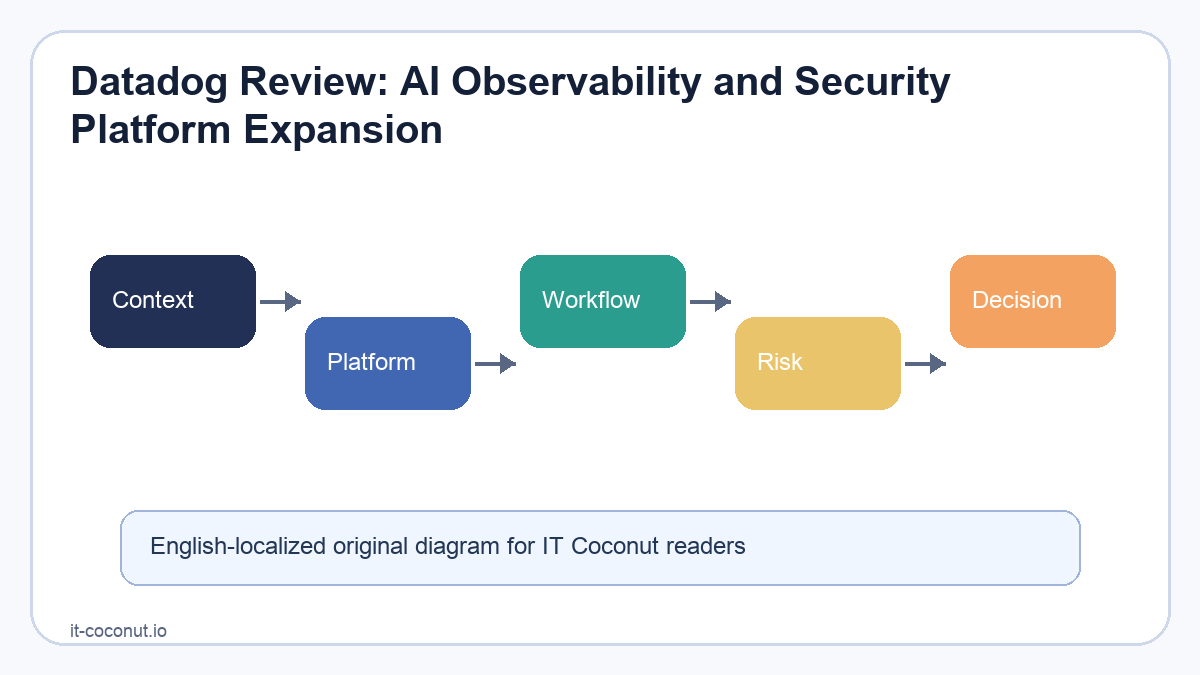
How the business works
Key details at a glance
| Reader question | Practical takeaway |
|---|---|
| What this article explains | Datadog Review: AI Observability and Security Platform Expansion |
| Core SEO focus | Datadog AI observability, Bits AI SRE, Datadog MCP Server |
| How to read it | Separate the durable signal from vendor messaging, short-term hype, and implementation friction. |
Datadog collects metrics, logs, traces, events, and security signals through agents, APIs, OpenTelemetry, and cloud integrations. Customers then use the platform for infrastructure monitoring, APM, log management, real-user monitoring, security analytics, cloud cost management, and incident response. Pricing is typically a mix of subscriptions and usage.
The business benefits when customers add products over time. A team may start with infrastructure monitoring, then add APM, logs, security, user monitoring, and cost tools. The company has highlighted growth in large customers, which matters because observability platforms become more valuable when they cover more of a customer's stack.
Why AI makes observability harder
AI systems are not ordinary web applications. A model can be available but produce poor answers. An agent can call the wrong tool. A retrieval layer can leak sensitive context. Token costs can spike even when traffic looks normal. That is why AI observability needs to connect quality, cost, security, and infrastructure signals.
Datadog's opportunity is to become the place where operations teams see that combined picture. The risk is competition from cloud providers, open-source observability stacks, security platforms, and AI-native monitoring startups. The neutral conclusion is that Datadog has a credible platform position, but AI expansion will only matter if it helps customers resolve incidents and control risk faster than a patchwork of specialized tools.
Why AI changes observability demand
AI systems create a different debugging surface from ordinary web applications. Teams need to understand model calls, latency, token costs, retrieval quality, prompt changes, user feedback, and downstream service failures together. That makes observability less about a single dashboard and more about connecting application behavior, infrastructure signals, and security events.
The security angle
Datadog's expansion into security matters because production incidents and security signals increasingly overlap. A suspicious API pattern, a vulnerable dependency, and a sudden cost spike can belong to the same operational story. The platform thesis is that one shared telemetry layer can help engineering, operations, and security teams respond without passing fragmented evidence between tools.
Practical takeaway
The opportunity is not simply that Datadog adds more AI features. The stronger question is whether Datadog can remain the system of record for production telemetry as AI workloads make software behavior more probabilistic, more expensive to inspect, and harder to debug with traditional logs alone.
For readers comparing search terms, this article is also relevant to AI security monitoring.
Related reading
For broader context, read AI coding agents.
A second useful reference is vibe coding.
Readers following the infrastructure side may also want Claude 4 agentic coding.



No comments:
Post a Comment