Demis Hassabis is easy to associate with the 2016 AlphaGo match, especially for Korean readers who remember the shock of Lee Sedol facing DeepMind. But the more important arc after that match is scientific. Hassabis has pushed AI from games into protein structure prediction, genomics, world models, and evaluation systems that test longer-horizon behavior.
AlphaFold is the clearest example. The Nobel Prize organization awarded part of the 2024 Chemistry Prize to Hassabis and John Jumper for protein structure prediction. Google DeepMind's public AlphaFold timeline connects the CASP14 breakthrough, the Nature publication, code release, large-scale structure database, AlphaFold 3, and AlphaFold Server.
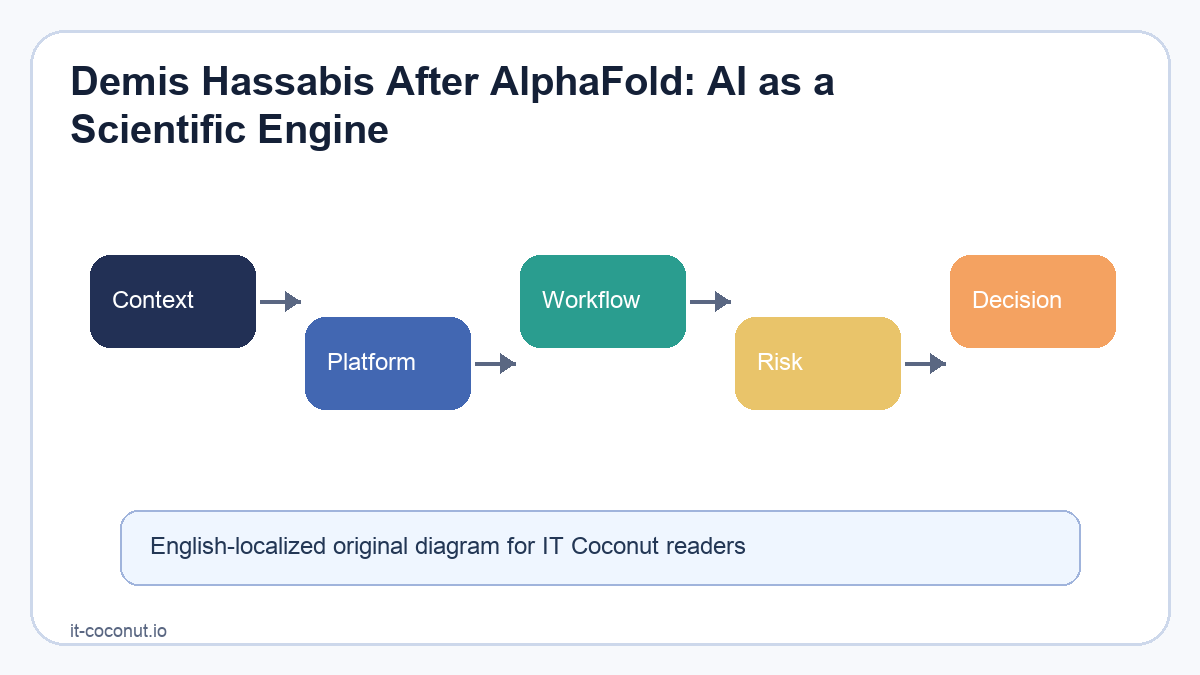
What AlphaFold changed
Key details at a glance
| Reader question | Practical takeaway |
|---|---|
| What this article explains | Demis Hassabis After AlphaFold: AI as a Scientific Engine |
| Core SEO focus | Demis Hassabis, AlphaFold AI science, Google DeepMind |
| How to read it | Separate the durable signal from vendor messaging, short-term hype, and implementation friction. |
| AlphaFold did not turn drug discovery into an automatic pipeline. Biology still requires experiments, toxicity studies, clinical work, regulation, manufacturing, and cost control. Its achievement was different: it compressed part of the search space for scientists. When a model can suggest plausible structures for proteins at massive scale, researchers can spend more time on hypotheses and experiments that are worth testing. |
That is why Hassabis's work is better understood as scientific infrastructure than as another chatbot story. The same pattern appears in AlphaGenome, which points AI at genomic sequence interpretation, and in world-model projects such as Genie, where the goal is to learn environments that can predict the consequences of action.
The Korean ecosystem lesson
For Korea's AI ecosystem, the lesson is not simply to build a bigger model. DeepMind's strongest work joined models with a testable domain, high-quality data, scientific collaboration, and public evaluation. Healthcare, manufacturing, materials, robotics, and biology may offer similar opportunities if teams can connect AI systems to measurable problems.
That connection also explains why evaluation matters. If AI is going to help science or operations, it must be judged by whether it improves discovery, reduces uncertainty, or supports better decisions. Hassabis's post-AlphaFold path is a reminder that the most valuable AI systems may be the ones that help experts see the world more clearly.
For readers comparing search terms, this article is also relevant to AI world models.
Primary sources
Related reading
For broader context, read AI coding agents.
A second useful reference is Claude 4 agentic coding.
Readers following the infrastructure side may also want OpenAI Codex cloud agent.




No comments:
Post a Comment