Customer data at a small or midsize business may look simpler than at a global enterprise, but it can fragment more easily. Marketing uses a website and email tool, sales keeps spreadsheets and call notes, and service lives in inboxes and tickets. A smaller workforce is also less likely to have a dedicated team for integrating systems and cleaning data. HubSpot grew by addressing that problem with an accessible CRM and integrated marketing, sales, and service tools.
This HubSpot company review asks whether Breeze AI and Agent Hub can extend the company into an agentic customer platform. The direction is clear: marketing, sales, and service agents share the same customer context on Smart CRM. Salesforce and Microsoft competition, credit-based cost, data quality, and accountability for autonomous action cannot be solved by ease of use alone.
This is not investment advice. It evaluates technology, the business model, leadership, financial performance, and risk using HubSpot’s official product documentation, newsroom, earnings release, and SEC filing. Company-reported customer outcomes and non-GAAP measures do not replace GAAP results.

From inbound marketing to Smart CRM
Brian Halligan and Dharmesh Shah founded HubSpot in 2006. Instead of pushing customers through advertising and cold calls, inbound marketing used useful content and search to help customers find a business. HubSpot packaged that method as software and educational content. It then expanded around a free CRM with Marketing Hub, Sales Hub, Service Hub, Content Hub, Data Hub, and commerce and revenue functions.
Yamini Rangan, CEO since 2021, has emphasized customer-led growth and multi-hub adoption. In 2026, Chief Product and Technology Officer Duncan Lennox is leading Agent Hub and the open agent ecosystem. Co-founder Shah remains Chief Technology Officer and a board member, continuing to influence product culture. The structure combines founder-led product philosophy with a professional CEO’s upmarket execution.
Smart CRM is the shared data layer. It relates contacts, companies, deals, tickets, email, web behavior, and call records through objects, properties, and associations, with workflows and permissions on top. Salesforce Agentforce and Data 360 target a complex large-enterprise data and application estate. HubSpot differentiates around faster adoption, one administration experience, and lower operating burden.
| Platform layer | Main components | Value supplied | Risk to verify |
|---|---|---|---|
| Smart CRM | Contacts, companies, deals, tickets, activity | Shared customer records and relationships | Duplicates, stale properties, consent errors |
| Hubs | Marketing, sales, service, content, data | Execution tools across the journey | Edition, seat, and hub complexity |
| Breeze | Assistant, Agents, Intelligence | Summarization, generation, analysis, automation | Hallucination, cost, human review |
| Agent Hub | Agent list, status, performance | Unified control of multiple agents | Metric quality and accountability |
| Agent Builder | Triggers, workflows, custom agents | Natural-language automation design | Excess permissions and hidden exceptions |
The economics of integration can be especially strong for a small team. One data model and user experience may deploy faster than a project connecting separate CRM, marketing automation, support, and content systems. As a company grows, however, complex pricing, customization limits, data storage and reporting requirements, and ERP integration can become burdens. Whether “easy HubSpot” survives advanced requirements is the central test of its upmarket strategy.
Shared-context execution with Breeze and Agent Hub
Breeze is the AI layer across HubSpot. Breeze Assistant reads CRM context to help with questions, summaries, and content. Customer Agent uses knowledge and customer records in support conversations; Prospecting Agent researches and contacts potential buyers; Data Agent enriches and analyzes customer and company information. HubSpot’s July 2026 official Breeze documentation describes Assistant, Agents, Projects, tools, knowledge vaults, and reporting as one operating system.
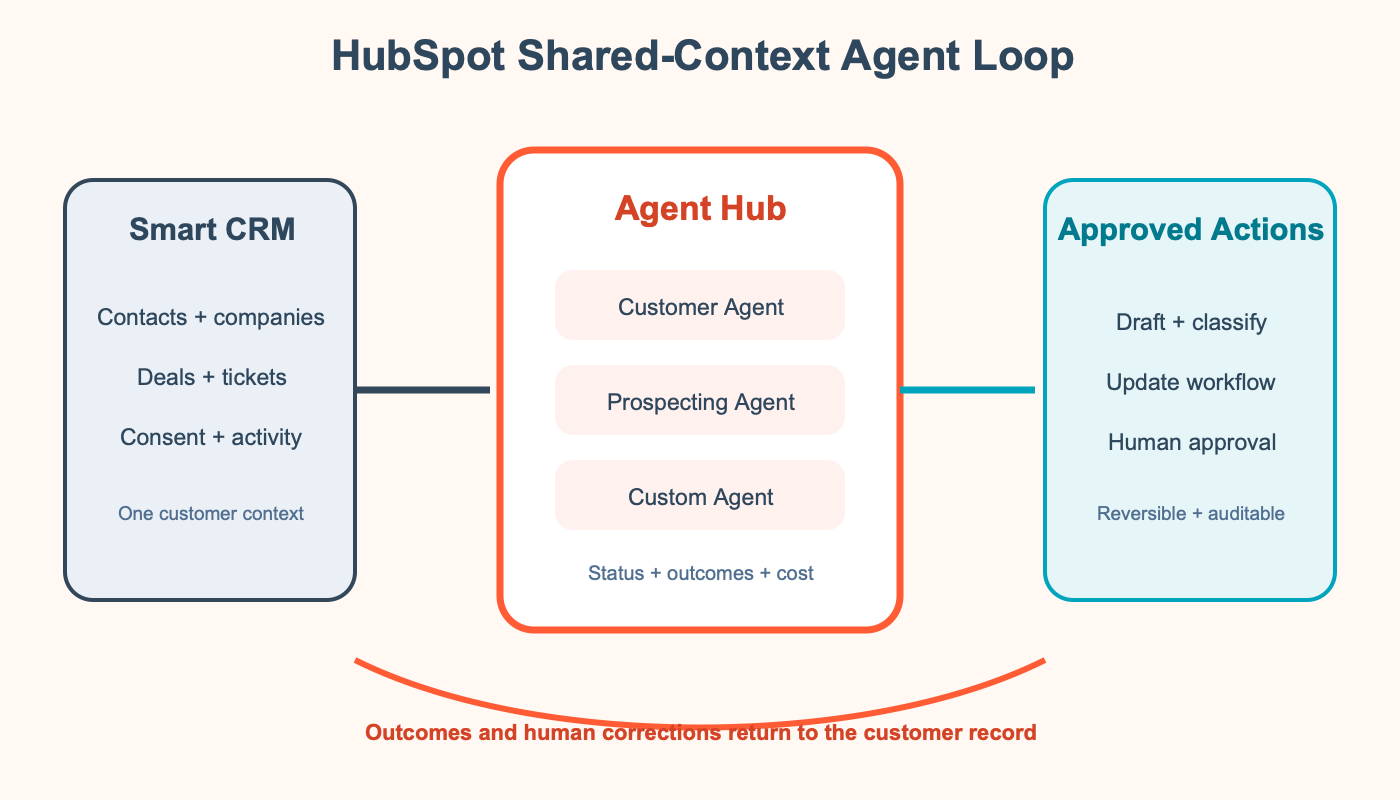
The Agent Hub and Agent Builder announcement on July 23, 2026 proposes one place to manage multiple agents. Shared deal history, contacts, call transcripts, and buying signals should help keep a marketing prospecting agent from contradicting a service agent working an open complaint at the same account. An administrator can inspect running agents and outcomes, then use Agent Builder to design custom automations and agents in natural language.
- A contact update, schedule, webhook, or external integration begins the work.
- Smart CRM supplies deal, ticket, consent, interaction, and product-usage context.
- Breeze plans or drafts inside instructions and workflows defined in Agent Builder.
- Allowed tools execute low-risk work, while pricing, contracts, and sensitive data require human approval.
- Agent Hub measures results, human edits, conversion or resolution, and cost, then feeds them into later operation.
In HubSpot’s official example, Ignite Reading built a custom agent that finds and parses school-district calendars using the domain and school year stored in a deal. Work that previously took 15 to 20 minutes per district fell to seconds, saving more than 350 hours per year, according to the customer and HubSpot. The example shows why narrow work with clear inputs and verifiable outputs is a good agent target. It does not prove that every sales or service conversation can be automated to the same degree.
Agent Hub matters less for the number of agents than for shared context and control. With separate copies of data, a sales agent can send a promotion to a customer who has an unresolved service complaint. A shared CRM improves the chance of detecting that collision, but incorrect source data or broad permission can spread a bad action consistently. Contact merges, consent withdrawal, deletion requests, and regional boundaries must propagate to agent caches and knowledge vaults.
Credit-based pricing is also an operating-design issue. Outcome pricing can connect cost to completed work, but a supplier’s definition of “success” may differ from the customer’s business outcome. Sending an email is not the same as making a valuable contact with the right customer. Completion rate, human-edit rate, false positives, cancellation, complaints, and total cost per successful outcome belong on the same dashboard.
What Q1 2026 financials say about growth and upmarket execution
HubSpot’s official Q1 2026 results reported revenue of $881.0 million for the quarter ended March 31, up 23% year over year. Subscription revenue was $862.3 million and professional services and other revenue was $18.7 million. Subscriptions make up roughly 98% of revenue, while the small services share supports a software-led expansion model.
| Metric | Official Q1 2026 figure | Meaning |
|---|---|---|
| Total revenue | $881.0 million | 23% year-over-year growth |
| Subscription revenue | $862.3 million | Roughly 98% of revenue |
| GAAP operating income | $27.9 million | Reversal from a $27.5 million loss |
| GAAP operating margin | 3.2% | Distinct from 17.8% non-GAAP |
| Customers | 299,458 | 16% year-over-year increase |
| Average subscription revenue per customer | $11,722 | 6% year-over-year increase |
| Operating cash flow | $198.8 million | Capacity for investment and capital returns |
GAAP net income was $32.6 million, reversing a $21.8 million loss a year earlier. Operating cash flow reached $198.8 million, while cash, cash equivalents, and investments totaled $1.8 billion. HubSpot repurchased $211.0 million of shares and retained $789.0 million under its existing $1 billion authorization. Customer count rose 16% to 299,458, while average subscription revenue per customer increased 6% to $11,722.
Growth came from both more customers and more revenue per customer. Multi-hub adoption, higher editions, and AI credits can lift revenue per customer, but small customers are structurally price-sensitive. HubSpot guided to 2026 revenue of $3.700 billion to $3.708 billion and a non-GAAP operating margin near 21%. That outlook reflects information available on May 7, 2026 and does not guarantee actual results.
The gap between a 3.2% GAAP operating margin and 17.8% non-GAAP margin reflects adjustments including stock compensation, acquired-intangible amortization, and restructuring. HubSpot’s Q1 2026 Form 10-Q is the appropriate basis for checking R&D and sales expense, stock compensation, contracts, and risk under GAAP. Improving cash flow and adjusted profit do not make stock compensation costless; dilution remains real.
Conditions for an agentic customer platform
HubSpot’s opportunity is to place agents in the CRM context already used by hundreds of thousands of growing companies. A customer can begin with records, content, email, deals, and tickets without first building a data lake or a separate AI platform. B2B data from the Clearbit acquisition and 2026 products such as AEO and Revenue Hub widen the range from customer discovery through quote and payment. If Agent Hub joins them through shared context and outcome metrics, HubSpot becomes stronger than a bundle of features.
Competition comes from both directions. Salesforce has large-enterprise data and a partner ecosystem, Microsoft has productivity distribution and Copilot, and the ServiceNow AI control layer owns enterprise workflows. Low-cost CRMs and standalone AI tools can be simpler or faster alternatives. HubSpot has to preserve easy adoption while adding complex permissions, data residency, auditability, and large-scale customization.
Evaluate agents by business outcomes, not activation count. Start with reversible work such as reading, classification, and drafting. Put sending, pricing changes, contracts, and personal-data edits behind separate approval. Track consent, human-edit rate, mistaken contacts, reversibility, and credit cost per outcome together.
The final assessment is conditionally positive. Smart CRM’s shared data, accessible user experience, a base above 299,000 customers, and subscription growth give HubSpot a credible distribution surface for AI. Agent Hub and Agent Builder directly address the problem of multiple agents holding contradictory views of one customer, while narrow and verifiable work has produced a concrete time-saving example.
Three tests determine success. AI credits must create measurable customer outcomes rather than function as a price increase on existing capabilities; HubSpot must preserve simplicity and reliable data governance as it moves upmarket; and GAAP profitability must improve without weakening R&D or customer support. For a growing company with disciplined data, an agentic customer platform can operate a wider customer journey with fewer people. With unclear data and approval rules, automation will scale mistaken contact and loss of trust before it scales growth.




No comments:
Post a Comment