Nobel Physics 2024 surprised many readers because the winners were closely associated with artificial intelligence. John Hopfield and Geoffrey Hinton did not receive the prize for launching a consumer AI product. They were honored for foundational work that showed how ideas from physics could make machine learning with artificial neural networks possible.
The Nobel Committee’s official wording was “foundational discoveries and inventions that enable machine learning with artificial neural networks.” That phrase is careful. It points to the physics of energy, probability, and many interacting parts rather than to today’s large language models directly.
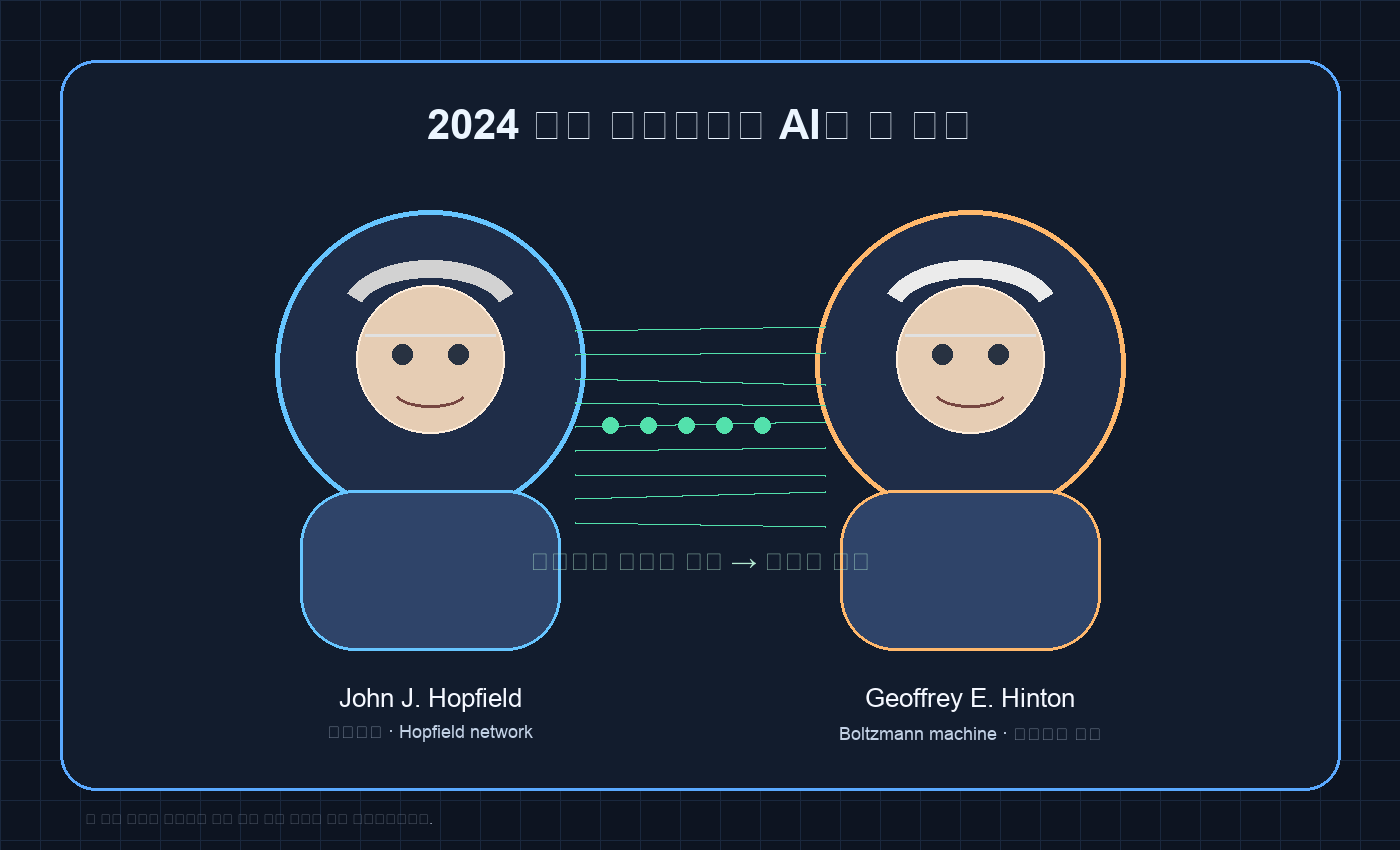
Why an AI story belongs in physics
The 2024 prize went to two scientists whose work helped answer a basic question: how can a network store patterns, recover incomplete information, and learn useful features from data?
| Laureate | Affiliation cited by Nobel Prize | Core contribution | Why it matters |
|---|---|---|---|
| John Hopfield | Princeton University | Hopfield network | A way for a network to store and reconstruct patterns |
| Geoffrey Hinton | University of Toronto | Boltzmann machine | A way to learn features from data using probabilistic ideas |
According to the Nobel Prize press release, Hopfield developed a network that can save and recreate patterns. Hinton used tools from statistical physics to create the Boltzmann machine, which helped machines discover properties in data. The Nobel popular science background explains the connection through familiar physics concepts: energy landscapes, spin systems, and probability.
That is why the prize was not simply a cultural signal that “AI is important.” It recognized that the mathematics and intuition of physics became part of the machinery of modern AI.
Hopfield networks turn memory into an energy landscape
A Hopfield network is easiest to understand as a memory system. Imagine seeing a damaged image or remembering only part of a word. A human mind may move from a blurry hint toward a complete memory. Hopfield’s model gives a network a similar behavior in a simplified mathematical form.
Each node in the network has a state, and the connections between nodes influence one another. A stored pattern acts like a low-energy valley. When the network starts from an incomplete or noisy input, it updates its state step by step. If the network is set up well, the state moves toward the nearest stored pattern, just as a ball rolls down toward a valley.
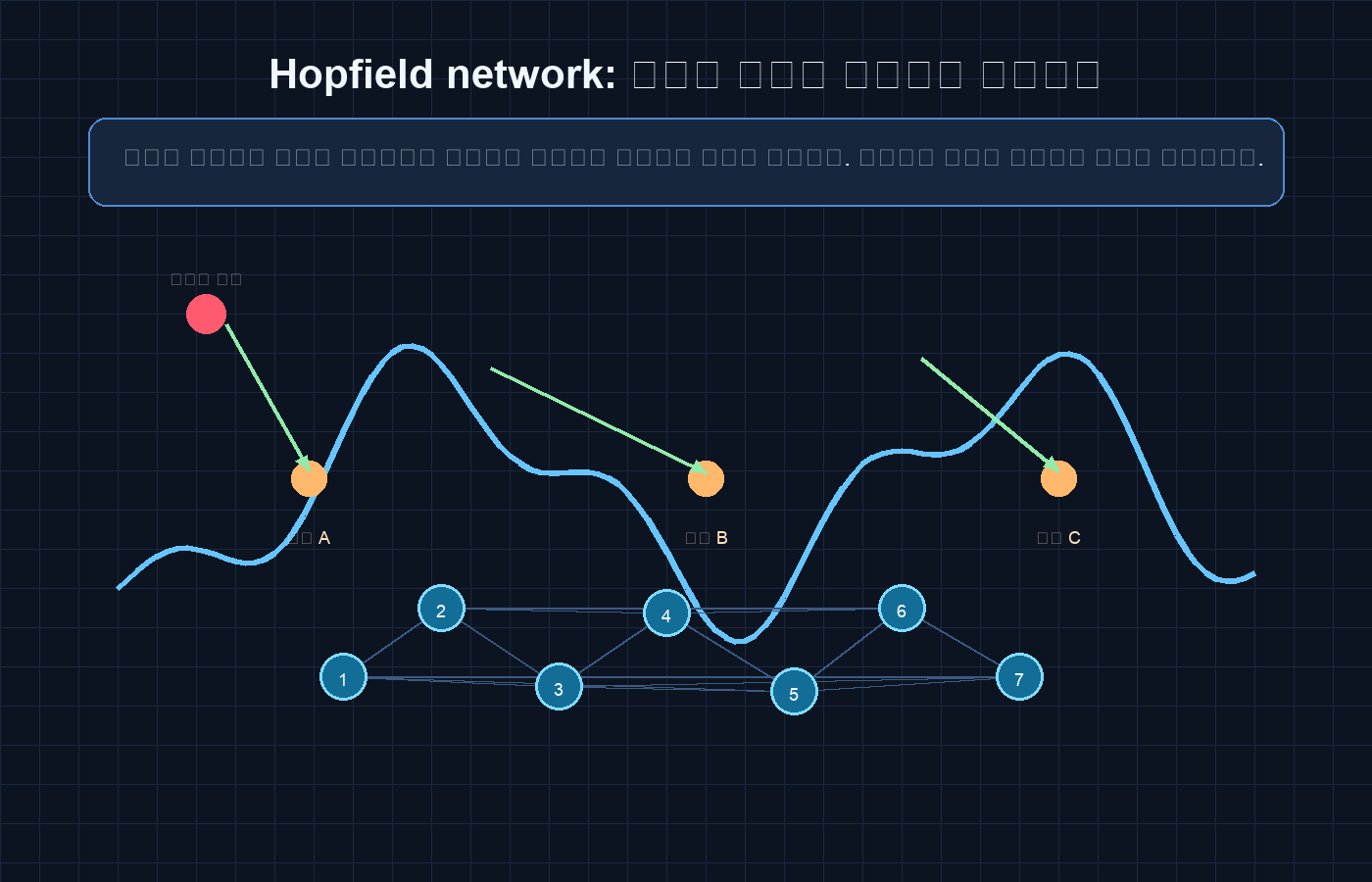
The physics analogy matters. In magnetic materials, many small spins interact and create a larger order. Hopfield used similar thinking to describe how many simple units in a network can settle into a stable pattern. This was not yet modern generative AI. It was a crucial step in treating information, memory, and computation as systems of interacting parts.
Boltzmann machines made learning probabilistic
Hinton’s Boltzmann machine takes the story from memory toward learning. The name refers to Ludwig Boltzmann, whose work in statistical physics helped explain how the behavior of many particles can be understood through probability and energy.
In AI terms, a Boltzmann machine tries to learn which patterns in data are likely. Some units are visible, representing the observed data. Other units are hidden, helping the system capture structure that is not obvious at the surface. The machine learns by adjusting connections so that useful patterns become more probable.
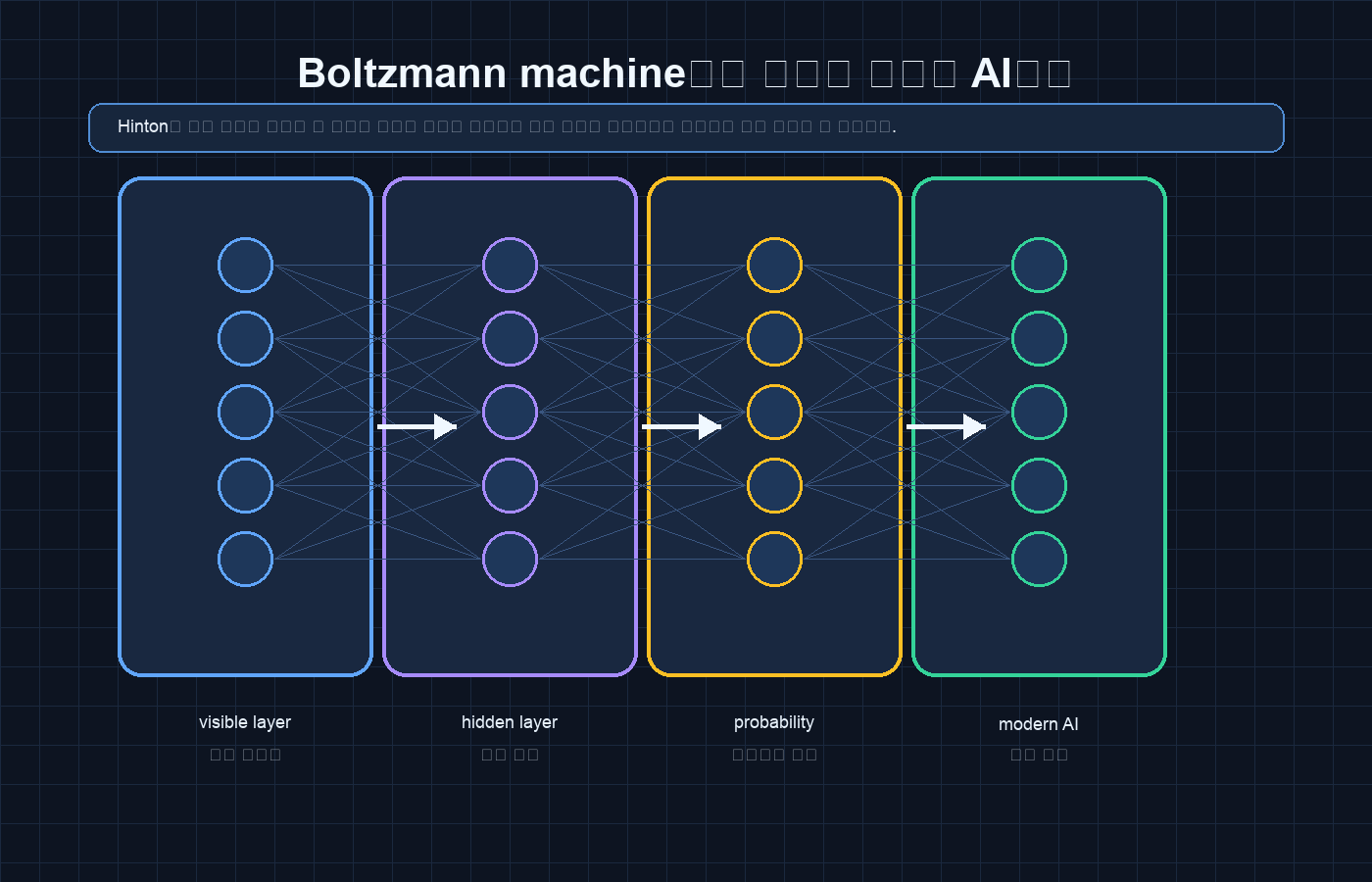
This does not mean a Boltzmann machine is the same thing as a Transformer or a modern chatbot. The path from early neural networks to today’s systems includes backpropagation, convolutional neural networks, GPUs, Transformers, massive datasets, and many engineering breakthroughs. The fair claim is narrower and more interesting: Hopfield and Hinton helped establish ways to think about networks that store, reconstruct, and learn patterns.
That foundation still echoes in modern AI. Even when the architecture changes, machine learning keeps returning to concepts such as optimization, representation, probability, and energy-like objectives.
What the prize does and does not say about AI
The prize does not mean physics has been replaced by AI, or that every AI system is now automatically good science. It says something subtler: physics supplied tools that became powerful in another field. Ideas originally used to reason about matter, magnets, and particles helped explain how information systems can learn.
There are also limits to remember. A Nobel Prize recognizes specific scientific contributions; it does not settle current debates about AI safety, labor, copyright, or misuse. Hinton himself has become known not only for his technical contributions but also for public warnings about AI risks. That tension is not a contradiction. It is a reminder that powerful methods create responsibilities beyond the laboratory. The same caution applies to everyday AI coding: impressive output still needs human review.
For readers trying to place the award in context, three conclusions are enough. First, John Hopfield and Geoffrey Hinton received the physics prize because their early work helped make neural-network machine learning possible. Second, the link to physics runs through energy, probability, and systems of interacting units. Third, today’s AI boom did not appear from nowhere. It grew from decades of work across physics, neuroscience, computer science, mathematics, and engineering.



No comments:
Post a Comment