Solo founder boom: can vibe coding really create economies of scale?
Open YouTube, X, TikTok, or any founder community for long enough and the same story keeps showing up: this is the age of the solo founder. One person can record content, launch a landing page, attach a payment link, and start selling. Add vibe coding to the story, and the pitch becomes even stronger. The phrase vibe coding solo founder now captures the promise that you do not need to write every line of code. You describe what you want, an AI tool builds a working product, and a one person business suddenly looks possible.
I do not think that direction is wrong. In fact, it is probably one of the most important shifts in small business right now. But one question is often missing. Building something alone and turning it into a business with economies of scale are completely different problems. The method that sells 100 units, the method that sells 10,000, and the method that reaches 1 million users are not just larger versions of the same thing. At each stage, the rules change.
The U.S. Census Bureau reported that the United States had 29.8 million nonemployer businesses in 2022, meaning businesses with no paid employees, with $1.7 trillion in receipts. A later Census story said nonemployer establishments kept growing through 2023 and that their average annual growth from 2012 to 2023 outpaced employer businesses. So yes, the era of one person businesses is real. But that does not mean large solo businesses are easy. The data actually suggests the opposite: more people are operating alone, while the number of solo operators that break into large scale remains limited.
The argument of this essay is simple. Solo founding is more possible than before, but big outcomes still depend on IT products, quality and marketing, and the ability to build economies of scale. Vibe coding lowers the cost of getting the first product into the world. It does not remove every bottleneck in the business.
Solo founding became easier, but scale did not
The solo founder boom is persuasive because the tooling really has changed. In the past, one person needed a developer, designer, marketer, support person, payment system, hosting stack, and operations workflow just to get started. Today, many of those layers are available as software. No code builders, payment infrastructure, cloud platforms, generative AI, and automation tools have moved into the hands of individuals.
But a business does not end at “can I build it?” It has to sell. It has to deliver the same thing repeatedly. It has to hold quality when more customers arrive. That is where solo founding gets much harder.
| Scale stage | What can work | Capability required | Main bottleneck |
|---|---|---|---|
| 100 sales | Personal network, communities, hand selling | Trust, explanation, fast response | The founder’s own time |
| 10,000 sales | Content, ads, partnerships, search traffic | Distribution, funnels, customer data | Marketing efficiency and operations |
| 1 million users | Product led growth, network effects, platform loops | Product strategy, automation, infrastructure | Quality, security, scalability, brand |
The point of this table is blunt. The larger the scale, the less a business can rely on the founder’s stamina. Selling 100 pens through friends and personal trust is possible. Selling 10,000 requires distribution, content, advertising, inventory or fulfillment, and customer support. Reaching 1 million users requires a product that carries its own expansion loop. People need to arrive, stay, refer, return, and trust the product without the founder manually pushing every interaction.
That is why modern solo founding almost inevitably needs IT products. By IT products, I do not only mean a venture backed SaaS platform. I also mean booking flows, payment pages, course platforms, automated estimates, customer dashboards, CRM systems, recommendation engines, onboarding emails, community tools, analytics, and anything else that turns repeated work into a system. When Stripe talks about financial infrastructure from the first transaction to the billionth, it is describing this same reality. Modern businesses need payments, subscriptions, billing, data, and automation inside the product if they want to grow beyond the founder’s hands.
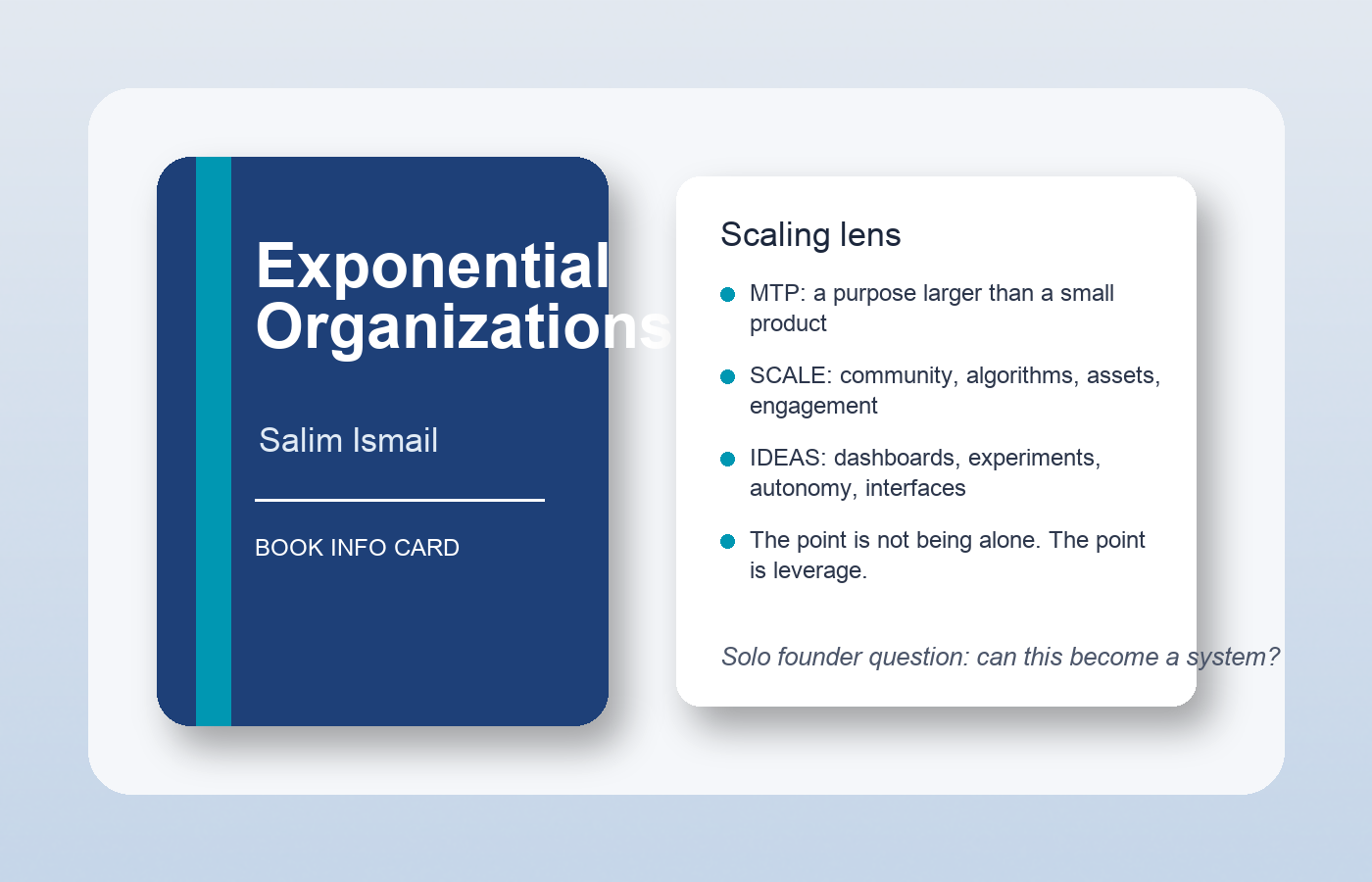
Salim Ismail’s Exponential Organizations, published in Korean as 《지수형 인간》, is useful here because it gives language to this exact gap. The book argues that fast growing organizations do not scale only by adding more people. They use information technology, algorithms, communities, external assets, and engagement mechanisms to increase output. Readingraphics’ summary describes the ExO framework through ideas such as MTP, SCALE, and IDEAS. The vocabulary belongs to business books, but the lesson is sharp for solo founders.
If you are working alone, you need leverage even more than a team does. You cannot add staff every time demand rises, so the system has to absorb more of the work. Without that leverage, solo founding is not freedom. It becomes a high pressure self employment job where the founder is the product manager, developer, marketer, salesperson, support desk, and operations team at the same time.
Vibe coding is a strong starting point, but quality is a separate problem
Vibe coding became tied to solo founding for an obvious reason: it lowers the product creation barrier. Business Insider reported on Andrej Karpathy’s February 2025 description of a new style of coding where you “fully give in to the vibes.” In practice, the founder describes a feature in natural language, an AI tool generates code, and the founder keeps testing and steering the result.
This works especially well from zero to one. Landing pages, internal tools, MVPs, simple web apps, and prototypes can be produced much faster than before. Forbes described solo founders using tools such as Replit, Cursor, Lovable, and Claude Code to build digital products and test revenue; that is the same productivity pressure behind AI coding on Mac. Given that shift, it is not surprising that “solo founding equals vibe coding” has become a strong marketing line.
The problem starts after the first version. Human level software quality does not appear just because a lot of code was generated. Good software comes from understanding the customer’s real problem, deciding what not to build, handling edge cases, recovering from failures, checking security, and feeding customer complaints back into product decisions. That work is related to coding, but it is not just coding.
| Quality area | What vibe coding helps with | What the human still owns |
|---|---|---|
| First screen and MVP | Layout, basic logic, sample data | Problem definition and willingness to pay |
| Feature additions | Common implementation patterns | Prioritization and scope control |
| Testing | Test scaffolds and repeated checks | Deciding which failures matter |
| Security and scalability | Checklists and partial fixes | Architecture, permissions, operational responsibility |
| Customer care | Chatbots and email automation | Complaint interpretation, refund policy, trust repair |
Startups.com’s overview of vibe coding draws a similar boundary. Vibe coding works well for prototyping, greenfield projects, common web app patterns, and automation scripts. It struggles with complex existing codebases, performance critical systems, security sensitive work, complex debugging, and production scale. In other words, vibe coding is a way to get a product into the world faster. It is not an automatic quality guarantee.
This is where the first wall appears: quality and marketing. Quality is not a one time checklist. It is a probabilistic measure built over time. A product working today does not prove that it is good. It has to work for different customers, in different environments, with different mistakes, over many support cycles. It has to become more reliable as complaints repeat. It has to keep basic promises even when the founder is asleep. That takes planning, customer experience, painful iteration, and operations sense.
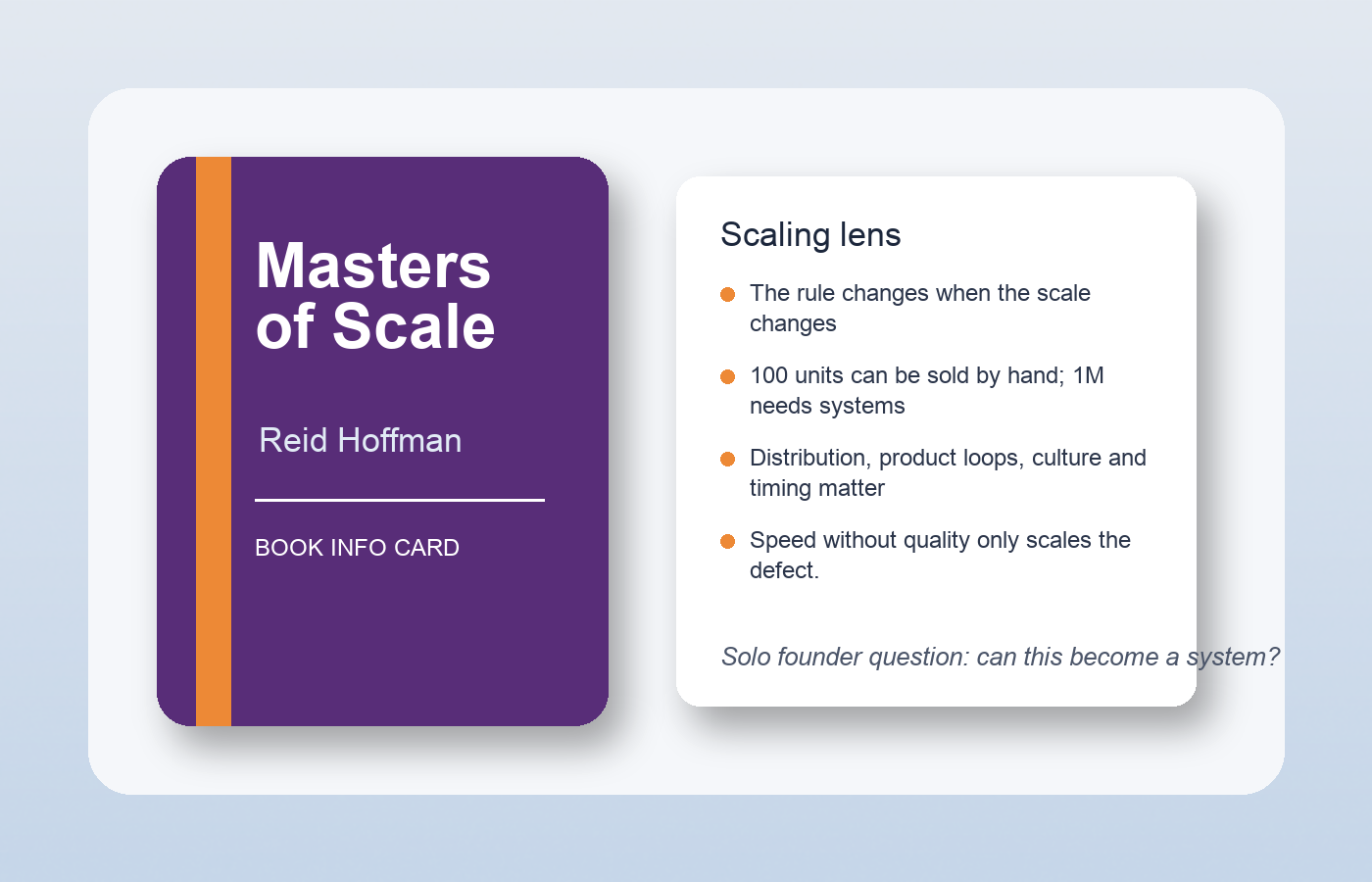
Reid Hoffman’s Masters of Scale is relevant for exactly this reason. The Masters of Scale profile describes Hoffman as LinkedIn’s cofounder, a Greylock investor, and the host of a show focused on how companies grow. The useful idea is not simply “grow fast.” It is that a company needs different rules at different stages of scale. Manual work that makes sense early becomes a bottleneck later. But automating too early can freeze the product before the founder understands the customer.
So a solo founder using vibe coding has to care about sequence. First, touch the customer’s problem by hand. Then productize the repeated parts. After that, automate the operations that would break as customers increase. Skip that order and a fast built product becomes a fast breaking product.
Continued in part 2: the harder wall is distribution and marketing.




No comments:
Post a Comment