This is part 2 of the solo founder boom essay. Part 1 covered why vibe coding can be a useful starting point and why quality remains a separate wall. If you want the beginning first, read solo founder boom part 1.
The focus here is solo founder marketing. Distribution and marketing are not just ad buying; they require a product distribution strategy and a clear view of the startup marketing bottleneck that stops a promising product from reaching enough people.
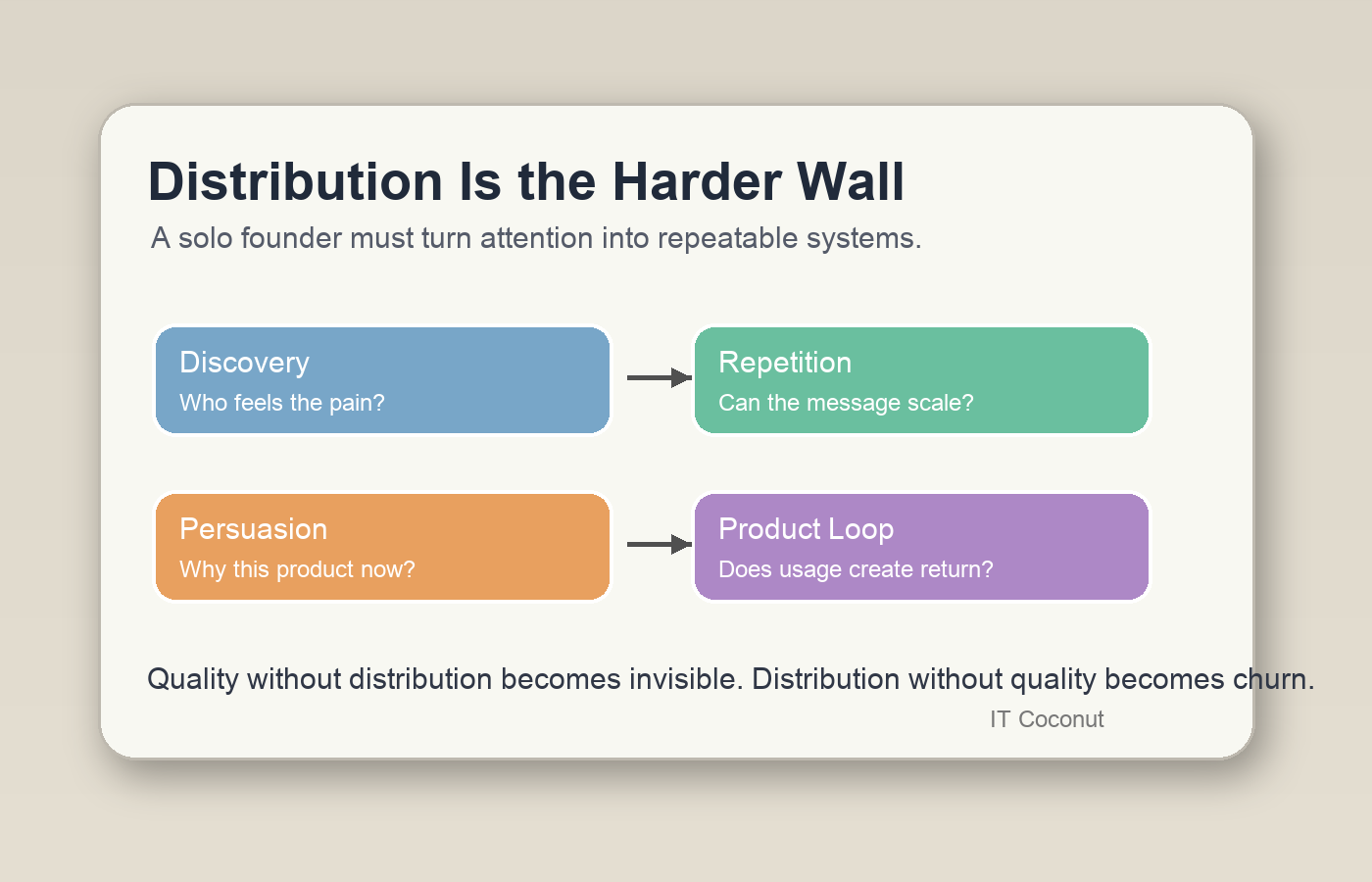
The harder wall is distribution, which means marketing
Even if the product becomes reasonably good, the business is not done. Distribution is the harder wall. A good product and a product that reaches customers are different things. Marketing is hard even for marketing professionals. In most categories, modern markets are red oceans: similar products, similar messages, similar ads, similar landing pages, and similar founder stories all compete for the same few seconds of attention.
The rise of the creator economy makes sense in that environment. Search ads and display ads alone often fail to create trust, so people with YouTube channels, TikTok accounts, newsletters, podcasts, and communities have become new distribution networks. AMT’s creator economy overview describes the creator economy as a market already worth roughly $200 billion in 2024 and increasingly treated by brands as a performance acquisition channel rather than a loose awareness experiment.
But this also creates a dangerous illusion. Social platforms mostly show the outcome. “I built it alone.” “I made revenue in a month.” “I grew without ads.” Those lines sound clean, but they hide accumulation: an existing audience, a practiced content instinct, a deep feel for customer language, repeated failures, luck, timing, and sometimes invisible ad spend.
The most dangerous belief in solo founding is that a good product will automatically spread. Sometimes products do spread by themselves. But that moment usually comes after deliberate product design, repeated experiments, a receptive market, a strong problem, and a long period where almost nobody is watching.
Distribution can be split into three stages.
| Distribution stage | What the founder must do | Why it fails |
|---|---|---|
| Discovery | Find who actually suffers from the problem | The customer definition is too broad |
| Persuasion | Explain why this product matters now | The founder explains features but not pain |
| Repetition | Make the same message work across channels | Content, ads, and product data are disconnected |
This is where IT products matter again. An IT product is not merely something sold online. It measures behavior, creates repeated touchpoints, automates payment, learns from usage data, and builds recommendation and return loops. AI coding on Mac and other AI coding tools can speed up creation, but the product’s data and automation are what make marketing more repeatable. AI developer productivity only becomes business productivity when it also reduces bottlenecks in sales, onboarding, support, and operations.
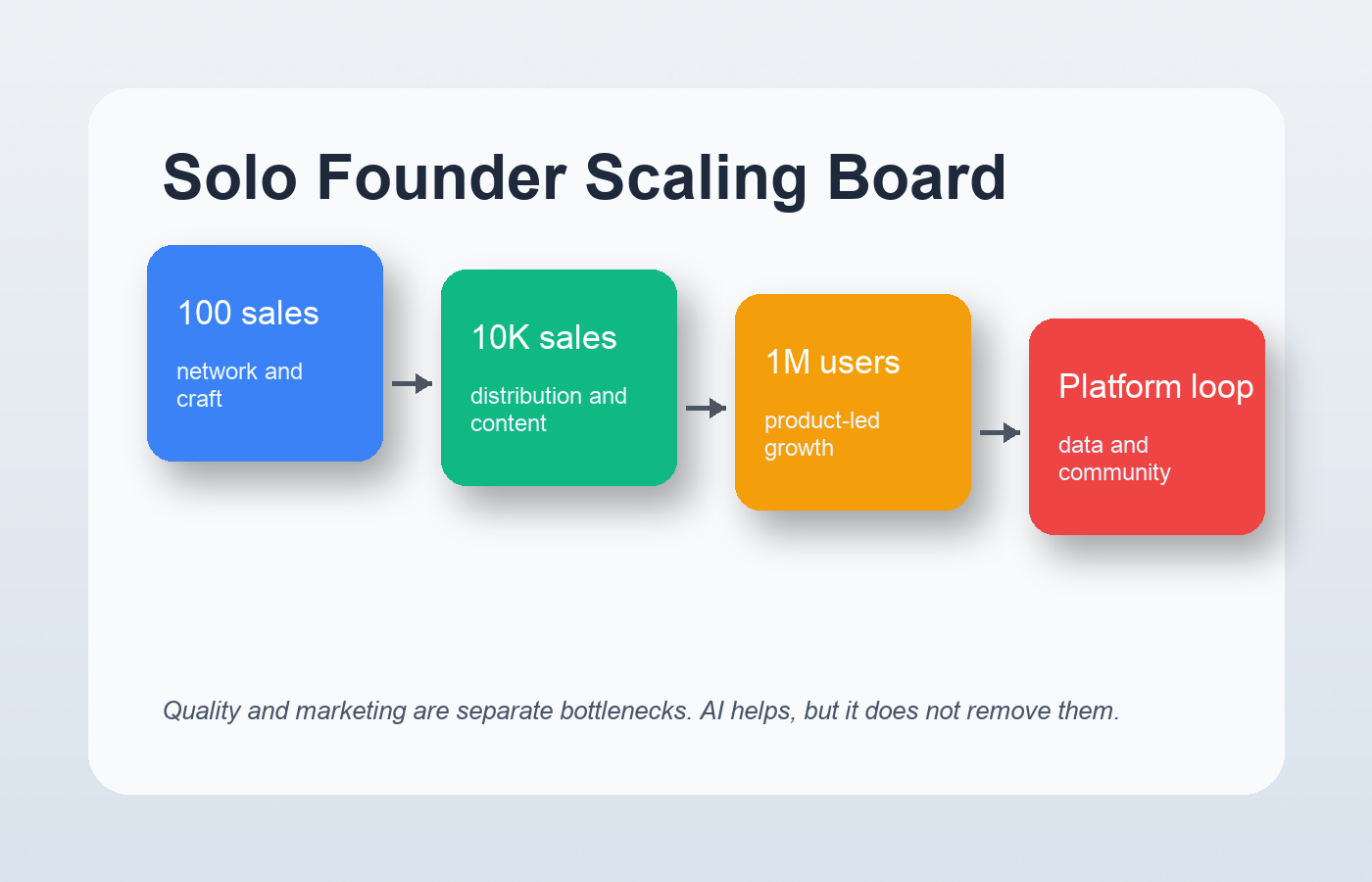
Marketing is a longer and more exhausting fight than most founder content admits. Reaching a customer once is hard. Being remembered later is harder. Large companies spend enormous marketing budgets not because they have nothing better to do, but because a place in the customer’s mind is expensive. Individuals, small teams, organizations, and giant companies all face that same problem. The scale of the budget differs, but the difficulty is shared.
The realistic solo founder formula is leverage, not being alone
None of this means solo founding is hopeless. The opposite is true. This is probably the best time in history for individuals to access leverage. Work that once required a technical team can now be started by one person. Experiments that once needed an agency can be tested directly. A small business can combine Stripe, global SaaS tools, and APIs into an operating system that would have looked impossible a decade ago.
But the formula is not “do everything alone.” It is closer to “start alone, but design leverage.” A solo founder has fewer employees, not fewer business functions. Product planning, development, design, payments, support, content, advertising, analytics, accounting, legal work, and security still exist. The difference is whether those jobs are handled only by the founder’s labor or increasingly by tools and systems.
| Success condition | Question | Practical solo founder behavior |
|---|---|---|
| IT products | Can the business become a repeatable product? | Turn manual service work into templates, dashboards, booking, and payment flows |
| Quality | Can quality hold as customers increase? | Fix errors, onboarding, refunds, and support before adding more features |
| Marketing | Is customer acquisition repeatable? | Commit to one channel such as content, search, partnerships, or community |
| Data | What guides improvement? | Track visits, signups, payments, returns, and reasons for churn |
| Scaling strategy | Are you ready to change rules as scale changes? | Learn manually, automate repeated work, then design product loops |
I do not think solo founding is impossible. I do think the popular version of the story, “just vibe code an app and launch,” is too thin. An app is the beginning. A business exists when customers pay, keep using it, tell others, and the operator can handle that repetition without burning out.
So the central question in the solo founder boom is not “can one person start?” The better question is “how much of what one person starts can become a system?” As Masters of Scale repeatedly frames growth as a stage-by-stage discipline, the skill needed to sell 100 units is different from the skill needed to serve 1 million users. Founders who accept that difference have a better chance of lasting.
The right attitude toward vibe coding is neither dismissal nor blind belief. Vibe coding is a useful marketing story and a useful production tool. It is especially powerful for early tech startup funding validation, prototypes, and narrow workflow products. But the final force that turns a product into a company still comes from quality and marketing. Those two are hard for individuals, teams, and large companies alike. That is why they matter.
The era of solo founders has arrived. But the winning formula is not “one person does everything.” It is “one person starts, then the product and system do more work than one person ever could.” In the current era, that system usually has an IT product at its center. And if that product is going to survive in the market, durable quality and stubborn distribution matter more than flashy build speed.



No comments:
Post a Comment