Tesla OTA Update Technical Analysis: How Much of a Car Can Change?
OTA is the correct term. Over-the-Air means transferring vehicle software and data over a wireless network instead of connecting a cable or service tool. Calling it an automatic wireless update leaves out the installation decision. A Tesla can download a new version automatically, but the driver normally reviews the notification and chooses to install now or schedule a time.
That distinction matters for safety. According to Tesla Software Updates, the car can be driven during a download but cannot be driven during installation. Charging pauses if installation starts while plugged in and resumes automatically afterward. Automotive OTA is not just replacing one phone app. It has to preserve a consistent state across multiple electronic control units.
As checked on July 27, 2026, Tesla's Korean owner manual for the 2025-and-newer Model Y is published against software version 2026.20. This is not one universal latest version delivered to every vehicle at once. Tesla stages releases by model, hardware, region and regulation.
Which Tesla models receive OTA, and how does it work?
Tesla's current owner manual selector lists Model S, Model X, Model 3, Model Y and Cybertruck, plus separate manuals for legacy generations. These vehicles participate in the OTA system, but they do not all receive identical features or builds. Older Model S and X vehicles can still receive updates while missing features that require a newer MCU, Autopilot computer, camera or modem.
As explained in Tesla FSD Technical Analysis Part 1, some Computer 2.0 and 2.5 vehicles need a physical FSD Computer 3.0 retrofit for newer FSD capabilities. OTA cannot manufacture compute performance that the hardware lacks.
Download and installation are separate phases
Tesla owner documentation divides an update into these stages:
- The car checks for an eligible package and normally downloads it over Wi-Fi.
- The driver selects immediate or scheduled installation in the touchscreen or Tesla app.
- The vehicle checks parked state, battery condition and other installation requirements.
- Driving and charging are disabled while multiple modules are updated.
- The vehicle reports completion, shows release notes and resumes charging.
Important safety updates can be delivered over cellular. Standard Connectivity vehicles retain access to OTA, and Premium Connectivity is not a prerequisite for ordinary vehicle updates or FSD operation. Wi-Fi is still recommended for the fastest and most reliable large downloads.
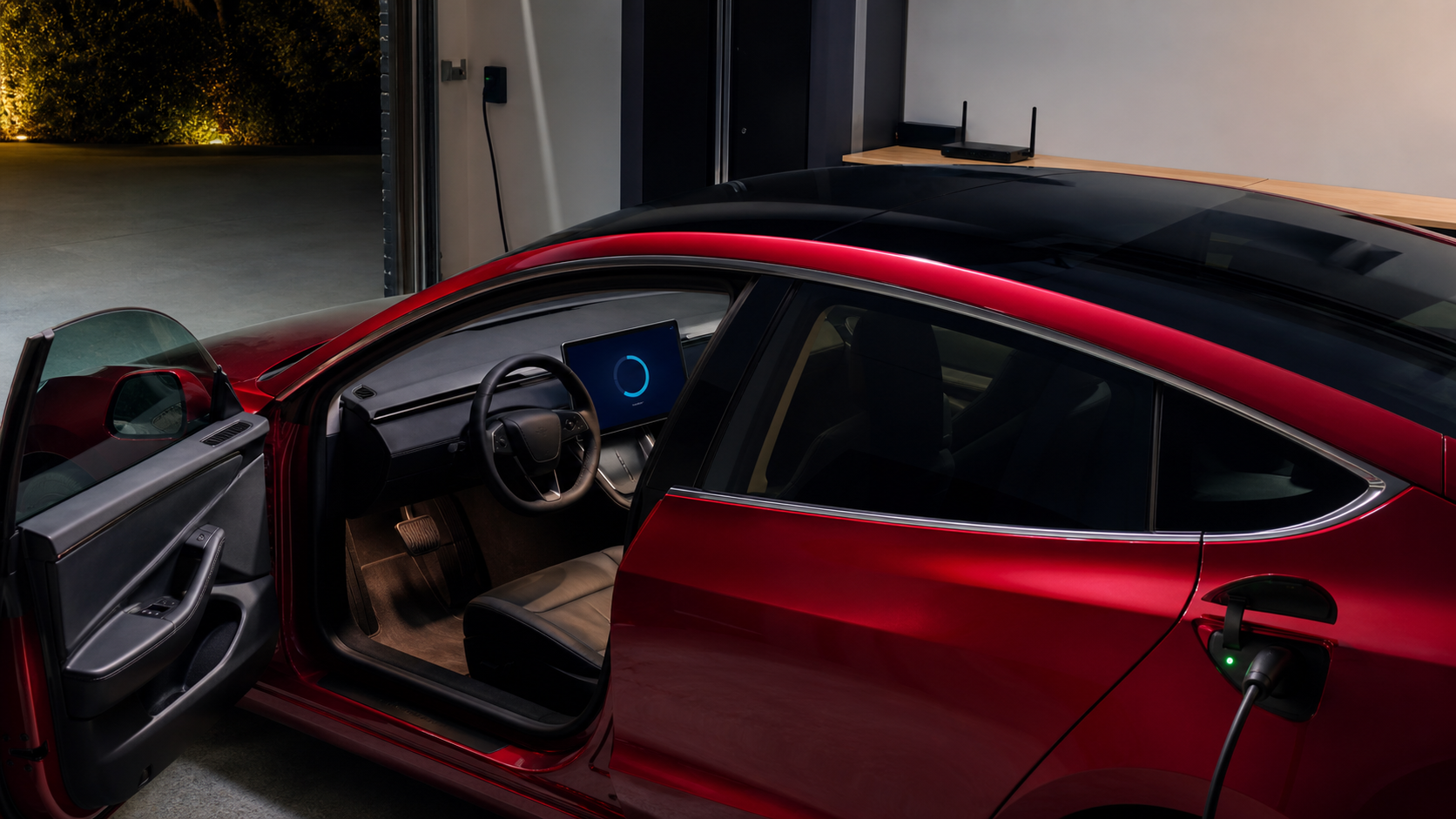
Why does the latest version differ by vehicle?
Tesla's public Service Mode release notes include the 2026.20 family at the time of this review, and the latest Model Y manual also identifies 2026.20. The build an owner receives may have a patch suffix such as 2026.20.x, while FSD can use its own product version alongside the vehicle firmware number.
Eligibility can be divided by:
- Model S, 3, X, Y and Cybertruck production generations
- Intel Atom or AMD Ryzen infotainment and MCU generations
- Driver-assistance computers such as HW2, 2.5, 3 and AI4
- Camera, radar and ultrasonic sensor configurations
- Battery, thermal-management and charging hardware
- Country-specific certification and permitted features
Not receiving a version seen online immediately is not proof of a fault. Staged release also limits the impact of a defect and lets Tesla observe behavior across hardware combinations.
What OTA can and cannot change
Tesla OTA reaches beyond touchscreen apps. The ECU Update Status panel in Tesla's service documentation checks whether updates succeeded on individual electronic control units. A separate service procedure for reinstalling the current vehicle software explicitly targets all CAN ECUs.
| Area | OTA or wireless data update examples | Limit |
|---|---|---|
| Touchscreen and infotainment | UI, media apps, browser, Bluetooth, voice commands, games and convenience features | Cannot change CPU, GPU, memory or display performance |
| Maps and navigation | Offline map data, route features, charger information and Trip Planner | Road accuracy depends on regional source data |
| Driver assistance and FSD | Neural weights, perception and planning code, driver monitoring and camera firmware | Cannot exceed sensor resolution or AI computer capacity |
| Body control | Doors, windows, lighting, wipers, climate, keys and alarm behavior | Cannot add an absent sensor or actuator |
| Driving and energy | Accelerator response, regenerative braking logic, range estimates, battery preconditioning and charging control | Cannot change physical battery capacity, motor rating or brake hardware |
| Service and diagnostics | Service Mode, alerts, ECU routines, camera and TPMS procedures | A failed module still requires physical repair |
| Security and connectivity | Certificates, vulnerability fixes, app links, Bluetooth, Wi-Fi and modem software | Cannot add a newer radio standard to obsolete modem hardware |
The table does not mean every physical property can be remotely rewritten. Tesla can patch software-controlled behavior broadly, but a missing camera, slow processor or unsupported actuator cannot be added by download. That is why Tesla AI Computer Installations includes separate computer and early-camera retrofit procedures.
Maps update separately from vehicle firmware
Tesla owner documentation says updated maps are automatically sent as a separate package over Wi-Fi, followed by an installation notice on the touchscreen. Navigation data and the vehicle operating software are not the same package. Tesla's FSD documentation also says current maps improve accuracy while the driver-assistance system primarily uses visual camera data.
The map supplier question in South Korea needs careful handling. Official Tesla Korea documentation describes navigation, live traffic and map updates but does not identify one current provider for Korean base maps, search and routing. Online claims cite combinations of Google tiles, Mapbox, OpenStreetMap and TMAP, often mixing the visual layer, place search and routing engine or referring to different generations. No current supplier should be asserted without an official contract or in-vehicle attribution for the exact feature.
South Korea's conditional approval in February 2026 for Google to export 1:5,000 map data does not prove that Korean Teslas immediately switched to Google navigation. The verifiable conclusion is narrower: Tesla operates regional map packages and online routing services, while its official documents reviewed here do not disclose the supplier stack.
FSD models update, but they are not public models
As Tesla FSD Technical Analysis Part 2 explains, a new FSD version is trained and evaluated in Tesla data centers before vehicle deployment. A package can contain neural-network weights, execution graphs, AI-accelerator-compiled artifacts, pre- and post-processing and control code.
Tesla does not release the latest FSD weights, full source, parameter count or exact file size. Public information consists of architecture presentations at AI Day, historical network details on Tesla's AI page and selected safety and mileage statistics. FSD is a closed commercial model delivered by OTA, not an open-source model available for independent download and inspection.
Why competitors cannot simply copy Tesla OTA
Wireless file transfer is not the hard part. The barrier is designing and operating the whole vehicle so that one bad package does not disable braking, charging, airbags or driver assistance.
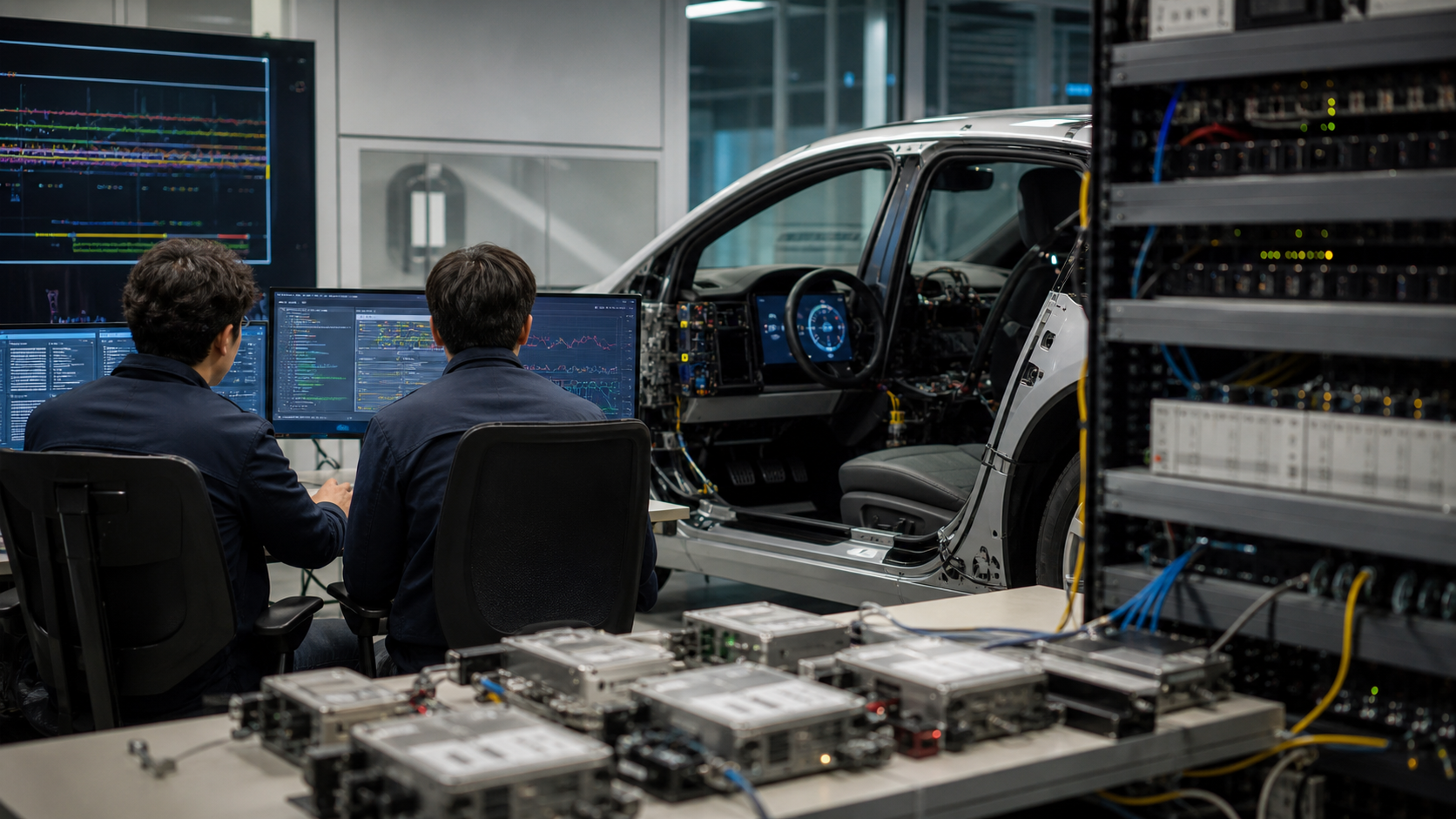
1. The manufacturer must control a software-centric electrical architecture
Traditional cars contain supplier-specific ECUs with separate firmware, diagnostics and contractual ownership. If the automaker cannot control build, signing, compatibility and recovery across modules, only the infotainment system receives OTA while safety-critical controllers remain service-center work. Tesla vertically integrated vehicle computers, gateways, networking and software families relatively early.
2. Every hardware combination must be identified precisely
Two vehicles with the same model badge can contain different computers, cameras, batteries, thermal systems and sensors depending on production date and factory. The deployment system must know each vehicle's hardware and current versions and reject incompatible packages. Tesla's ECU-level status and camera-firmware mismatch diagnostics show this is an operational requirement, not a theoretical edge case.
3. Deployment must be recoverable and effectively atomic
If power is interrupted or one module stops responding, the vehicle must remain safe and support retry or recovery. International UN R156 rules require delivery integrity and authenticity, sufficient power, safe execution, restoration after failure and user notification. Encryption alone is not an OTA system.
4. Post-release validation and regression infrastructure must exist
Engineers need simulation, hardware-in-the-loop, validation vehicles and staged fleet deployment to confirm that changing brake logic does not break charging or climate control and that new FSD code works across camera generations. Without this organization and data, a higher update frequency can create more failures rather than more improvement.
5. Regulation and product liability must connect to version control
Changing automotive software is not complete when a new feature works. A braking, steering or safety change can affect type approval. The manufacturer must know which software is installed on every relevant vehicle and assess certification impact and recall obligations. Tesla's real barrier is linking design, validation, approval, deployment and monitoring across the vehicle lifecycle.
Technical assessment and cautions
Tesla OTA is a leading example of turning a car from a machine fixed at delivery into a software product that can keep changing. Its breadth—infotainment, maps, camera firmware, FSD, thermal management, charging and many ECUs under one operating system—is the central strength.
An update does not guarantee improvement. Risks include new bugs, regional feature differences, hardware-generation exclusions, vehicle downtime during installation and limited public release detail. Owners should read release notes and provide adequate battery, Wi-Fi and a period when the car will not be needed.
The analysis reduces to three points:
- OTA is wireless delivery, while safe automotive OTA also requires controlled installation and recovery.
- Tesla updates maps and infotainment as well as FSD and multiple ECUs, but cannot bypass physical hardware limits.
- The competitive barrier is not a download button; it is unified electrical architecture, supply-chain control, validation data and regulatory traceability.



No comments:
Post a Comment